


How to read the labels Historical what the old sources say. Later tradition what later writers added. Modern modern practice and my own notes.
| Number | 28 of 72 |
|---|---|
| Rank | Duke |
| Legions | 26 |
| Office (1904) | Gives true answers, past, present, and to come. |
| Other spellings | Beale, Beal, Bofry, Bolfry (1904), Beall (Weyer, Scot), Baal-Berith |
Berith is number 28 in the catalog of 72 spirits that opens the Lesser Key of Solomon. The 1904 edition by S. L. MacGregor Mathers and Aleister Crowley calls him a duke ruling 26 legions, and the first office it gives him is this: Berith gives true answers, past, present, and to come.
His entry is one of the few to record the names a spirit had among different groups of people. Each part below carries a label for its layer, explained in how to read a spirit page.
At a glance
| Fact | In the entry |
|---|---|
| Number | 28 of 72, in the 1904 order. |
| Name and spellings | Berith in 1904; other spellings: Beale, Beal, Bofry, Bolfry (1904), Beall (Weyer, Scot), Baal-Berith. |
| Rank and legions | Duke, 26 legions. |
| Metal of his rank (Observations) | Copper. |
| Hours for dukes (Observations) | “From Sunrise till Noonday in Clear Weather.” |
| In Weyer’s catalog (1577) | Yes, as the source comparison below shows. |
The 1904 entry
Historical The full entry from the 1904 edition, with footnote numbers and the dash after the heading left out and the heading set in ordinary type:
Berith. The Twenty-eighth Spirit in Order, as Solomon bound them, is named Berith. He is a Mighty, Great, and Terrible Duke. He hath two other Names given unto him by men of later times, viz.: Beale, or Beal, and Bofry or Bolfry. He appeareth in the Form of a Soldier with Red Clothing, riding upon a Red Horse, and having a Crown of Gold upon his head. He giveth true answers, Past, Present, and to Come. Thou must make use of a Ring in calling him forth, as is before spoken of regarding Beleth. He can turn all metals into Gold. He can give Dignities, and can confirm them unto Man. He speaketh with a very clear and subtle Voice. He is a Great Liar, and not to be trusted unto. He governeth 26 Legions of Spirits. His Seal is this, etc.
Berith is “a Mighty, Great, and Terrible Duke” with “two other Names given unto him by men of later times”, Beale (or Beal) and Bofry (or Bolfry). He appears as a soldier in red on a red horse, with a gold crown. He answers about past, present and future, must be called with a ring “as is before spoken of regarding Beleth”, turns all metals into gold, gives and confirms dignities, and speaks “with a very clear and subtle Voice”. Then comes the warning: “He is a Great Liar, and not to be trusted unto.”
Appearance
Historical Berith is “a Mighty, Great, and Terrible Duke.” He appears “in the Form of a Soldier with Red Clothing, riding upon a Red Horse, and having a Crown of Gold upon his head.” He “speaketh with a very clear and subtle Voice.”
Offices in the Ars Goetia
Historical The offices of Berith, in the order the 1904 text gives them:
- Gives true answers, past, present, and to come.
- Can turn all metals into gold.
- Can give dignities and confirm them.
- Is “a Great Liar, and not to be trusted unto.”
Mathers notes that this “hardly agrees” with the claim that Berith gives true answers. He governs 26 legions. The magician must use a ring in calling him, “as is before spoken of regarding Beleth.”
The text adds that “he hath two other Names given unto him by men of later times,” Beale or Beal, and Bofry or Bolfry.
Source comparison: Weyer and Scot
Historical Scot’s Weyer says Berith “hath three names. Of some he is called Beall; of the Jewes Berith; of Nigromancers Bolfry.” He comes as “a red souldier, with red clothing, and upon a horsse of that colour, and a crowne on his head.”
Weyer also says he is compelled at a certain hour “by a ring of art magicke.” Scot’s margin calls him “a golden divell,” for his gold-making office. Both give 26 legions.
Historical Weyer is more specific about the three names: “à quibusdam Beal, à Iudæis Berith, à necromanticis Bolfri”, Beal to some, Berith to the Jews, Bolfri to necromancers. The Latin also says “Mendax etiam est”, he is also a liar; the 1904 text makes this stronger, “a Great Liar, and not to be trusted unto”. Some later reprints and online transcriptions drop that sentence, so check which text you are reading. (About Weyer and Scot.)
Name and etymology
Historical Beal resembles Baal, and Berith the Hebrew word for covenant, discussed under later tradition below. Bolfri has no known meaning.
Seal and images
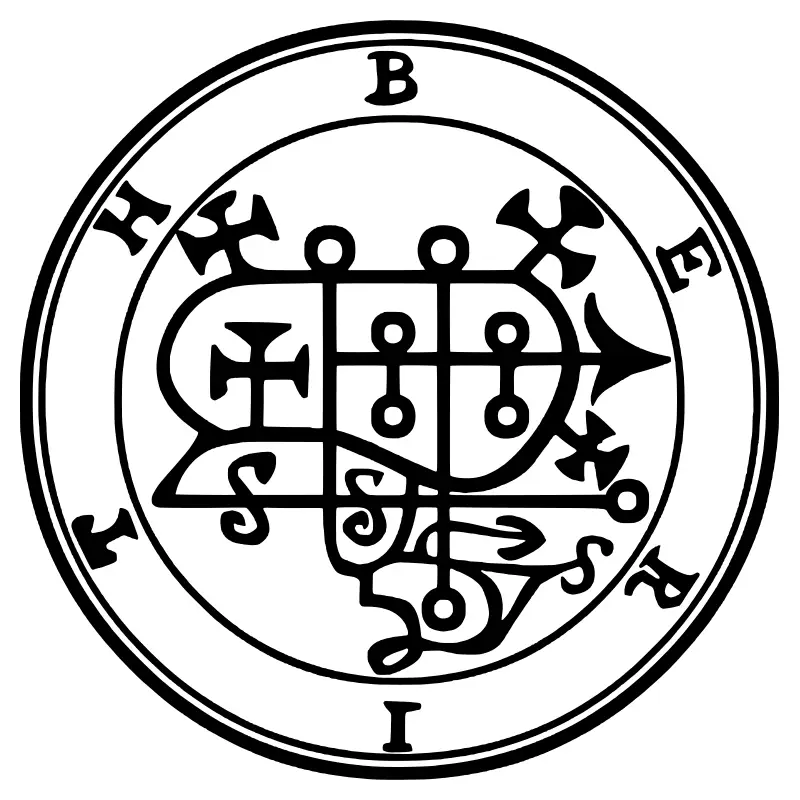
Historical The seal above is Berith’s as printed in 1904, and by the rules of the Observations it would be made in copper, the metal of his rank. Why seals were worn, why editions draw them differently and how to study one are explained in seals, circle and triangle.
Later tradition Le Breton’s 1863 plate shows a crowned rider on a rearing horse, close to the red soldier of the text.
Later tradition and modern practice
Later tradition The name Berith comes from Hebrew berit, “covenant.” The Hebrew Bible mentions a god called Baal-Berith, “lord of the covenant,” worshipped at Shechem (Judges 8:33 and 9:4). Christian demonology turned this into a demon’s name. The link is a name, not a preserved cult.
Modern Modern writers often present Berith as a spirit of alchemy, because of the gold office.
Lore about Berith’s personality, likes or chosen people is modern, not grimoire material; modern approaches explains where such claims come from.
Beginner’s quick reference
| Item | What the sources say |
|---|---|
| Rank metal and hours (Goetia) | Duke: copper; sunrise to noon, in clear weather. |
| Planet (later tradition: Golden Dawn and Crowley’s 777) | Venus. |
| Decan and day or night spirit (later tradition: 777) | Capricorn, first decan (0 to 10 degrees); day spirit. 777 decan incense: asafetida (irritating smoke; not for beginners). Tarot card of the decan: Two of Pentacles. |
| Commonly reported color, incense, and plant (modern UPG; sources copy each other) | Color green; incense sandalwood; plant heliotrope (reported in some sources; toxic: do not burn, ingest, or handle). |
| Associated symbols | Goetia image: a soldier in red on a red horse, with a gold crown; a clear voice. 777 Magical Image: the same, adding bad breath. Le Breton engraving (1863): a crowned rider on a horse. Modern Demonolatry/UPG: the seal, used as an altar image. |
| Associated offerings | Modern practice, not in the Goetia manuscripts: most often listed, sandalwood. |
Before you burn or handle anything listed for Berith, read incense, plants and offerings.
Practical notes
Berith is a duke, but the text calls him “Terrible” and requires the ring. His offices are divination, gold-making, and dignities, with no teaching office, and the text calls him a great liar. This spirit falls outside the beginner criteria. Alchemy as a historical subject is fascinating and can be studied through books, without any contact work.
In the directory, Berith is not among the 30 spirits that fit the beginner criteria.
Try this: one question to study
List the three names in Weyer’s Latin and who used each, then compare the 1904 phrase “men of later times”.
What next
To compare Berith with other spirits of his rank, read Astaroth and Bune.
Later tradition In the Golden Dawn scheme of the decans, Berith is the day spirit of the first decan of Capricorn, which belongs to the Two of Pentacles; the night spirit of the same decan is Haures (spirit 64).
Common questions
Is Berith a good spirit for beginners?
Not as a first choice. He does not meet all three beginner criteria I use: not a king, at least one teaching office, and no central harm, deception or compulsion. His entry is still worth reading as history.
What does Berith do in the Ars Goetia?
The 1904 text calls him a duke ruling 26 legions. Its first office for him is this: Berith gives true answers, past, present, and to come. The entry lists 4 offices in all.
Does looking at Berith's seal call him?
No. Reading a name or looking at a seal does not call a spirit. The seal is a drawing from a 1904 book, and even the grimoire itself required long rituals for its own purposes.
Get the free Mini-Grimoire
A short printable starter guide to tarot and everyday witchcraft, plus my newsletter. Unsubscribe any time.
Opens Substack in a new tab to confirm. More about the newsletter · Privacy