


| Arcana | Minor Arcana: Pentacles |
|---|---|
| Image | RWS 1909 (PD) |
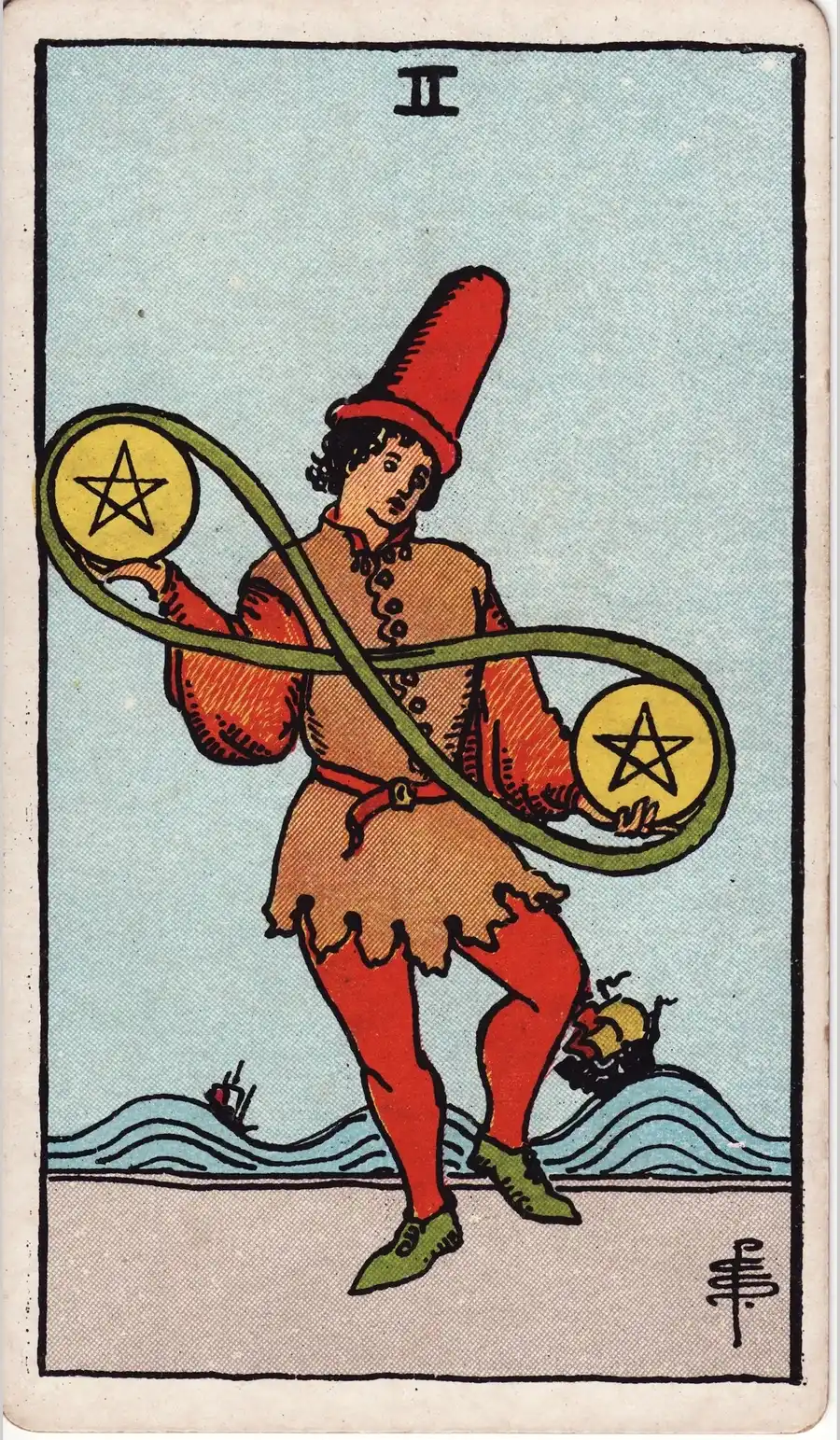
The Two of Pentacles shows a young man dancing as he juggles two pentacles, joined by a looping ribbon shaped like a figure eight. Behind him, two ships ride high waves.
It is a card of balance, adaptability and keeping everyday life moving. Here is what the Two of Pentacles means upright and reversed, the symbols in the 1909 card and a spread for busy times.
Here is the Two of Pentacles at a glance.
| At a glance | This card |
|---|---|
| Upright keywords | balance, adaptability, time management |
| Reversed keywords | imbalance, overwhelmed, disorganization |
| Number | 2 in the suit of Pentacles |
| Golden Dawn title | Lord of Harmonious Change Later tradition |
| Astrology | Jupiter in Capricorn, first decan (0° to 10° Capricorn) Later tradition |
| Tree of Life | Chokmah (2), Wisdom Later tradition |
| Suit and element | Pentacles, Earth Later tradition |
| Yes or no | Maybe Modern |
The Golden Dawn named the Two of Pentacles the Lord of Harmonious Change and gave it Jupiter in Capricorn, the first decan of the sign, on Chokmah. Jupiter is in its fall in Capricorn, so expansion has to work within limits, which is what juggling is. The looping ribbon around Smith’s coins echoes Book T’s own description of the card, in which a serpent binds the two discs in a figure eight.
Later tradition The Golden Dawn also gave each decan two of the 72 Goetic spirits, one for the day and one for the night. For the first decan of Capricorn, and so for the Two of Pentacles, they are Berith (spirit 28, day) and Haures (spirit 64, night). Their pages read the old entries as history; see the spirit directory for all 72.
The card: what Pamela Colman Smith drew
Waite wrote: “A young man, in the act of dancing, has a pentacle in either hand, and they are joined by that endless cord which is like the number 8 reversed.” Smith gave him a very tall hat and put the stormy sea behind him.
The endless cord. The ribbon loops around the two pentacles in a sideways eight, the sign of infinity. Juggling never quite ends. It is a rhythm, not a problem to solve once.
The dance. He moves with the juggling. Balance here is not stillness. It is flexibility.
The ships on the waves. Behind him, ships rise and fall on big waves. Life goes up and down, and he keeps dancing.
Upright meaning
Upright, the Two of Pentacles is juggling. A young man dances as he balances two pentacles, joined by a looping ribbon shaped like a figure eight. Behind him, two ships ride high waves. The card speaks of balancing priorities, adapting to change and keeping many things in motion at once.
It often appears when you are managing work and family, two jobs, a budget with too little in it, or a schedule that keeps changing. The young man is not stressed. He is dancing. The card suggests that flexibility and a light touch can keep everything moving.
The figure eight is a symbol of infinity and flow. Balance is not something you achieve once. It is something you keep doing.
Reversed meaning
Reversed, the Two of Pentacles shows the balls being dropped: overwhelm, disorganization, or too many commitments. It can also show financial juggling that has stopped working.
Ask what you can put down. A reversed Two usually needs fewer things in the air, not better juggling.
Reversed, the Two can also show that you are juggling to avoid a decision. Keeping every option in the air feels flexible, but it can be a way of not choosing. Ask which pentacle you would keep if you could only hold one.
In love, work and spirituality
In love. Upright: Balancing a relationship with other priorities. Reversed: Too little time for each other, or one partner juggling too much.
At work. Upright: Multitasking, adapting to change, or managing several projects. Reversed: Overwhelm, missed deadlines or disorganization.
With money. Upright: Managing a tight budget well. Reversed: Financial juggling that is no longer working.
In spiritual practice. Upright: Balancing practice with daily life. Reversed: Neglecting practice because life is too full.
As feelings. Interested, but busy and balancing many things.
As a person. An adaptable, busy person who keeps many things in motion.
As advice. Stay flexible and keep your balance.
Reading the Two of Pentacles: positions and yes or no
In the past position: Juggling many things shaped this situation. In the present position: Keep your balance with rhythm, not perfection.
In the future position: A busy, changing time is ahead. As advice: Plan loosely and stay flexible.
In modern yes or no readings, the Two of Pentacles is a maybe. It depends on how well you balance things.
What the Two means, and the history behind the card
Two is a first choice, and in Pentacles the choice is how to balance limited resources. The Golden Dawn called it the Lord of Harmonious Change, which describes the dance well.
Here is how the Two looks across the four suits:
- Two of Wands: planning, decisions, expansion
- Two of Cups: unity, partnership, mutual attraction
- Two of Swords: indecision, stalemate, difficult choices
- Two of Pentacles (this card): balance, adaptability, time management
The cord that links the two pentacles is drawn as a loop shaped like a figure eight lying on its side, the same infinity sign that floats above the Magician and over the woman in Strength. Behind the juggler, two ships ride very high waves.
Smith put the calm, dancing figure in front of a rough sea, and that contrast is the easiest way to remember the card: life is moving a lot, and you can still keep your rhythm if you stay light on your feet.
When A. E. Waite published The Pictorial Key to the Tarot in 1910, he listed these divinatory meanings for the Two of Pentacles: “On the one hand it is represented as a card of gaiety, recreation and its connections, which is the subject of the design; but it is read also as news and messages in writing, as obstacles, agitation, trouble, embroilment.”
Reversed, he gave: “Enforced gaiety, simulated enjoyment, literal sense, handwriting, composition, letters of exchange.”
Common questions
Is the Two of Pentacles a yes or no card? It is a maybe. It depends on balance.
What does the Two of Pentacles mean in love? Balancing love with other parts of life. Reversed, too little time.
What does the Two of Pentacles mean for money? Managing a budget, moving money around or juggling bills.
Try this
Try this small spread for the Two of Pentacles. Use it when life feels busy.
| Card | Question | What it shows |
|---|---|---|
| 1 | What am I juggling? | The two big things. |
| 2 | What keeps my rhythm? | The habit that helps. |
| 3 | What can I set down? | One thing to drop. |
Affirmation: I adjust my commitments to the time and energy I have.
Reversed affirmation: I acknowledge my limits and simplify what I can.
If you keep a tarot journal, take one of these questions to it: What am I juggling right now? What could I put down on purpose? Where can I add a little play?
What next
Cards that sit close to this one are Temperance (the Major Arcana card of balance), Wheel of Fortune (the ups and downs of life) and Two of Cups (another Two, about joining rather than juggling).
The Two of Pentacles is part of the lesson Pentacles in my free Tarot for Beginners course. To see the whole suit on one page, go to the suit of Pentacles. To keep walking the suit, read the card before it, Ace of Pentacles or the card after it, Three of Pentacles, or go back to all the card meanings.
For the suits and numbers in one place, see The Minor Arcana: suits and numbers made simple. For every card with keywords, affirmations and examples, see my book The Novice’s Guide to Tarot. If you would like a printable cheat sheet for all 78 cards, my 45-page Tarot Workbook is on Etsy.
Sources
- A. E. Waite, The Pictorial Key to the Tarot (London: Rider, 1910), Part III, sections 1 and 2.
- Pamela Colman Smith and A. E. Waite, the Rider-Waite-Smith tarot (London: Rider, 1909).
- Nicolas Conver, Tarot de Marseille (Marseille, 1760).
- Lauri Mukkala, The Novice’s Guide to Tarot, entry for the Two of Pentacles.
- Aleister Crowley, 777 (London: Walter Scott, 1909), columns of the decans, the Minor Arcana and the court cards.
- Israel Regardie, ed., The Golden Dawn (Chicago: Aries Press, 1937 to 1940), “Book T”, titles and attributions of the small cards and the court.
All 78 cards
Major Arcana
- The Fool
- The Magician
- The High Priestess
- The Empress
- The Emperor
- The Hierophant
- The Lovers
- The Chariot
- Strength
- The Hermit
- Wheel of Fortune
- Justice
- The Hanged Man
- Death
- Temperance
- The Devil
- The Tower
- The Star
- The Moon
- The Sun
- Judgement
- The World
Wands
- Ace of Wands
- Two of Wands
- Three of Wands
- Four of Wands
- Five of Wands
- Six of Wands
- Seven of Wands
- Eight of Wands
- Nine of Wands
- Ten of Wands
- Page of Wands
- Knight of Wands
- Queen of Wands
- King of Wands
Cups
- Ace of Cups
- Two of Cups
- Three of Cups
- Four of Cups
- Five of Cups
- Six of Cups
- Seven of Cups
- Eight of Cups
- Nine of Cups
- Ten of Cups
- Page of Cups
- Knight of Cups
- Queen of Cups
- King of Cups
Swords
- Ace of Swords
- Two of Swords
- Three of Swords
- Four of Swords
- Five of Swords
- Six of Swords
- Seven of Swords
- Eight of Swords
- Nine of Swords
- Ten of Swords
- Page of Swords
- Knight of Swords
- Queen of Swords
- King of Swords
Pentacles
Get the free Mini-Grimoire
A short printable starter guide to tarot and everyday witchcraft, plus my newsletter. Unsubscribe any time.
Opens Substack in a new tab to confirm. More about the newsletter · Privacy