


How to read the labels Historical what the old sources say. Later tradition what later writers added. Modern modern practice and my own notes.
| Number | 39 of 72 |
|---|---|
| Rank | President |
| Legions | 40 |
| Office (1904) | Can build houses and high towers. |
| Other spellings | none common |
Malphas is spirit 39 of the 72 in the Ars Goetia, the first book of the Lesser Key of Solomon. The 1904 edition by S. L. MacGregor Mathers and Aleister Crowley calls him a president ruling 40 legions, and the first office it gives him is this: Malphas can build houses and high towers.
He is a builder in the text, and his entry carries the clearest warning in the book about offerings. Each part below carries a label for its layer, explained in how to read a spirit page.
At a glance
| Fact | In the entry |
|---|---|
| Number | 39 of 72, in the 1904 order. |
| Name and spellings | Malphas in 1904; other spellings: none common. |
| Rank and legions | President, 40 legions. |
| Metal of his rank (Observations) | Mercury. |
| Hours for presidents (Observations) | “At any time, excepting Twilight, at Night, unless the King whom they are under be Invocated.” |
| In Weyer’s catalog (1577) | Yes, as the source comparison below shows. |
The 1904 entry
Historical The full entry from the 1904 edition, with footnote numbers and the dash after the heading left out and the heading set in ordinary type:
Malphas. The Thirty-ninth Spirit is Malphas. He appeareth at first like a Crow, but after he will put on Human Shape at the request of the Exorcist, and speak with a hoarse Voice. He is a Mighty President and Powerful. He can build Houses and High Towers, and can bring to thy Knowledge Enemies’ Desires and Thoughts, and that which they have done. He giveth Good Familiars. If thou makest a Sacrifice unto him he will receive it kindly and willingly, but he will deceive him that doth it. He governeth 40 Legions of Spirits, and his Seal is this, etc.
Malphas appears “at first like a Crow” and speaks hoarsely in human shape. His offices fall into two kinds: building, “Houses and High Towers”, and knowledge of enemies, “Enemies’ Desires and Thoughts, and that which they have done”. The last sentences turn on the magician: “If thou makest a Sacrifice unto him he will receive it kindly and willingly, but he will deceive him that doth it.” The grammar shifts from “thou” to “him that doth it”, as if the warning were meant for anyone tempted to try.
Appearance
Historical Malphas “appeareth at first like a Crow, but after he will put on Human Shape at the request of the Exorcist, and speak with a hoarse Voice.”
Offices in the Ars Goetia
Historical The offices of Malphas, in the order the 1904 text gives them:
- Can build houses and high towers.
- Can bring to the magician’s knowledge enemies’ desires and thoughts, and what they have done. Reported as history; not taught here.
- Gives good familiars.
He governs 40 legions. “If thou makest a Sacrifice unto him he will receive it kindly and willingly, but he will deceive him that doth it.”
Source comparison: Weyer and Scot
Historical Scot’s translation of Weyer gives “Malphas” as “a great president,” “seene like a crowe,” who “buildeth houses and high towres wonderfullie, and quicklie bringeth artificers togither,” and “throweth downe also the enimies edifications.”
He “receiveth sacrifices willinglie, but he deceiveth all the sacrificers.” Weyer has him destroy enemies’ buildings. The Goetia changes this to knowing enemies’ thoughts. Both give 40 legions.
Historical Weyer’s Latin gives Malphas more as a builder. He “mirè extruit”, builds wonderfully, and “obvios citò facit artifices maximos”, quickly brings together the greatest craftsmen; he also “hostium verò ædes & turres deijcit”, throws down the houses and towers of enemies. The sacrifice clause is stronger: “Sacrificia libenter suscipit, at sacrificatores omnes fallit”, he accepts sacrifices gladly but deceives all who sacrifice. Weyer’s bird is “corvo”, a raven; Scot and the Goetia make it a crow. (About Weyer and Scot.)
Name and etymology
Historical Malphas has no recorded variant spelling in the 1904 text or Weyer, and no meaning for the name is known.
Seal and images
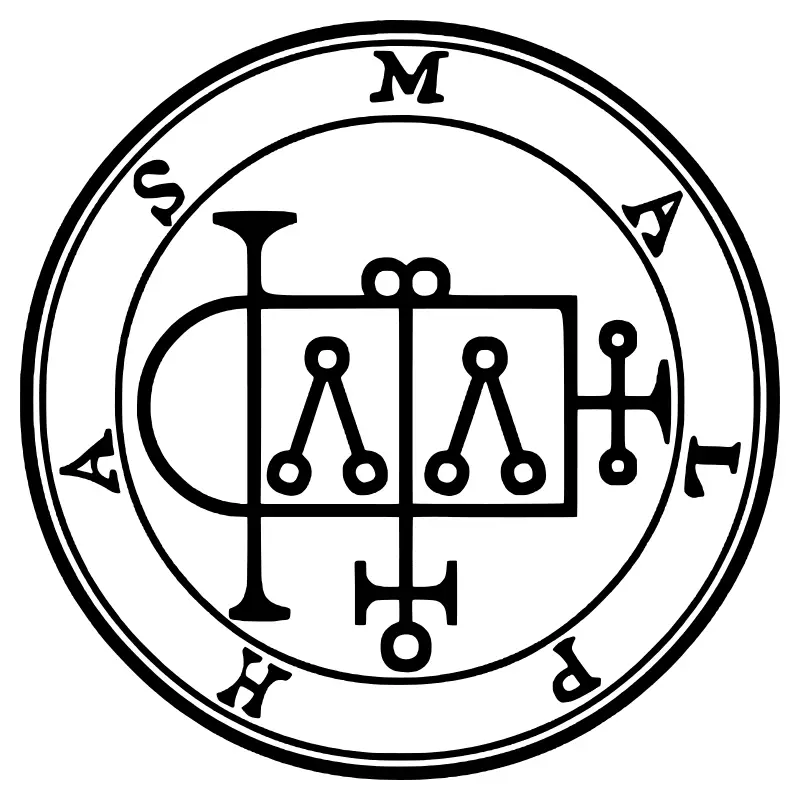
Historical The seal above is Malphas’s as printed in 1904, and by the rules of the Observations it would be made in mercury, the metal of his rank. Mercury is toxic, so a modern copy belongs on paper. Why seals were worn, why editions draw them differently and how to study one are explained in seals, circle and triangle.
Later tradition Le Breton’s 1863 plate shows a winged crow standing upright on bird’s feet, dressed in breeches, with what looks like a mason’s trowel: the builder of the text, drawn literally.
Later tradition and modern practice
Modern Malphas’s building office has made him a modern favorite with architects, builders, and people starting projects. His warning about sacrifice is often quoted by modern writers as a caution against transactional practice.
Lore about Malphas’s personality, likes or chosen people is modern, not grimoire material; modern approaches explains where such claims come from.
Beginner’s quick reference
| Item | What the sources say |
|---|---|
| Rank metal and hours (Goetia) | President: mercury (toxic; never handle it); any time except twilight or night, unless his king is invoked (the wording is unclear). |
| Planet (later tradition: Golden Dawn and Crowley’s 777) | Mercury. |
| Decan and day or night spirit (later tradition: 777) | Aries, third decan (20 to 30 degrees); night spirit. 777 decan incense: black pepper (irritating smoke; not for beginners). Tarot card of the decan: Four of Wands. |
| Commonly reported color, incense, and plant (modern UPG; sources copy each other) | Color orange; incense storax; plant marigold. |
| Associated symbols | Goetia image: a crow; later a man; a hoarse voice; houses and towers belong to his office. 777 Magical Image: the same, with the hoarse voice read as a “sore throat.” Le Breton engraving (1863): a crow in human clothes holding a trowel. Modern Demonolatry/UPG: the seal, used as an altar image. |
| Associated offerings | The Goetia says Malphas receives a sacrifice “kindly and willingly, but he will deceive him that doth it,” and does not say what it is; I use no sacrifice. Modern practice, not in the Goetia manuscripts: most often listed, storax; one source adds mulberry and saffron. |
Before you burn or handle anything listed for Malphas, read incense, plants and offerings.
Practical notes
Malphas is a president, and his building office has no harm in it. But the text says he deceives those who sacrifice to him, and his other office concerns enemies’ thoughts, which I do not teach.
He does not meet the beginner criteria, although his building office comes close. His entry is a useful lesson about offerings: an offering given as payment invites the bargaining frame I avoid.
In the directory, Malphas is not among the 30 spirits that fit the beginner criteria.
Try this: one question to study
Write out the sacrifice sentence in Weyer’s Latin, Scot’s English and the 1904 text, and note whether the deceived person is “all” or only the one who sacrifices.
What next
To compare Malphas with other spirits of his rank, read Gaap and Foras.
Later tradition In the Golden Dawn scheme of the decans, Malphas is the night spirit of the third decan of Aries, which belongs to the Four of Wands; the day spirit of the same decan is Vassago (spirit 3).
Common questions
Is Malphas a good spirit for beginners?
Not as a first choice. He does not meet all three beginner criteria I use: not a king, at least one teaching office, and no central harm, deception or compulsion. His entry has no office of harm and is still worth reading as history.
What does Malphas do in the Ars Goetia?
The 1904 text calls him a president ruling 40 legions. Its first office for him is this: Malphas can build houses and high towers. The entry lists 3 offices in all.
Does looking at Malphas's seal call him?
No. Reading a name or looking at a seal does not call a spirit. The seal is a drawing from a 1904 book, and even the grimoire itself required long rituals for its own purposes.
Get the free Mini-Grimoire
A short printable starter guide to tarot and everyday witchcraft, plus my newsletter. Unsubscribe any time.
Opens Substack in a new tab to confirm. More about the newsletter · Privacy