


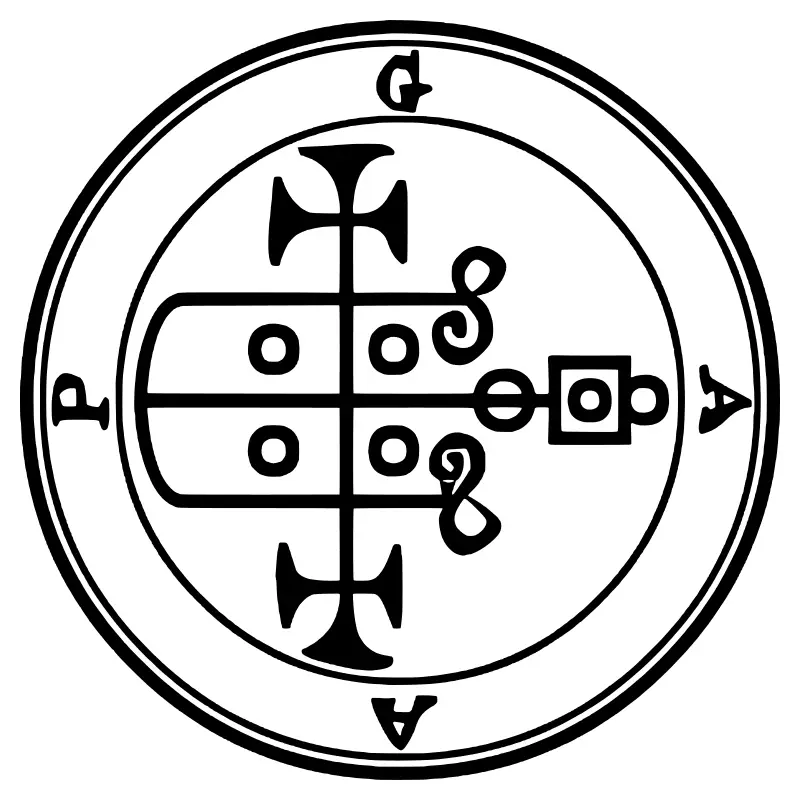
How to read the labels Historical what the old sources say. Later tradition what later writers added. Modern modern practice and my own notes.
| Number | 33 of 72 |
|---|---|
| Rank | President and Prince |
| Legions | 66 |
| Office (1904) | Makes men insensible or ignorant. |
| Other spellings | Tap (Weyer, Scot), Goap (as a king of the quarters) |
Gaap is spirit 33 of the 72 in the Ars Goetia, the first book of the Lesser Key of Solomon. The 1904 edition by S. L. MacGregor Mathers and Aleister Crowley calls him a president and prince ruling 66 legions, and the first office it gives him is this: Gaap makes men insensible or ignorant.
His entry connects the catalog to the story of the brass vessel and to the four kings of the quarters. Each part below carries a label for its layer, explained in how to read a spirit page.
At a glance
| Fact | In the entry |
|---|---|
| Number | 33 of 72, in the 1904 order. |
| Name and spellings | Gaap in 1904; other spellings: Tap (Weyer, Scot), Goap (as a king of the quarters). |
| Rank and legions | President and Prince, 66 legions. |
| Metal of his rank (Observations) | Mercury (as president) or tin (as prince); two ranks. |
| Hours for presidents (Observations) | “At any time, excepting Twilight, at Night, unless the King whom they are under be Invocated.” |
| Hours for princes (Observations) | “Any hour of the Day.” |
| In Weyer’s catalog (1577) | Yes, as the source comparison below shows. |
The 1904 entry
Historical The full entry from the 1904 edition, with footnote numbers and the dash after the heading left out and the heading set in ordinary type:
Gaap. The Thirty-third Spirit is Gaap. He is a Great President and a Mighty Prince. He appeareth when the Sun is in some of the Southern Signs, in a Human Shape, going before Four Great and Mighty Kings, as if he were a Guide to conduct them along on their way. His Office is to make men Insensible or Ignorant; as also in Philosophy to make them Knowing, and in all the Liberal Sciences. He can cause Love or Hatred, also he can teach thee to consecrate those things that belong to the Dominion of Amaymon his King. He can deliver Familiars out of the Custody of other Magicians, and answereth truly and perfectly of things Past, Present, and to Come. He can carry and re-carry men very speedily from one Kingdom to another, at the Will and Pleasure of the Exorcist. He ruleth over 66 Legions of Spirits, and he was of the Order of Potentates. His Seal is this to be made and to be worn as aforesaid, etc.
Gaap appears “when the Sun is in some of the Southern Signs”, in human shape, going before four great kings “as if he were a Guide”. His offices are mixed: making men insensible or ignorant, making them knowing in philosophy and the liberal sciences, causing love or hatred, teaching the consecration of things belonging to Amaymon, delivering familiars from other magicians, true answers and carrying people quickly between kingdoms. The text calls him “of the Order of Potentates” and, at the end of the catalog, one of the four chiefs of the brass vessel.
Appearance
Historical Gaap appears “when the Sun is in some of the Southern Signs, in a Human Shape, going before Four Great and Mighty Kings, as if he were a Guide to conduct them along on their way.”
Offices in the Ars Goetia
Historical The offices of Gaap, in the order the 1904 text gives them:
- Makes men insensible or ignorant. Reported as history; not taught here.
- Makes them knowing in philosophy and all the liberal sciences.
- Can cause love or hatred. Reported as history; not taught here.
- Can teach how to consecrate things belonging to the dominion of Amaymon.
- Can deliver familiars from the custody of other magicians.
- Answers truly of things past, present, and to come.
- Can carry men speedily from one kingdom to another.
He rules 66 legions and “was of the Order of Potentates.” In the story of the vessel he is one of the four chiefs.
Source comparison: Weyer and Scot
Historical Weyer, in Scot’s English, gives “Gaap, alias Tap,” “a great president and a prince,” who appears in a “meridionall” (southern) sign, and in human shape is the guide of the four principal kings.
Weyer adds a long note: certain necromancers offered sacrifices and burnt offerings to him, claiming an art from Solomon. Weyer calls this false, saying it came rather from Ham, son of Noah, whom he names the first necromancer.
Historical Weyer has “Gaap, aliàs Tap”, appearing “in signo meridiei”. The Latin entry turns into an argument: necromancers who sacrificed to him claimed an art from Solomon, but Weyer says it came rather from Cham (Ham), son of Noah, who first called up evil spirits after the flood. Only after this does Weyer list the offices. (About Weyer and Scot.)
Name and etymology
Historical Tap is Weyer’s alias. Goap, one of the four kings of the quarters, is similar, and the two may be related; the text does not say so.
Seal and images
Historical The seal above is Gaap’s as printed in 1904, and by the rules of the Observations it would be made in mercury or tin, the metals of his two ranks. Mercury is toxic, so a modern copy belongs on paper. Why seals were worn, why editions draw them differently and how to study one are explained in seals, circle and triangle.
Later tradition Le Breton’s 1863 plate shows a horned figure with bat wings, crouching.
Later tradition and modern practice
Later tradition The name Goap appears in the Goetia’s Observations as one of the four kings of the quarters, ruling the South or West depending on the source. Whether Gaap and Goap are one spirit is debated.
Modern Modern writers sometimes treat Gaap as a spirit of travel and transformation.
Lore about Gaap’s personality, likes or chosen people is modern, not grimoire material; modern approaches explains where such claims come from.
Beginner’s quick reference
| Item | What the sources say |
|---|---|
| Rank metal and hours (Goetia) | As president: mercury (toxic; never handle it); any time except twilight or night, unless his king is invoked (the wording is unclear). As prince: tin; any hour of the day. The text does not say which rule applies. |
| Planet (later tradition: Golden Dawn and Crowley’s 777) | Mercury. This differs from 777’s usual pattern for a president and prince, which would give Mercury and Jupiter. This is how the 1909 printing gives it. |
| Decan and day or night spirit (later tradition: 777) | Aquarius, third decan (20 to 30 degrees); day spirit. 777 decan incense: rhubarb. Tarot card of the decan: Seven of Swords. |
| Commonly reported color, incense, and plant (modern UPG; sources copy each other) | Color orange (sometimes with blue); incense storax; plant moss. |
| Associated symbols | Goetia image: a human form walking before four great kings as their guide. 777 Magical Image: “Like a guide.” Le Breton engraving (1863): a horned, bat-winged demon, crouching. Modern Demonolatry/UPG: the seal, used as an altar image; one practitioner’s blog adds the raven and the leopard. |
| Associated offerings | Modern practice, not in the Goetia manuscripts: most often listed, storax and moss, then balsam. One source, repeated by another, names tobacco as a favorite; tobacco is toxic and is never used here. |
Before you burn or handle anything listed for Gaap, read incense, plants and offerings.
Practical notes
Gaap holds two ranks and is listed among the four chiefs of the vessel. His offices include making men ignorant and causing hatred, which I do not teach, and his office of taking familiars from other magicians is a kind of interference. Not a first-contact choice under the beginner criteria.
In the directory, Gaap is not among the 30 spirits that fit the beginner criteria.
Try this: one question to study
Read Weyer’s argument about Ham and Solomon and write one sentence on why a sixteenth-century physician might want to deny Solomon’s authorship.
What next
To compare Gaap with other spirits of his rank, read Foras and Malphas.
Later tradition In the Golden Dawn scheme of the decans, Gaap is the day spirit of the third decan of Aquarius, which belongs to the Seven of Swords; the night spirit of the same decan is Decarabia (spirit 69).
Common questions
Is Gaap a good spirit for beginners?
Not as a first choice. He does not meet all three beginner criteria I use: not a king, at least one teaching office, and no central harm, deception or compulsion. His entry is still worth reading as history.
What does Gaap do in the Ars Goetia?
The 1904 text calls him a president and prince ruling 66 legions. Its first office for him is this: Gaap makes men insensible or ignorant. The entry lists 7 offices in all.
Does looking at Gaap's seal call him?
No. Reading a name or looking at a seal does not call a spirit. The seal is a drawing from a 1904 book, and even the grimoire itself required long rituals for its own purposes.
Get the free Mini-Grimoire
A short printable starter guide to tarot and everyday witchcraft, plus my newsletter. Unsubscribe any time.
Opens Substack in a new tab to confirm. More about the newsletter · Privacy