


How to read the labels Historical what the old sources say. Later tradition what later writers added. Modern modern practice and my own notes.
| Number | 38 of 72 |
|---|---|
| Rank | Earl |
| Legions | 26 |
| Office (1904) | Builds up towers and furnishes them with ammunition and weapons. |
| Other spellings | Malthus, Malthous, Malthas (1904) |
Spirit 38 of the Ars Goetia is Halphas. The 1904 edition by S. L. MacGregor Mathers and Aleister Crowley calls him an earl ruling 26 legions, and the first office it gives him is this: Halphas builds up towers and furnishes them with ammunition and weapons.
His entry shows how one misread word can change a spirit’s whole image, and his office is purely military. Each part below carries a label for its layer, explained in how to read a spirit page.
At a glance
| Fact | In the entry |
|---|---|
| Number | 38 of 72, in the 1904 order. |
| Name and spellings | Halphas in 1904; other spellings: Malthus, Malthous, Malthas (1904). |
| Rank and legions | Earl, 26 legions. |
| Metal of his rank (Observations) | Copper and silver. |
| Hours for earls (Observations) | “Any hour of the Day, so it be in Woods, or in any other places whither men resort not, or where no noise is.” |
| In Weyer’s catalog (1577) | Yes, as the source comparison below shows. |
The 1904 entry
Historical The full entry from the 1904 edition, with footnote numbers and the dash after the heading left out and the heading set in ordinary type:
Halphas, or Malthus. The Thirty-eighth Spirit is Halphas, or Malthus (or Malthas). He is a Great Earl, and appeareth in the Form of a Stock-Dove. He speaketh with a hoarse Voice. His Office is to build up Towers, and to furnish them with Ammunition and Weapons, and to send Men-of-War to places appointed. He ruleth over 26 Legions of Spirits, and his Seal is this, etc.
The entry is short and practical. Halphas appears as a stock-dove, a wild pigeon, “with a hoarse Voice”, and his office is “to build up Towers, and to furnish them with Ammunition and Weapons, and to send Men-of-War to places appointed”. “Men-of-War” here means soldiers, not warships, as Mathers notes. A dove that arms fortresses is an odd pairing, and the comparison with Weyer below explains it: the dove was once a stork.
Appearance
Historical Halphas “appeareth in the Form of a Stock-Dove. He speaketh with a hoarse Voice.”
Offices in the Ars Goetia
Historical The offices of Halphas, in the order the 1904 text gives them:
- Builds up towers and furnishes them with ammunition and weapons.
- Sends men of war to places appointed. Reported as history; not taught here.
Source comparison: Weyer and Scot
Historical Weyer, in Scot’s English, gives “Halphas” as “a great earle,” who “commeth abroad like a storke, with a hoarse voice.”
He “notablie buildeth up townes full of munition and weapons” and “sendeth men of warre to places appointed.” Weyer’s stork becomes the Goetia’s stock-dove, a kind of wild pigeon. The same change happens with Shax (44). Both give 26 legions.
Historical Weyer’s Latin has “similis ciconiæ”, like a stork, and he “insigniter ædificat oppida ampla armis plena”, notably builds large towns full of arms. Weyer also says “bellum movet”, he stirs up war, which the Goetia drops. Joseph Peterson, the modern editor of the manuscripts, notes that only Sloane MS 2731 keeps “towns”, while Sloane 3825, Sloane 3648 and Harley 6483 read “towers”, the reading Mathers printed. (About Weyer and Scot.)
Name and etymology
Historical The 1904 text gives Malthus, Malthous and Malthas as other names. Their meaning, and why they sound so close to Malphas, the next spirit, is not known. Crowley could not resist a footnote on the first of them: “But Malthus is certainly in heaven”, a joke at the economist Thomas Malthus.
Seal and images
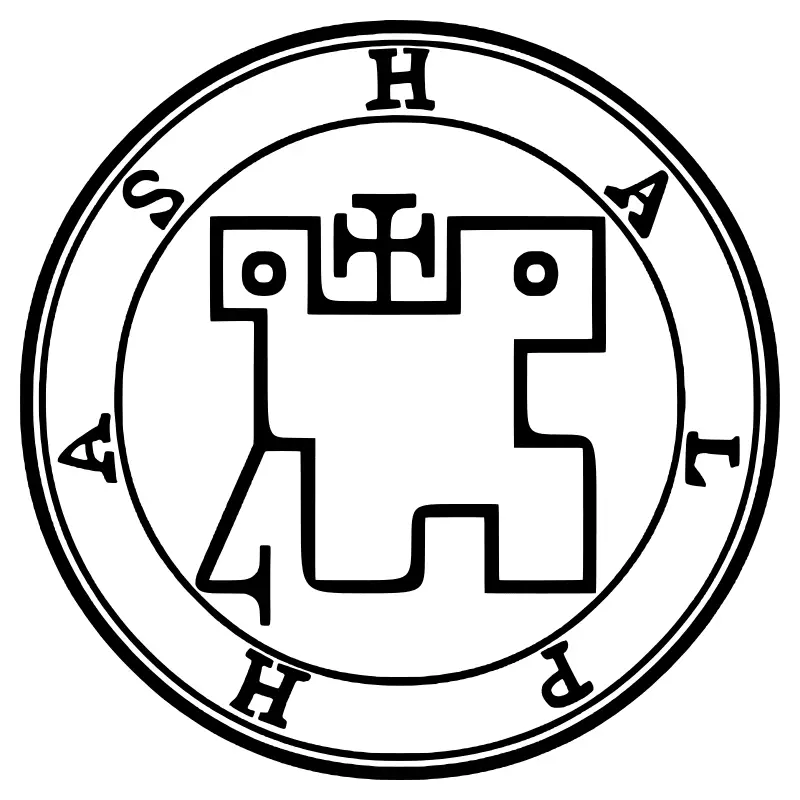
Historical The seal above is Halphas’s as printed in 1904, and by the rules of the Observations it would be made in copper and silver, the metals of his rank. Why seals were worn, why editions draw them differently and how to study one are explained in seals, circle and triangle.
Later tradition and modern practice
Later tradition The confusion of stork and stock-dove may come from the Latin ciconia, stork, misread or misunderstood by an English copyist, but this is a guess.
Modern Modern writers sometimes present Halphas as a spirit of defense and protection. That is a modern reading of a military office.
Lore about Halphas’s personality, likes or chosen people is modern, not grimoire material; modern approaches explains where such claims come from.
Beginner’s quick reference
| Item | What the sources say |
|---|---|
| Rank metal and hours (Goetia) | Earl: copper and silver; any hour of the day, in woods or other quiet places. |
| Planet (later tradition: Golden Dawn and Crowley’s 777) | Mars. For earls, 777 gives Mars, following the 1904 editor’s note, rather than the Venus and Moon of their copper and silver. |
| Decan and day or night spirit (later tradition: 777) | Aries, second decan (10 to 20 degrees); night spirit. 777 decan incense: “Stammonia” (unidentified; may refer to a toxic plant: do not burn it). Tarot card of the decan: Three of Wands. |
| Commonly reported color, incense, and plant (modern UPG; sources copy each other) | Color red; incense dragon’s blood; plant marjoram (toxic to cats). |
| Associated symbols | Goetia image: a stock dove; a hoarse voice. 777 Magical Image: the same, with the hoarse voice read as a “sore throat.” Modern Demonolatry/UPG: the seal, used as an altar image. |
| Associated offerings | Modern practice, not in the Goetia manuscripts: most often listed, dragon’s blood resin; one source adds cinquefoil and fresh leaves. |
Before you burn or handle anything listed for Halphas, read incense, plants and offerings.
Practical notes
Halphas’s offices are military. He falls outside the beginner criteria, and I do not teach any work related to weapons or war. His entry is a good example of how a single word can change between versions: compare the stork and the dove.
In the directory, Halphas is not among the 30 spirits that fit the beginner criteria.
Try this: one question to study
Find two words in this entry, stork and towns, that changed between Weyer and the 1904 text, and write down how each change alters the picture.
What next
To compare Halphas with other spirits of his rank, read Raum and Furfur.
Later tradition In the Golden Dawn scheme of the decans, Halphas is the night spirit of the second decan of Aries, which belongs to the Three of Wands; the day spirit of the same decan is Agares (spirit 2).
Common questions
Is Halphas a good spirit for beginners?
Not as a first choice. He does not meet all three beginner criteria I use: not a king, at least one teaching office, and no central harm, deception or compulsion. His entry is still worth reading as history.
What does Halphas do in the Ars Goetia?
The 1904 text calls him an earl ruling 26 legions. Its first office for him is this: Halphas builds up towers and furnishes them with ammunition and weapons. The entry lists 2 offices in all.
Does looking at Halphas's seal call him?
No. Reading a name or looking at a seal does not call a spirit. The seal is a drawing from a 1904 book, and even the grimoire itself required long rituals for its own purposes.
Get the free Mini-Grimoire
A short printable starter guide to tarot and everyday witchcraft, plus my newsletter. Unsubscribe any time.
Opens Substack in a new tab to confirm. More about the newsletter · Privacy