


How to read the labels Historical what the old sources say. Later tradition what later writers added. Modern modern practice and my own notes.
| Number | 55 of 72 |
|---|---|
| Rank | Prince |
| Legions | 20 |
| Office (1904) | Discovers all things past, present, and to come. |
| Other spellings | none common |
Orobas is number 55 in the catalog of 72 spirits that opens the Lesser Key of Solomon. The 1904 edition by S. L. MacGregor Mathers and Aleister Crowley calls him a prince ruling 20 legions, and the first office it gives him is this: Orobas discovers all things past, present, and to come.
He is the horse-shaped prince who, the text says, deceives no one. Each part below carries a label for its layer, explained in how to read a spirit page.
At a glance
| Fact | In the entry |
|---|---|
| Number | 55 of 72, in the 1904 order. |
| Name and spellings | Orobas in 1904; other spellings: none common. |
| Rank and legions | Prince, 20 legions. |
| Metal of his rank (Observations) | Tin. |
| Hours for princes (Observations) | “Any hour of the Day.” |
| In Weyer’s catalog (1577) | Yes, as the source comparison below shows. |
The 1904 entry
Historical The full entry from the 1904 edition, with footnote numbers and the dash after the heading left out and the heading set in ordinary type:
Orobas. The Fifty-fifth Spirit is Orobas. He is a Great and Mighty Prince, appearing at first like a Horse; but after the command of the Exorcist he putteth on the Image of a Man. His Office is to discover all things Past, Present, and to Come; also to give Dignities, and Prelacies, and the Favour of Friends and of Foes. He giveth True Answers of Divinity, and of the Creation of the World. He is very faithful unto the Exorcist, and will not suffer him to be tempted of any Spirit. He governeth 20 Legions of Spirits. His Seal is this, etc.
Orobas appears “at first like a Horse” and then in the image of a man. His offices include knowledge of past, present and future, “Dignities, and Prelacies”, and “True Answers of Divinity, and of the Creation of the World”. Prelacies are church offices such as bishoprics. The entry closes with a rare promise: “He is very faithful unto the Exorcist, and will not suffer him to be tempted of any Spirit.”
Appearance
Historical Orobas appears “at first like a Horse; but after the command of the Exorcist he putteth on the Image of a Man.”
Offices in the Ars Goetia
Historical The offices of Orobas, in the order the 1904 text gives them:
- Discovers all things past, present, and to come.
- Gives dignities, prelacies, and the favor of friends and foes.
- Gives true answers of divinity and of the creation of the world.
- “Is very faithful unto the Exorcist, and will not suffer him to be tempted of any Spirit.”
Source comparison: Weyer and Scot
Historical In Scot’s English, Weyer gives “Orobas” as “a great prince,” like a horse, who in man’s “idol” (image) “talketh of divine vertue,” gives true answers, “deceiveth none, nor suffereth anie to be tempted,” and gives dignities and favor. Both give 20 legions. The close match includes the promise of faithfulness.
Historical Weyer’s Latin begins with speech, “de virtute divina loquitur”, he speaks of divine power, and states the promise as a fact about the spirit: “neminem decipit, nec tentari sinit”, he deceives no one and does not allow anyone to be tempted. The Goetia’s “very faithful unto the Exorcist” narrows a general honesty to loyalty toward one person. (About Weyer and Scot.)
Name and etymology
Historical Weyer, Scot and the 1904 text all spell the name Orobas. No meaning is known.
Seal and images
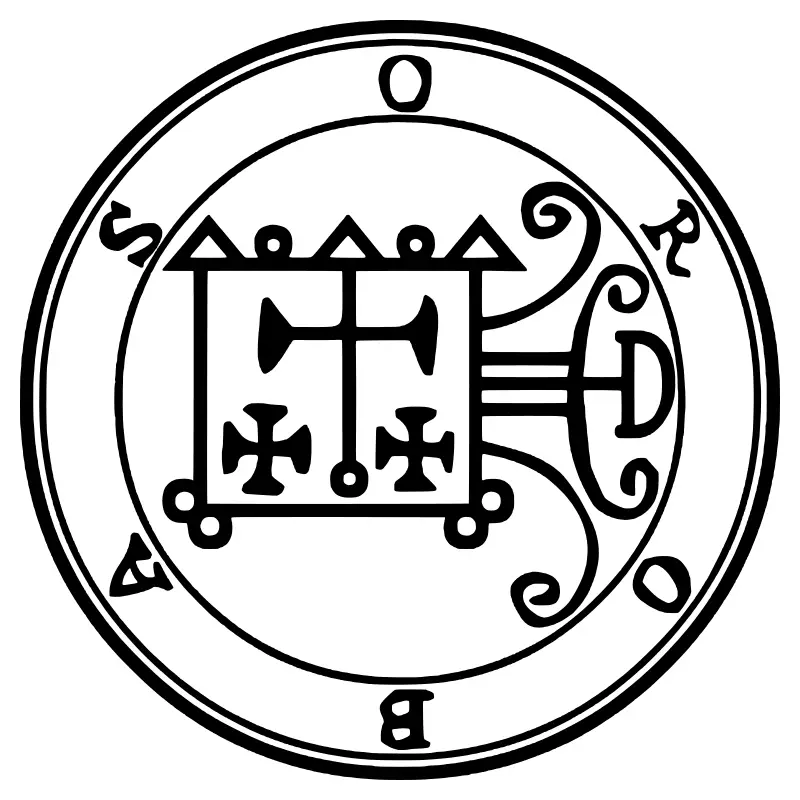
Historical The seal above is Orobas’s as printed in 1904, and by the rules of the Observations it would be made in tin, the metal of his rank. Why seals were worn, why editions draw them differently and how to study one are explained in seals, circle and triangle.
Later tradition Le Breton’s 1863 plate shows a horse-headed figure rearing on hind legs with human arms raised, halfway between the horse and the man of the text.
Later tradition and modern practice
Later tradition Later demonologies add nothing of note to Orobas’s entry.
Modern Because the text says Orobas is faithful and protects the magician from other spirits’ temptation, modern writers often recommend him as a trustworthy spirit for beginners. Like Vassago’s “good nature,” this is a modern reading of one line.
Lore about Orobas’s personality, likes or chosen people is modern, not grimoire material; modern approaches explains where such claims come from.
Beginner’s quick reference
| Item | What the sources say |
|---|---|
| Rank metal and hours (Goetia) | Prince: tin; any hour of the day. |
| Planet (later tradition: Golden Dawn and Crowley’s 777) | Jupiter. |
| Decan and day or night spirit (later tradition: 777) | Libra, first decan (0 to 10 degrees); night spirit. 777 decan incense: galbanum. Tarot card of the decan: Two of Swords. |
| Commonly reported color, incense, and plant (modern UPG; sources copy each other) | Color blue; incense cedar; plant broom. |
| Associated symbols | Goetia image: a horse; later a man. 777 Magical Image: a horse. Le Breton engraving (1863): an upright figure with a horse’s head. Modern Demonolatry/UPG: the seal, used as an altar image. |
| Associated offerings | Modern practice, not in the Goetia manuscripts: most often listed, cedar; one source adds cinnamon and white sandalwood. |
Before you burn or handle anything listed for Orobas, read incense, plants and offerings.
Practical notes
Orobas is a prince, not a king, and his offices include divination and answers about theology and creation, with no harm. He fits the beginner criteria reasonably well, especially for questions about religious or philosophical history. The text’s claim of faithfulness is not a guarantee. Keep Goetia safety, ethics and mental health in mind.
In the directory, Orobas is one of the 30 spirits that fit the beginner criteria.
Try this: one question to study
Compare “neminem decipit” with “very faithful unto the Exorcist” and write down who is protected in each version.
What next
To compare Orobas with other spirits of his rank, read Seere and Stolas.
Later tradition In the Golden Dawn scheme of the decans, Orobas is the night spirit of the first decan of Libra, which belongs to the Two of Swords; the day spirit of the same decan is Sallos (spirit 19).
Common questions
Is Orobas a good spirit for beginners?
He is counted among the 30 of the 72 that fit the three beginner criteria I use: not a king, at least one teaching office, and no central harm, deception or compulsion. Even so, read his whole entry first, because nearly every entry is mixed.
What does Orobas do in the Ars Goetia?
The 1904 text calls him a prince ruling 20 legions. Its first office for him is this: Orobas discovers all things past, present, and to come. The entry lists 4 offices in all.
Does looking at Orobas's seal call him?
No. Reading a name or looking at a seal does not call a spirit. The seal is a drawing from a 1904 book, and even the grimoire itself required long rituals for its own purposes.
Get the free Mini-Grimoire
A short printable starter guide to tarot and everyday witchcraft, plus my newsletter. Unsubscribe any time.
Opens Substack in a new tab to confirm. More about the newsletter · Privacy