


| Arcana | Minor Arcana: Swords |
|---|---|
| Image | RWS 1909 (PD) |
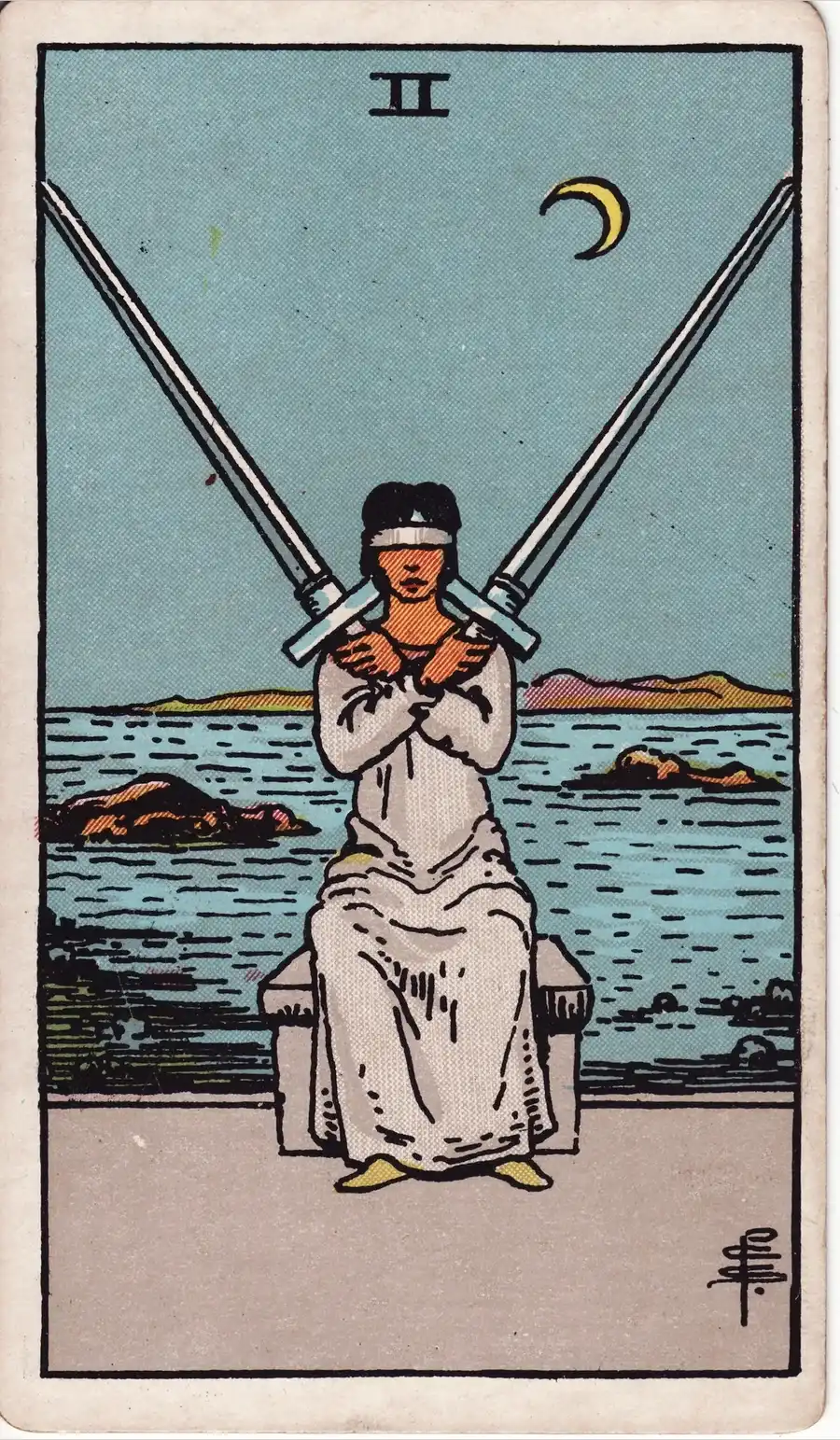
The Two of Swords shows a blindfolded woman sitting by the sea at night with two heavy swords crossed over her chest. The water behind her is full of rocks, and a thin moon hangs in the sky.
It is a card of stalemate, hard choices and not wanting to look. Here is what the Two of Swords means upright and reversed, the symbols in the 1909 card and a spread for making a hard decision.
Here is the Two of Swords at a glance.
| At a glance | This card |
|---|---|
| Upright keywords | indecision, stalemate, difficult choices |
| Reversed keywords | confusion, indecision, information overload |
| Number | 2 in the suit of Swords |
| Golden Dawn title | Lord of Peace Restored Later tradition |
| Astrology | Moon in Libra, first decan (0° to 10° Libra) Later tradition |
| Tree of Life | Chokmah (2), Wisdom Later tradition |
| Suit and element | Swords, Air Later tradition |
| Yes or no | No Modern |
The Golden Dawn named the Two of Swords the Lord of Peace Restored and gave it the Moon in Libra, the first decan of the sign, on Chokmah. The Moon’s changeability in the sign of the scales makes a fitting background for a card about a balance that holds only as long as nothing moves.
Later tradition The Golden Dawn also gave each decan two of the 72 Goetic spirits, one for the day and one for the night. For the first decan of Libra, and so for the Two of Swords, they are Sallos (spirit 19, day) and Orobas (spirit 55, night). Their pages read the old entries as history; see the spirit directory for all 72.
The card: what Pamela Colman Smith drew
Waite described it in one line: “A hoodwinked female figure balances two swords upon her shoulders.” Hoodwinked means blindfolded. Smith put her with her back to the sea, so she cannot see the water or the rocks.
The blindfold. She cannot see. Sometimes that is because information is missing, and sometimes because looking would hurt. The card asks which one it is.
The crossed swords. The two swords are equally heavy. Holding them crossed protects her heart, but she cannot hold that pose forever.
The sea and the moon. Behind her the water is rocky and the moon is a thin crescent. Feelings and intuition are at her back, unseen. The answer may be in what she feels, not only in what she thinks.
Upright meaning
Upright, the Two of Swords is a stalemate. A blindfolded woman sits by the sea at night with two swords crossed over her chest. The water behind her is full of rocks, and a crescent moon hangs above. She is holding very still, keeping two forces in balance by refusing to look at either.
The card appears when you face a difficult choice and have decided not to decide, at least for now. It can describe a truce, a temporary peace or a protective pause. The Golden Dawn called it Peace Restored, and sometimes that peace is genuinely needed.
But the blindfold is a warning. You cannot hold the swords forever, and you cannot make a good choice without looking. Take the blindfold off when you are ready, and look at both options honestly.
Reversed meaning
Reversed, the Two of Swords can show the stalemate breaking, as the swords come down and the decision gets made. It can also show deeper confusion, information overload, or being torn between people who both want something from you.
Ask what information you are avoiding. Often the hardest choices become clearer once you name what you are afraid of losing.
If the choice involves other people, the reversed Two may show you that you are trying to keep everyone happy. That is a kind of blindfold too. Ask which option you would choose if nobody else would be disappointed, then decide how to tell them.
In love, work and spirituality
In love. Upright: A truce, or avoiding a decision about a relationship. Reversed: Being torn between two people, or a stalemate finally ending.
At work. Upright: Delaying a decision, or a fragile peace between colleagues. Reversed: Too much information, or being forced to choose.
With money. Upright: Avoiding looking at your finances. Reversed: Finally facing the numbers.
In spiritual practice. Upright: Meditation, stillness and inner balance. Reversed: Avoidance disguised as calm.
As feelings. Guarded and undecided. They may be protecting themselves.
As a person. Someone diplomatic but avoidant, who finds it hard to choose.
As advice. Take off the blindfold and look at both options.
Reading the Two of Swords: positions and yes or no
In the past position: An avoided decision shaped where you are. In the present position: You are stuck between two options. Look at both honestly.
In the future position: A choice is coming. Gather information now. As advice: Lift the blindfold and look at what you already know.
In modern yes or no readings, the Two of Swords leans no. The answer is blocked until a decision is made.
What the Two means, and the history behind the card
Two in Swords is a mind holding two ideas in tension. Peace Restored, the Golden Dawn’s title, is a peace that depends on balance and may not last.
Here is how the Two looks across the four suits:
- Two of Wands: planning, decisions, expansion
- Two of Cups: unity, partnership, mutual attraction
- Two of Swords (this card): indecision, stalemate, difficult choices
- Two of Pentacles: balance, adaptability, time management
When A. E. Waite published The Pictorial Key to the Tarot in 1910, he listed these divinatory meanings for the Two of Swords: “Conformity and the equipoise which it suggests, courage, friendship, concord in a state of arms; another reading gives tenderness, affection, intimacy.”
Reversed, he gave: “Imposture, falsehood, duplicity, disloyalty.”
Common questions
Is the Two of Swords a yes or no card? It leans no, or not yet. The decision has not been made.
What does the Two of Swords mean in love? Avoiding a choice, or a guarded heart. Reversed, confusion and mixed feelings.
What is the difference between the Two of Swords and the Two of Wands? Both are choices. The Two of Wands looks outward at possibilities. The Two of Swords is frozen and looking inward.
Try this
Try this small spread for the Two of Swords. Use it when you are stuck between two options.
| Card | Question | What it shows |
|---|---|---|
| 1 | Option one | What this path offers and costs. |
| 2 | Option two | What the other path offers and costs. |
| 3 | What am I not seeing? | The missing piece that helps me choose. |
Affirmation: I face difficult choices with the facts I have and the values I hold.
Reversed affirmation: I cut through overload and name the preference I already feel.
If you keep a tarot journal, take one of these questions to it: What am I avoiding looking at? What would I choose if both options cost the same? What does my body feel about each path?
What next
Cards that sit close to this one are Justice (the Major Arcana card of weighing things fairly), Seven of Cups (too many options instead of two) and Eight of Swords (another blindfolded figure, held by fear).
The Two of Swords is part of the lesson Swords in my free Tarot for Beginners course. To see the whole suit on one page, go to the suit of Swords. To keep walking the suit, read the card before it, Ace of Swords or the card after it, Three of Swords, or go back to all the card meanings.
For the suits and numbers in one place, see The Minor Arcana: suits and numbers made simple. For every card with keywords, affirmations and examples, see my book The Novice’s Guide to Tarot. If you would like a printable cheat sheet for all 78 cards, my 45-page Tarot Workbook is on Etsy.
Sources
- A. E. Waite, The Pictorial Key to the Tarot (London: Rider, 1910), Part III, sections 1 and 2.
- Pamela Colman Smith and A. E. Waite, the Rider-Waite-Smith tarot (London: Rider, 1909).
- Nicolas Conver, Tarot de Marseille (Marseille, 1760).
- Lauri Mukkala, The Novice’s Guide to Tarot, entry for the Two of Swords.
- Aleister Crowley, 777 (London: Walter Scott, 1909), columns of the decans, the Minor Arcana and the court cards.
- Israel Regardie, ed., The Golden Dawn (Chicago: Aries Press, 1937 to 1940), “Book T”, titles and attributions of the small cards and the court.
All 78 cards
Major Arcana
- The Fool
- The Magician
- The High Priestess
- The Empress
- The Emperor
- The Hierophant
- The Lovers
- The Chariot
- Strength
- The Hermit
- Wheel of Fortune
- Justice
- The Hanged Man
- Death
- Temperance
- The Devil
- The Tower
- The Star
- The Moon
- The Sun
- Judgement
- The World
Wands
- Ace of Wands
- Two of Wands
- Three of Wands
- Four of Wands
- Five of Wands
- Six of Wands
- Seven of Wands
- Eight of Wands
- Nine of Wands
- Ten of Wands
- Page of Wands
- Knight of Wands
- Queen of Wands
- King of Wands
Cups
- Ace of Cups
- Two of Cups
- Three of Cups
- Four of Cups
- Five of Cups
- Six of Cups
- Seven of Cups
- Eight of Cups
- Nine of Cups
- Ten of Cups
- Page of Cups
- Knight of Cups
- Queen of Cups
- King of Cups
Swords
- Ace of Swords
- Two of Swords
- Three of Swords
- Four of Swords
- Five of Swords
- Six of Swords
- Seven of Swords
- Eight of Swords
- Nine of Swords
- Ten of Swords
- Page of Swords
- Knight of Swords
- Queen of Swords
- King of Swords
Pentacles
Get the free Mini-Grimoire
A short printable starter guide to tarot and everyday witchcraft, plus my newsletter. Unsubscribe any time.
Opens Substack in a new tab to confirm. More about the newsletter · Privacy