


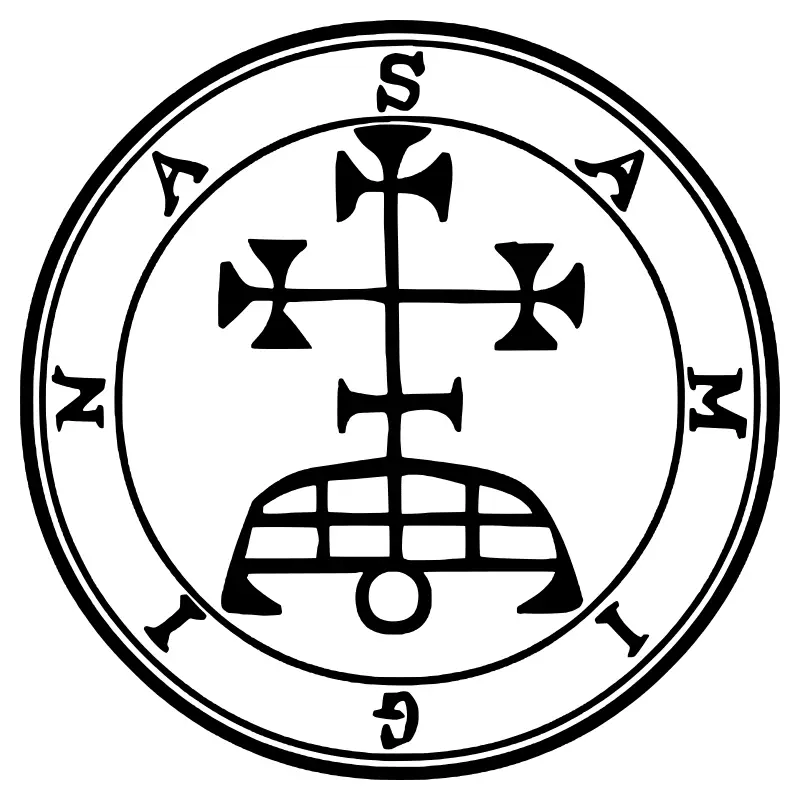
How to read the labels Historical what the old sources say. Later tradition what later writers added. Modern modern practice and my own notes.
| Number | 4 of 72 |
|---|---|
| Rank | Marquis |
| Legions | 30 |
| Office (1904) | Teaches all liberal sciences. |
| Other spellings | Gamigin (Weyer, Scot), Gamygyn |
Samigina is number 4 in the catalog of 72 spirits that opens the Lesser Key of Solomon. The 1904 edition by S. L. MacGregor Mathers and Aleister Crowley calls him a marquis ruling 30 legions, and the first office it gives him is this: Samigina teaches all liberal sciences.
His entry is one of the clearest cases where the Goetia shortens a longer and darker passage in Weyer. Each part below carries a label for its layer, explained in how to read a spirit page.
At a glance
| Fact | In the entry |
|---|---|
| Number | 4 of 72, in the 1904 order. |
| Name and spellings | Samigina in 1904; other spellings: Gamigin (Weyer, Scot), Gamygyn. |
| Rank and legions | Marquis, 30 legions. |
| Metal of his rank (Observations) | Silver. |
| Hours for marquises (Observations) | “From 3 in the afternoon till 9 at Night, and from 9 at Night till Sunrise.” |
| In Weyer’s catalog (1577) | Yes, as the source comparison below shows. |
The 1904 entry
Historical The full entry from the 1904 edition, with footnote numbers and the dash after the heading left out and the heading set in ordinary type:
Samigina, or Gamigin. The Fourth Spirit is Samigina, a Great Marquis. He appeareth in the form of a little Horse or Ass, and then into Human shape doth he change himself at the request of the Master. He speaketh with a hoarse voice. He ruleth over 30 Legions of Inferiors. He teaches all Liberal Sciences, and giveth account of Dead Souls that died in sin. And his Seal is this, which is to be worn before the Magician when he is Invocator, etc.
The heading gives two names, “Samigina, or Gamigin”, and the second is the form Scot used for Weyer’s Gamygyn. The image changes on command, from “a little Horse or Ass” into human shape, a pattern the Goetia uses for many spirits. His offices sit side by side without comment: teaching “all Liberal Sciences” (the seven arts of the medieval school, from grammar to astronomy) and giving “account of Dead Souls that died in sin”.
Appearance
Historical Samigina appears “in the form of a little Horse or Ass,” and then changes into human shape “at the request of the Master.” He “speaketh with a hoarse voice.”
Offices in the Ars Goetia
Historical The offices of Samigina, in the order the 1904 text gives them:
- Teaches all liberal sciences.
- Gives account of “Dead Souls that died in sin.” Reported as history; not taught here.
Source comparison: Weyer and Scot
Historical Weyer calls him Gamigin, “a great marquesse,” seen “in the forme of a little horsse.” In human shape he speaks hoarsely, “disputing of all liberall sciences.”
Weyer’s account of the dead is longer and darker: he makes the souls of those drowned in the sea, or who dwell in purgatory (called Cartagra, “affliction of souls”), take airy bodies and appear and answer questions.
The Goetia shortens this to an account of “Dead Souls that died in sin.” Scot’s text places Gamigin late in the list, not fourth.
Historical Weyer’s Latin is much more specific about the dead: Gamygyn makes souls “in mari exeuntes”, those who perished at sea, and those in purgatory, “quod dicitur Cartagra”, appear in airy bodies and answer questions. It also says he stays with the exorcist until the wish is fulfilled. The Goetia keeps only the souls “that died in sin”, a phrase that turns a purgatorial scene into a moral one. (About Weyer and Scot.)
Name and etymology
Historical Weyer and Scot give Gamygyn and Gamigin; the Goetia’s Samigina may come from a misread initial G. No earlier meaning for either form is known.
Seal and images
Historical The seal above is Samigina’s as printed in 1904, and by the rules of the Observations it would be made in silver, the metal of his rank. Why seals were worn, why editions draw them differently and how to study one are explained in seals, circle and triangle.
Later tradition and modern practice
Later tradition The change from Gamigin to Samigina is probably a copying variant, the G and S easily confused in some hands.
In the seventeenth-century context, calling the dead was necromancy in its oldest sense, and church authorities condemned it.
Modern Modern writers sometimes use both names. Because of his office concerning the dead, Samigina is sometimes linked in modern writing with mediumship and grief work. That link is modern.
Lore about Samigina’s personality, likes or chosen people is modern, not grimoire material; modern approaches explains where such claims come from.
Beginner’s quick reference
| Item | What the sources say |
|---|---|
| Rank metal and hours (Goetia) | Marquis: silver; 3 p.m. to 9 p.m., and 9 p.m. to sunrise. |
| Planet (later tradition: Golden Dawn and Crowley’s 777) | Moon. |
| Decan and day or night spirit (later tradition: 777) | Taurus, first decan (0 to 10 degrees); day spirit. 777 decan incense: “Costum.” Tarot card of the decan: Five of Pentacles. |
| Commonly reported color, incense, and plant (modern UPG; sources copy each other) | Color purple; incense jasmine; plant juniper. |
| Associated symbols | Goetia image: a little horse or donkey that later takes human shape; a hoarse voice. 777 Magical Image: the same image. Modern Demonolatry/UPG: the seal, used as an altar image. |
| Associated offerings | Modern practice, not in the Goetia manuscripts: most often listed, jasmine and juniper. |
Before you burn or handle anything listed for Samigina, read incense, plants and offerings.
Practical notes
Samigina’s teaching office fits the beginner criteria, and he is a marquis. His office concerning dead souls is not one I teach. Grief deserves real support, from people and, when needed, from professionals.
If you are grieving, consider whether contact work is right for you at this time. If you choose Samigina for study, keep your question to the liberal sciences.
In the directory, Samigina is one of the 30 spirits that fit the beginner criteria.
Try this: one question to study
Make a two-line table: Weyer’s souls drowned at sea and in purgatory on one side, the Goetia’s “Dead Souls that died in sin” on the other.
What next
To compare Samigina with other spirits of his rank, read Amon and Leraje.
Later tradition In the Golden Dawn scheme of the decans, Samigina is the day spirit of the first decan of Taurus, which belongs to the Five of Pentacles; the night spirit of the same decan is Raum (spirit 40).
Common questions
Is Samigina a good spirit for beginners?
He is counted among the 30 of the 72 that fit the three beginner criteria I use: not a king, at least one teaching office, and no central harm, deception or compulsion. Even so, read his whole entry first, because nearly every entry is mixed.
What does Samigina do in the Ars Goetia?
The 1904 text calls him a marquis ruling 30 legions. Its first office for him is this: Samigina teaches all liberal sciences. The entry lists 2 offices in all.
Does looking at Samigina's seal call him?
No. Reading a name or looking at a seal does not call a spirit. The seal is a drawing from a 1904 book, and even the grimoire itself required long rituals for its own purposes.
Get the free Mini-Grimoire
A short printable starter guide to tarot and everyday witchcraft, plus my newsletter. Unsubscribe any time.
Opens Substack in a new tab to confirm. More about the newsletter · Privacy