


How to read the labels Historical what the old sources say. Later tradition what later writers added. Modern modern practice and my own notes.
| Number | 7 of 72 |
|---|---|
| Rank | Marquis |
| Legions | 40 |
| Office (1904) | Tells all things past and to come. |
| Other spellings | Aamon (Weyer, Scot), Ammon |
Amon is number 7 in the catalog of 72 spirits that opens the Lesser Key of Solomon. The 1904 edition by S. L. MacGregor Mathers and Aleister Crowley calls him a marquis ruling 40 legions, and the first office it gives him is this: Amon tells all things past and to come.
He is one of the best-known marquises, partly because of his vivid image and partly because of an old textual puzzle in his offices. Each part below carries a label for its layer, explained in how to read a spirit page.
At a glance
| Fact | In the entry |
|---|---|
| Number | 7 of 72, in the 1904 order. |
| Name and spellings | Amon in 1904; other spellings: Aamon (Weyer, Scot), Ammon. |
| Rank and legions | Marquis, 40 legions. |
| Metal of his rank (Observations) | Silver. |
| Hours for marquises (Observations) | “From 3 in the afternoon till 9 at Night, and from 9 at Night till Sunrise.” |
| In Weyer’s catalog (1577) | Yes, as the source comparison below shows. |
The 1904 entry
Historical The full entry from the 1904 edition, with footnote numbers and the dash after the heading left out and the heading set in ordinary type:
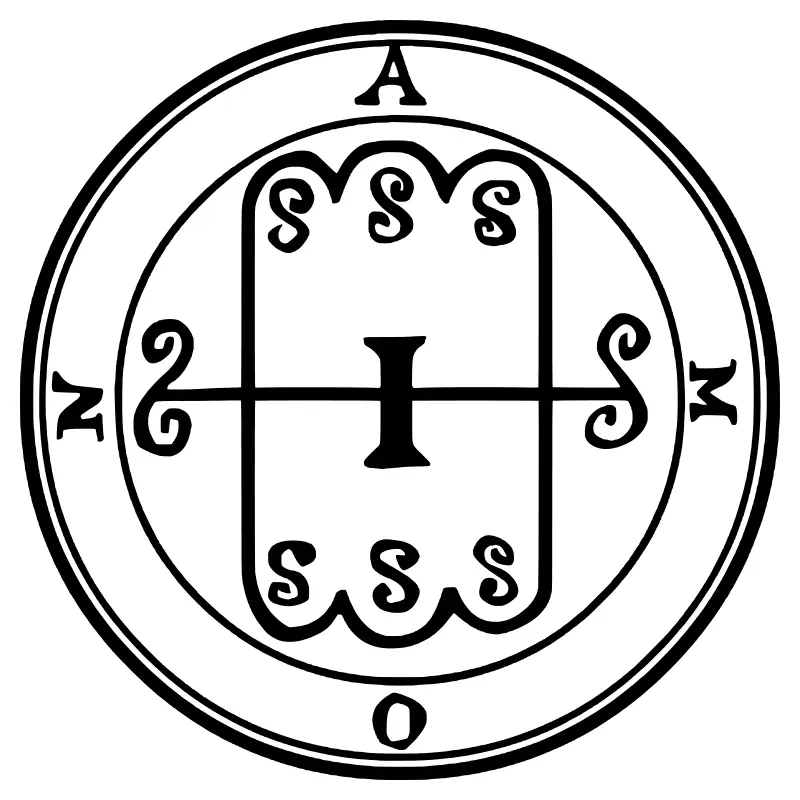
Amon. The Seventh Spirit is Amon. He is a Marquis great in power, and most stern. He appeareth like a Wolf with a Serpents tail, vomiting out of his mouth flames of fire; but at the command of the Magician he putteth on the shape of a Man with Dog’s teeth beset in a head like a Raven; or else like a Man with a Raven’s head (simply). He telleth all things Past and to Come. He procureth feuds and reconcileth controversies between friends. He governeth 40 Legions of Spirits. His Seal is this which is to be worn as aforesaid, etc.
Amon is “most stern”. He first appears as a wolf with a serpent’s tail, “vomiting out of his mouth flames of fire”, then takes a human shape with “Dog’s teeth beset in a head like a Raven”. The 1904 text offers two alternatives for this second form, which shows Mathers recording disagreement between his manuscripts. His offices are divination, “procureth feuds” and reconciling controversies between friends.
Appearance
Historical Amon is “a Marquis great in power, and most stern.” He appears “like a Wolf with a Serpent’s tail, vomiting out of his mouth flames of fire.” At the magician’s command he takes “the shape of a Man with Dog’s teeth beset in a head like a Raven; or else like a Man with a Raven’s head.”
Offices in the Ars Goetia
Historical The offices of Amon, in the order the 1904 text gives them:
- Tells all things past and to come.
- Procures feuds.
- Reconciles controversies between friends.
Source comparison: Weyer and Scot
Historical Weyer, in Scot’s English, gives “Amon, or Aamon,” “a great and mightie marques,” as a wolf with a serpent’s tail, “spetting out and breathing flames of fier.” In man’s shape “he sheweth out dogs teeth, and a great head like to a mightie raven.”
Weyer calls him “the strongest prince of all other,” a phrase the Goetia does not repeat. Both give 40 legions. Where the 1904 text has “procureth feuds,” Scot has “procureth favor” and Sloane 3825 “procureth love”; “feuds” is probably a misreading.
Historical Weyer’s Latin calls the bird “nycticorax”, the night raven, a nocturnal bird that most modern scholars take to be a night heron. It also gives him the line “princeps omnium fortissimus”, the strongest prince of all. The Latin office is “gratiam concilians omnium amicorum et inimicorum”, winning the favour of friends and enemies, which supports reading the 1904 “feuds” as an error for “favour”. (About Weyer and Scot.)
Name and etymology
Historical Weyer gives Amon vel Aamon. The resemblance to the Egyptian god’s name is discussed under later tradition below; the Goetia itself never mentions Egypt.
Seal and images
Historical The seal above is Amon’s as printed in 1904, and by the rules of the Observations it would be made in silver, the metal of his rank. Why seals were worn, why editions draw them differently and how to study one are explained in seals, circle and triangle.
Later tradition and modern practice
Later tradition The name resembles that of the Egyptian god Amun, often written Amon, and some modern writers identify the two. There is no evidence that the compilers meant to. The resemblance may be chance, or may reflect a learned borrowing of an exotic name.
Collin de Plancy’s Dictionnaire Infernal (1863 edition) shows Amon as a wolf with a serpent’s tail and an owl’s head.
Modern Amon also appears in many games and novels.
Lore about Amon’s personality, likes or chosen people is modern, not grimoire material; modern approaches explains where such claims come from.
Beginner’s quick reference
| Item | What the sources say |
|---|---|
| Rank metal and hours (Goetia) | Marquis: silver; 3 p.m. to 9 p.m., and 9 p.m. to sunrise. |
| Planet (later tradition: Golden Dawn and Crowley’s 777) | Moon. |
| Decan and day or night spirit (later tradition: 777) | Gemini, first decan (0 to 10 degrees); day spirit. 777 decan incense: “Mastick.” Tarot card of the decan: Eight of Swords. |
| Commonly reported color, incense, and plant (modern UPG; sources copy each other) | Color purple; incense jasmine; plant nightshade (reported in some sources; toxic: do not burn, ingest, or handle). |
| Associated symbols | Goetia image: a wolf with a serpent’s tail, breathing flame; later a man with a raven’s head and a dog’s teeth. 777 Magical Image: the same two forms. Le Breton engraving (1863): an owl-like head with tusks on a wolf’s body, with a serpent’s tail. Modern Demonolatry/UPG: the seal, used as an altar image. |
| Associated offerings | Modern practice, not in the Goetia manuscripts: most often listed, jasmine; one source adds cinnamon, galangal, and licorice root. |
Before you burn or handle anything listed for Amon, read incense, plants and offerings.
Practical notes
Amon is a marquis. His offices are divination, ending quarrels and, in the 1904 text, causing feuds, with no teaching office. He is not a good fit for a first study. I do not teach any work to cause feuds. If you are interested in reconciliation, ordinary conversation, mediation, and time are the tools I recommend.
In the directory, Amon is not among the 30 spirits that fit the beginner criteria.
Try this: one question to study
Copy the two human forms the 1904 text gives Amon and note which one matches Weyer’s “night raven”.
What next
To compare Amon with other spirits of his rank, read Samigina and Leraje.
Later tradition In the Golden Dawn scheme of the decans, Amon is the day spirit of the first decan of Gemini, which belongs to the Eight of Swords; the night spirit of the same decan is Sabnock (spirit 43).
Common questions
Is Amon a good spirit for beginners?
Not as a first choice. He does not meet all three beginner criteria I use: not a king, at least one teaching office, and no central harm, deception or compulsion. His entry is still worth reading as history.
What does Amon do in the Ars Goetia?
The 1904 text calls him a marquis ruling 40 legions. Its first office for him is this: Amon tells all things past and to come. The entry lists 3 offices in all.
Does looking at Amon's seal call him?
No. Reading a name or looking at a seal does not call a spirit. The seal is a drawing from a 1904 book, and even the grimoire itself required long rituals for its own purposes.
Get the free Mini-Grimoire
A short printable starter guide to tarot and everyday witchcraft, plus my newsletter. Unsubscribe any time.
Opens Substack in a new tab to confirm. More about the newsletter · Privacy