


How to read the labels Historical what the old sources say. Later tradition what later writers added. Modern modern practice and my own notes.
| Number | 5 of 72 |
|---|---|
| Rank | President |
| Legions | 36 |
| Office (1904) | Answers truly of things hidden or secret. |
| Other spellings | Barbas (Weyer, Scot) |
Spirit 5 of the Ars Goetia is Marbas. The 1904 edition by S. L. MacGregor Mathers and Aleister Crowley calls him a president ruling 36 legions, and the first office it gives him is this: Marbas answers truly of things hidden or secret.
He shows how the Goetia pairs harm and cure in one office, a way of thinking about spirits that was common in the sixteenth century. Each part below carries a label for its layer, explained in how to read a spirit page.
At a glance
| Fact | In the entry |
|---|---|
| Number | 5 of 72, in the 1904 order. |
| Name and spellings | Marbas in 1904; other spellings: Barbas (Weyer, Scot). |
| Rank and legions | President, 36 legions. |
| Metal of his rank (Observations) | Mercury. |
| Hours for presidents (Observations) | “At any time, excepting Twilight, at Night, unless the King whom they are under be Invocated.” |
| In Weyer’s catalog (1577) | Yes, as the source comparison below shows. |
The 1904 entry
Historical The full entry from the 1904 edition, with footnote numbers and the dash after the heading left out and the heading set in ordinary type:
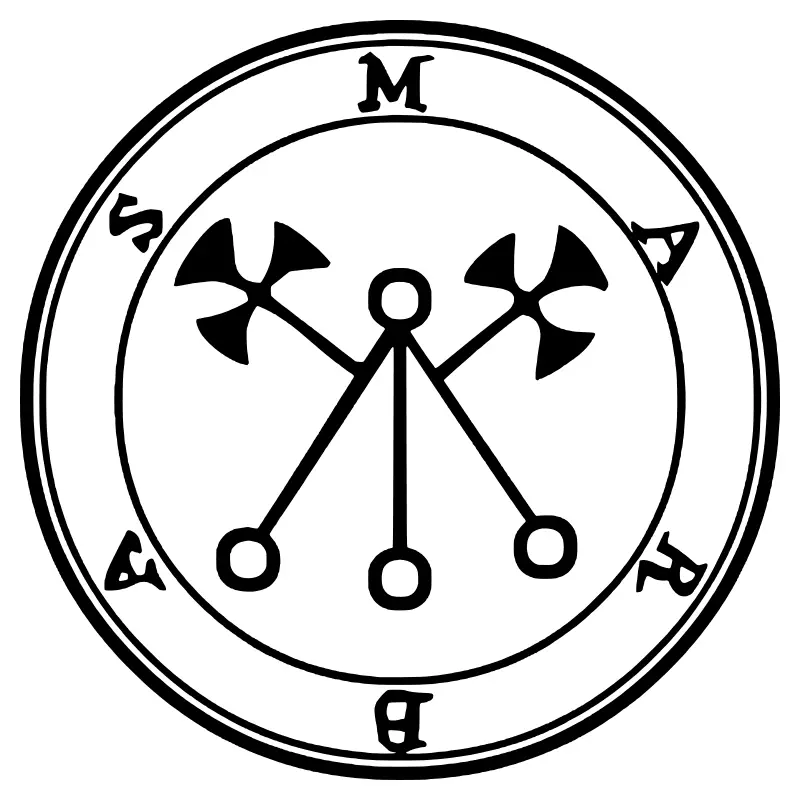
Marbas. The fifth Spirit is Marbas. He is a Great President, and appeareth at first in the form of a Great Lion, but afterwards, at the request of the Master, he putteth on Human Shape. He answereth truly of things Hidden or Secret. He causeth Diseases and cureth them. Again, he giveth great Wisdom and Knowledge in Mechanical Arts; and can change men into other shapes. He governeth 36 Legions of Spirits. And his Seal is this, which is to be worn as aforesaid.
Marbas begins as “a Great Lion” and takes human shape “at the request of the Master”. His offices are a mixed list: true answers about hidden or secret things, causing and curing diseases, “great Wisdom and Knowledge in Mechanical Arts” and changing men into other shapes. “Mechanical arts” meant the practical crafts, such as building, metalwork and weaving, as opposed to the liberal arts of the schools.
Appearance
Historical Marbas appears “at first in the form of a Great Lion,” then “at the request of the Master” puts on human shape.
Offices in the Ars Goetia
Historical The offices of Marbas, in the order the 1904 text gives them:
- Answers truly of things hidden or secret.
- Causes diseases and cures them. Reported as history; not taught here.
- Gives great wisdom and knowledge in mechanical arts.
- Can change men into other shapes. Reported as history; not taught here.
Source comparison: Weyer and Scot
Historical Scot’s Weyer gives “Marbas, alias Barbas” as “a great president” in the form of a mighty lion, who in man’s likeness “answereth fullie as touching anie thing which is hidden or secret.”
He “bringeth diseases, and cureth them,” promotes wisdom and “the knowledge of mechanicall arts, or handicrafts,” and changes men into other shapes. The Goetia follows Weyer closely. In Weyer, Marbas is third, not fifth, because Vassago and Samigina come earlier in the Goetia.
Historical Weyer gives “Marbas, alias Barbas” and says he “promovet sapientiam artiumque mechanicarum cognitionem”, promotes wisdom and the knowledge of mechanical arts. Scot added a gloss for English readers, “or handicrafts”. The Latin “morbos invehit et tollit”, brings in and takes away diseases, is the source of the Goetia’s “causeth Diseases and cureth them”. (About Weyer and Scot.)
Name and etymology
Historical The alias Barbas appears in Weyer and Scot. Neither form has a known meaning, and the switch between M and B may again be a copyist’s variant.
Seal and images
Historical The seal above is Marbas’s as printed in 1904, and by the rules of the Observations it would be made in mercury, the metal of his rank. Mercury is toxic, so a modern copy belongs on paper. Why seals were worn, why editions draw them differently and how to study one are explained in seals, circle and triangle.
Later tradition and modern practice
Later tradition The linking of disease and cure in one office is typical of early modern thinking about spirits and illness: a spirit able to cause an illness was thought able to remove it.
Modern Modern writers often present Marbas as a spirit of mechanics, engineering, and healing, following his offices. Some modern practitioners describe working with him on technical problems. These are modern applications.
Lore about Marbas’s personality, likes or chosen people is modern, not grimoire material; modern approaches explains where such claims come from.
Beginner’s quick reference
| Item | What the sources say |
|---|---|
| Rank metal and hours (Goetia) | President: mercury (toxic; never handle it); any time except twilight or night, unless his king is invoked (the wording is unclear). |
| Planet (later tradition: Golden Dawn and Crowley’s 777) | Mercury. |
| Decan and day or night spirit (later tradition: 777) | Taurus, second decan (10 to 20 degrees); day spirit. 777 decan incense: “Codamoms” (unidentified). Tarot card of the decan: Six of Pentacles. |
| Commonly reported color, incense, and plant (modern UPG; sources copy each other) | Color orange; incense storax; plant chicory. |
| Associated symbols | Goetia image: a great lion that later takes human shape. 777 Magical Image: the same image. Modern Demonolatry/UPG: the seal, used as an altar image. |
| Associated offerings | Modern practice, not in the Goetia manuscripts: most often listed, storax and chicory, then anise, cinquefoil, and thistle; one source adds teas and classical music. |
Before you burn or handle anything listed for Marbas, read incense, plants and offerings.
Practical notes
Marbas is a president, and his office of mechanical arts fits the beginner criteria. His offices of causing disease and changing shapes are not ones I teach. Do not use anything on this site in place of medical care, for yourself or anyone else. A question about learning a craft or skill suits a first contact with Marbas.
In the directory, Marbas is one of the 30 spirits that fit the beginner criteria.
Try this: one question to study
List which of Marbas’s offices are knowledge, which are harm and which are both, and notice how the text gives them equal weight.
What next
To compare Marbas with other spirits of his rank, read Buer and Botis.
Later tradition In the Golden Dawn scheme of the decans, Marbas is the day spirit of the second decan of Taurus, which belongs to the Six of Pentacles; the night spirit of the same decan is Focalor (spirit 41).
Common questions
Is Marbas a good spirit for beginners?
He is counted among the 30 of the 72 that fit the three beginner criteria I use: not a king, at least one teaching office, and no central harm, deception or compulsion. Even so, read his whole entry first, because nearly every entry is mixed.
What does Marbas do in the Ars Goetia?
The 1904 text calls him a president ruling 36 legions. Its first office for him is this: Marbas answers truly of things hidden or secret. The entry lists 4 offices in all.
Does looking at Marbas's seal call him?
No. Reading a name or looking at a seal does not call a spirit. The seal is a drawing from a 1904 book, and even the grimoire itself required long rituals for its own purposes.
Get the free Mini-Grimoire
A short printable starter guide to tarot and everyday witchcraft, plus my newsletter. Unsubscribe any time.
Opens Substack in a new tab to confirm. More about the newsletter · Privacy