


In this lesson: what divination is, how people practiced it from Babylon to Rome, and how I use it today as a tool for reflection.
Divination is the oldest question people ask with their hands: what is going on here, and what might happen next? Before you pick up a pendulum or a set of runes, it helps to know what divination is, how long people have practiced it, and what it can and cannot do for you. That knowledge keeps you curious and keeps you safe.
A very old human habit
The word comes from the Latin divinare, to foresee or to be inspired by a god. In the ancient world divination was not a fringe hobby. Babylonian scribes kept long collections of omens drawn from the sky, from the livers of sacrificed sheep and from everyday events, and kings consulted them before acting. Greek cities sent questions to the oracle at Delphi. Roman officials watched the flight of birds before public business could begin.
In 44 BCE the Roman statesman Cicero wrote a whole book, On Divination, in which his brother defends the practice and Cicero himself questions it. His brother sorts divination into two kinds, and the sorting is still useful. Natural divination comes to you unasked, through dreams or sudden inspiration. Artificial divination uses a method and a skill: reading signs, drawing lots, casting objects and interpreting the result. Almost everything in this course is the second kind, a method you can learn.
Divination around the ancient world
Historical Some of the oldest written records of divination come from Mesopotamia. Babylonian diviners practiced extispicy, reading the liver and entrails of a sacrificed sheep, and they collected thousands of omens in long reference works. The great astrological omen series Enuma Anu Enlil, compiled by the late second millennium BCE, lists signs in the sky and what they were thought to predict for the king and the land. Clay models of sheep livers, used to teach students, survive in museums such as the British Museum.
Historical In China, Shang dynasty diviners (about 1250 to 1050 BCE) heated ox shoulder blades and turtle shells until they cracked, then read the cracks and carved the question and answer on the bone. These oracle bones contain the earliest known Chinese writing. Later, the I Ching or Book of Changes became a classic of divination and philosophy, still used today.
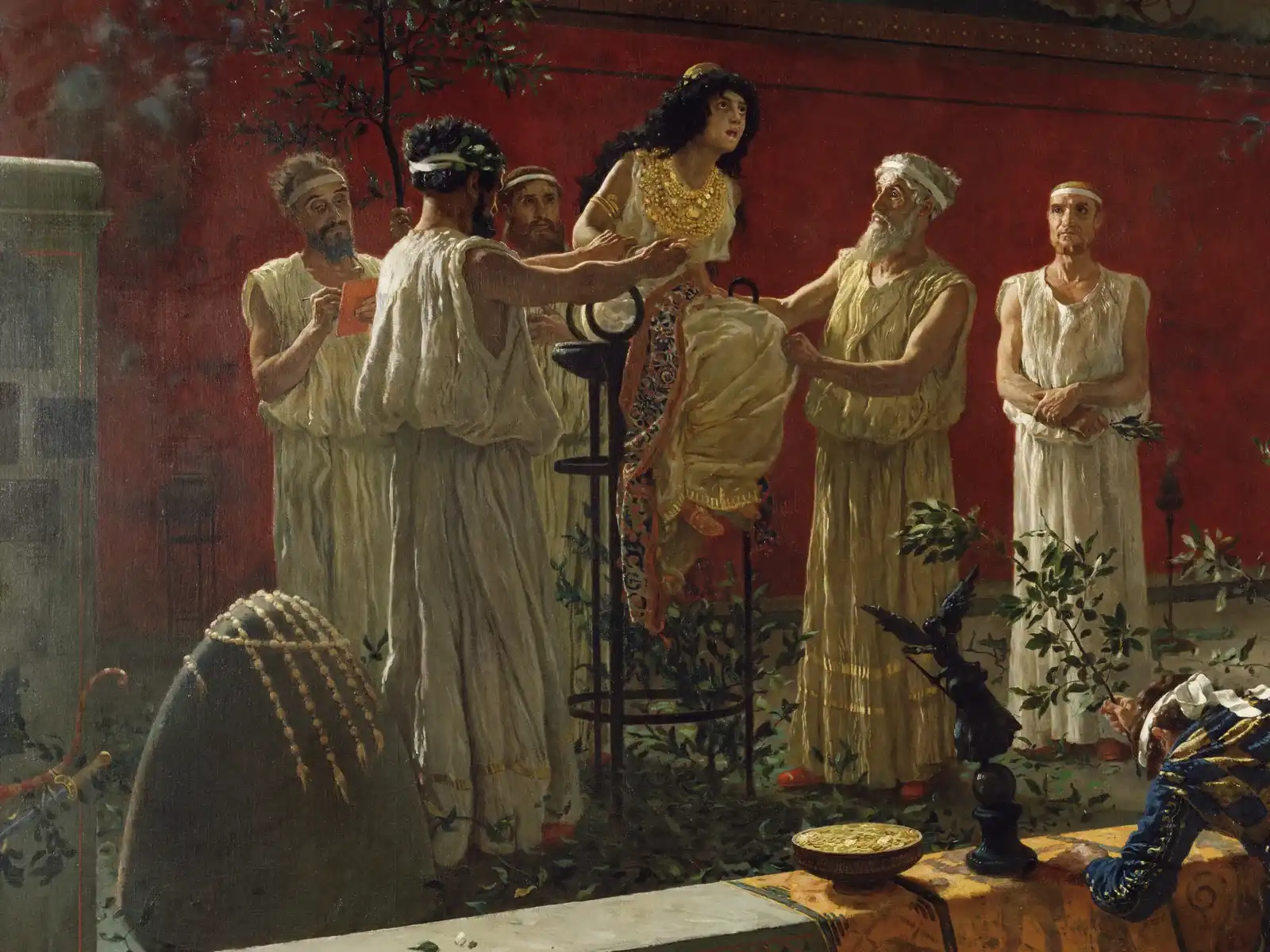
Historical In Greece, people traveled to oracles such as Delphi, where the priestess of Apollo, the Pythia, gave answers. In Rome, official augurs watched the flight of birds before public decisions, and haruspices, trained in Etruscan tradition, read entrails. The Roman historian Tacitus, in his Germania (98 CE, chapter 10), described Germanic peoples cutting a branch into slips, marking them with signs and drawing three at random. Divination is, in short, one of the most widespread human practices.
Skeptics in the ancient world too
Historical Doubt is just as old. The Roman statesman Cicero wrote On Divination (De Divinatione) in 44 BCE as a dialogue. His brother Quintus defends divination, and Cicero himself argues against it, pointing out lucky guesses, vague answers and the many failed predictions people forget. It is worth knowing that a careful beginner who asks “how would I know if this works?” stands in a two-thousand-year-old tradition.
What divination does in my practice
I do not treat divination as a machine that prints out the future. I treat it as a structured conversation. A random draw of runes or cards gives me a set of symbols I did not choose, and those symbols push me to look at my situation from an angle I would not have picked myself. The skill is in asking a good question, reading the symbols honestly and noticing what I feel when I read them.
People sometimes ask whether divination is against their religion. Some traditions forbid it, and others have their own forms, such as the casting of lots in the Bible. If you belong to a faith, read what your own tradition says and decide for yourself. Nothing in this course asks you to give up your beliefs.
That means divination works best for questions about yourself: your choices, your feelings, your next step. It works badly as a lie detector, a medical test or a way to spy on other people.
The most famous ambiguous answer
Historical The Greek historian Herodotus, writing in the fifth century BCE, tells a story that every diviner should know. Croesus, the wealthy king of Lydia, wanted to go to war against the Persians and sent to the oracles to ask whether he should. In G. C. Macaulay’s public domain translation of 1890, the oracles told him “that if he should march against the Persians he should destroy a great empire”. Croesus marched, and a great empire was indeed destroyed: his own.
Herodotus then lets the oracle answer back. Croesus, it says, “ought to have sent and asked further whether the god meant his own empire or that of Cyrus”. Whether or not the story happened as told, its lesson is timeless. An answer that sounds clear can carry two opposite meanings, and we tend to hear the one we want. A good diviner slows down, asks what else the answer could mean, and never stakes everything on a single reading.
An old joke from a sceptic
Historical Cicero’s On Divination also preserves a famous joke. In W. A. Falconer’s translation of 1923, Cicero says it “was quite a clever remark which Cato made many years ago: ‘I wonder,’ said he, ‘that a soothsayer doesn’t laugh when he sees another soothsayer.’” Two thousand years later it still makes me smile, and it is a healthy reminder. Taking divination seriously as a practice does not require taking every diviner, or every reading, at face value.
Natural and artificial divination, sorted
Cicero’s two kinds of divination make a useful sorting exercise. Take five things: a vivid dream, a tarot spread, a sudden gut feeling about a decision, a pendulum, and noticing a bird at your window on an important morning. The dream and the gut feeling arrive unasked, so they belong to natural divination. The tarot spread and the pendulum use a method you choose, so they are artificial divination. The bird is an interesting case: it arrives unasked, but reading it as an omen means applying a system of signs, so it sits between the two.
Sorting your own experiences like this helps you see what kind of practice suits you. Some people are drawn to methods with rules and structure; others pay most attention to dreams and intuition. Both are old, and both benefit from the same honest record-keeping.
Questions beginners ask
Is divination fortune-telling? It can be used that way, but many modern practitioners use it as a tool for reflection rather than prediction. In this course I treat it as a way to see a situation from new angles.
Is divination against my religion? Some religious traditions forbid it; others have their own forms, such as casting lots in the Hebrew Bible. Respect your own conscience.
Which method should I learn first? Choose one that appeals to you and is easy to get: playing cards, a pendulum or a dream journal. Lesson 7 helps you choose.
Do I need psychic powers? No. Most methods rely on symbols, attention and reflection.
Myths to drop: Divination is not only a “witch” practice; it existed in nearly every culture, including the official religions of Rome and China. Ancient diviners were often state officials, not outsiders. And a reading cannot tell you something certain about the future.
A worked example
Imagine you are deciding whether to sign up for an evening class. You could ask, “Will the class be good?” but any answer to that is a guess about the future. Instead you ask, “What do I need to understand about taking this class?” You draw one rune and get Raidho, the rune of the journey.
You read its meaning, then ask yourself what journey you are really on. Perhaps you notice the class is less about the subject and more about getting out of the house in winter. That insight came from you, prompted by the symbol. The decision is still yours.
Try this
Pick a real question from your week. Write it down as a yes-or-no question, then rewrite it as an open question that starts with “What do I need to see about…”. You do not need any tools yet. Just notice how the second version invites a richer answer, and keep both versions for lesson 6.
Journal prompts: What do I hope divination will help me with? Which ancient method fascinates me most? How will I keep track of whether readings help me?
A beginner’s worry, answered. “What if I get a frightening reading?” A reading is a set of symbols, not a sentence passed on your life. Write down what frightened you, then ask what practical step is in your hands. If a reading leaves you anxious for days, take a break from divination; it should help you think, not make you afraid.
A variation for your first week. Instead of choosing one method straight away, keep a “signs notebook” for seven days. Each evening, write down anything that felt like a sign: a dream, a song on the radio, a chance meeting. At the end of the week, read it back and notice which kind of sign you pay most attention to. That is a good clue to which method of divination will suit you.
Recap
Divination is a set of methods for reading signs, used across the ancient world from Babylon to Rome. Cicero split it into natural divination, which arrives unasked, and artificial divination, which uses a learned method. In this course we treat it as a structured way to reflect, best suited to open questions about your own life, not as a guaranteed forecast.
What next
My divination overview shows the methods side by side. If you already love tarot, the tarot learning hub goes deeper, and the runes hub is where we head in lesson 3. Next up: pendulums, and the honest science of why they move.
Further reading: Cicero, On Divination, in the Loeb Classical Library (public domain translations online). Sarah Iles Johnston, Ancient Greek Divination (Wiley-Blackwell, 2008). David N. Keightley, Sources of Shang History (University of California Press, 1978).
Sources
- Marcus Tullius Cicero, On Divination (De Divinatione), trans. W. A. Falconer (Loeb Classical Library, 1923; written 44 BCE).
- J. Gordon Melton (ed.), Encyclopedia of Occultism and Parapsychology (5th edition, Gale, 2001).
- Ulla Koch-Westenholz, Mesopotamian Astrology: An Introduction to Babylonian and Assyrian Celestial Divination (Museum Tusculanum Press, 1995).
Quick check
Go deeper: the tarot and runes pages on this site
Get the free Mini-Grimoire
A short printable starter guide to tarot and everyday witchcraft, plus my newsletter. Unsubscribe any time.
Opens Substack in a new tab to confirm. More about the newsletter · Privacy
Comments
Questions and notes from readers. Anyone with a free account can comment, and I reply when I can. Please read the community guidelines.
Comments load from Google Firebase (EU) when you ask for them. Nothing is stored on your device. Privacy