


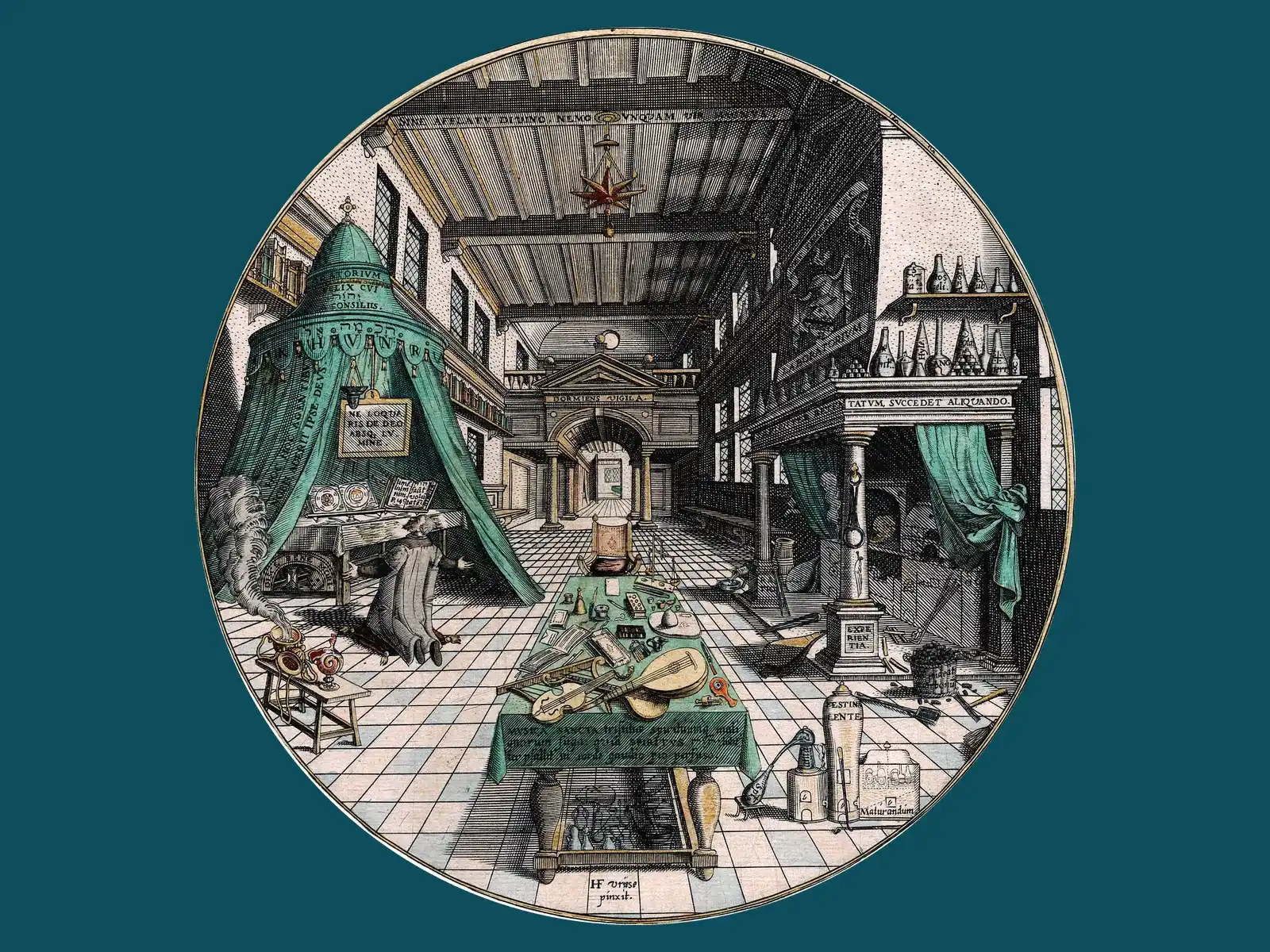
In this lesson: what the words occult and esotericism mean, how historians study them and the three labels used in this course.
Much of what you read about magic online begins with “since ancient times”. Sometimes that is true. Often it is not. This course gives you the real story of the Western esoteric traditions, from the Hermetic texts of Roman Egypt to modern witchcraft, so you can enjoy the history and spot a shaky claim. It starts with the words themselves.
Two words: occult and esotericism
“Occult” comes from the Latin occultus, hidden. In the Renaissance, “occult qualities” were simply forces you could not see, like magnetism. Only later did the word take on a spooky tone. “Esoteric” comes from the Greek esoterikos, belonging to an inner circle. Historians today prefer “Western esotericism” as the name for their field, because it sounds less sensational.
How historians define it
In the 1990s the French scholar Antoine Faivre proposed that esoteric thought shares a few typical features: the idea that everything in the universe corresponds to everything else, that nature is alive, that imagination and intermediaries such as angels or symbols connect us to higher realities, and that a person can be inwardly transformed. His Access to Western Esotericism (1994) made this definition famous.
The Dutch historian Wouter Hanegraaff took another route. In Esotericism and the Academy (2012) he argued that esotericism is best understood as the large body of ideas that mainstream religion, science and universities rejected over the centuries, from astrology and alchemy to magic. That does not make the ideas true or false. It explains why they were left out of the history books for so long. Since 1999 the University of Amsterdam has had a dedicated chair for this field, and serious academic study is now common.
The labels in this course
Like my other courses, I mark claims with three labels. Historical means there is good evidence from the period. Later tradition means a story or practice added later, often centuries after the event. Modern means practice of our own time, honest about its age.
Where the words came from
The vocabulary is younger than the ideas. In antiquity, writers sometimes called teaching meant only for insiders “esoteric”, and teaching for the general public “exoteric”. The satirist Lucian of Samosata, in the second century CE, used the pair when he joked about philosophers. Historical
The noun is much later. The French historian Jacques Matter used ésotérisme in 1828, in a book about ancient Gnosticism. “Occultism” appears in French in the 1840s and spread through Éliphas Lévi and his readers in the 1850s and 1860s. By the end of the nineteenth century, “occultism” was a word people chose for themselves, in magazines, lodges and bookshops. Historical
So when a modern book talks about “the occult”, it uses a word that the Renaissance would have understood as “hidden forces of nature”, and that the Victorians turned into the name of a movement. Keeping those two meanings apart already clears up a lot of confusion.
A field with a history of its own
Universities ignored this material for a long time, or treated it as a list of errors. That began to change in the twentieth century. In 1965 the École Pratique des Hautes Études in Paris created a chair for the history of Christian esotericism, first held by François Secret. Antoine Faivre held it from 1979. Historical
Faivre’s famous description has four main features and two extra ones. The four are correspondences, living nature, imagination and mediations, and the experience of inner transformation. The two extra features are the search for agreement between many traditions, and the idea that knowledge is passed on from teacher to student. A text does not need all six to count, and Faivre himself saw them as a tool, not a fence.
Later scholars pushed back. Wouter Hanegraaff, who took up the Amsterdam chair in 1999, stressed rejected knowledge. Kocku von Stuckrad suggested looking at how people talk about higher, secret knowledge rather than at a fixed list of features. Others, such as Egil Asprem and Julian Strube, ask whether “Western” is the right word at all, since these ideas travelled between Europe, the Middle East, India and the Americas. These are live debates. I mention them so that you know the definition is still being argued, not so that you have to pick a side.
The European Society for the Study of Western Esotericism was founded in 2005, and there are now journals, conferences and degree courses. You can read their work for free in many places, which makes this a wonderful subject to study on your own.
How historians study it
The working rule is called methodological agnosticism. It sounds technical, but it simply means this: a historian describes what people believed, did and wrote, without deciding whether the spirits, stars or hidden forces were real. That question is left open, because evidence from the past cannot settle it.
I find this rule freeing. It lets a believer, a sceptic and a curious beginner sit at the same table and read the same source. It also protects you. When a writer insists that history proves their magic works, or proves it is all nonsense, they have stepped outside history.
Questions beginners ask
Is esotericism a religion? Not one religion. It is a family of ideas and practices that show up inside Christianity, Judaism, Islam, paganism and secular life. Some people build religions from it, such as Theosophy or modern witchcraft. Others use parts of it with no religion at all.
Is “occult” the same as satanic or evil? No. The word means hidden. Most occult history is about astrology, alchemy, healing, philosophy and ritual. The link with evil comes mostly from religious polemic and from horror fiction.
Was it all secret? Much less than the word suggests. Agrippa, Lévi and Blavatsky printed their books and sold them. Some groups had oaths and grades, but the ideas mostly travelled openly in print.
Do I need to believe any of it to take this course? No. You only need curiosity and a notebook.
Myths to drop early:
- “An unbroken secret tradition since ancient Egypt.” Historians find many new beginnings, borrowings and revivals, not one chain. The idea of a single ancient wisdom is itself a Renaissance idea, called the “ancient theology”, which you will meet in the next lesson.
- “Scholars of the occult are either believers or debunkers.” Most try to be neither. Their job is to describe and date.
- “If it is old, it is true. If it is new, it is fake.” Age is a fact about history. It does not prove or disprove meaning.
A worked example
Imagine you read that “the tarot is the ancient Book of Thoth from Egypt”. Ask three questions. When does the evidence start? The earliest tarot decks come from fifteenth-century Italy. Who first made the claim? A French writer, Antoine Court de Gébelin, in 1781. Is there any Egyptian evidence? None. So the claim is a Later tradition: interesting, influential, and not ancient. That is the habit this course builds.
A second example: “the occult was always forbidden”
You will often read that occult knowledge was always persecuted and had to hide. Let me test that the same way. When does the evidence start? It depends on the topic. Astrology was taught at medieval universities such as Bologna, and court astrologers worked openly for kings and popes. Alchemy had famous patrons, including the Emperor Rudolf II in Prague. Ficino’s translation of the Hermetica was printed with the support of the Medici. Historical
Some practices really were dangerous to be accused of, above all harmful magic during the witch trials. So the honest answer is mixed: some things were forbidden, some were respectable, and the line moved over time. The phrase “always forbidden” turns a complicated history into a dramatic one. It is a Later tradition that many nineteenth-century occultists liked, because it made them heirs of persecuted sages.
When you meet a sweeping word such as “always”, “never” or “everyone”, slow down. That is usually where a claim needs a date.
A short timeline of the words and the field:
- Second century CE: Lucian jokes about “esoteric” and “exoteric” teaching.
- 1828: Jacques Matter uses the French noun ésotérisme.
- 1840s to 1860s: “occultism” appears in French and spreads with Éliphas Lévi.
- 1965: a chair for the history of Christian esotericism opens in Paris.
- 1994: Faivre’s Access to Western Esotericism appears in English.
- 1999: the Amsterdam chair opens.
- 2005: the European Society for the Study of Western Esotericism is founded.
Try this
Write down three things you have heard called “ancient” in witchcraft, tarot or magic. Next to each, guess a date and mark it Historical, Later tradition or Modern. Keep the list for lesson 7.
Journal prompts: What first drew you to the occult or to magic? Which word feels more comfortable to you, “occult” or “esoteric”, and why? Write down one claim you would love to be true and promise yourself to check it as kindly as one you doubt.
A third example, step by step: “the ancient Book of Shadows”
Let me run one more claim through the method, slowly, so you can copy the steps. The claim: “Witches have kept a Book of Shadows for centuries.” Step one, find the earliest evidence. The phrase “Book of Shadows” first appears in the circle of Gerald Gardner in England in the late 1940s or early 1950s, in the documents of what became Wicca. Step two, check what came before. Earlier centuries did have handwritten books of charms, recipes and rituals, kept by cunning folk and learned magicians, and some survive in libraries.
But they were not called Books of Shadows and were not part of a single witches’ religion. Step three, follow it forward. From Gardner’s circle the idea spread through Wicca and then to almost all modern witchcraft. Step four, label it. Handwritten books of magic are Historical. The idea that they formed one secret witches’ tradition is Later tradition.
The Book of Shadows as we know it is Modern. The result is not a debunking. It is a better story: an old habit of writing magic down, renamed and given new life in the twentieth century. You will find a longer trace of this kind in lesson 9.
Recap
“Occult” means hidden and “esoteric” means belonging to an inner circle. Faivre described esotericism by its typical features, such as correspondences and living nature, while Hanegraaff described it as the knowledge mainstream culture rejected. Historians now study it seriously. In this course, every claim gets a label: Historical, Later tradition or Modern.
What next
See the same labels at work in my history of witchcraft, history of the Goetia and history of tarot. For the visual side, try esoteric art. Next lesson: the Hermetica, where the story begins.
Further reading: Wouter J. Hanegraaff, Western Esotericism: A Guide for the Perplexed (Bloomsbury, 2013) is a short, readable starting point. Kocku von Stuckrad, Western Esotericism: A Brief History of Secret Knowledge (Equinox, 2005) and Antoine Faivre, Access to Western Esotericism (SUNY, 1994) show two different approaches.
Sources
- Antoine Faivre, Access to Western Esotericism (State University of New York Press, 1994).
- Wouter J. Hanegraaff, Esotericism and the Academy: Rejected Knowledge in Western Culture (Cambridge University Press, 2012).
- Nicholas Goodrick-Clarke, The Western Esoteric Traditions: A Historical Introduction (Oxford University Press, 2008).
Quick check
Go deeper: the art history and Goetia pages on this site
Get the free Mini-Grimoire
A short printable starter guide to tarot and everyday witchcraft, plus my newsletter. Unsubscribe any time.
Opens Substack in a new tab to confirm. More about the newsletter · Privacy
Comments
Questions and notes from readers. Anyone with a free account can comment, and I reply when I can. Please read the community guidelines.
Comments load from Google Firebase (EU) when you ask for them. Nothing is stored on your device. Privacy