


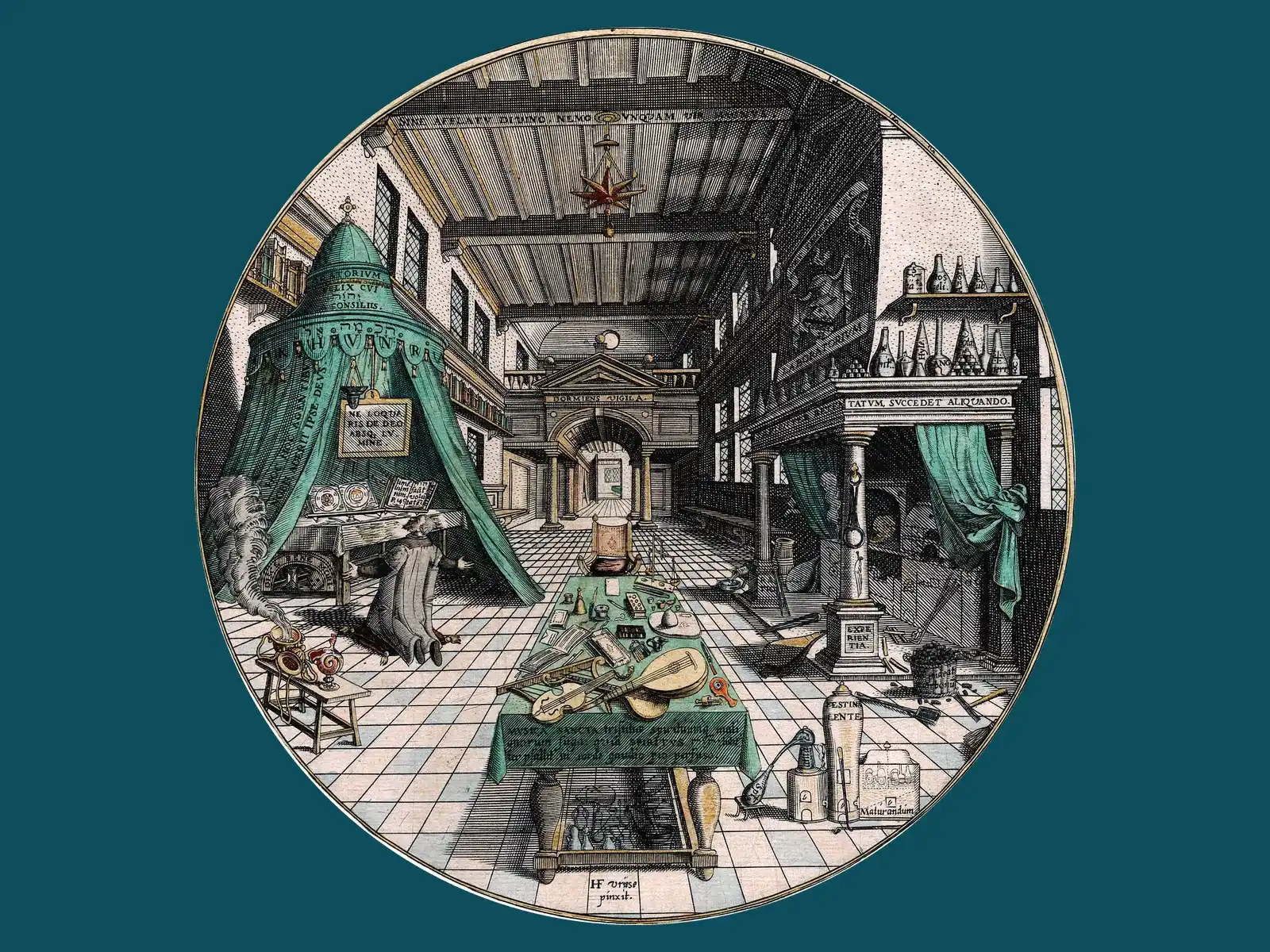
In this lesson: who Hermes Trismegistus was said to be, what the Hermetic texts say, when they were written and why Ficino mattered.
If Western esotericism has a founding library, it is the Hermetica: a group of texts written in Greek and Latin and attributed to a wise figure called Hermes Trismegistus, “thrice-great Hermes”. Phrases like “as above, so below” trace back to this tradition, and so does the idea that everything in the cosmos is connected. Knowing where these texts really come from is the first step in reading occult history well.
Who was Hermes Trismegistus?
He was not a historical person. In Hellenistic Egypt, Greeks identified their messenger god Hermes with the Egyptian god of writing and wisdom, Thoth. Over time a legendary sage emerged from that blend, said to have written books on astrology, magic and the nature of God. The historian Garth Fowden traces this figure in The Egyptian Hermes (1986).
What the texts are
The most famous collection, the Corpus Hermeticum, is a set of Greek dialogues in which Hermes teaches a student about the creation of the world, the nature of the soul and how a person can rise towards the divine. Another text, the Asclepius, survived in Latin and was known throughout the Middle Ages. Brian Copenhaver’s 1992 translation is the standard English version today. Scholars date the Greek texts to Roman Egypt, roughly the first to third centuries CE. Historical
The Emerald Tablet is a separate, much shorter text. Its earliest known version is in Arabic, from around the eighth or ninth century, and it entered Latin in the twelfth century. “That which is above is like that which is below” is a paraphrase of its opening lines. Historical
Ficino and Casaubon
In 1463, Cosimo de’ Medici asked the Florentine scholar Marsilio Ficino to stop translating Plato and translate the newly arrived Greek Hermetic manuscript first. Ficino believed Hermes was an ancient sage, older than Moses or nearly so. His Latin translation, printed in 1471, became a Renaissance bestseller. Then in 1614 the scholar Isaac Casaubon showed, from the language and ideas, that the texts were written in the Christian era, not in deep antiquity. The idea of a primeval Egyptian wisdom survived anyway. Later tradition
What the Hermetica actually teach
The texts are not spell books. Most of the Corpus Hermeticum is religious philosophy, written as conversations between a teacher and a student. In the first treatise, the Poimandres, the narrator falls into deep thought and meets Poimandres, a divine Mind, who shows him a vision of how the world came to be and how the soul returns upward through the planetary spheres. Historical
A few ideas come back again and again:
- God is one and beyond words, yet can be known through the beauty and order of the cosmos.
- The human being is a small world. We share in matter and in divine mind, so we can turn either way.
- Knowledge saves. The Greek word is gnosis, knowledge that changes you, not just information.
- The cosmos is alive and full of meaning. Stars, planets and nature are signs to read, not dead machinery.
The Asclepius adds a passage that later readers found thrilling and shocking. It describes Egyptian priests bringing statues to life by drawing divine powers into them. Medieval Christian writers, including Augustine in the fifth century, quoted this passage to warn against idolatry, which is one reason the text stayed famous. Historical
Two kinds of Hermetic texts
Historians often separate the philosophical Hermetica, like the texts above, from the technical Hermetica: works on astrology, alchemy, healing plants and magic that also carried the name of Hermes. Fowden argued that the two belong more closely together than older scholars thought, because the same Egyptian milieu produced both. You do not need to settle that. Just remember that “Hermetic” can mean a refined dialogue about the soul or a practical recipe, depending on the text.
In 1945, a jar of books found near Nag Hammadi in Upper Egypt included Coptic versions of Hermetic writings, among them a text scholars call The Discourse on the Eighth and Ninth. It describes a teacher leading a student into a vision. That find showed that Hermetic texts were read in Egypt alongside Christian Gnostic writings in the fourth century. Historical
The “ancient theology”
Why were Ficino and his readers so excited? Renaissance scholars believed in a prisca theologia, an ancient theology: a single true wisdom given to the earliest sages and passed down through Hermes, Orpheus, Pythagoras and Plato before Christ. If Hermes was older than Plato, then Plato’s best ideas, and some Christian ones, seemed to have been known in Egypt long before. That made Hermes a bridge between pagan learning and Christianity. Later tradition
Casaubon’s dating in 1614 broke that bridge for scholars, because it placed the texts after Christ. Yet the dream of one ancient wisdom never really died. You can see it in eighteenth-century Freemasonry, in Theosophy, and in many modern books that promise “the original teaching” of all religions.
Where “as above, so below” really comes from
The popular slogan is a shortened paraphrase. Medieval Latin versions of the Emerald Tablet say, in a common translation, that what is below is like what is above, and what is above is like what is below, to accomplish the miracles of the one thing. The tablet was read above all as a compressed recipe for alchemy. Its Arabic form appears in texts linked with the name Balinas, the Arabic form of Apollonius of Tyana, a first-century philosopher to whom many later works were credited. Historical
The short form “As above, so below” became a motto in nineteenth-century occultism and is everywhere today. I love it too. Just remember that the original sentence is longer, belongs to alchemy, and was not written by an Egyptian priest. Modern
Questions beginners ask
Is The Kybalion a Hermetic text? No. It was published in Chicago in 1908 by “Three Initiates” and draws on American New Thought. You will trace that claim in lesson 9.
Where can I read the Hermetica? Brian Copenhaver’s translation is the standard scholarly one. Older public domain translations, such as G. R. S. Mead’s from 1906, are online, but they use dated language and Theosophical notes.
Are the Hermetica Egyptian or Greek? Both, in a way. They are written in Greek, in Roman Egypt, by people who drew on Greek philosophy and on Egyptian religious ideas. Scholars still debate how much is Egyptian.
Did Hermetism have temples and priests? There is no firm evidence of a Hermetic church. The texts suggest small circles of teachers and students. Some passages mention prayers and a shared meal, which hints at quiet group practice.
Myths to drop:
- “Hermes Trismegistus was a real Egyptian king or priest.” He is a literary and religious figure.
- “The Hermetica are older than the Bible.” They date from the first to third centuries CE.
- “Hermeticism is the same as Gnosticism.” They overlap, but the Hermetica are generally kinder to the material world than many Gnostic texts.
A worked example
Imagine you see a quote online: “Hermes Trismegistus, the Egyptian priest who taught Moses, wrote: as above, so below.” Unpick it. Hermes was a legendary figure, not a priest. The idea that he taught Moses is a Renaissance belief that Casaubon disproved. “As above, so below” paraphrases the Emerald Tablet, an Arabic-era text. The idea is beautiful and worth thinking about. The framing is a Later tradition.
Try this
Find a free translation of the opening of the Poimandres, the first treatise of the Corpus Hermeticum, and read a page. Write three sentences: what it says, what it reminds you of and one question about the people who wrote it.
Journal prompts: Which Hermetic idea moved you most, and why? Is there a saying you live by that turned out to be younger or different than you thought? How does it feel to keep a beautiful idea while letting go of a myth about its age?
The opening of the Poimandres, in Mead’s words
Historical Reading a few lines yourself shows the tone of the philosophical Hermetica better than any summary. Here is the opening of the first treatise in G. R. S. Mead’s 1906 translation, now in the public domain: “It chanced once on a time my mind was meditating on the things that are, my thought was raised to a great height, the senses of my body being held back…
Methought a Being more than vast, in size beyond all bounds, called out my name and saith: What wouldst thou hear and see, and what hast thou in mind to learn and know?” The narrator asks who this is, and the answer comes: “I am Man-Shepherd (Poemandres), Mind of all-masterhood.” The narrator replies: “I long to learn the things that are, and comprehend their nature, and know God.”
Notice three things. The setting is a vision during meditation, not a ritual. The teacher is divine Mind itself. And the goal is to understand the nature of things and know God, which is a religious and philosophical aim. Mead’s English is deliberately old-fashioned, and his notes reflect his Theosophical views, so compare a line or two with Copenhaver’s modern translation if you can. The difference between the two versions is itself a lesson in how translation shapes meaning.
A practice variation: three translations, one sentence
Choose one sentence from the Hermetica, such as the opening above or the “as above” line of the Emerald Tablet. Find it in two or three translations: Everard (1650) for the Pymander, Mead (1906), Copenhaver (1992), or for the Tablet the medieval Latin and Isaac Newton’s English. Copy each version into your notebook, one under the other. Underline the words that change. Then write two sentences on what each translator seems to emphasize. Spending ten minutes this way teaches you more about the Hermetica than an hour of quotations on social media.
Recap
Hermes Trismegistus is a legendary sage born from the blending of Hermes and Thoth. The Greek Hermetic texts come from Roman Egypt in the first to third centuries CE, and the Emerald Tablet first appears in Arabic. Ficino translated the Corpus Hermeticum in 1463, and Casaubon dated it to the Christian era in 1614. The texts are historical; the myth of their great age is a later tradition.
What next
The idea that everything corresponds is the root of my correspondences page, and esoteric art shows how Hermetic ideas became images. Next lesson: magic in the Middle Ages and the Renaissance.
Further reading: Brian P. Copenhaver, Hermetica (Cambridge University Press, 1992) for the texts with notes. Garth Fowden, The Egyptian Hermes (1986) for the setting. Florian Ebeling, The Secret History of Hermes Trismegistus (Cornell University Press, 2007) follows the figure from antiquity to modern times.
Sources
- Brian P. Copenhaver, Hermetica: The Greek Corpus Hermeticum and the Latin Asclepius in a New English Translation (Cambridge University Press, 1992).
- Garth Fowden, The Egyptian Hermes (Cambridge University Press, 1986).
- Wouter J. Hanegraaff, Western Esotericism: A Guide for the Perplexed (Bloomsbury, 2013).
Quick check
Go deeper: the art history and Goetia pages on this site
Get the free Mini-Grimoire
A short printable starter guide to tarot and everyday witchcraft, plus my newsletter. Unsubscribe any time.
Opens Substack in a new tab to confirm. More about the newsletter · Privacy
Comments
Questions and notes from readers. Anyone with a free account can comment, and I reply when I can. Please read the community guidelines.
Comments load from Google Firebase (EU) when you ask for them. Nothing is stored on your device. Privacy