


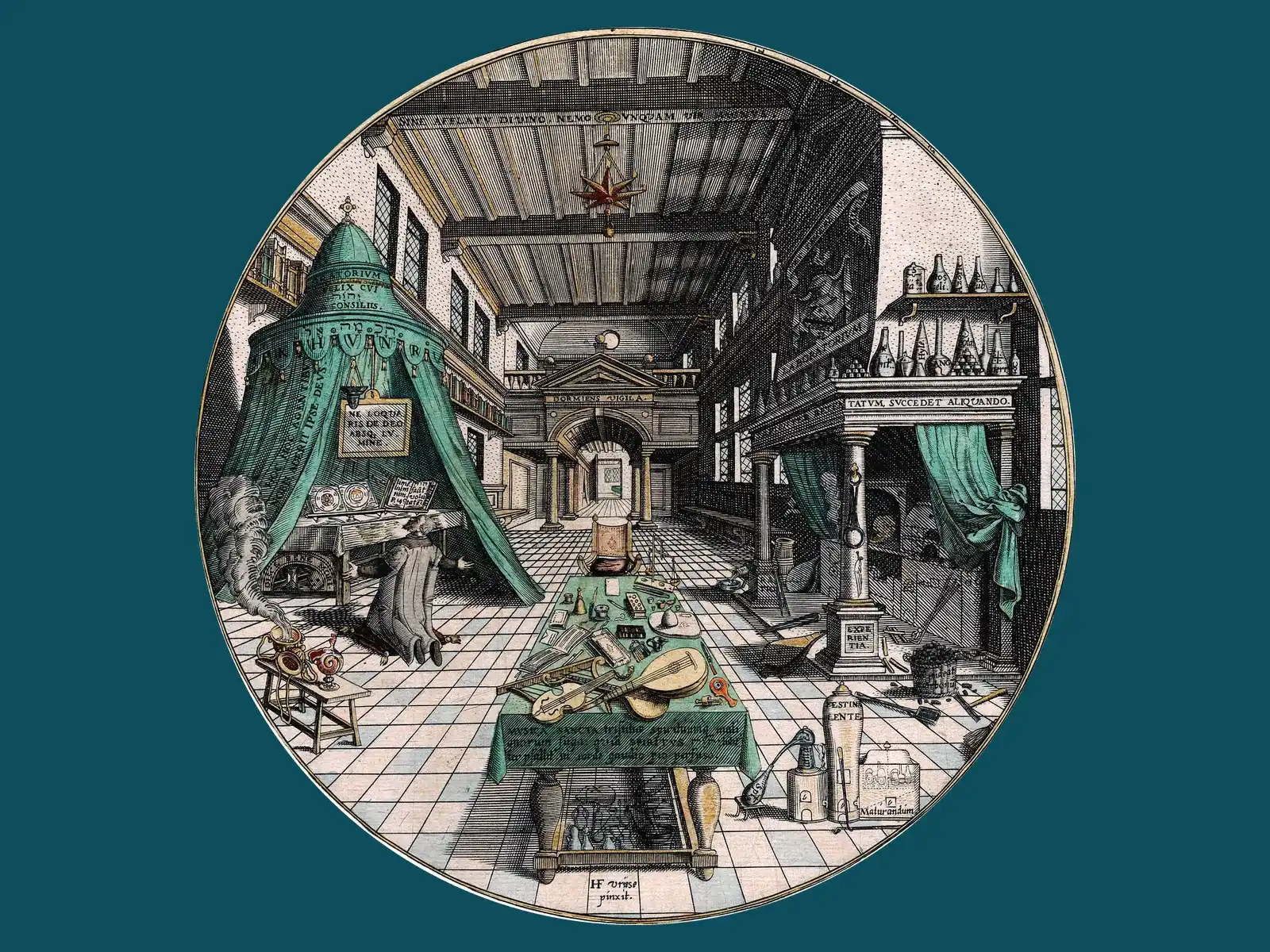
In this lesson: what alchemy really was, from Zosimos to Newton, and the story of the Rosicrucian manifestos of 1614 to 1616.
Alchemy and the Rosicrucians are where laboratory, symbol and secret society meet. Alchemical images of kings, queens, lions and dragons fill esoteric art, and the Rosicrucian legend shaped almost every magical order that came after. Both have real histories that are stranger and more interesting than the myths.
What alchemy was
Alchemy was an early form of chemistry with philosophical and religious dimensions. The earliest alchemical writings we can name come from Greek-speaking Egypt, especially Zosimos of Panopolis around 300 CE. The art passed into Arabic, where writers developed it further, and returned to Europe through Latin translations from the twelfth century onwards. Alchemists worked on transforming metals, making medicines and purifying substances. Paracelsus (1493 to 1541) turned alchemy towards medicine, and Isaac Newton wrote over a million words on alchemical subjects. Historical
The historian Lawrence Principe, who has recreated alchemical experiments in a modern laboratory, shows in The Secrets of Alchemy (2013) that many of the strange images were coded instructions for real chemical processes. The idea that alchemy was really only about inner, spiritual transformation became popular in the nineteenth century and later through Carl Jung. That reading has value, but it is a Later tradition layered over a practical art.
The long journey of alchemy
The word itself tells the story. “Alchemy” comes from the Arabic al-kīmiyā’, which goes back to a Greek word whose origin is still debated. Greek, then Arabic, then Latin: the art travelled through three languages before it reached early modern Europe. Historical
Greek-speaking Egypt. Zosimos wrote for a woman named Theosebeia and quoted earlier experts, including Maria the Jewess, whom he credits with apparatus for heating and distilling. A much later tradition links her name with the bain-marie, the water bath cooks still use. Zosimos also described dreams and visions, which is one reason later readers saw alchemy as spiritual.
The Arabic world. A large body of writings carries the name of Jābir ibn Ḥayyān. Many scholars think most of it was written by several authors across the ninth and tenth centuries. These texts taught that metals are made of two principles, sulphur and mercury, in different balances. The physician Abū Bakr al-Rāzī, who died around 925, described laboratory equipment and classified substances with great care. Historical
Latin Europe. A translation by Robert of Chester, traditionally dated 1144, is often counted as the first alchemical text in Latin. In the late thirteenth century, a Latin work called the Summa perfectionis appeared under the name “Geber”. The historian William Newman has argued it was written by a Franciscan, Paul of Taranto. It became a standard textbook for centuries.
What alchemists were trying to do
Alchemists had several goals, and most did not chase only gold:
- Transmutation, turning a base metal into silver or gold, usually with a “philosophers’ stone” that would perfect metals.
- Medicines, from distilled waters to strong mineral remedies. Paracelsus added a third principle, salt, to sulphur and mercury, and argued that chemistry should serve healing.
- Useful products, such as pigments, dyes, acids, perfumes and imitation gems.
Fraud was a real problem. Around 1317 Pope John XXII condemned alchemists who promised what they could not deliver. Satirists mocked the “puffers” who worked the bellows and burned their patrons’ money. At the same time, princes such as the Emperor Rudolf II in Prague funded serious work. Historical
Chymistry: when alchemy and chemistry were one
Historians Lawrence Principe and William Newman use the old spelling “chymistry” for the sixteenth and seventeenth centuries, when nobody separated alchemy from chemistry. Robert Boyle, often called a founder of modern chemistry and author of The Sceptical Chymist (1661), believed transmutation was possible and pursued it. Principe’s study The Aspiring Adept (1998) shows this in Boyle’s own papers. Historical
Newton fits here too. After his alchemical manuscripts were sold in 1936, the economist John Maynard Keynes bought many of them and wrote that Newton was “not the first of the age of reason” but “the last of the magicians”. Historians today prefer to see Newton as a serious experimenter for whom alchemy and natural philosophy were parts of one search.
The split came in the early eighteenth century. Writers began to use “alchemy” for gold-making fraud and “chemistry” for respectable science. That new story made alchemy look like a dead end, which is one reason its real contributions, from distillation to laboratory method, were forgotten.
Pictures and spiritual alchemy
The strange images you see online mostly come from the sixteenth and seventeenth centuries. The Splendor Solis, a richly painted sixteenth-century manuscript, shows kings, suns and flasks. Michael Maier’s Atalanta fugiens (1617) combines fifty emblems with short poems and musical fugues, so you can look, read and sing. The images worked as memory aids, as coded recipes and as meditations, all at once. Historical
In 1850 Mary Anne Atwood published A Suggestive Inquiry into the Hermetic Mystery, which read alchemy as a mystical path of the soul. In the twentieth century, Carl Jung’s Psychology and Alchemy (1944) read the images as symbols of the unconscious. These readings are meaningful, and I use them myself. But in a well-known 2001 article, Principe and Newman showed how they pushed the laboratory out of the story. Later tradition
The Rosicrucian manifestos
In 1614 a pamphlet was printed in Kassel called the Fama Fraternitatis, the Report of the Fraternity. It told of Christian Rosenkreuz, who travelled to the East, learned secret wisdom and founded a brotherhood whose members healed the sick for free. His tomb, it said, had been rediscovered after 120 years. A second manifesto, the Confessio, followed in 1615, and in 1616 The Chymical Wedding of Christian Rosenkreuz, an alchemical allegory. Johann Valentin Andreae, a Lutheran theologian, later said he wrote the Chymical Wedding and called it a ludibrium, a playful fiction.
Nobody has ever found evidence that the original brotherhood existed. But readers across Europe searched for it, and people founded Rosicrucian groups of their own, including the Order of the Golden and Rosy Cross in the eighteenth century and the Societas Rosicruciana in Anglia in 1865, whose members helped found the Golden Dawn. Frances Yates explored this in The Rosicrucian Enlightenment (1972), though some of her conclusions are now debated.
The Rosicrucian furore
The manifestos caused a sensation. Within a few years, hundreds of books and pamphlets answered them, some praising the brotherhood, some attacking it, and many writers asking to be admitted. The English physician Robert Fludd defended the fraternity in print from 1616, and Michael Maier did the same. In 1623 posters appeared in Paris claiming that Rosicrucians were invisibly present in the city, which caused a brief panic. Historical
Historians link the manifestos to a circle of Lutheran scholars in Tübingen around Andreae and his friend Tobias Hess. Their themes were a general reform of learning and religion, hope for a new age, and the union of Christian faith with natural knowledge. Read that way, the manifestos are less a secret society advert and more a utopian call for reform, wrapped in a story.
Twentieth-century groups such as the Rosicrucian Order AMORC, founded in the United States in 1915, and the Rosicrucian Fellowship, founded by Max Heindel in 1909, use the name and symbols today. None can show an unbroken link back to 1614. Modern
Questions beginners ask
Did anyone ever make gold? There are dramatic stories of transmutations, but none has been verified, and modern chemistry explains why it cannot be done with chemical means.
Was alchemy witchcraft? No. Alchemy was a learned, written and often expensive art practiced in workshops and courts. It overlaps with magic in its symbols, but it is a different history from the village witchcraft of the trials.
Is spiritual alchemy fake? No. It is a real modern practice with its own nineteenth and twentieth century history. It is simply not the whole of historical alchemy.
Can I join the original Rosicrucians? No evidence shows the original brotherhood existed. Modern groups exist and you can judge them on what they teach today.
Myths to drop:
- “Alchemy was only a failed attempt to make gold.” It was also medicine, technology and early chemistry.
- “Alchemy began in pharaonic Egypt.” The earliest named alchemical writings come from Greek-speaking Roman Egypt.
- “The Rosicrucians secretly ran Europe.” The manifestos were real. A secret ruling order is not supported by evidence.
A worked example
Imagine you see an alchemical emblem of a king and queen in a bath together. A spiritual reading might call it the union of opposites in the soul. Principe would point out that “king” and “queen” often stood for substances such as gold and silver or sulfur and mercury, and the bath for a solution in a vessel. Both readings can be true at once: a recipe and a symbol.
Try this
Write a short alchemical recipe for one change you want in your life, using three stages: dissolve what you are letting go of, purify what needs cleaning up and combine what you want to build. Label it Modern in your notes.
Journal prompts: Which of the three stages, dissolve, purify or combine, feels hardest for you right now? What is one change in your life that was both practical and inner at the same time, like a recipe and a symbol?
Newton’s Emerald Tablet
Historical Among Isaac Newton’s alchemical papers, now in King’s College, Cambridge, is his own English translation of the Emerald Tablet. It begins: “Tis true without lying, certain and most true. That which is below is like that which is above and that which is above is like that which is below to do the miracle of one only thing.”
Later lines describe the “one thing” in the language of alchemy: “The Sun is its father, the moon its mother, the wind hath carried it in its belly, the earth is its nurse,” and “Separate thou the earth from the fire, the subtle from the gross sweetly with great industry.” For Newton these were instructions to decode in the laboratory, not slogans. Reading them in his hand is a reminder that one of the founders of modern physics took alchemy seriously as a path to knowledge.
Recap
Alchemy was an early chemistry with spiritual dimensions, from Zosimos around 300 CE through the Arabic world to Paracelsus and Newton. Its images were often coded lab instructions; the purely spiritual reading is a later tradition. The Rosicrucian manifestos of 1614 to 1616 described a brotherhood nobody has found, yet they inspired real orders for centuries.
What next
You can see alchemical images in my esoteric art guide, and the four elements page shows how classical elements live on in modern practice. Next lesson: Kabbalah and its branches.
Further reading: Lawrence M. Principe, The Secrets of Alchemy (2013) is the best short history. William R. Newman and Lawrence M. Principe, Alchemy Tried in the Fire (University of Chicago Press, 2002) goes deeper. Christopher McIntosh, The Rosicrucians (revised edition, Weiser, 1997) tells the Rosicrucian story. The Science History Institute in Philadelphia has free online articles and images on alchemy.
Sources
- Lawrence M. Principe, The Secrets of Alchemy (University of Chicago Press, 2013).
- Anonymous (Rosicrucian manifesto), Fama Fraternitatis (Kassel, 1614; English trans. Thomas Vaughan, 1652).
- Frances A. Yates, The Rosicrucian Enlightenment (Routledge, 1972).
Quick check
Go deeper: the art history and Goetia pages on this site
Get the free Mini-Grimoire
A short printable starter guide to tarot and everyday witchcraft, plus my newsletter. Unsubscribe any time.
Opens Substack in a new tab to confirm. More about the newsletter · Privacy
Comments
Questions and notes from readers. Anyone with a free account can comment, and I reply when I can. Please read the community guidelines.
Comments load from Google Firebase (EU) when you ask for them. Nothing is stored on your device. Privacy