


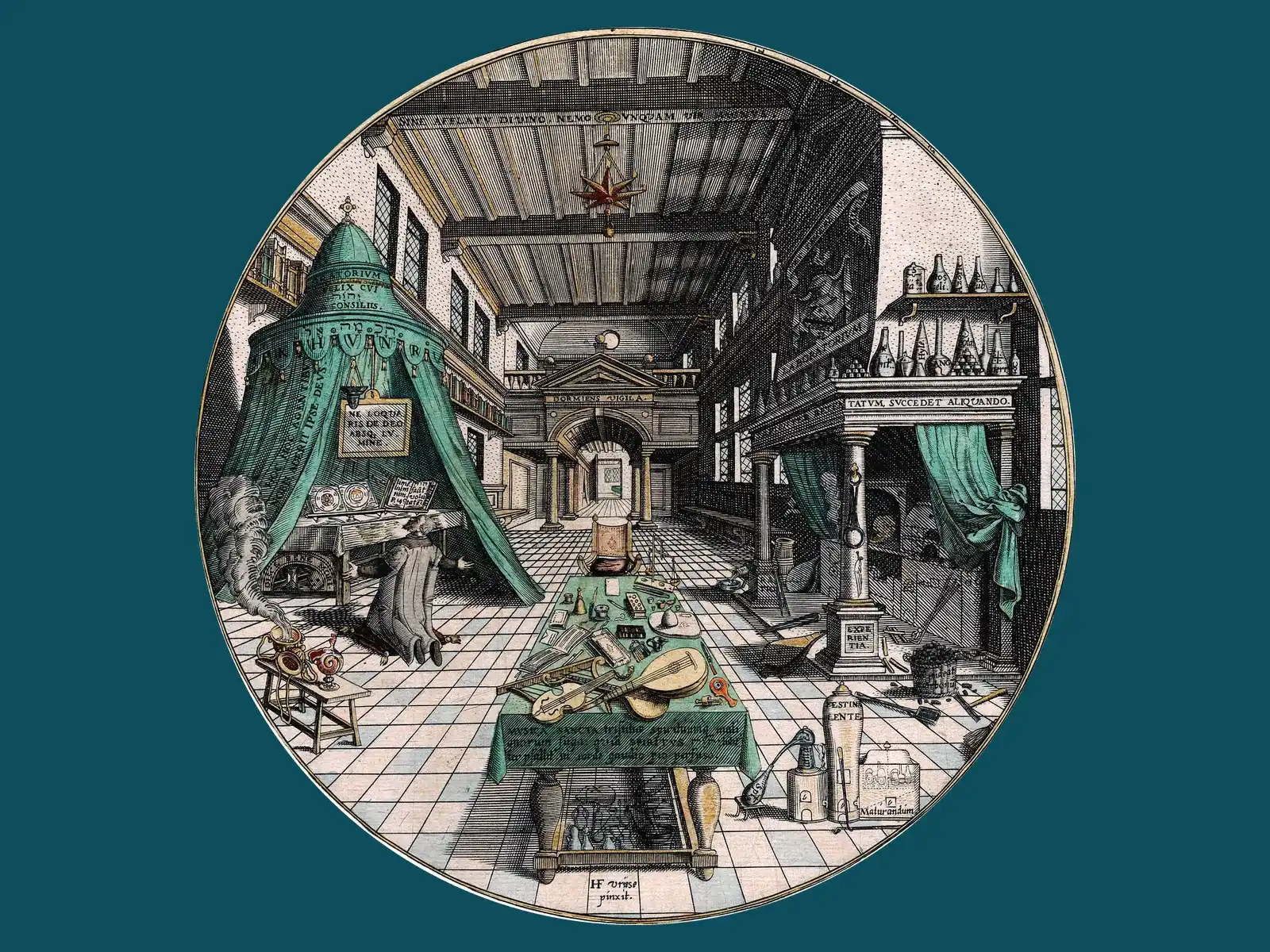
In this lesson: natural and demonic magic, the Picatrix, grimoires, Ficino, Agrippa and John Dee, and how magic and science met.
The Middle Ages and the Renaissance are where most of the grimoires, the famous books of magic, come from. They are also a time when magic, religion and early science overlapped in ways that surprise modern readers. Understanding this period explains a great deal about the Goetia, astrology and the magical images you see in art.
Two kinds of magic
The historian Richard Kieckhefer, in Magic in the Middle Ages (1989), shows that medieval writers commonly separated natural magic from demonic magic. Natural magic used the hidden properties of stones, herbs and stars, and many learned people thought it was a legitimate part of studying nature. Demonic magic worked by calling on spirits, and the Church condemned it. In practice the line was blurry, and that blurriness runs through the whole period. Historical
Books of magic
A great deal of medieval magic came to Europe from the Arabic world. The Picatrix, an Arabic book of astral magic known as the Ghayat al-Hakim, was translated into Spanish and then Latin at the court of King Alfonso X of Castile in the mid-thirteenth century.
Grimoires attributed to King Solomon circulated in manuscript, and the collection now called the Lemegeton, which includes the Ars Goetia, took shape in the seventeenth century. Owen Davies tells this story in Grimoires: A History of Magic Books (2009). The attribution to Solomon is a Later tradition, not evidence that the king wrote them.
The Renaissance magus
In fifteenth-century Florence, Marsilio Ficino wrote Three Books on Life (1489), which taught how to draw on the influence of the planets through music, scents and images. His friend Giovanni Pico della Mirandola combined Hermetic and Kabbalistic ideas. In 1533 Heinrich Cornelius Agrippa printed his Three Books of Occult Philosophy in full, an encyclopaedia of correspondences, numbers, seals and spirits that later magicians plundered for centuries. In England, John Dee (1527 to 1608 or 1609) was a mathematician and royal adviser as well as a magician. For these men, magic was part of understanding the whole of creation.
Who actually did magic?
When we picture medieval magic, we often picture a lonely wizard. The sources suggest something more ordinary. Richard Kieckhefer described a “clerical underworld”: young men with some church education, who could read Latin and copy texts, and who passed around books of conjuration. A fifteenth-century Latin manuscript now in Munich, which Kieckhefer edited and translated in Forbidden Rites (1997), contains rituals for finding treasure, gaining love and calling spirits. It shows that these books were made and used by literate people inside Christian culture. Historical
Ordinary people used a different kind of magic. Charms for toothache, blessings on cattle, protective prayers and simple divination were everywhere, and many of them borrowed the words of the Church. Historians now treat this everyday magic as part of lived religion rather than as a separate secret world.
Learned books and their reputations
Several famous titles appear in this period:
- The Ars notoria, “the notory art”, from the thirteenth century, promised fast learning and a good memory through prayers and diagrams. Thomas Aquinas criticized it, which tells us it was well known. Historical
- The Sworn Book of Honorius, dated by scholars to the thirteenth or fourteenth century, describes ritual purification and a vision of God, alongside the calling of spirits.
- The Picatrix, already mentioned, taught how to make talismans at the right astrological moment. Its Arabic original is usually dated to the tenth or eleventh century in al-Andalus.
These books were dangerous to own. In 1277 the bishop of Paris, Étienne Tempier, condemned a long list of teachings and also books of necromancy and invocation. Yet the condemnations themselves prove that the books circulated. Many survive today in church and university libraries, which is one reason we can study them. Historical
Natural magic and the road to science
Natural magic was a respectable idea for a long time. In 1558 the Neapolitan scholar Giambattista della Porta published Natural Magic, which he later expanded to twenty books in 1589. It mixes optics, magnets, perfumes, cooking tricks and invisible ink. To a modern reader it looks half like a science book and half like a party guide. To della Porta, it was all the study of nature’s hidden powers. Historical
This is the background to the long debate about magic and the rise of science. In the 1960s, Frances Yates argued that the Hermetic tradition encouraged a new confidence in human power over nature. Many historians now think she overstated the case. Still, it is true that people such as Johannes Kepler cast horoscopes and that the line between “occult” and “experimental” was drawn much later than we imagine.
Agrippa, Trithemius and Dee in more detail
Agrippa wrote the first draft of his Occult Philosophy around 1510 and sent it to the abbot Johannes Trithemius. Its three books follow the three worlds of Renaissance thought: the elemental world of nature, the celestial world of stars and numbers, and the intellectual world of angels and God. In 1530, before the full edition appeared, Agrippa also published a book attacking the vanity of all sciences, magic included. Historians still argue about how to read a man who wrote both. Historical
Trithemius wrote the Steganographia around 1500. It looks like a manual for sending messages by angels, but large parts are a disguised system of secret writing. It was printed only in 1606 and was put on the Catholic Index of forbidden books soon after.
John Dee wrote the Monas Hieroglyphica (1564), a single symbol meant to sum up the cosmos, and a famous preface to the first English Euclid (1570). In the 1580s he worked with Edward Kelley, who scried in a crystal or a polished stone while Dee wrote down the angelic messages. A black obsidian mirror linked with Dee, made in Aztec Mexico, is now in the British Museum. His records were printed in 1659 by Meric Casaubon, the son of the Isaac Casaubon you met in lesson 2. Historical
Questions beginners ask
Were magicians burned as witches? Rarely. Most people executed in the witch trials were ordinary villagers accused of harming neighbors, not scholars with grimoires. Learned magicians did face church courts and occasionally harsh punishment, but the witch trials are a different story, which my witchcraft course tells.
Was Giordano Bruno burned for magic? Bruno was executed in Rome in 1600 after a long trial. Yates presented him as a Hermetic magus. Historians today stress his theological and cosmological heresies. Magic was part of his thought, but it is too simple to say he died for it.
Can I read these books today? Yes. Many are edited and translated, and digitised manuscripts are free online. Treat ritual instructions as history to study, not as recipes to follow.
Myths to drop:
- “Agrippa wrote the Fourth Book of Occult Philosophy.” A fourth book appeared under his name after his death and is generally regarded as spurious.
- “Enochian is the ancient language of the angels, older than Hebrew.” It comes to us from Dee and Kelley’s sessions in the 1580s. Believers and sceptics disagree about its source, but its documented history begins there.
- “The Church destroyed every magic book.” Some books were burned, but a remarkable number survived, often in church libraries.
A worked example
Imagine you look at Albrecht Dürer’s engraving Melencolia I (1514). A winged figure sits surrounded by tools, a polyhedron, a magic square and a bell. Knowing about Ficino helps: he linked melancholy with Saturn and with intellectual genius, and the magic square in the engraving is a kind traditionally associated with Jupiter, a planet thought to soften Saturn. The picture becomes a meditation on genius, gloom and the limits of knowledge, rooted in Renaissance magical thought.
Try this
Find a large image of Dürer’s Melencolia I and list five objects that a Renaissance viewer might connect with Saturn, geometry or magic. Then read my artwork page on it and see how many you spotted.
Journal prompts: Which figure from this lesson would you most like to have dinner with, and what would you ask? Where do you draw your own line between natural and spiritual magic, and has that line moved over the years?
Agrippa in his own words
Historical The first chapter of Agrippa’s Three Books of Occult Philosophy, in the English translation of 1651 by “J. F.”, usually identified as John French, sets out the whole plan of the work. It begins: “Seeing there is a three fold World, Elementary, Celestiall, and Intellectuall, and every inferior is governed by its superior, and receiveth the influence of the vertues thereof…”
Wise men, Agrippa says, “conceive it no way irrationall that it should be possible for us to ascend by the same degrees through each World.” He then explains the three books: “the first contains naturall Magick, the second Celestiall, and the third Ceremoniall.”
Read slowly, this short passage contains the core of Renaissance magic. The universe is a ladder of worlds. Higher things pour their powers, called “virtues”, into lower things. And the magician climbs the ladder through natural philosophy and medicine, then astrology and mathematics, then religious ceremony. Notice that Agrippa presents magic as a learned discipline that includes what we would call science and religion. This is why historians call it “occult philosophy” and not simply spellcraft.
A second worked example: a charm in a manuscript
Imagine you open a digitized fifteenth-century English manuscript and find a charm for toothache, written in Latin and English among medical recipes. It invokes a saint, includes a short prayer and tells the reader to write certain words on a piece of parchment. Using this lesson, you can place it: this is ordinary, practical magic of the kind Kieckhefer describes, shared between clergy and laypeople, mixed with medicine and religion. It is not demonic magic, not a grimoire and not a secret tradition. Writing that sentence in your notebook is exactly how historians work.
Recap
Medieval writers separated natural magic, based on hidden properties of nature, from demonic magic, though the line blurred. Books like the Picatrix brought Arabic astral magic into Latin, and Solomonic grimoires circulated in manuscript. Renaissance thinkers such as Ficino, Pico, Agrippa and Dee treated magic as part of understanding creation.
What next
My Goetia history, King Solomon and Lemegeton pages follow the grimoires further, and the Melencolia I page decodes the engraving. Next lesson: alchemy and the Rosicrucians.
Further reading: Richard Kieckhefer, Magic in the Middle Ages (Cambridge University Press, 1989; new edition 2014). Owen Davies, Grimoires: A History of Magic Books (Oxford University Press, 2009). Glyn Parry, The Arch-Conjuror of England: John Dee (Yale University Press, 2011).
Sources
- Richard Kieckhefer, Magic in the Middle Ages (Cambridge University Press, 1989).
- Owen Davies, Grimoires: A History of Magic Books (Oxford University Press, 2009).
- Heinrich Cornelius Agrippa, Three Books of Occult Philosophy (Cologne, 1533).
Quick check
Go deeper: the art history and Goetia pages on this site
Get the free Mini-Grimoire
A short printable starter guide to tarot and everyday witchcraft, plus my newsletter. Unsubscribe any time.
Opens Substack in a new tab to confirm. More about the newsletter · Privacy
Comments
Questions and notes from readers. Anyone with a free account can comment, and I reply when I can. Please read the community guidelines.
Comments load from Google Firebase (EU) when you ask for them. Nothing is stored on your device. Privacy