


You already know a short history of the cards from module 1. In this lesson you turn that history into a practice. You build a timeline you can keep in your notebook, you compare one card across three famous decks, and you meet tarot in its first and still living role: a card game. Knowing where each layer comes from makes you a calmer, more honest reader.
Five dates worth knowing
Historical Tarot began in northern Italy in the fifteenth century as a pack of ordinary suit cards with an extra suit of picture cards called trionfi, “triumphs”. The earliest written mentions date from 1440 and 1442. The luxurious hand-painted Visconti-Sforza cards were made for the ruling families of Milan in the mid-fifteenth century. By the 1600s a cheaper woodcut pattern was printed in France, and it became known as the Tarot de Marseille. For more than three hundred years these cards were used to play trick-taking games.
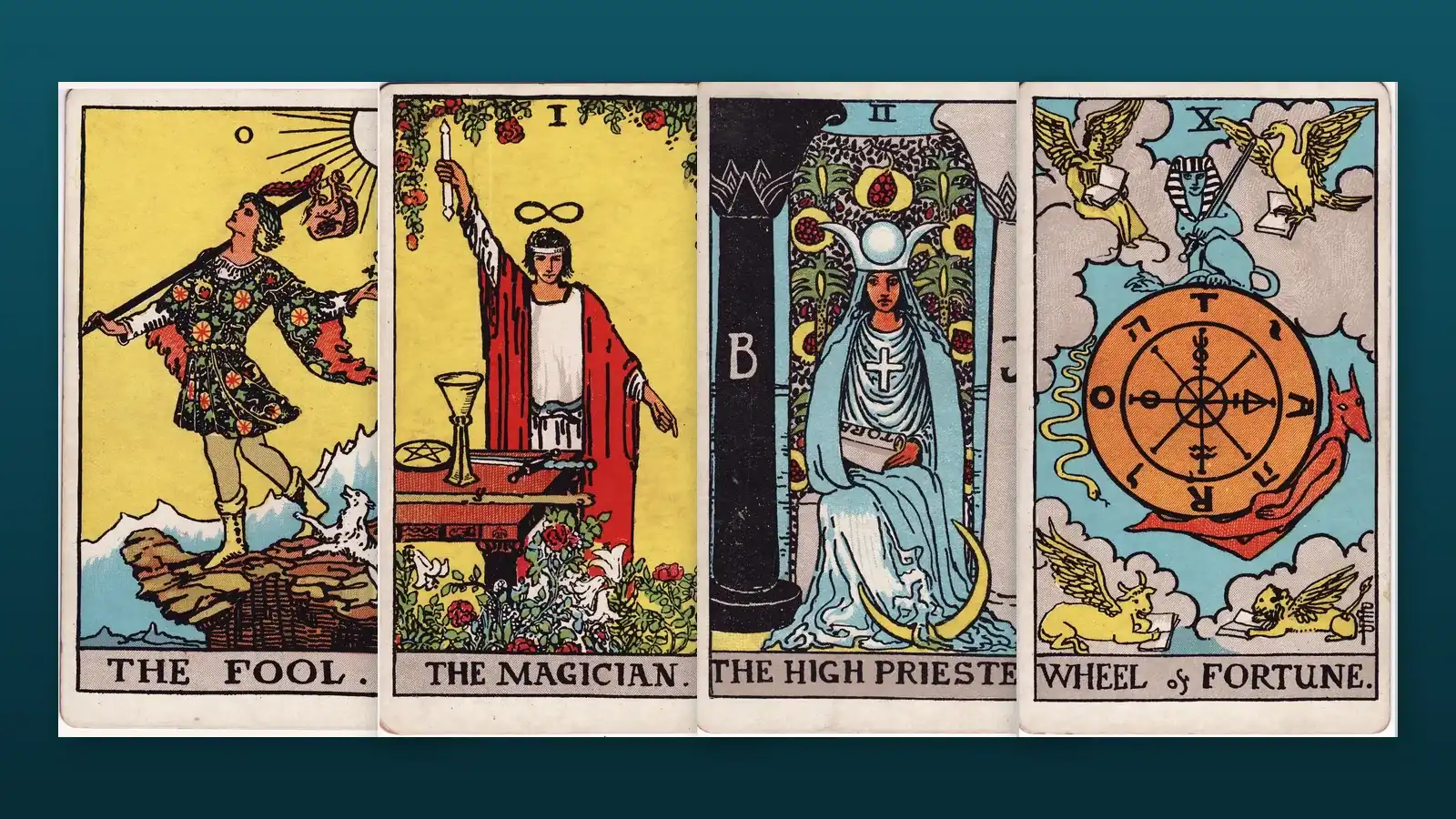
Later tradition In 1781 Antoine Court de Gébelin claimed in Le Monde primitif that tarot preserved the wisdom of ancient Egypt. Nobody could read hieroglyphs yet, so the claim could not be checked. In the 1780s Etteilla published the first tarot made for fortune telling. In 1909 Pamela Colman Smith drew a new deck to A. E. Waite’s design, the first popular deck with a full scene on every minor card.
Modern The Egyptian story is a myth, but it shaped how people see the cards. Most readers today learn on the Waite-Smith deck or a deck based on it, and many of the “traditional” meanings you will read were fixed in Waite’s 1910 book. That does not make them wrong. It makes them about a century old, which is worth saying honestly.
The earliest mentions, in more detail
Historical The two earliest written mentions of trionfi cards are worth knowing. In 1440 a Florentine merchant named Giusto Giusti noted in his diary that he had given a pack of trionfi cards to Sigismondo Malatesta, the lord of Rimini. In 1442 the account books of the court of Ferrara record the purchase of carte da trionfi.
Within a few decades, decks had spread to Milan, Bologna and other cities, each with its own order of trumps. The surviving hand-painted decks of the Visconti and Sforza families are luxury objects; ordinary players used cheaper printed decks, very few of which survive, because cards were used until they wore out.
How the game is played
Historical Tarot games are trick-taking games, like whist or bridge. Players must follow the suit that is led; if they cannot, they must play a trump, and the highest trump wins the trick. The Fool works as an “excuse”, which can be played instead of following suit. At the end, players count points for the cards they have won, with the highest trump, the lowest trump and the Fool usually worth the most. The rules vary from country to country, and some games are played with fewer cards.
Tarot is still a game
Historical In France, Austria, Hungary, Denmark, Italy and elsewhere, tarot games never stopped. French tarot is played with the full 78-card pack by three to five players. The trumps outrank the suits, the Fool works as “the Excuse” that lets you skip following suit, and points come from the cards you win. Card historians such as Michael Dummett showed how old and widespread these games are. If you ever play a round, you are using the cards in their oldest way.
Your timeline practice, step by step
What you need: your tarot notebook, a pen, about forty minutes, and a device to look at free museum and library images of old decks. Work through the steps over one or two sittings.
- Draw a line across a double page and mark 1440, 1500, 1650, 1781, 1909, 1944 and today.
- Under each date write one event from this lesson, in your own words.
- Choose one card you love or find hard, such as the Fool, Death or the Star.
- Find that card in a Visconti-Sforza deck, a Marseille deck and the Waite-Smith deck, using museum or library images.
- For each version write three things you see before you read any meaning.
- Write what was added and what disappeared between the decks.
- Finish with one sentence: which meaning of this card depends on the 1909 picture?
Journal prompts: Which “ancient” claim about tarot did you believe before this course, and where did you first meet it? Does knowing the cards were a game change how seriously you take a hard card? Which deck’s version of your chosen card speaks to you most, and why?
Where tarot is played today
Historical The game is very much alive. In France, jeu de tarot is a popular family and club game, and the Fédération Française de Tarot, founded in 1973, organizes competitions. The cards used for it, often called Tarot Nouveau, show scenes of nineteenth-century daily life on the trumps instead of allegories, and many French players have never thought of tarot as fortune-telling at all.
In Austria and parts of central Europe, games called Tarock are played with a 54-card deck, and in Hungary a game called Tarokk is traditional. In Italy, a few towns still play old tarocchi games with regional decks. If you ever have the chance to learn one, it is a lovely way to meet the cards as their first users did.
Modern A common beginner question is whether using the cards for a game disrespects them. Historically it is the opposite: the game came first. Another question is whether you can learn the game with your reading deck. You can, though dedicated game decks are easier to handle. A myth to drop is that the game was a cover for secret teachings; there is no evidence for this, and the game sources talk about points, not mysteries.
How tarot history gets corrected
Historical Tarot history is not finished. Ideas that seemed certain a century ago have been revised as scholars checked the records. Waite’s own book shows this happening. In The Pictorial Key to the Tarot (1910) he wrote: “Now it is well known that in the year 1393 the painter Charles Gringonneur… designed and illuminated some kind of cards for the diversion of Charles VI of France”.
He then described seventeen beautiful painted cards in Paris, with “a background of gold”, which some writers had linked to Gringonneur, and noted that this link “was disputed so far back as the year 1848”.
Today those cards, kept at the Bibliothèque nationale de France and often called the “Charles VI” tarot, are generally thought to be Italian work from the fifteenth century, not the cards made for the French king. A royal account of the early 1390s does record a payment to Gringonneur for painted cards, but nothing shows they were tarot. The story is a good example of how a famous object can carry the wrong label for a long time.
Reading history like a detective
When you meet a date or claim about tarot’s past, ask three simple questions. What is the source? A diary, an account book or a surviving deck is stronger evidence than a later writer’s opinion. How close is the source to the event? A record written at the time beats a story told three centuries later. Has anyone checked it recently? Older books, including Waite’s, can be out of date. Modern card historians have done a great deal of careful work in museum and archive collections.
This habit protects you from repeating myths, and it makes history more fun. Each date on your timeline becomes a small detective story rather than a fact to memorize.
Practice variations
Add a source line. For each date on your timeline, write one short note on the kind of evidence behind it: “diary”, “surviving deck”, “printed book”, “legend”. You will quickly see which parts of the story are well supported and which are not.
The museum visit, online. Many museums and libraries publish high-quality images of old cards. Choose one collection, look at five cards closely and write three things you notice about each: colors, clothing, materials, signs of wear. Old cards were handled and played with, and the wear tells part of their story.
Tell it to a friend. Explain tarot’s history to someone in two minutes, without notes. If you can do it clearly, you understand it. If you stumble, return to your timeline and find the gap.
A beginner’s question: “Does it matter if I get a date slightly wrong?” Not much for reading, but it is worth correcting your timeline when you learn better. Updating your notes is exactly what historians do.
A worked example
A learner picks Death. In the Visconti-Sforza card she sees a skeleton with a bow. In the Marseille card a skeleton mows a field with a scythe, and the card has a number but often no name. In the Waite-Smith card Death rides a white horse past a fallen king, a bishop and a child, and the sun rises between two towers.
Her line reads: “The sunrise and the idea of a new dawn come from the 1909 picture. The old cards simply show death.” She adds that this makes her trust the card more, not less, because she knows which part is a modern teaching image.
Try this
Choose one card, such as the Fool, Death or the Star. Find it in a Visconti-Sforza deck, a Marseille deck and the 1909 Waite-Smith deck, and write one line for each: what you see, what was added and what was left out.
Recap
Tarot began as an Italian card game around 1440 and is still played. The Egyptian story dates from 1781, fortune-telling decks from the 1780s and the deck most of us use from 1909. A timeline and a three-deck comparison help you see which meanings are old and which are modern.
What next
Press “Mark as done” and continue with Reading a Marseille-style deck. For more pictures and dates, read my history of tarot and the tarot art history page.
Further reading: Michael Dummett, The Game of Tarot (Duckworth, 1980). The International Playing-Card Society publishes rules and history online.
Sources
- Antoine Court de Gébelin, Le Monde primitif, analysé et comparé avec le monde moderne, volume 8 (Paris, 1781).
- A. E. Waite, The Pictorial Key to the Tarot (London: Rider, 1910).
- Michael Dummett, The Game of Tarot: From Ferrara to Salt Lake City (London: Duckworth, 1980).
Quick check
Go deeper: the tarot history and deck pages on this site
Get the free Mini-Grimoire
A short printable starter guide to tarot and everyday witchcraft, plus my newsletter. Unsubscribe any time.
Opens Substack in a new tab to confirm. More about the newsletter · Privacy
Comments
Questions and notes from readers. Anyone with a free account can comment, and I reply when I can. Please read the community guidelines.
Comments load from Google Firebase (EU) when you ask for them. Nothing is stored on your device. Privacy