


Many beginners pick up a Marseille-style deck, see four cups or seven swords and no story, and put it back in the box. You do not need to. You already have the tools from module 4: numbers and suits. In this lesson you learn to read pip cards with them, and you practice step by step until a card with no scene starts to talk.
What makes a Marseille deck different
Historical The Tarot de Marseille is a family of woodcut decks printed in France from the seventeenth century, later named after the port where several famous makers worked. Its 56 suit cards show arranged suit symbols, called pips, with decorative flowers and vines, and only the court cards show people. The 22 trumps are close to the ones you know, with a few differences. In many Marseille decks Justice is VIII and Strength is XI, the card numbered XIII often has no name, and the Fool is unnumbered.
Modern Reading the pips through number and suit is a modern method, shaped by twentieth-century readers. The same method also works for playing cards, so you are learning a skill you can carry to other decks.
Historical A few names are useful if you start comparing Marseille decks. One of the oldest surviving complete decks of this kind was made by Jean Noblet in Paris around 1650. Jean Dodal of Lyon printed a famous version in the early 1700s, roughly between 1701 and 1715.
Nicolas Conver of Marseille printed his deck in 1760, and it became the model that many later printers copied. In 1997 the card maker Philippe Camoin and the filmmaker Alejandro Jodorowsky published a restored version, which is popular with readers today. Each version differs a little in colors, faces and small details, which is part of the fun of comparing them.
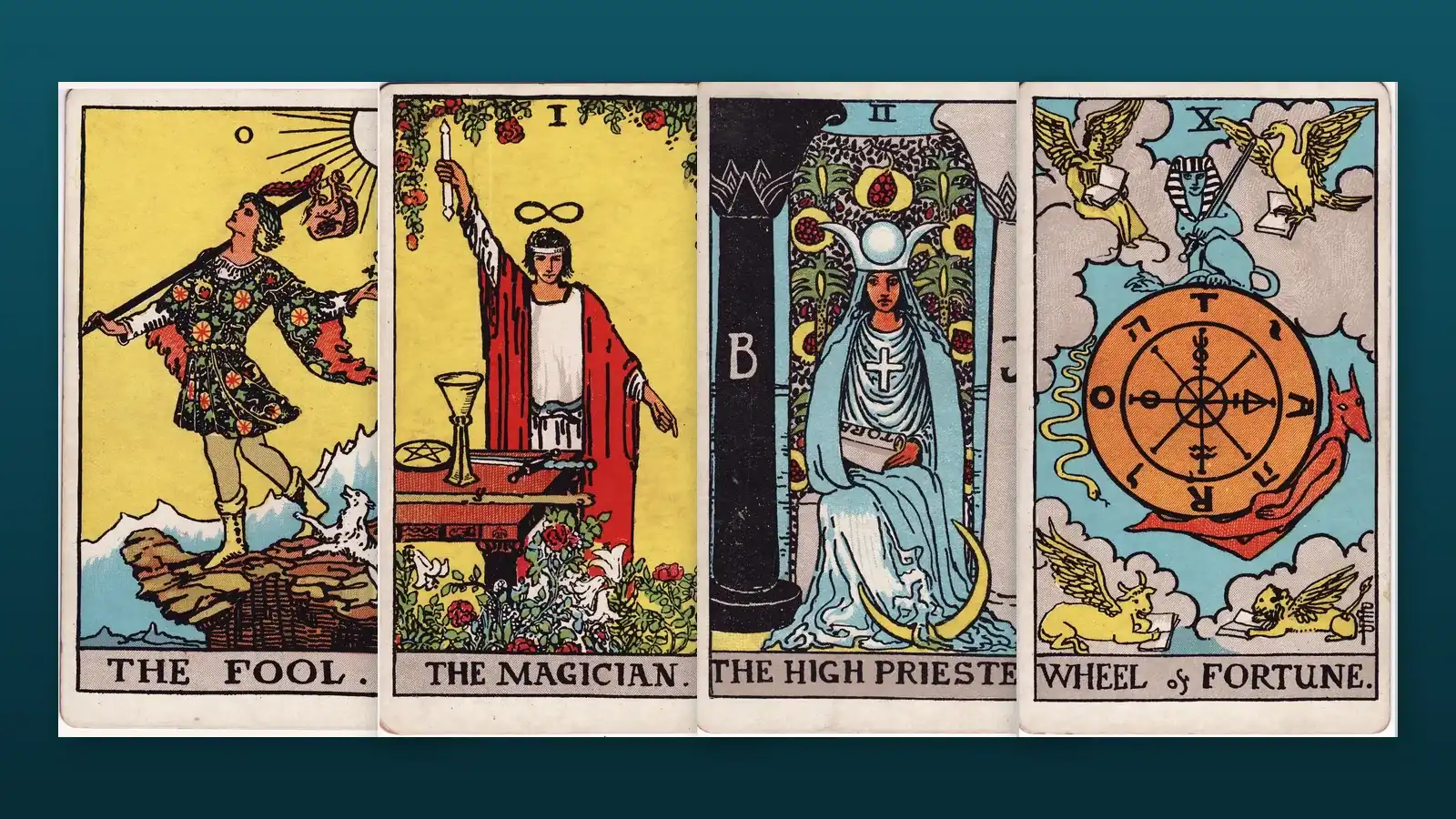
Historical The trumps also differ from the Waite-Smith deck in a few places. In most Marseille decks Justice is VIII and Strength is XI, the reverse of Waite’s order. Death is usually left unnamed on card XIII. The Fool is unnumbered. Titles are in French, such as Le Bateleur for the Magician and La Maison Dieu for the Tower, and the spelling can be old-fashioned or simply mistaken, because woodcutters copied what they saw. None of this changes how you read; it just means you look twice before assuming a number.
Number plus suit
Modern Give each number one keyword, as you did in module 4: Ace a seed, Two a choice or pair, Three growth, Four stability, Five challenge, Six harmony, Seven testing, Eight movement, Nine nearly there, Ten completion. Give each suit one keyword too: Batons or Wands are energy and work, Cups feelings, Swords thoughts and conflict, Coins or Pentacles the body, money and home.
Join them into a sentence. The Five of Cups becomes “a challenge in feelings”, which you then shape to the question. Look at the design as well: crossed swords feel tense, a flower growing through the middle of the cups feels like something alive.
Your Marseille practice, step by step
What you need: a Marseille-style deck if you have one, or free images online; your notebook; a pencil; and twenty minutes a day for a week. If you only own a Waite-Smith deck, cover the scenes with a sticky note and look only at the number of suit symbols.
- Write your ten number keywords and four suit keywords on one page.
- Each day, draw one pip card from the suit cards only.
- Before you read anything, count the pips and note the pattern: crossed, stacked, in a circle or with a flower.
- Join the number and suit keywords into one sentence.
- Add one word for the pattern, such as tight, open or growing.
- Ask a simple question, such as “What do I need to notice today?”, and answer it with your sentence.
- In the evening, write one line about whether the card’s idea showed up in your day.
- On day seven, read back the week and circle any keyword that kept being useful.
Journal prompts: Which suit felt hardest without pictures, and why? Did any card mean something different from the Waite-Smith picture you remember? What did the pattern of pips add that the number alone did not?
Beginner questions about Marseille decks
Modern A common question is whether Marseille readers use reversals. Some do, and some prefer to read the direction the figures face, linking cards by where the faces look. Another question is whether you need to learn the pips by heart. You do not; number plus suit gives you a starting meaning in seconds, and over time the patterns become familiar faces. People also ask whether the Waite-Smith meanings apply. Many readers borrow them as a starting point, but be careful not to read a scene into a card that does not show one.
Modern A myth to drop is that Marseille decks are “more authentic” or more magical than later decks. They are older, and that is interesting, but no deck has a monopoly on meaning. Another myth is that the pips are impossible for beginners. With the method in this lesson, many people find them restful, because there is less to interpret and more room for their own words.
A second worked example, with a pair
Imagine a reader draws the Two of Coins and the Nine of Cups for a question about money and pleasure. In many Marseille decks the Two of Coins shows two large coins linked by a flowing ribbon. Two is a choice or a pair, and Coins are the material world: “juggling two practical things”.
Nine is near completion and Cups are feelings: “nearly full contentment”. Her sentence is “If I keep balancing the two practical things, contentment is close.” She notices that the ribbon looks like a figure of eight and writes the word “flow” in her notebook. It becomes her reminder to keep things moving rather than deciding everything at once.
Even Waite read the pips this way
Historical It may surprise you that Waite, whose deck gave every card a scene, described the plain pip cards in exactly the way this lesson does. In The Pictorial Key to the Tarot (1910) he wrote that the smaller cards “depend on the particular meaning attaching to their numbers in connexion with the particular suit.” Number plus suit was the method long before Smith drew her scenes, and her pictures were one artist’s way of showing it.
Reading the patterns of the pips
Marseille pip cards are not random arrangements. Their designs follow traditional layouts that you can learn to read.
Swords are usually drawn as curved blades that weave into an oval, with a straight sword through the middle on odd numbers. Notice whether the center is open or crossed.
Wands are drawn as long crossed batons, often with a single upright staff on odd numbers. Notice how tightly they cross.
Cups are stacked in rows, sometimes with leaves and flowers growing between them. Notice whether there is room between the cups or whether they crowd each other.
Coins are set in neat geometric patterns, often with plant designs between them, and the Two of Coins carries a flowing ribbon, often with the maker’s name or date on it.
These details give you a third layer beyond number and suit: a feeling of space, tension, growth or order. A crowded Nine of Cups might feel abundant; an open Four of Coins might feel calm and steady.
Practice variations
Pip sketching. Choose one pip card a day and sketch its pattern roughly in your notebook. You do not need any drawing skill. Sketching forces you to notice how the symbols are arranged, which is the key to reading them.
Compare two makers. If you can, look at the same pip card in two Marseille-style decks, such as a Conver-style and a Noblet-style version. Small differences in flowers or spacing can change how a card feels.
Pips and scenes. Lay a Marseille pip card beside the same card from a Waite-Smith deck. Ask whether Smith’s scene matches the feeling of the pips. Sometimes it does closely, and sometimes she added a story the pips do not suggest.
A beginner’s question: “Will I ever read pips as easily as scenes?” Yes, with practice. Many readers who learn both say the pips eventually feel freer, because no single picture limits what a card can mean.
Reading the Marseille trumps
The Marseille trumps have figures, so you can read them much as you read Waite-Smith Majors, with a few adjustments. Read by title rather than number where the two decks differ, especially Justice and Strength. Look at the directions the figures face, since many Marseille readers link cards by gaze. And notice the strong, flat colors of the woodcut tradition. Red, blue, yellow and flesh tones repeat across the deck, and some readers give them simple meanings of their own, such as action, feeling and light.
A worked example
A reader draws the Seven of Swords from a Marseille deck. She counts seven swords: six curved blades forming an oval and one straight sword through the middle. Seven is testing, Swords are thoughts. Her sentence is “my thinking is being tested”, and the single straight sword in a ring of curved ones suggests “one clear idea among many tangled ones”. Her question was about a work email, so she writes: “Find the one clear point and say it plainly.” That evening she notes that the shorter email worked.
Try this
Take the four Fives from any deck, or look at them online in a Marseille deck. For each, write the number keyword, the suit keyword and one sentence that joins them, before you look at any book meaning.
Recap
Marseille decks show pips instead of scenes on the minor cards. Number plus suit, plus a word for the pattern, gives you a clear reading. A week of daily practice is enough to feel comfortable, and the same skill works with any deck.
What next
Press “Mark as done” and continue with The Thoth deck and choosing a second deck. Revisit numbers and elements whenever a pip card puzzles you.
Further reading: Yoav Ben-Dov, Tarot: The Open Reading, on reading Marseille decks.
Sources
- A. E. Waite, The Pictorial Key to the Tarot (London: Rider, 1910), for the comparison with the scenic minor cards.
- Michael Dummett, The Game of Tarot: From Ferrara to Salt Lake City (London: Duckworth, 1980), on the Marseille pattern.
Quick check
Go deeper: the tarot history and deck pages on this site
Get the free Mini-Grimoire
A short printable starter guide to tarot and everyday witchcraft, plus my newsletter. Unsubscribe any time.
Opens Substack in a new tab to confirm. More about the newsletter · Privacy
Comments
Questions and notes from readers. Anyone with a free account can comment, and I reply when I can. Please read the community guidelines.
Comments load from Google Firebase (EU) when you ask for them. Nothing is stored on your device. Privacy