


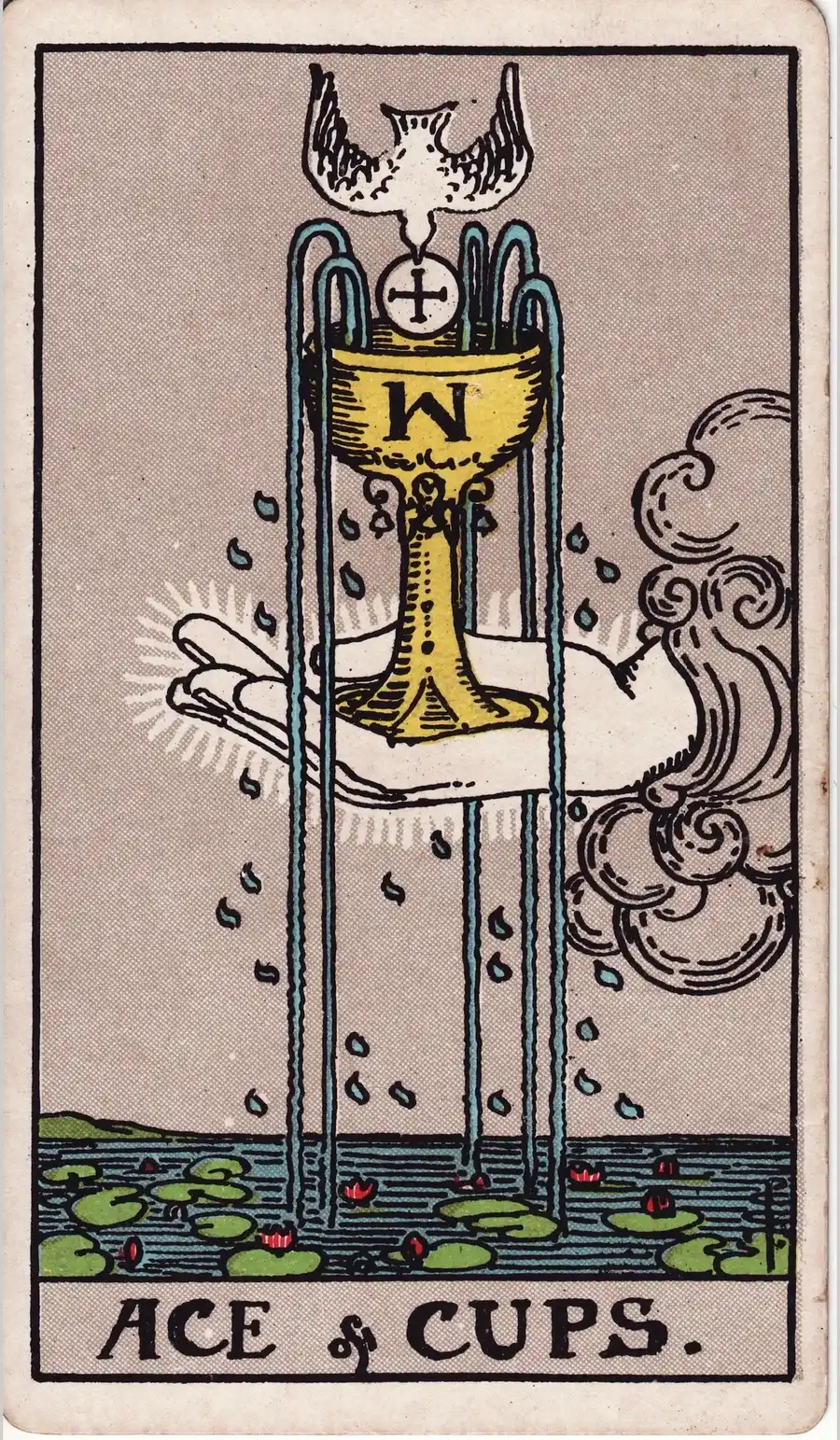
The suit of Cups is the water suit of the tarot. Its cards are about feelings, love, friendship, imagination and intuition. When Cups fill a reading, the heart has something to say.
This page gathers all 14 Cups cards in one place, with a short meaning for each, the story the suit tells from Ace to Ten, and simple ways to read it.
At a glance
| Feature | The Cups |
|---|---|
| Element | Water Later tradition |
| Themes | Feeling, relationship, imagination and the emotional weather of a situation |
| Other names | Chalices; Coppe in Italian decks and Coupes in the Tarot de Marseille |
| Playing card suit | Hearts |
| Zodiac signs | Cancer, Scorpio and Pisces Later tradition |
| Cards | Ace to Ten, then Page, Knight, Queen and King |
What the Cups are about
Cups cover relationships of every kind: romance, friendship, family and the relationship you have with yourself. They also cover creativity, dreams, memories and intuition. Their hard cards describe grief, boredom, fantasy and the decision to walk away.
In the Rider-Waite-Smith deck of 1909, Pamela Colman Smith drew a full scene on every one of these cards. That makes the suit easy to learn: look at what the people in the picture are doing, and you already know most of the meaning.
All 14 cards of Cups
Here is each card with its upright keywords from my book. Follow the links for the full meaning, reversed meaning, symbols and a spread for every card.
| Card | Upright keywords |
|---|---|
| Ace of Cups | New emotions, relationships, love |
| Two of Cups | Unity, partnership, mutual attraction |
| Three of Cups | Celebration, friendship, creativity |
| Four of Cups | Contemplation, apathy, reevaluation |
| Five of Cups | Regret, loss, sorrow |
| Six of Cups | Nostalgia, memories, reunion |
| Seven of Cups | Fantasy, illusion, choices |
| Eight of Cups | Walking away, letting go, seeking meaning |
| Nine of Cups | Satisfaction, contentment, emotional fulfillment |
| Ten of Cups | Harmony, joy, shared belonging |
| Page of Cups | Intuition, creativity, emotional openness |
| Knight of Cups | Romance, charm, idealism |
| Queen of Cups | Compassion, intuition, emotional security |
| King of Cups | Emotional balance, diplomacy, wisdom |
The story of the Cups, Ace to Ten
One easy way to learn a suit is to read the numbered cards as a story. Each number has a shape that repeats across the suits, and the suit gives it a setting.
The Ace overflows with new feeling. The Two shares it with another person, and the Three celebrates with friends. In the Four the feeling goes flat, and in the Five there is loss.
The Six turns to sweet memories, the Seven to daydreams and choices. In the Eight you walk away from what no longer feeds you. The Nine is the wish granted, and the Ten is shared happiness under a rainbow.
This story is a teaching tool. It is a modern habit, not something Waite or Smith wrote down, and you do not need it to read the cards. Many readers find it helps the cards stick.
The court cards of Cups
The Cups courts are sensitive people. The Page is a dreamy beginner, the Knight is a romantic, the Queen is compassionate and intuitive, and the King keeps his balance in emotional water.
Court cards can describe a person in your life, a part of you or an approach to the situation. The gender or age of the figure does not limit who the card can describe.
Reading the Cups in a spread
Many Cups in one reading usually means emotions are central. It is often a good sign for love and friendship. It can also mean you are led more by feeling than by facts right now.
No Cups at all can suggest that the question is practical rather than emotional, or that feelings are being kept out of the picture. Ask how you actually feel.
Look also at which Cups cards appear. Low numbers point to beginnings, middle numbers to struggle and adjustment, high numbers to completion. Courts point to people or attitudes. Read the pattern first, then each card.
The history behind the suit
Historical The four suits are older than tarot. They came to Europe with playing cards in the late 1300s, and Italian and Spanish cards still use cups, coins, swords and batons. When tarot appeared in 15th century Italy, it added the trump cards to this ordinary pack of four suits.
Later tradition In Italian decks the suit is Coppe and in the Tarot de Marseille it is Coupes, goblets. Card players often match Cups with hearts in an ordinary deck, which is a good clue to what the suit is about.
Smith gave the cups faces, rivers, rainbows and dreams. The water in so many of her Cups scenes is the easiest clue to the suit’s element. The pairing of suits with elements comes from occult writers of the 1800s and was fixed in its best-known form by the Golden Dawn.
Try this: a spread for the Cups
Use this four-card spread when you want to look at feeling and the other themes of the suit in your life right now.
- What do I feel? My honest emotion.
- What does my heart want? The wish under the feeling.
- What blocks it? The fear or old hurt.
- How do I care for it? One kind action.
Shuffle the whole deck, not only this suit. If one of the cards that turns up is a Cup, pay extra attention to it.
What next
The Cups are covered in the lesson Cups of my free Tarot for Beginners course. For all four suits and the numbers in one place, see The Minor Arcana: suits and numbers made simple, and for the people cards see Tarot court cards without confusion.
You can browse every card in all the card meanings, and my book The Novice’s Guide to Tarot has the full entry for each card.
Sources
- A. E. Waite, The Pictorial Key to the Tarot (London: Rider, 1910), Part III.
- Pamela Colman Smith and A. E. Waite, the Rider-Waite-Smith tarot (London: Rider, 1909).
- Michael Dummett, The Game of Tarot (London: Duckworth, 1980).
- Lauri Mukkala, The Novice’s Guide to Tarot.
Questions
What element are the Cups?
Water. Almost every tarot system agrees on this one.
What playing card suit matches Cups?
Hearts. The Italian and Spanish suit of cups became hearts in French playing cards.
Are Cups only about love?
No. They are about all feelings, including friendship, creativity, grief and intuition.
Get the free Mini-Grimoire
A short printable starter guide to tarot and everyday witchcraft, plus my newsletter. Unsubscribe any time.
Opens Substack in a new tab to confirm. More about the newsletter · Privacy