

About Moon magic for beginners
The moon is the easiest place to start a regular practice. It is free, it is the same for everyone and it keeps its own calendar. Every 29.5 days it moves from dark to full and back again, and many witches use that rhythm to set intentions, check in and let go.
This page explains what each phase is, how witches commonly use it, where the esbat comes from, how to keep a simple moon journal and how to stay safe outdoors at night. The labels in the text show what kind of claim each part is: Historical, Later tradition or Modern.
The phases, and what witches do in each
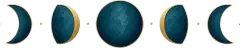
The moon takes about 29.5 days to go from one new moon to the next. We see its phases because, as it orbits the Earth, we see different amounts of its sunlit half. That is the astronomy, and it is the same everywhere on Earth.
Modern The uses below are common modern practice, not ancient rules. A simple way to remember them: while the moon is growing, practice often focuses on building and beginning. While it shrinks, practice often focuses on finishing, sorting and letting go.
| Phase | What you see | Common uses |
|---|---|---|
| New moon | Nothing: the moon sits between the Earth and the sun, lit side away from us | intentions, beginnings, quiet reflection |
| Waxing crescent | A thin sliver in the west just after sunset, a day or two after the new moon | the first small steps on a new intention |
| First quarter | Half the face lit, high in the sky at sunset | decisions, action, a check-in on the intention |
| Waxing gibbous | More than half lit and growing | adjusting and building momentum |
| Full moon | The whole face lit; rises around sunset and shines all night | celebration, gratitude, divination, reflection |
| Waning gibbous | Shrinking from full, rising later each evening | gratitude, sharing, beginning to release |
| Last quarter | Half lit again, high in the morning sky | clearing, breaking habits, forgiveness |
| Waning crescent | A thin sliver in the east before dawn | rest and preparing for the next cycle |
You do not need to work with all eight. Most witches mark two or three: the new moon for beginnings, the full moon for gratitude and the dark moon for rest. The rest of the month is simply the space in between, where the ordinary work happens.
Some witches also speak of the dark moon, the last day or so before the new moon when no moon is visible.
It is not a separate astronomical phase, but many people treat it as a time for rest and quiet, and keep the name “new moon” for the first thin crescent. Both ways of counting are fine. Pick one and write it in your notes.
In the Southern Hemisphere the phases happen on the same dates, but the lit side looks flipped: the waxing crescent is lit on the left instead of the right. Near the equator, a crescent can look like a smile or a boat.
Watching the real moon
Many people practice moon magic for years without really watching the moon. A few facts make it easier.
The moon rises about 50 minutes later each day on average. That is why the full moon rises at sunset, but a few days later you only see it late at night.
The waxing moon is an evening sight and the waning moon a morning sight, and from first quarter to just before full you can often see the moon in the afternoon.
Through binoculars, a half moon is more interesting than a full one, because craters stand out best along the line between light and dark. And the huge moon on the horizon is an illusion of perception. The moon is not actually larger when it rises.
If you live far north or far south, the summer full moon stays low near the horizon and the winter full moon rides high for most of the night. Beyond the Arctic Circle, the full moon may not rise at all for a while around midsummer.
Note what the moon actually does where you live. Those local details make your notes your own. In the far north, the winter full moon on snow can be bright enough to walk by.
Special moons and moon names
You will hear a lot of names for particular moons. Here is where the common ones come from.
A blue moon today usually means the second full moon in one calendar month. That meaning spread after a 1946 article in Sky & Telescope misread an older almanac rule, which counted the third full moon in a season that had four. Either way, it happens every two or three years.
A supermoon is a full moon near the moon’s closest point to the Earth, so it looks slightly bigger and brighter. The word was coined by the astrologer Richard Nolle in 1979. It is not an astronomical term, though astronomers now use it too.
A blood moon is the coppery red color of the moon during a total lunar eclipse, caused by sunlight bending through the Earth’s atmosphere.
Then there are the monthly names such as Wolf Moon, Harvest Moon or Hunter’s Moon. Harvest Moon and Hunter’s Moon are old English names. Many of the others were popularized by twentieth-century American almanacs, which linked some of them loosely to Native American and colonial names. Treat any single list as one modern tradition among many.
Esbats: where the word comes from
Historical The link between witches and the moon is old. Greek writers told of the witches of Thessaly, who were said to be able to “draw down the moon,” and the idea appears in Aristophanes’ play The Clouds around 423 BCE.
The word “esbat” is much younger. It comes from French witch-trial writing: the judge Pierre de Lancre, who led a notorious witch hunt in the Basque country in 1609, wrote of witches’ “esbats” in a book of 1612. It was one of many words demonologists used for the gatherings they imagined witches held.
Later tradition Margaret Murray brought the word into English in The Witch-Cult in Western Europe (1921). She used it for small local meetings, as opposed to the great sabbaths.
Historians later showed that her theory of an organized pagan witch religion was wrong.
The link with the full moon came from a different book: Charles Godfrey Leland’s Aradia, or the Gospel of the Witches (1899), in which followers are told to meet “once in the month, and when the moon is full.” Gerald Gardner and Doreen Valiente built on that line when they shaped Wiccan ritual.
Modern Today “esbat” usually means any ritual held at a moon phase, most often the full moon.
There are usually twelve full moons in a year, sometimes thirteen. A solitary esbat can be as simple as a candle, a few minutes of reflection and a note in your book. The esbat guide goes into more detail.
Simple moon practices
You can begin with one of these and add the others later. Each one links the moon to something you actually do, which is what makes a moon practice last.
A new moon intention. This is the best first practice, because the rest of the month builds on it.
- On the evening of the new moon, or a day or two after, sit somewhere quiet with a card and a pen.
- Choose one intention for the next four weeks. Make it specific, about your own actions and small enough to do. “I will walk for twenty minutes, four days a week” works. “Everything will get better” does not.
- Write it down, with three concrete first steps underneath.
- Read it aloud once and put it where you will see it every day.
- Take the first step within a day.
If you like, plant a fast-growing seed such as cress or basil and water it each day as a reminder.
A full moon check-in. On the night of the full moon, or the night before or after, look at the moon from a window, a balcony or outside if it is safe. Light a candle in a stable holder, or switch on a small lamp.
Write down what has grown since the new moon: what you did, what happened and what surprised you. Name three things you are grateful for this month.
If you read tarot, draw one card and ask, “What do I need to know for the coming weeks?” The one-card reading is enough. Put the candle out before you leave the room, and eat or drink something ordinary. For a fuller version, see the full moon ritual.
A waning moon release. Between the full moon and the dark moon, write one thing you are ready to let go of on a slip of paper: a habit, a worry or an old story about yourself. Read it aloud, tear it up and put it in the trash.
Then name one thing you will do instead. That last step is what turns a release into a change.
Later tradition Moon water, safely. Moon water is a folk practice: clean water in a clean jar, set out for one night under the open sky. If you make it, bring the jar in by morning, add nothing to it (no oils, herbs or crystals) and do not drink it.
Use it to wipe your altar or water a hardy plant, then pour the rest away the same day. Keep open jars away from pets. Moonlight does not clean or change water. It is a cue for attention, not medicine.
The moon journal
A moon journal turns the phases into something you can learn from. Keep it in your Book of Shadows or a separate notebook.
For each entry, write the date and the phase, and what you could actually see, or simply “cloudy.” Add how you slept and felt, what you did, if anything, and one line about what you noticed.
Keep it for one full cycle, then look back. Did you feel different at certain phases? Did your intentions move? You may find a pattern, or you may not. Both are useful answers.
Modern You will read that the full moon makes people restless, increases births or controls menstrual cycles. Large studies of hospital admissions, births and crime have mostly found no consistent full moon effect, though a few studies report small effects on sleep.
Your own records are a better guide than general claims either way. If sleep or mood is troubling you, talk to a health professional rather than relying on a moon calendar.
Staying safe
If you go outdoors at night, tell someone where you are, carry a light, stay on paths you know and dress for the weather. A window or balcony works just as well. With candles, use a stable holder, keep nothing flammable nearby and never leave a flame alone.
A lunar eclipse is safe to watch with the naked eye. A solar eclipse is not. Never look at the sun without eclipse glasses that meet the ISO 12312-2 standard, or use a pinhole projector. Ordinary sunglasses are not enough.
If you are under 18, keep night practice outside and open flame for times when a safe adult agrees.
Try this: one cycle, two moments
For the next lunar month, mark only two moments: the new moon and the full moon. At the new moon, write one intention with three first steps. At the full moon, read it back and write what has grown.
In between, add a line to your moon journal whenever you happen to see the moon. After one cycle you will know where it rises from your window, and your practice will be built on the real sky.
What next
The moon’s phases are real, regular and beautiful. Whether a phase changes the outcome of a spell is a matter of belief, not evidence. What is certain is that a monthly rhythm of intention, reflection and letting go can steady a practice. Start with one phase, keep a few notes and add more only if it helps.
The new moon, full moon and dark moon pages each give a complete ritual, and the esbat guide tells the history.
For the sun’s yearly rhythm, see the Wheel of the Year. The Novice’s Guide to Witchcraft has a moon chapter with a cycle-tracking practice and the full moon water safety rules.
Frequently asked questions
What is an esbat? An esbat is a ritual held at a phase of the moon, most often the full moon. The word comes from French witch-trial writing of the early 1600s and was brought into English by Margaret Murray in 1921. Its modern meaning took shape in twentieth-century Wicca.
What do witches do at the new moon? Many witches use the new moon for intentions and quiet beginnings: one clear goal for the coming month, written down, with a first practical step.
Can I drink moon water? No. Use moon water externally, for example to wipe an altar or water a hardy plant, and pour leftovers away the same day. Moonlight does not clean water.
Do I have to work with every phase? No. Many witches only mark the full moon, or the full and new moon. The moon is a calendar of attention, not a rule.
Which moon phase should a beginner start with? The new moon. Set one small intention with three first steps, then check in on it at the full moon. That simple pair is the core of most moon practice.
Does the full moon really affect sleep or mood? The evidence is mixed. Large studies have mostly found no consistent full moon effect, though a few report small effects on sleep. Your own journal is the best guide for you.