

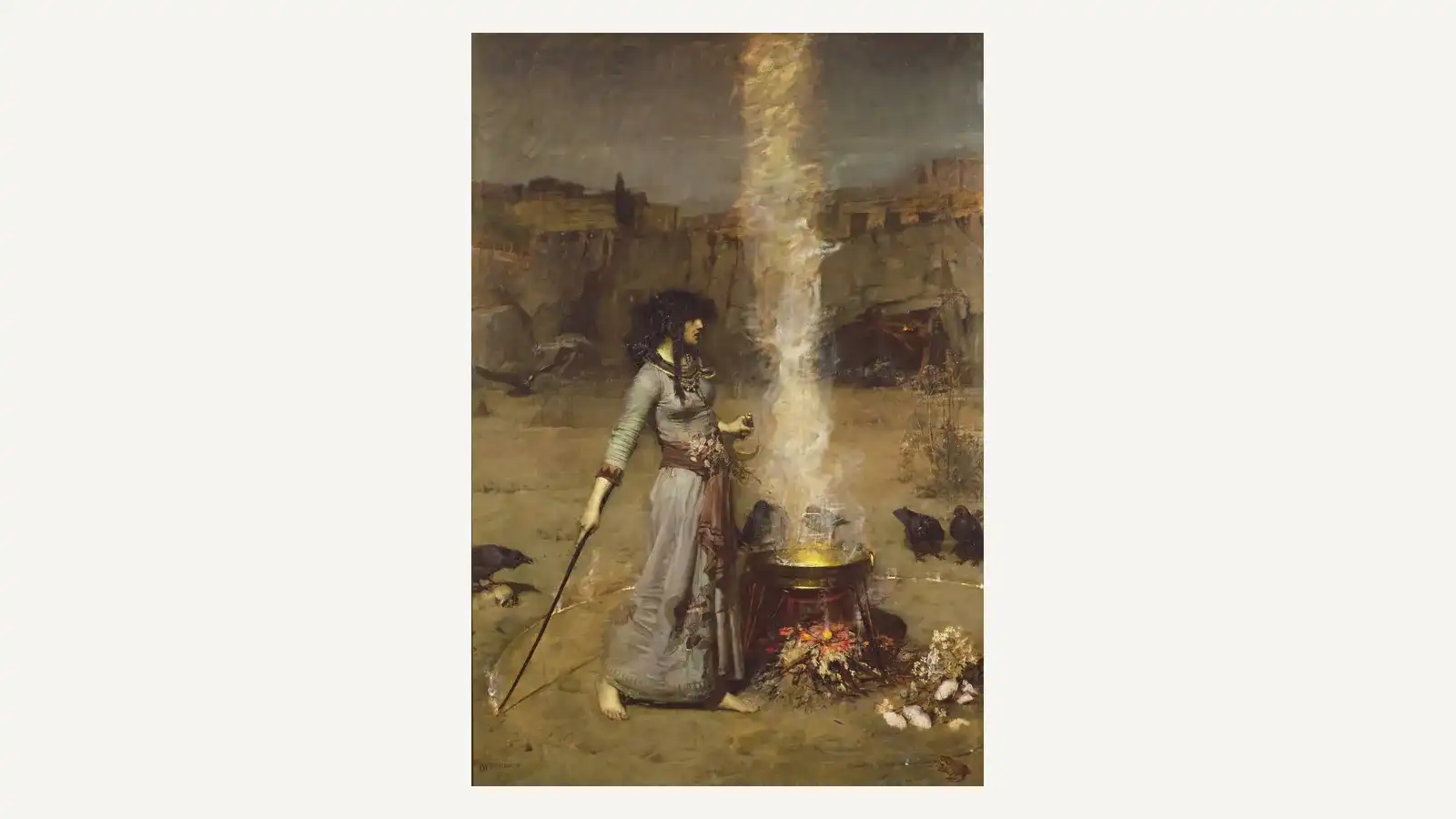
This course is free and always will be. No account, no email needed. Your progress stays in your own browser. If you have been curious about witchcraft for a while but did not know where to start, or if social media made it look expensive and complicated, you are exactly who I wrote it for.
Witchcraft for Beginners: A Novice’s Path follows my book The Novice’s Guide to Witchcraft in twelve short lessons. We begin with the real history, including the witch trials and the modern revival. Then we build a calm practice step by step: intention, grounding, a small altar, the elements, herbs and the kitchen, the moon and the seasons, simple spells, protection and ethics. The last three lessons are pure practice: a real trial record, a moon journal with herb cards and a plan for your first year. Each lesson teaches one thing, ends with a small practice and has a quick quiz so you can check that the main idea landed.
What you will learn
- What witchcraft is, where the word comes from and what the history really shows.
- How to set an intention that is about your own actions.
- How to ground and center in a few minutes, with or without imagery.
- How to set up a small, safe altar and work with the four elements.
- Plant safety, the herbs this course never uses and simple kitchen witchcraft.
- The moon’s phases, the Wheel of the Year and where both ideas come from.
- How a simple spell is built, what protection really means and how to keep a Book of Shadows.
- An ethics frame you can use for the rest of your practice.
How it works
Open a lesson, read it, try the practice and press “Mark as done”. Your progress is saved privately in your browser, so nothing is sent to me. When every lesson is done, you can open your certificate of completion.
I label what I teach in three layers, as everywhere on this site: Historical for what the evidence shows, Later tradition for what writers and occultists added later, and Modern for practice today. Most of what witches do now is modern, and that is fine. Modern does not mean fake. It means honest about its age.
The lessons
- What witchcraft is, and its history
- Intention, grounding and centering
- Your altar and the elements
- Correspondences and colors
- Herbs and kitchen witchcraft, safely
- The moon and the Wheel of the Year
- Spellcraft and protection
- Candle magic, step by step
- Ethics, divination and your Book of Shadows
- The witch trials and cunning folk: an archive practice
- A moon journal and kitchen herb cards
- Your first year of practice
How each lesson works
Every lesson opens with why the topic matters. Then comes the teaching itself in plain prose, a worked example that shows the idea in action, one small exercise for your notebook and a short recap, with the sources I used listed at the end. A three-question quiz at the bottom checks the main idea. Nobody sees your answers. The last part of each lesson links to the next one and to the longer guide pages on this site, so you can go deeper whenever a topic catches you.
Who this course is for
This course is for complete beginners of any background, for people who practice privately and for anyone who wants to check what they have read online. It does not ask you to join a group or follow a religion. It does ask you to keep your practice honest: no guarantees, no working on other people’s will and ordinary care first.
What you need
A notebook and pen, a small clear surface such as a shelf or a tray, one candle in a fireproof holder or an LED light, a cup of water and a few dried kitchen herbs. That is all. You do not need to buy anything else.
Start now
Begin with What witchcraft is, and its history. It takes about fifteen minutes.
Go deeper
The witchcraft hub on this site links every guide page, from herbs to the moon. If you prefer to learn from a book, the whole path is in my book The Novice’s Guide to Witchcraft, with longer appendices on herbs, crystals, tools and correspondences.
Sources
- Lauri Mukkala, The Novice’s Guide to Witchcraft, chapters 1 to 16.
- Ronald Hutton, The Triumph of the Moon: A History of Modern Pagan Witchcraft (Oxford University Press, 1999).
- Brian P. Levack, The Witch-Hunt in Early Modern Europe (London: Longman, 1987).
- Ronald Hutton, The Witch: A History of Fear, from Ancient Times to the Present (Yale University Press, 2017).
0% done · 12 of 12 lessons ready
Comments
Questions and notes from readers. Anyone with a free account can comment, and I reply when I can. Please read the community guidelines.
Comments load from Google Firebase (EU) when you ask for them. Nothing is stored on your device. Privacy