


How to read the labels Historical what the old sources say. Later tradition what later writers added. Modern modern practice and my own notes.
The moon is the oldest clock and the oldest companion of anyone who works at night. Artists have painted it as a scientific object, a symbol of longing, a lamp for travelers and a quiet light on a floor. This gallery gathers fourteen works from the Metropolitan Museum of Art in New York, all released as public domain images under the Met’s Open Access program. Each caption gives the maker, date, material, size and object number.
How to use this gallery
Treat it like a slow walk. Look at one picture, ask where the light comes from, and only then read my note. Check the sizes too: a woodblock print, a postcard-size painting and a canvas wider than a meter ask different things of you.
The moon up close
The first two works look straight at the moon itself, two centuries apart, one engraved and one photographed.
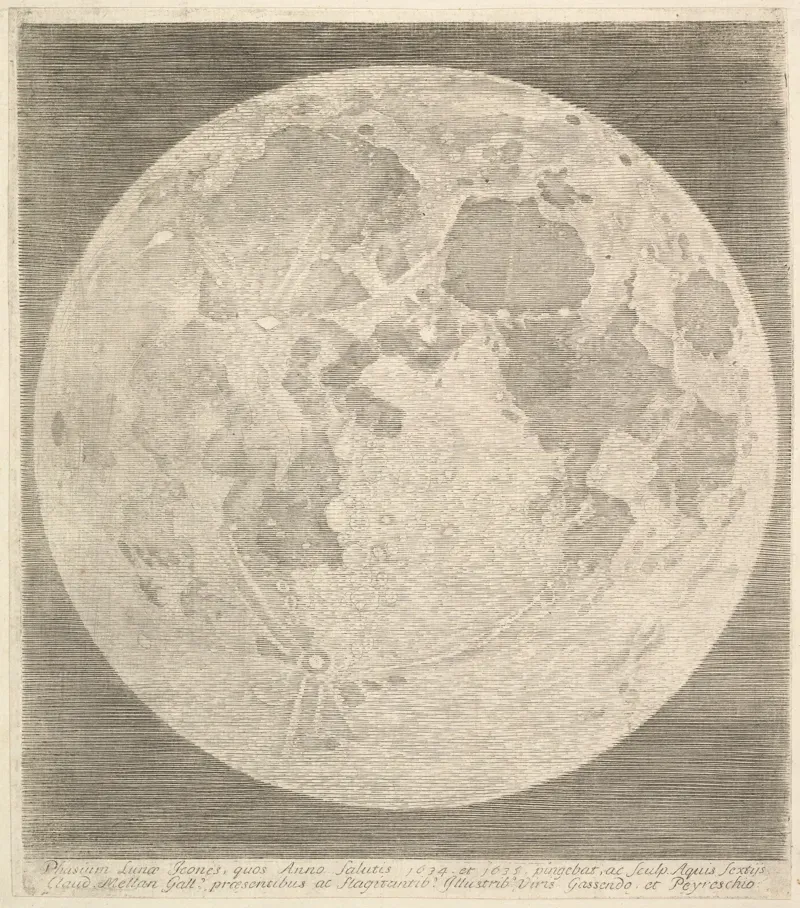
Full Moon, Claude Mellan, 1635. Engraving; first state of two (BN), 24.8 × 21.7 cm. The Metropolitan Museum of Art, object 60.634.36, The Elisha Whittelsey Collection, The Elisha Whittelsey Fund, 1960. Public domain (CC0, Met Open Access).
Mellan made this in 1635 with the astronomers Pierre Gassendi and Nicolas-Claude Fabri de Peiresc, working from views through a telescope. It is one of the earliest detailed pictures of the moon’s face. Look closely: every shade is built from tiny engraved lines.
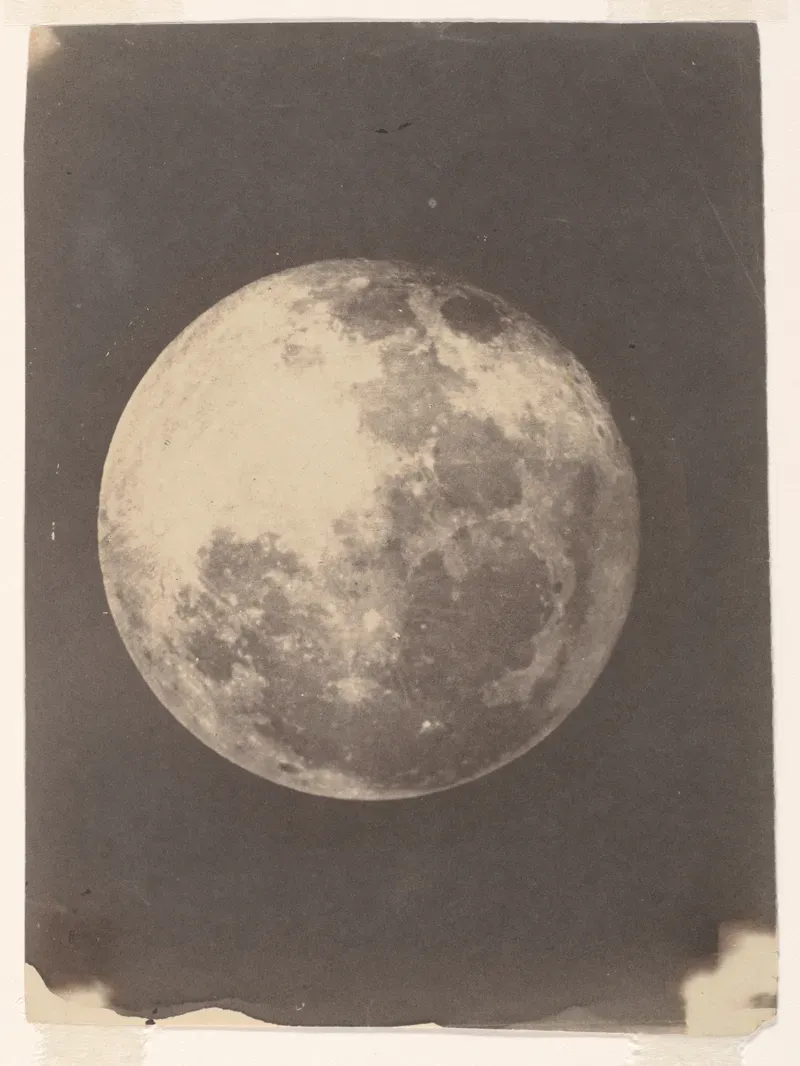
The Moon, John Adams Whipple and James Wallace Black, 1857-60. Salted paper print from glass negative, 21.1 × 15.8 cm. The Metropolitan Museum of Art, object 1978.649.7, Robert O. Dougan Collection, Gift of Warner Communications Inc., 1978. Public domain (CC0, Met Open Access).
Within a few decades of the first photographs, people pointed cameras through telescopes. Whipple and Black worked in Boston, and this salted paper print turns the moon from a symbol into a measured object, yet it still feels a little magical.
Romantic moonlight
For painters in Dresden and Scandinavia in the early nineteenth century, moonlight became a way to paint inner life.
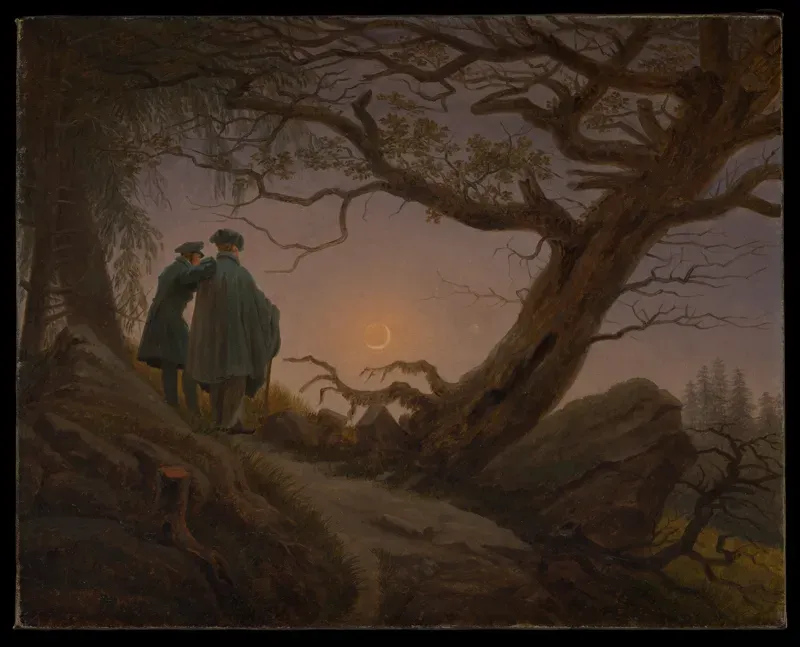
Two Men Contemplating the Moon, Caspar David Friedrich, ca. 1825-30. Oil on canvas, 34.9 × 43.8 cm. The Metropolitan Museum of Art, object 2000.51, Wrightsman Fund, 2000. Public domain (CC0, Met Open Access).
Friedrich painted this subject more than once. We see the figures from behind, so we stand where they stand. The bare oak beside them is a typical Friedrich reminder of time passing.
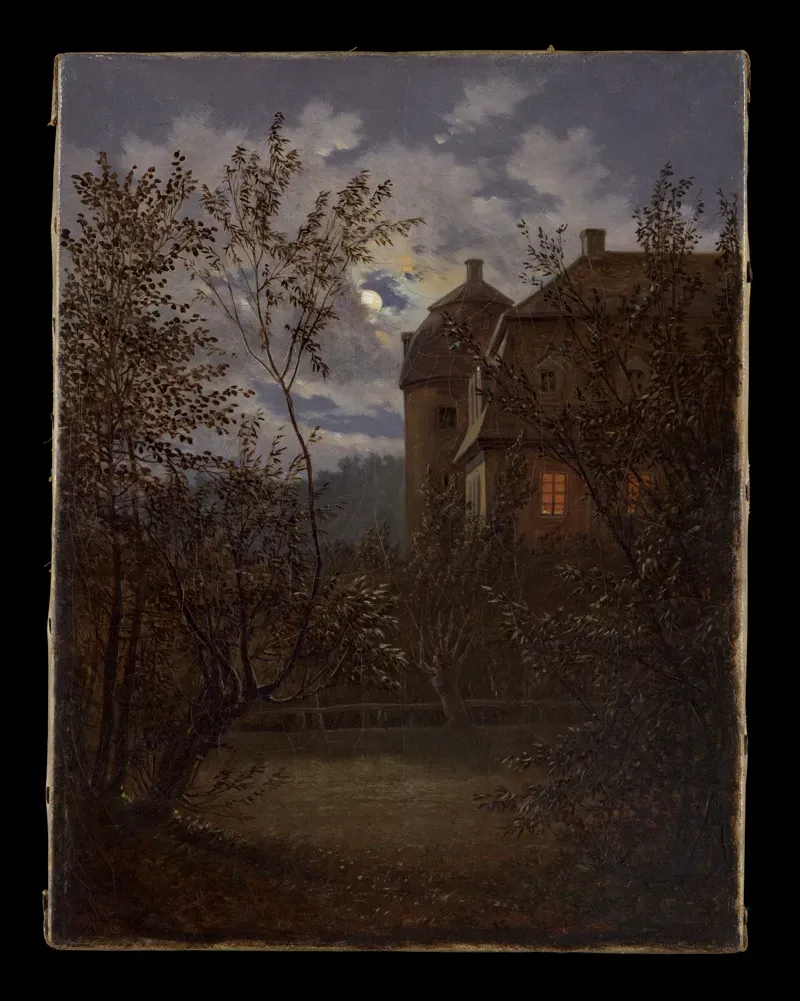
Schloss Milkel in Moonlight, Carl Gustav Carus, ca. 1833-35. Oil on canvas, 28.5 × 21.5 cm. The Metropolitan Museum of Art, object 2018.749, Purchase, Fern and George Wachter Gift, 2018. Public domain (CC0, Met Open Access).
Carl Gustav Carus was a physician as well as a painter, and a friend of Friedrich. Here the moon and a single lit window are the only lights. Notice how small the painting is, under thirty centimeters tall.
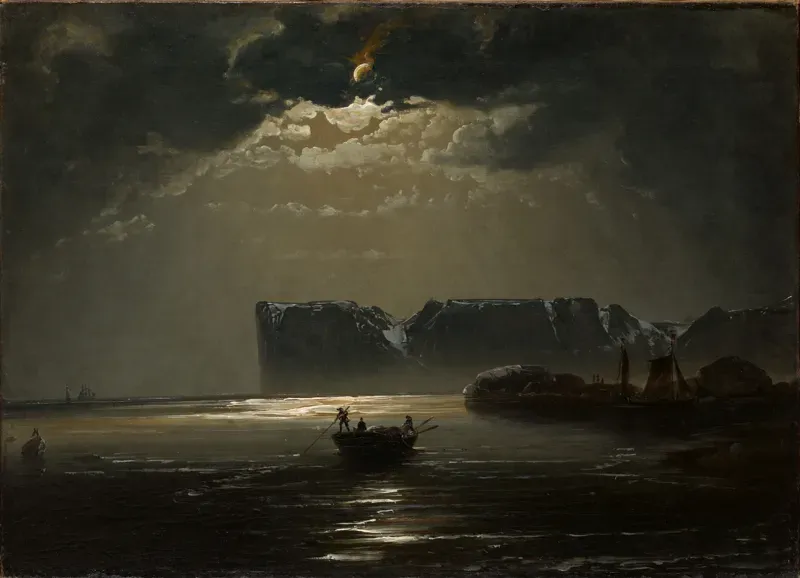
The North Cape by Moonlight, Peder Balke, 1848. Oil on canvas, 62 × 85 cm. The Metropolitan Museum of Art, object 2019.167.4, Gift of Christen Sveaas, in celebration of the Museum’s 150th Anniversary, 2019. Public domain (CC0, Met Open Access).
Peder Balke traveled to the far north of Norway as a young man, and the North Cape stayed with him for life. The moon is half hidden, and the light falls in a path on the water toward the boat.
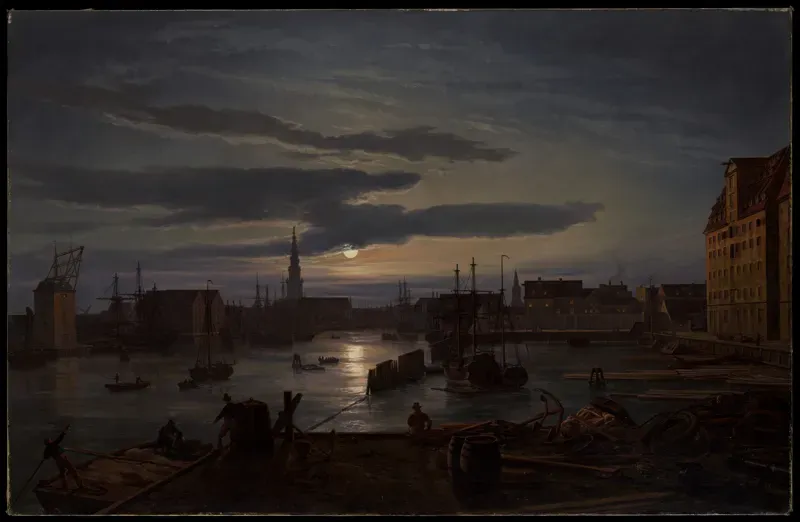
Copenhagen Harbor by Moonlight, Johan Christian Dahl, 1846. Oil on canvas, 95.9 × 154 cm. The Metropolitan Museum of Art, object 2019.167.2, Gift of Christen Sveaas, in celebration of the Museum’s 150th Anniversary, 2019. Public domain (CC0, Met Open Access).
Dahl was a Norwegian painter who spent most of his career in Dresden. In this large painting, moonlight and a few warm lamps share the scene. Try finding every light source before you read on.
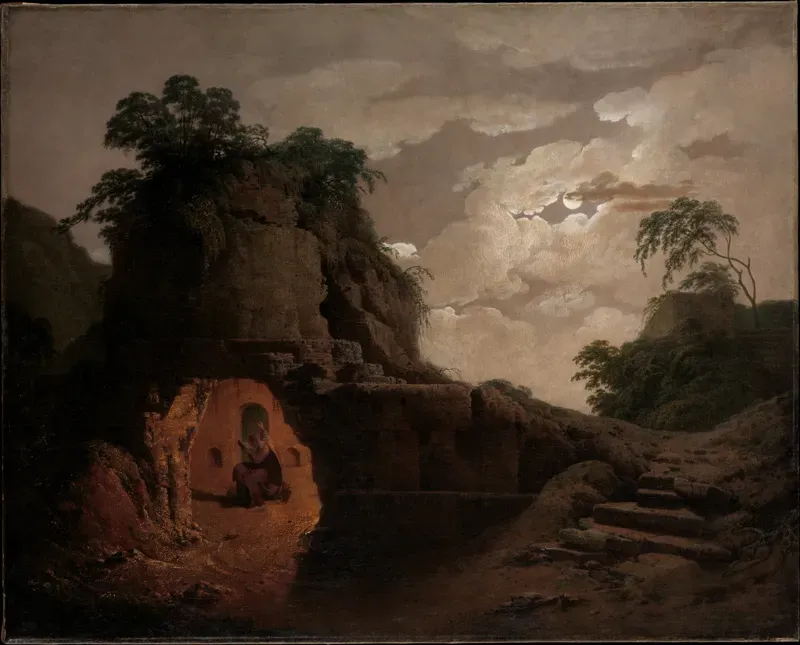
Virgil’s Tomb by Moonlight, with Silius Italicus Declaiming, Joseph Wright (Wright of Derby), 1779. Oil on canvas, 101.6 × 127 cm. The Metropolitan Museum of Art, object 2013.155, Purchase, Lila Acheson Wallace Gift, Gifts of Mrs. William M. Haupt, Josephine Bay Paul, and Estate of George Quackenbush, in his memory, by exchange, The Morris and Alma Schapiro Fund Gift, and funds from various donors, 2013. Public domain (CC0, Met Open Access).
Wright of Derby loved dramatic light. The Roman poet Silius Italicus was said to have owned the land around Virgil’s tomb near Naples and honored it as a shrine. A poet visiting a dead poet by moonlight: this is the moon as memory.
Moon on the water
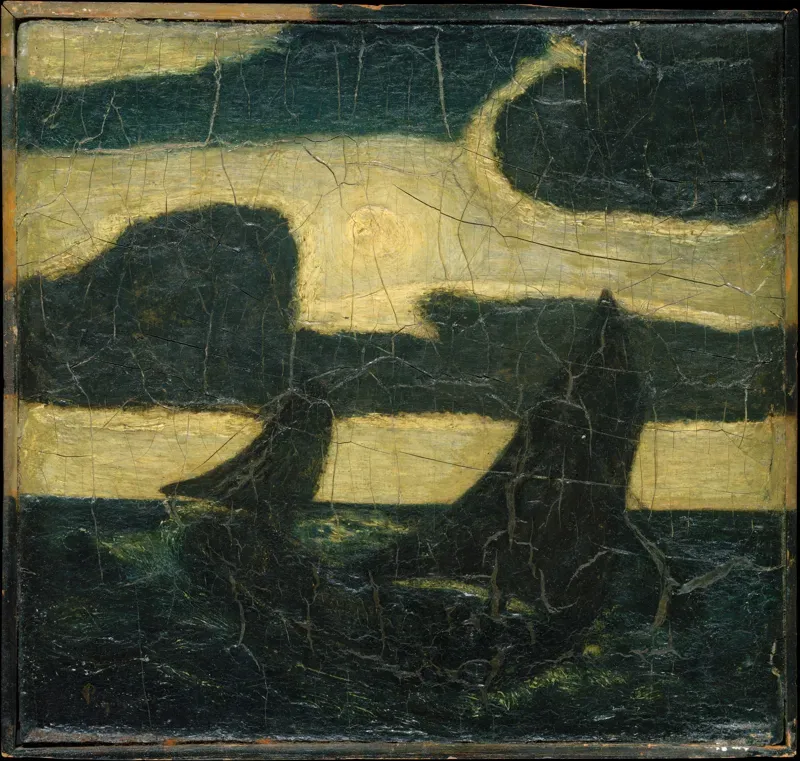
Moonlight Marine, Albert Pinkham Ryder, 1870-90. Oil and possibly wax on wood panel, 29.2 × 30.5 cm. The Metropolitan Museum of Art, object 34.55, Samuel D. Lee Fund, 1934. Public domain (CC0, Met Open Access).
Ryder built up his paintings in many layers and used unstable materials, and the cracks you see are part of that history. The shapes are simplified almost to symbols: boat, cloud, moon.
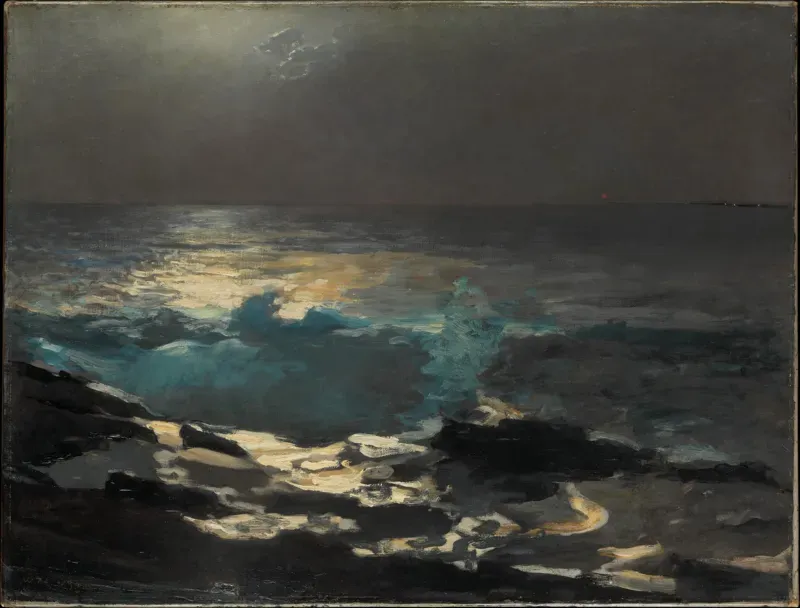
Moonlight, Wood Island Light, Winslow Homer, 1894. Oil on canvas, 78.1 × 102.2 cm. The Metropolitan Museum of Art, object 11.116.2, Gift of George A. Hearn, in memory of Arthur Hoppock Hearn, 1911. Public domain (CC0, Met Open Access).
Winslow Homer painted the sea near his home at Prouts Neck in Maine for years. The moon itself stays outside the picture, and you only see what it does to the water.
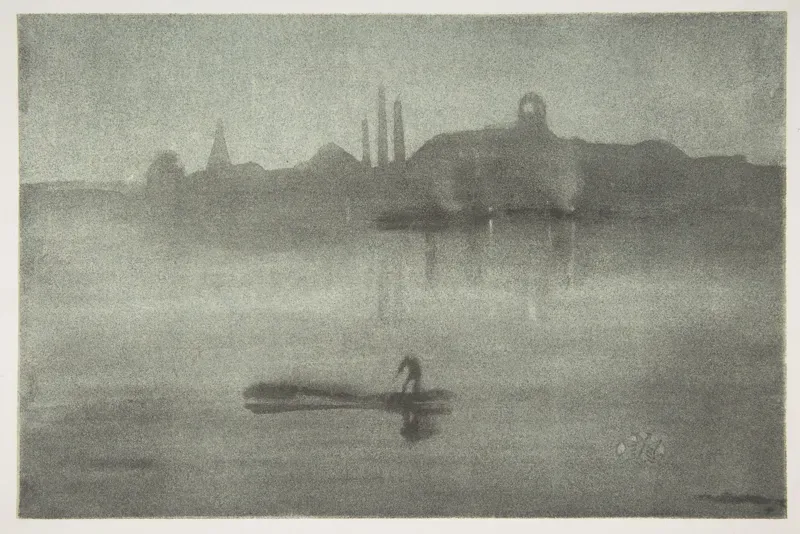
Nocturne (Nocturne: The Thames at Battersea), James McNeill Whistler, 1878. Lithotint with scraping on a prepared half-tint ground, printed in soft gray-black ink on pale blue laid chine mounted on ivory wove plate paper; second state of two (Chicago), 17.1 × 25.9 cm. The Metropolitan Museum of Art, object 17.3.159, Harris Brisbane Dick Fund, 1917. Public domain (CC0, Met Open Access).
Whistler called his night scenes nocturnes, a word from music. Almost nothing is described, only mist, water and a few dark shapes. It is a lesson in how little a picture needs.
Moon viewing in Japan
In Japan, viewing the moon has a long tradition in poetry and seasonal festivals. These two prints show it as a shared outing.
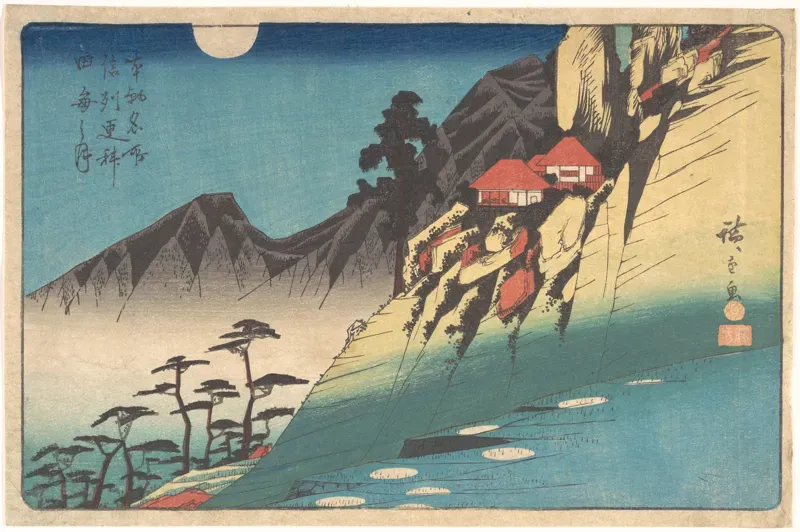
Reflections of the Moon in the Rice Fields of Sarashina in Shinshu, Utagawa Hiroshige, ca. 1832. Woodblock print; ink and color on paper, 23.5 × 35.9 cm. The Metropolitan Museum of Art, object JP1880, H. O. Havemeyer Collection, Bequest of Mrs. H. O. Havemeyer, 1929. Public domain (CC0, Met Open Access).
The terraced rice fields of Sarashina were famous for moon viewing, because the moon was said to appear in each flooded field. Hiroshige turns the famous view into a steep, stacked landscape.
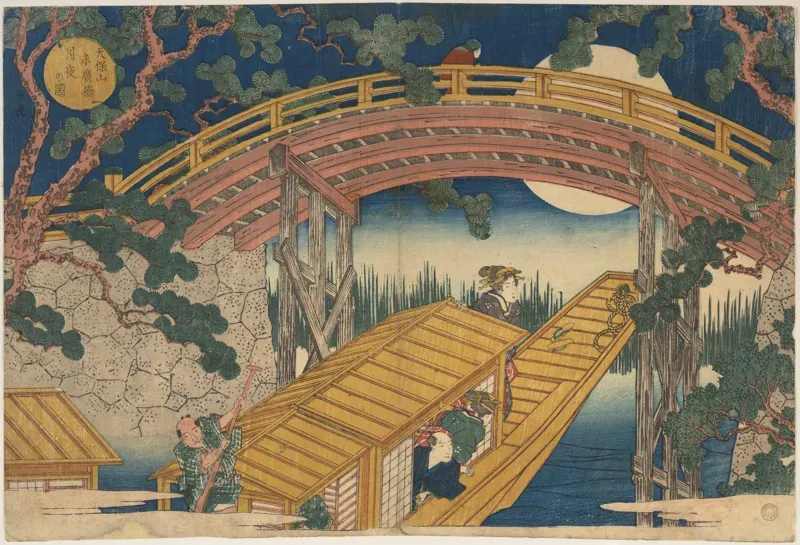
Moonlight View of Suihiro Bridge, Tempozan, Yashima Gakutei, 1838. Woodblock print; ink and color on paper, 25.7 cm. The Metropolitan Museum of Art, object JP1412, Rogers Fund, 1922. Public domain (CC0, Met Open Access).
Gakutei made a series of views of Tempozan, an artificial hill in Osaka harbor that became a popular spot for outings. Moon viewing was a social pleasure as well as a poetic one.
Night without a moon, and moon without a sky
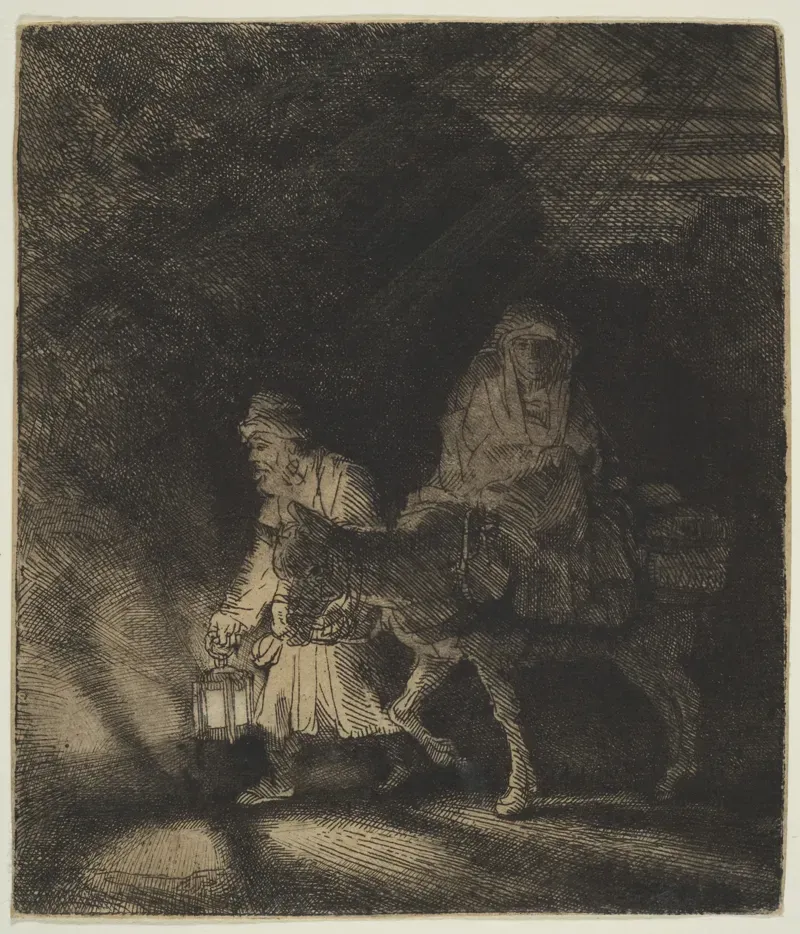
The Flight into Egypt: a Night Piece, Rembrandt (Rembrandt van Rijn), 1651. Etching with plate tone; first state, 12.7 × 11 cm. The Metropolitan Museum of Art, object 41.1.52, Gift of Felix M. Warburg and his family, 1941. Public domain (CC0, Met Open Access).
Rembrandt left ink on the plate to make the darkness, so each printing came out a little different. There is no moon here at all. I include it because it shows the other side of night: a family on the road with a single lantern.
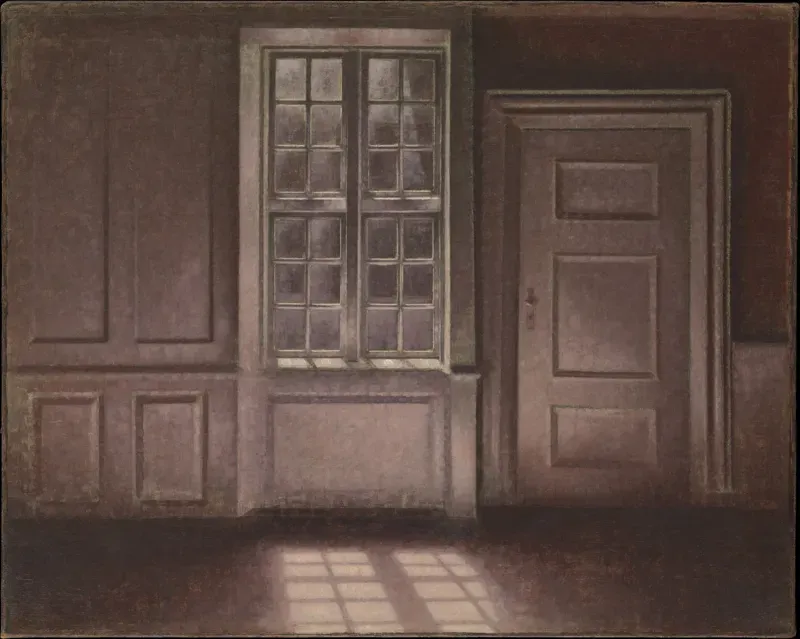
Moonlight, Strandgade 30, Vilhelm Hammershøi, 1900-1906. Oil on canvas, 41 × 51.1 cm. The Metropolitan Museum of Art, object 2012.203, Purchase, European Paintings Funds, and Annette de la Renta Gift, 2012. Public domain (CC0, Met Open Access).
Hammershøi painted his own Copenhagen apartment at Strandgade 30 again and again. Here the moon is only a shape of light on the floor. It is the quietest work in this gallery, and maybe the most moonlit.
How to reuse these images
Every image in this gallery is public domain under the Met’s Open Access program (CC0). You can download, print and share them, even commercially, without asking permission. CC0 does not require credit, but I recommend keeping the caption with the image: the artist, the date, the museum and the object number. Before you reuse anything, open the source page from the caption and check the licence there yourself, because policies can change. My page on museums and open access explains how to check an image and where to find thousands more.
The esoteric angle
Historical Few of these artists were thinking about magic. They were thinking about science, feeling, travel, poetry and light. That is worth remembering before we read our own meanings into them.
Later tradition Still, the moon’s associations with dreaming, memory and the hidden side of things run all through Romantic art, and those associations shaped how later occult writers talked about the moon.
Modern If you work with the moon in your practice, a gallery like this can be a gentle way to start an esbat or a journaling session: pick one image, sit with it, and notice what it stirs up. My guide to working with the moon and my full moon page explain the practice side.
Try it yourself
Here are the worksheet questions I use for every close reading. Copy them into a notebook, open the image as large as your screen allows, and give yourself twenty minutes. Fill them in order and do not skip ahead to meaning.
- Basic information. Write down the title, artist, date, material, size and collection number from the At a glance box. Size matters: picture the real object on a wall or in your hand.
- First look, two minutes. Before you read anything else, write three words for your first reaction.
- Description. List at least fifteen things you can see, without explaining any of them. People, animals, objects, places, colors, marks, writing.
- What is going on here? Then ask: what do I see that makes me say that? What more can I find?
- Formal analysis. Where are the lightest and darkest areas? Where do the lines lead your eye? Is the space deep or shallow? What is the focal point?
- Meaning in three levels. What is shown (a woman, a dog, an old man)? What story or theme do those things stand for? What does the work tell you about the time and place that made it?
- Evidence check. Mark each statement you wrote with E for evidence you can see or document, I for an interpretation, and P for your personal response. For this gallery, add one more question: where is the moon, or where is its light, and how did the artist make it the brightest thing in the picture?
If you want the full method with a worked example, my page on how to look at a painting walks through it step by step.
Questions
Are these moon images free to use?
Yes. Each one is marked public domain by the Met under its Open Access program (CC0). I still credit the artist, the museum and the object number in every caption, and I suggest you do the same.
What is a nocturne in art?
A nocturne is a night scene. James McNeill Whistler borrowed the word from music for his paintings and prints of the Thames after dark, to suggest that a picture could work like a quiet piece of music.
Why did Romantic painters love the moon?
For painters such as Caspar David Friedrich and his circle, moonlight was a way to paint feeling: solitude, longing and the sense of something larger than us. The moon gave them a light source that hides as much as it shows.
Get the free Mini-Grimoire
A short printable starter guide to tarot and everyday witchcraft, plus my newsletter. Unsubscribe any time.
Opens Substack in a new tab to confirm. More about the newsletter · Privacy