


How to read the labels Historical what the old sources say. Later tradition what later writers added. Modern modern practice and my own notes.
Hekate is a Greek goddess whose story runs for well over two thousand years and is still being written. In the oldest long text that describes her, she is an honored power with a share of earth, sea, and sky, generous to farmers, fishermen, soldiers, and kings. In a famous hymn, she is the goddess who hears a kidnapped girl cry out and who meets a grieving mother with a torch in her hands.
At household doorways and crossroads she stands guard. In magical papyri from Roman Egypt she is called on alongside the moon. In a late philosophical poem she becomes something like the soul of the cosmos. In Shakespeare she is queen of the witches. Online today she is often a moonlit crone with keys and black dogs. On this page I walk through those layers in order, history first, and then share a simple, safe way to begin.
Who Hekate is
Historical A question you will see debated is whether Hekate was originally Greek at all. Some scholars, noting her major sanctuary at Lagina in Caria (in southwestern Asia Minor, modern Turkey) and personal names in that region built on similar sounds, proposed an origin outside Greece. In their view, she began as a Carian or Anatolian goddess and was later adopted by the Greeks. Others point out that the earliest literary evidence is mainland Greek (Hesiod was a Boeotian farmer-poet), that the Lagina temple as we know it is Hellenistic and therefore late, and that similar-looking names are weak evidence of origin.
The fair summary is that the Anatolian-origin theory is possible, debated, and unproven. The question can stay open. It is enough to know that by the time we can see her clearly, she was worshiped across the Greek world, from mainland Greece and the islands to Asia Minor and, later, Roman Italy and Egypt.
The evidence we have comes in a few kinds: literary texts, inscriptions, images and magical papyri. Literary texts. Hesiod’s Theogony, probably composed around 700 BCE, gives her a long and unusually warm passage (lines 411 to 452). The Homeric Hymn to Demeter, probably from the seventh or sixth century BCE, gives her a small but memorable role. Later Greek and Roman writers, including tragedians, comic poets, Apollonius of Rhodes, Theocritus, Virgil, Ovid, Seneca, and Lucan, mention her in many settings. Each of these texts was written for its own purposes. A poet describing Medea’s nighttime ritual is telling a story, not writing a temple manual.
Ancient Greece: Hesiod and the Homeric Hymn to Demeter
Historical Hesiod’s Theogony, a poem about the origins of the gods, was probably composed around 700 BCE. Its passage on Hekate, lines 411 to 452 in modern numbering, is long and enthusiastic. Some scholars have wondered whether Hesiod or his family had a special devotion to her. Others suspect the passage was expanded by a later hand. Neither theory can be proven.
Hesiod places her in the generation of the Titans. Her mother is Asteria, a starry goddess, and her father is Perses. Her maternal grandparents are the Titans Phoebe and Coeus, which makes her a cousin of Apollo and Artemis. In Evelyn-White’s 1914 translation (public domain), Asteria “conceived and bare Hecate whom Zeus the son of Cronos honoured above all. He gave her splendid gifts, to have a share of the earth and the unfruitful sea. She received honour also in starry heaven, and is honoured exceedingly by the deathless gods.”
Historical The Homeric Hymns are a collection of poems to individual gods, attributed in antiquity to Homer but composed by various poets. The Hymn to Demeter, probably from the seventh or sixth century BCE, tells how Hades carried off Persephone, how her mother Demeter searched for her, and how the cycle of Persephone’s return was established. It is also closely tied to the Eleusinian Mysteries.
Demeter searches for nine days “with flaming torches in her hands.” On the tenth dawn, “Hecate, with a torch in her hands, met her, and spoke to her and told her news” (lines 51 to 53). Hekate admits she heard Persephone’s voice but did not see who took her. The two goddesses then go together, with torches, to Helios, the sun, who saw everything.
Historical The word hekataion (plural hekataia) can refer to any shrine or image of Hekate. It is used especially for a distinctive type of statue: three female figures standing back to back around a central column, each facing a different direction. Many examples survive in museum collections, mostly from the Hellenistic and Roman periods, often small enough for a household or wayside setting.
The traveler-writer Pausanias wrote in the second century CE. In his Description of Greece (2.30.2) he says he believed the sculptor Alkamenes, active in the later fifth century BCE, was the first to make Hekate as three figures joined together. Pausanias says this statue stood on the Athenian Acropolis beside the temple of Athena Nike, and that Athenians called it Epipyrgidia, “on the tower.” Whether Alkamenes truly invented the type is debated, but the triple form was established in Athens by the classical period.
Late antiquity and magic: the Greek Magical Papyri and the Chaldean Oracles
Historical The Greek Magical Papyri (often abbreviated PGM, from the Latin Papyri Graecae Magicae) are a group of papyrus texts, mostly from Roman Egypt, dating roughly from the second century BCE to the fifth century CE. Many were acquired in the nineteenth century, possibly from a single collection found near Thebes in Upper Egypt. They are written mainly in Greek, with Demotic Egyptian and Coptic sections, and they contain practical instructions: spells for love, protection, revelation, healing, restraint, and success, along with prayers, hymns, and lists of divine names.
The standard English edition is The Greek Magical Papyri in Translation, edited by Hans Dieter Betz (first edition 1986, second edition 1992). It is under copyright, so this page paraphrases rather than quotes it and gives the standard reference numbers, which follow the format PGM, then the papyrus number in Roman numerals, then line numbers. You can look these up in Betz yourself.
Historical The Chaldean Oracles are a collection of verses in Greek hexameter, probably composed in the second century CE. Later tradition attributed them to two men, Julian the Chaldean and his son Julian the Theurgist, said to have lived under the emperor Marcus Aurelius. The word “Chaldean” pointed, in Roman usage, to the wisdom of Babylonian priests and astrologers, but the content is largely Platonic philosophy expressed in oracular form.
The original work is lost. What survives are fragments quoted by later Neoplatonist philosophers, especially Proclus (fifth century CE), and by the Byzantine scholar Michael Psellus (eleventh century), along with others. The standard modern edition and translation is Ruth Majercik’s The Chaldean Oracles (1989), which is under copyright. Older English versions by Thomas Taylor (published in The Classical Journal in 1817 and 1818) and William Wynn Westcott (1895, drawing on Taylor and on Isaac Preston Cory) are in the public domain. They are less reliable, however, and sometimes include material that later scholars have rejected or reordered.
From medieval witch to modern goddess
Later tradition When public pagan worship ended in late antiquity, Hekate did not vanish. She lived on in the books educated Europeans read: Virgil, Ovid, Lucan, Seneca, and the commentators and mythographers who explained them. Over centuries she became mainly a literary figure, the classical goddess of witches and night. In the nineteenth and twentieth centuries, occultists, poets, scholars, and modern witches turned her back into a goddess people pray to. Much of what you will read about Hekate today was shaped on that journey.
Later tradition In Shakespeare’s Macbeth, Hekate (spelled Hecat or Hecate in the Folio) appears in two scenes. In Act 3, Scene 5, she scolds the three witches for meddling with Macbeth without her, calls herself “the mistress of your charms,” and plans to draw Macbeth to his ruin. In Act 4, Scene 1, she briefly enters to praise the witches’ work. Both scenes include cues for songs, “Come away, come away” and “Black spirits,” whose full texts appear in Thomas Middleton’s play The Witch.
Modern In 1948 the poet and novelist Robert Graves published The White Goddess, a long, passionate, and idiosyncratic book about poetry, myth, and a single great goddess he believed lay behind them. Graves described this goddess as threefold and connected her with the phases of the moon and with stages of a woman’s life: as the new moon she was a girl, as the full moon a woman, as the old moon a hag. His own favored triad was the goddess as mother, bride, and “layer-out” of the dead. Later popular writers turned these ideas into the fixed formula maiden, mother, and crone. Some of the ingredients were older, since nineteenth-century writers had already linked goddesses with the moon’s phases, but Graves gave the idea its most influential form. Graves developed related ideas in The Greek Myths (1955).
Symbols, animals and places
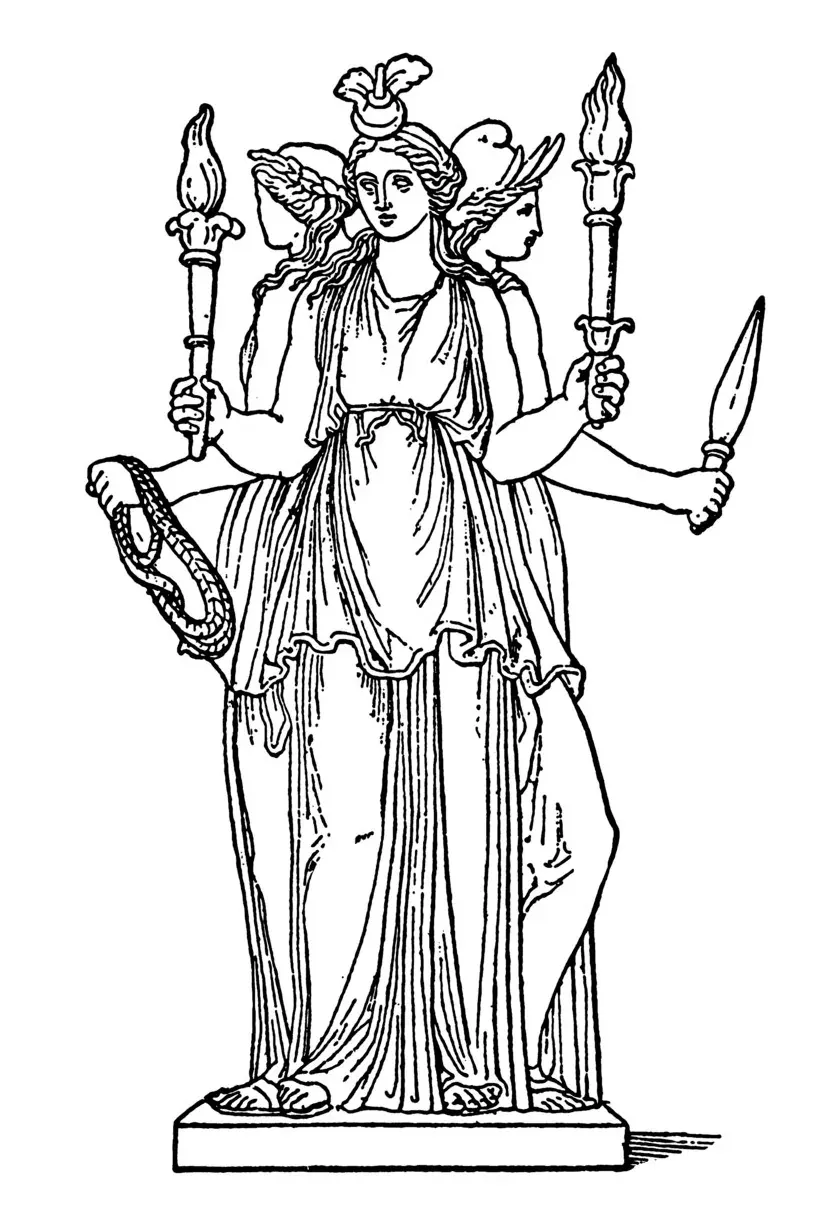 Triple Hecate statue in the Capitoline Museums, Rome. Engraving, 1891. Public domain, via Wikimedia Commons.
Historical Torches are Hekate’s oldest and most consistent emblem. In the Homeric Hymn to Demeter she meets the grieving Demeter carrying a torch. Vase paintings and statues frequently show her holding one or two long torches. Epithets such as Phosphoros, “light-bringer,” and Daidophoros, “torch-bearing,” name this role. In Greek religion, torches belonged to night festivals, weddings, funerals, and mystery rites. They lit the way, purified, and marked a boundary moment.
Historical Dogs are deeply connected with Hekate in ancient sources. Theocritus and Apollonius both pair her with howling dogs at night; in Theocritus, the howling tells the speaker that the goddess is at the crossroads. In some myths, the Trojan queen Hecuba is transformed into a dog, and later writers connected her with Hekate’s company.
There is a harder truth here too. Several ancient sources report that dogs were sacrificed to Hekate or to Enodia in certain rites. Plutarch (Roman Questions 68) mentions dogs in Greek purifications brought to Hekate, and Pausanias (3.14.9) says the people of Colophon sacrificed a black puppy to Enodia at night. This page mentions it because it is part of the record and because you will meet it in research. It is not part of modern practice in any form, and no animal should ever be harmed in your devotion.
Crossroads, thresholds and gates are her places. In Greek thought these places were powerful because they were uncertain. At a crossroads you must choose. At a threshold you pass from one space into another. Gates were where strangers entered and where a city was most vulnerable. A goddess who stood in these places was a guardian, keeping harm out and helping travelers through.
Before you begin: ethics and discernment
Before any practice, a few ground rules. Approach a goddess without fear and without grandiosity. Look after your mind, hold personal experiences lightly, respect the living religion she belongs to, and know when to step back. My deity ethics page covers all of this in more depth.
Please pause your practice and talk to someone if you notice that you are:
- frightened most of the time, or unable to sleep;
- hearing voices or seeing things that others do not, and finding it distressing;
- convinced you are being watched, targeted, or controlled;
- believing you have a special mission that alarms the people who care about you;
- unable to work, study, eat, or look after yourself;
- thinking about harming yourself or someone else.
These experiences are not a sign of spiritual failure or of a goddess’s anger. They are signs that you deserve support. Talk to a trusted person, your doctor, or a mental health professional. If you are struggling right now, call your local emergency number (112 in Europe, 911 in the US and Canada) or a crisis line in your country. Your practice will still be there when you are ready to return.
Hekate is a Greek goddess, and the religion of the ancient Greeks is practiced again today. Hellenic polytheism, sometimes called Hellenism, Hellenismos, or Hellenic reconstructionism, is a living religion with communities in Greece and around the world. In Greece, the Supreme Council of Ethnikoi Hellenes (YSEE), founded in 1997, is one of the best-known organizations, and Greek authorities recognized the Hellenic ethnic religion as a “known religion” in 2017. Outside Greece, groups such as Hellenion in the United States, founded in 1999, have organized as well. Views differ between groups, and no single organization speaks for everyone.
A simple devotional practice
My suggestion for a first practice is a tiny shrine on one shelf and a short evening greeting. Modern This is modern devotion, not an ancient rite.
Where to put it. Choose a shelf, a windowsill, the top of a bookcase, or a small box you can open and close. Near the front door is a good choice if it is practical and private enough, since it echoes the ancient doorway hekataia. Otherwise, anywhere you will see it daily works. Keep it out of reach of pets and small children if it holds anything breakable or flammable.
You only need a few things:
- A light. A candle in a stable holder, a small oil lamp, or an LED candle. This is the “torch.”
- A key. Any key: an old house key, a skeleton key, a key that matters to you.
- A small dish or cup for offerings, such as water.
- Optionally, an image. A printed photo of an ancient hekataion from a museum’s open-access collection, a drawing you made, or a simple symbol such as three lines meeting.
Then try this first evening greeting:
- Wash your hands.
- Stand or sit before your shrine. Take three slow breaths.
- Light your candle or switch on your LED, saying, “Hekate, light-bringer.”
- Touch or look at your key, saying, “Keeper of the keys.”
- Place fresh water in the offering cup, saying, “Guardian of the door, I offer you this water.”
- Speak a short prayer in your own words, such as “Hekate, guardian of the door, thank you for this day.”
- Sit quietly for one to three minutes. Notice your breathing and whatever you feel, without trying to change it.
- Say, “Thank you.” Extinguish the flame.
- Write a line or two in your journal.
The Deipnon and the dark moon
Historical Of all the ancient customs connected with Hekate, the deipnon, “Hekate’s supper,” is the one modern devotees most often revive. It is monthly, simple, tied to the household, and grounded in real ancient references. It also comes with gaps in the evidence that every careful practitioner should know about. My Deipnon guide explains what we know, offers a modern rite step by step and covers food safety and responsible disposal of offerings. For the ancient and modern meanings of her keys, torches and dogs, see Hekate’s symbols, and for moon timing, my moon guide.
Plant safety
Many plants linked with Hekate online, such as aconite, belladonna, mandrake and henbane, are poisonous. Treat them as symbols only: a picture or a word on a card, never the plant itself. When in doubt, do not handle, burn, or ingest a plant, and keep it away from children and pets. If you think a person or an animal has been poisoned, call your local emergency number or poison information center straight away.
Never burn any poisonous plant. Also avoid burning plants you cannot identify with certainty, plants treated with pesticides, and any plant around birds, cats, or people with asthma. Smoke is optional in every practice on this site.
Candle safety: never leave a flame unattended, keep it away from curtains and pets, and use an LED candle whenever you are tired or sharing a small space.
Questions
Who is Hekate in simple terms?
A Greek goddess of torches, doorways and crossroads, honored for over two thousand years. Hesiod praises her, the Homeric Hymn to Demeter shows her with a torch, and later magic and philosophy gave her new roles.
Is Hekate a triple moon goddess?
The triple statue is ancient, but the maiden, mother and crone triad comes from Robert Graves in 1948 and later popular writers. It is a modern layer, not an ancient teaching.
What can I offer Hekate as a beginner?
Water, a candle or LED light, a little bread or honey, and your time. Never offer or burn poisonous plants, and never harm an animal.
Do I need to be initiated to honor Hekate?
No. A simple shelf shrine and a short greeting are enough to begin, as long as you respect the living Hellenic religion she belongs to.
Get the free Mini-Grimoire
A short printable starter guide to tarot and everyday witchcraft, plus my newsletter. Unsubscribe any time.
Opens Substack in a new tab to confirm. More about the newsletter · Privacy