


How to read the labels Historical what the old sources say. Later tradition what later writers added. Modern modern practice and my own notes.
| Number | 23 of 72 |
|---|---|
| Rank | Duke |
| Legions | 26 |
| Office (1904) | Sets cities, castles, and great places on fire. |
| Other spellings | Aym, Haborim (Weyer, Scot), Haborym |
Spirit 23 of the Ars Goetia is Aim. The 1904 edition by S. L. MacGregor Mathers and Aleister Crowley calls him a duke ruling 26 legions, and the first office it gives him is this: Aim sets cities, castles, and great places on fire.
His entry pairs a fire-bringing image with offices of wit and truthful answers. Each part below carries a label for its layer, explained in how to read a spirit page.
At a glance
| Fact | In the entry |
|---|---|
| Number | 23 of 72, in the 1904 order. |
| Name and spellings | Aim in 1904; other spellings: Aym, Haborim (Weyer, Scot), Haborym. |
| Rank and legions | Duke, 26 legions. |
| Metal of his rank (Observations) | Copper. |
| Hours for dukes (Observations) | “From Sunrise till Noonday in Clear Weather.” |
| In Weyer’s catalog (1577) | Yes, as the source comparison below shows. |
The 1904 entry
Historical The full entry from the 1904 edition, with footnote numbers and the dash after the heading left out and the heading set in ordinary type:
Aim. The Twenty-third Spirit is Aim. He is a Great Strong Duke. He appeareth in the form of a very handsome Man in body, but with three Heads; the first, like a Serpent, the second like a Man having two Stars on his Forehead, the third like a Calf. He rideth on a Viper, carrying a Firebrand in his Hand, wherewith he setteth cities, castles, and great Places, on fire. He maketh thee witty in all manner of ways, and giveth true answers unto private matters. He governeth 26 Legions of Inferior Spirits; and his Seal is this, which wear thou as aforesaid, etc.
Aim is “a very handsome Man in body, but with three Heads”: a serpent, a man “having two Stars on his Forehead” and a calf. He rides a viper and carries a firebrand “wherewith he setteth cities, castles, and great Places, on fire”. His offices are making a person “witty in all manner of ways” and giving “true answers unto private matters”.
Appearance
Historical Aim appears “in the form of a very handsome Man in body, but with three Heads; the first, like a Serpent, the second like a Man having two Stars on his Forehead, the third like a Calf.” He rides on a viper, “carrying a Firebrand in his Hand, wherewith he setteth cities, castles, and great Places, on fire.”
Offices in the Ars Goetia
Historical The offices of Aim, in the order the 1904 text gives them:
- Sets cities, castles, and great places on fire.
- Makes the magician “witty in all manner of ways.”
- Gives true answers to private matters.
Source comparison: Weyer and Scot
Historical The Weyer catalog, as Scot renders it, gives “Aym or Haborim,” “a great duke and a strong,” with three heads: a serpent, a man “having two” stars (the printed text uses a star symbol), and a cat. The Goetia has a calf. This is a clear example of a copying change.
Historical Weyer has “Aym vel Haborym”. His third head is “felino”, a cat’s, not a calf’s. The printed Latin uses a star symbol for the stars on the man’s head, “duos ☆ habenti”, and Scot kept the symbol. (About Weyer and Scot.)
Name and etymology
Historical Haborym appears as an alias in Weyer, and Collin de Plancy uses it as the main name. Neither has a known meaning.
Seal and images
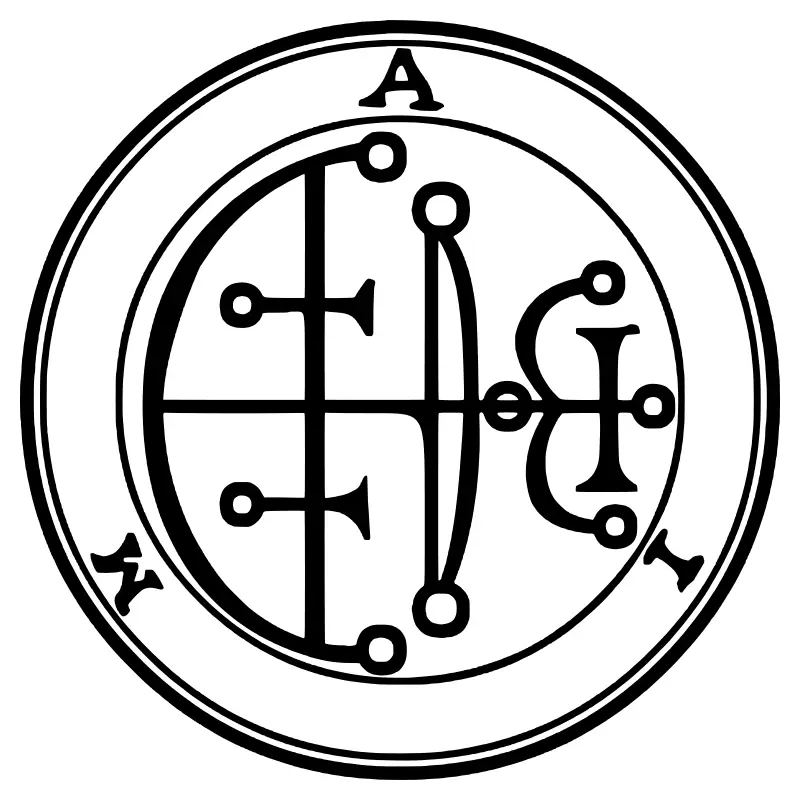
Historical The seal above is Aim’s as printed in 1904, and by the rules of the Observations it would be made in copper, the metal of his rank. Why seals were worn, why editions draw them differently and how to study one are explained in seals, circle and triangle.
Later tradition and modern practice
Later tradition Collin de Plancy’s Dictionnaire Infernal shows Haborym with three heads, of a snake, a man, and a cat, riding a viper and holding a torch, following Weyer rather than the Goetia.
Modern Modern writers sometimes connect Aim with fire, purification, and creativity, a modern reading of his destructive office.
Lore about Aim’s personality, likes or chosen people is modern, not grimoire material; modern approaches explains where such claims come from.
Beginner’s quick reference
| Item | What the sources say |
|---|---|
| Rank metal and hours (Goetia) | Duke: copper; sunrise to noon, in clear weather. |
| Planet (later tradition: Golden Dawn and Crowley’s 777) | Venus. |
| Decan and day or night spirit (later tradition: 777) | Scorpio, second decan (10 to 20 degrees); day spirit. 777 decan incense: opoponax (777 gives “As for Asc.,” which repeats it). Tarot card of the decan: Six of Cups. |
| Commonly reported color, incense, and plant (modern UPG; sources copy each other) | Color green; incense sandalwood; plant lemon (toxic to cats). |
| Associated symbols | Goetia image: a handsome man with three heads (a serpent’s, a man’s with two stars on the brow, and a calf’s), riding a viper and carrying a firebrand. 777 Magical Image: the same image. Le Breton engraving (1863): a many-headed figure riding a serpent and holding a torch, under the name Haborym. Modern Demonolatry/UPG: the seal, used as an altar image; one practitioner’s blog adds the platypus. |
| Associated offerings | Modern practice, not in the Goetia manuscripts: most often listed, sandalwood; single sources add tea, honey, basil, cinnamon, and jasmine, and one reports lemons and citrus scents (toxic to cats: keep out of reach). |
Before you burn or handle anything listed for Aim, read incense, plants and offerings.
Practical notes
Aim is a duke, and his offices include wit and answers to private matters. But the first office the text gives him is setting cities on fire. I do not teach that office.
If you choose Aim for a question about your own wit or learning, be aware of the full entry. A spirit whose offices center on teaching may be a better first choice.
In the directory, Aim is not among the 30 spirits that fit the beginner criteria.
Try this: one question to study
Compare the three heads in Weyer and the 1904 text and note the one that changed.
What next
To compare Aim with other spirits of his rank, read Bune and Sallos.
Later tradition In the Golden Dawn scheme of the decans, Aim is the day spirit of the second decan of Scorpio, which belongs to the Six of Cups; the night spirit of the same decan is Orias (spirit 59).
Common questions
Is Aim a good spirit for beginners?
Not as a first choice. He does not meet all three beginner criteria I use: not a king, at least one teaching office, and no central harm, deception or compulsion. His entry is still worth reading as history.
What does Aim do in the Ars Goetia?
The 1904 text calls him a duke ruling 26 legions. Its first office for him is this: Aim sets cities, castles, and great places on fire. The entry lists 3 offices in all.
Does looking at Aim's seal call him?
No. Reading a name or looking at a seal does not call a spirit. The seal is a drawing from a 1904 book, and even the grimoire itself required long rituals for its own purposes.
Get the free Mini-Grimoire
A short printable starter guide to tarot and everyday witchcraft, plus my newsletter. Unsubscribe any time.
Opens Substack in a new tab to confirm. More about the newsletter · Privacy