


| Arcana | Minor Arcana: Cups |
|---|---|
| Image | RWS 1909 (PD) |
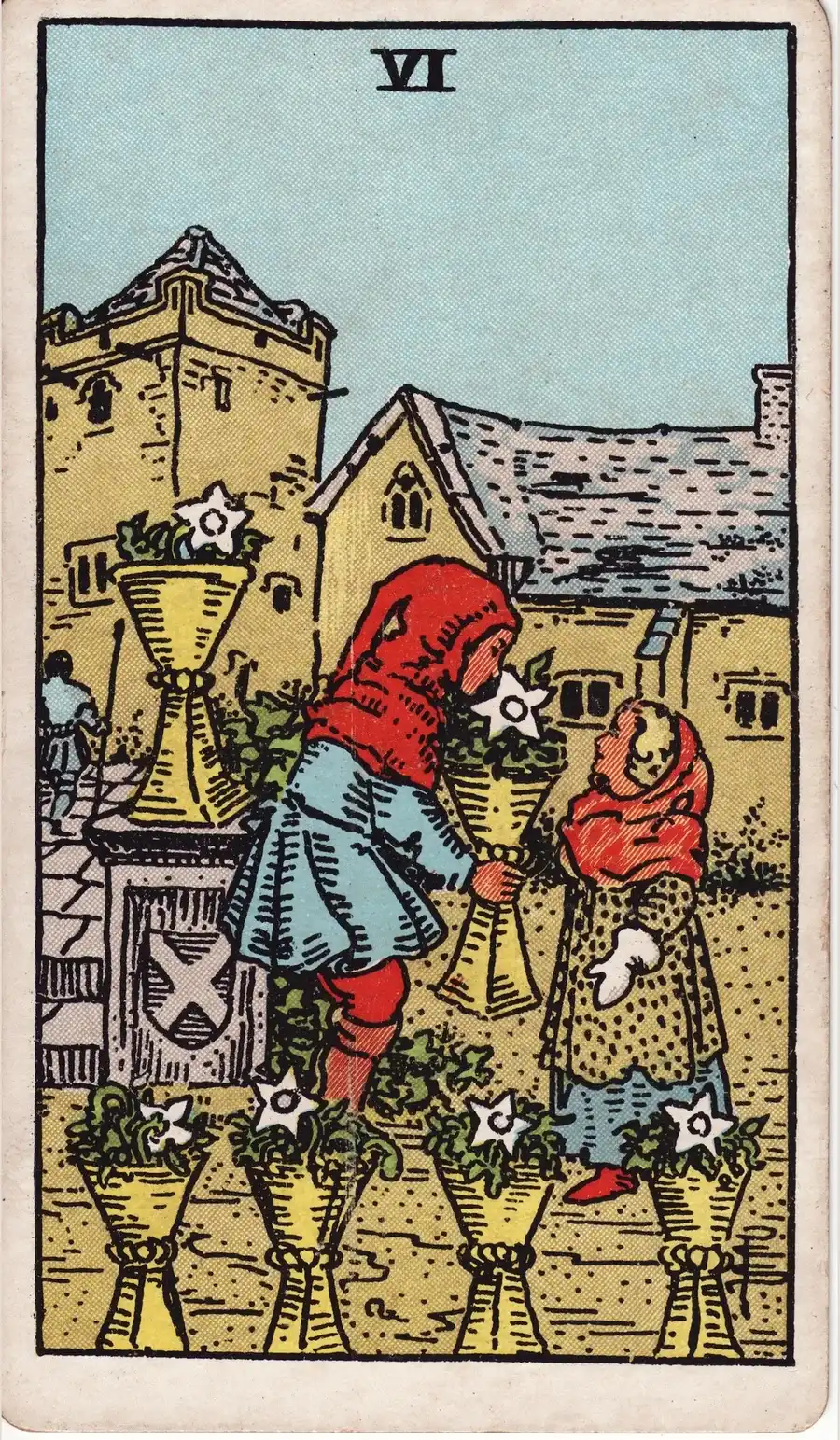
The Six of Cups shows two children in an old courtyard. The older one hands the younger one a cup filled with white flowers, and more cups of flowers stand around them.
It is a card of memories, nostalgia, kindness and reunion. Here is what the Six of Cups means upright and reversed, the symbols Pamela Colman Smith drew and how to read it in love and work.
Here is the Six of Cups at a glance.
| At a glance | This card |
|---|---|
| Upright keywords | nostalgia, memories, reunion |
| Reversed keywords | stuck in the past, unrealistic expectations, rose-tinted memory |
| Number | 6 in the suit of Cups |
| Golden Dawn title | Lord of Pleasure Later tradition |
| Astrology | Sun in Scorpio, second decan (10° to 20° Scorpio) Later tradition |
| Tree of Life | Tiphareth (6), Beauty Later tradition |
| Suit and element | Cups, Water Later tradition |
| Yes or no | Yes Modern |
Book T calls the Six of Cups the Lord of Pleasure and gives it the Sun in Scorpio, the middle decan of the sign, on Tiphareth. The Sun warms the deep water sign, and Tiphareth is the sephira of harmony. Smith turned that warmth into a scene of childhood, which is where most modern readings of the card come from.
Later tradition The Golden Dawn also gave each decan two of the 72 Goetic spirits, one for the day and one for the night. For the second decan of Scorpio, and so for the Six of Cups, they are Aim (spirit 23, day) and Orias (spirit 59, night). Their pages read the old entries as history; see the spirit directory for all 72.
The card: what Pamela Colman Smith drew
Waite’s description is short: “Children in an old garden, their cups filled with flowers.” Smith put the scene in a courtyard with old buildings, and a guard walking away in the background. Everything looks safe and slightly out of time.
The gift of flowers. The boy offers a cup of flowers. Nothing is asked in return. This is simple kindness, the kind we often remember from childhood.
The old courtyard. The buildings look old and settled, like a village from a fairy tale. The past is the setting of this card, whether that is childhood, an old home or an old friendship.
The walking guard. In the background an adult walks away. The children are protected but left to their own play. Safety and freedom sit together in the memory.
Upright meaning
Upright, the Six of Cups is memory and innocence. In an old courtyard, an older child hands a younger one a cup filled with white flowers. The card speaks of nostalgia, childhood, kindness and the warmth of the past. It often appears when old friends return, when you visit your hometown, or when a memory suddenly comes back.
It can also describe simple generosity, a gift given for no reason, help offered without conditions. In relationships it points to tenderness and familiarity, the comfort of being known for a long time.
The Six of Cups invites you to reconnect with what you loved as a child. Play, kindness and wonder are not things you grow out of.
Reversed meaning
Reversed, the Six of Cups shows the past held too tightly. You may be idealizing an old relationship, refusing to move forward, or comparing the present unfairly to a memory that was never as perfect as it seems.
It can also point to painful childhood memories that need care. Ask whether the past is feeding you or keeping you stuck. Honor it, then turn to what can be built now.
Notice whether the reversal is about a person or a place. Wanting to return to an old home, an old town or an old version of yourself is very human. The question is whether going back would give you something you need now, or only something you remember needing.
In love, work and spirituality
In love. Upright: An old flame returns, or a relationship rooted in long familiarity. Reversed: Living in the past, or comparing a partner to someone you used to love.
At work. Upright: Returning to an old workplace or skill, or teamwork based on trust. Reversed: Resistance to change, or nostalgia for how things used to be.
With money. Upright: Gifts, inheritance or help from family. Reversed: Clinging to old financial habits that no longer work.
In spiritual practice. Upright: Inner child work, or reconnecting with practices from your youth. Reversed: Getting stuck in the past instead of growing.
As feelings. Tenderness, nostalgia and affection. They feel comfortable with you.
As a person. Someone kind, sentimental and gentle, perhaps an old friend.
As advice. Honor the past with kindness, but live in the present.
Reading the Six of Cups: positions and yes or no
In the past position: Childhood or an old relationship shaped what you feel now. In the present position: Memories are close. Let them teach you something kind.
In the future position: A reunion or an old friend may come back. As advice: Give a simple gift without expecting anything.
In modern yes or no readings, the Six of Cups leans yes. Warm memories point to yes.
What the Six means, and the history behind the card
Six brings harmony after Five’s loss. In Cups that harmony is memory: what was good in the past comes back as comfort. The Golden Dawn simply called it the Lord of Pleasure.
Here is how the Six looks across the four suits:
- Six of Wands: success, recognition, victory
- Six of Cups (this card): nostalgia, memories, reunion
- Six of Swords: transition, moving on, healing
- Six of Pentacles: generosity, charity, balance
When A. E. Waite published The Pictorial Key to the Tarot in 1910, he listed these divinatory meanings for the Six of Cups: “A card of the past and of memories, looking back, as, for example, on childhood; happiness, enjoyment, but coming rather from the past; things that have vanished.”
Reversed, he gave: “The future, renewal, that which will come to pass presently.”
Common questions
Is the Six of Cups a yes or no card? It leans yes. It is gentle and kind.
Does the Six of Cups mean an ex is coming back? It can point to someone from the past returning, but it can also mean simply thinking about the past. Read the cards around it.
What does the Six of Cups mean in love? Tender, sweet affection, often linked to the past. Reversed, being stuck on an old relationship.
Try this
Try this small spread for the Six of Cups. Use it when old memories are coming up.
| Card | Question | What it shows |
|---|---|---|
| 1 | What memory is calling? | The past experience that wants attention. |
| 2 | What gift does it hold? | The strength or joy it offers. |
| 3 | How can I bring it into today? | One way to use that gift now. |
Affirmation: I keep what is kind from the past and live in the present.
Reversed affirmation: I release idealized memories that keep me from today.
If you keep a tarot journal, take one of these questions to it: What did I love doing as a child that I could do again? Which memory gives me strength? Am I missing the past, or something I could create now?
What next
Cards that sit close to this one are Five of Cups (the grief that comes before this gentler card), The Sun (the Major Arcana card with a happy child) and Page of Cups (another young, soft-hearted figure of the water suit).
The Six of Cups is part of the lesson Cups in my free Tarot for Beginners course. To see the whole suit on one page, go to the suit of Cups. To keep walking the suit, read the card before it, Five of Cups or the card after it, Seven of Cups, or go back to all the card meanings.
For the suits and numbers in one place, see The Minor Arcana: suits and numbers made simple. For every card with keywords, affirmations and examples, see my book The Novice’s Guide to Tarot. If you would like a printable cheat sheet for all 78 cards, my 45-page Tarot Workbook is on Etsy.
Sources
- A. E. Waite, The Pictorial Key to the Tarot (London: Rider, 1910), Part III, sections 1 and 2.
- Pamela Colman Smith and A. E. Waite, the Rider-Waite-Smith tarot (London: Rider, 1909).
- Nicolas Conver, Tarot de Marseille (Marseille, 1760).
- Lauri Mukkala, The Novice’s Guide to Tarot, entry for the Six of Cups.
- Aleister Crowley, 777 (London: Walter Scott, 1909), columns of the decans, the Minor Arcana and the court cards.
- Israel Regardie, ed., The Golden Dawn (Chicago: Aries Press, 1937 to 1940), “Book T”, titles and attributions of the small cards and the court.
All 78 cards
Major Arcana
- The Fool
- The Magician
- The High Priestess
- The Empress
- The Emperor
- The Hierophant
- The Lovers
- The Chariot
- Strength
- The Hermit
- Wheel of Fortune
- Justice
- The Hanged Man
- Death
- Temperance
- The Devil
- The Tower
- The Star
- The Moon
- The Sun
- Judgement
- The World
Wands
- Ace of Wands
- Two of Wands
- Three of Wands
- Four of Wands
- Five of Wands
- Six of Wands
- Seven of Wands
- Eight of Wands
- Nine of Wands
- Ten of Wands
- Page of Wands
- Knight of Wands
- Queen of Wands
- King of Wands
Cups
- Ace of Cups
- Two of Cups
- Three of Cups
- Four of Cups
- Five of Cups
- Six of Cups
- Seven of Cups
- Eight of Cups
- Nine of Cups
- Ten of Cups
- Page of Cups
- Knight of Cups
- Queen of Cups
- King of Cups
Swords
- Ace of Swords
- Two of Swords
- Three of Swords
- Four of Swords
- Five of Swords
- Six of Swords
- Seven of Swords
- Eight of Swords
- Nine of Swords
- Ten of Swords
- Page of Swords
- Knight of Swords
- Queen of Swords
- King of Swords
Pentacles
Get the free Mini-Grimoire
A short printable starter guide to tarot and everyday witchcraft, plus my newsletter. Unsubscribe any time.
Opens Substack in a new tab to confirm. More about the newsletter · Privacy