


| Arcana | Minor Arcana: Pentacles |
|---|---|
| Image | RWS 1909 (PD) |
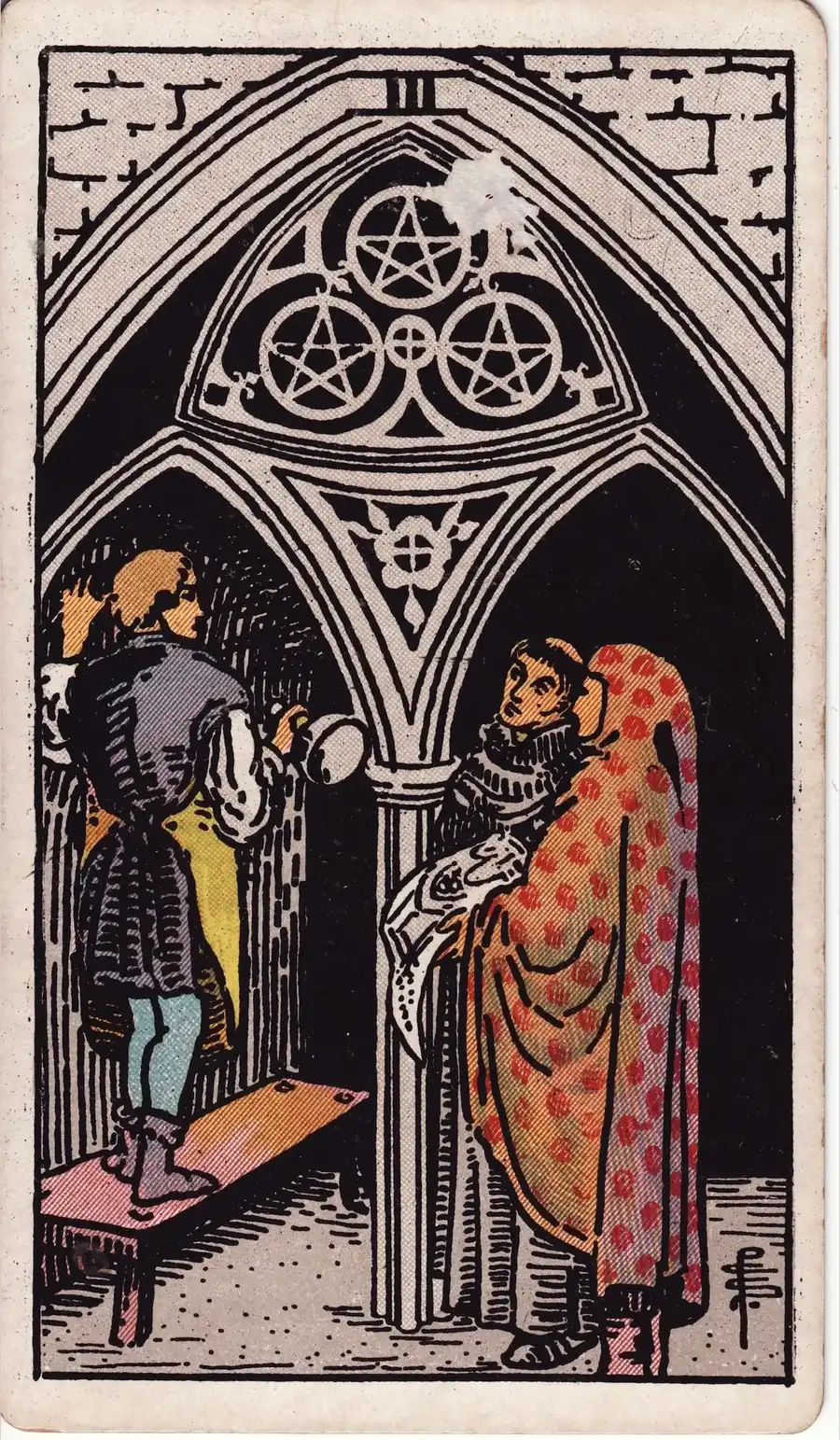
The Three of Pentacles shows a stonemason at work on the arch of a church, while a monk and a man holding the building plans stand below and talk with him. Three pentacles are carved into the arch.
It is a card of teamwork, skill and good work done together. This page covers what the Three of Pentacles means upright and reversed, the symbols in the 1909 card and how to read it in love and work.
Here is the Three of Pentacles at a glance.
| At a glance | This card |
|---|---|
| Upright keywords | collaboration, skill, teamwork |
| Reversed keywords | lack of teamwork, poor workmanship, disorganization |
| Number | 3 in the suit of Pentacles |
| Golden Dawn title | Lord of Material Works Later tradition |
| Astrology | Mars in Capricorn, second decan (10° to 20° Capricorn) Later tradition |
| Tree of Life | Binah (3), Understanding Later tradition |
| Suit and element | Pentacles, Earth Later tradition |
| Yes or no | Yes Modern |
Book T calls the Three of Pentacles the Lord of Material Works and gives it Mars in Capricorn, the middle decan of the sign, on Binah. Mars is exalted in Capricorn, so energy is disciplined and turned into skilled labour. The cathedral setting in Smith’s card is a good picture of work built to last.
Later tradition The Golden Dawn also gave each decan two of the 72 Goetic spirits, one for the day and one for the night. For the second decan of Capricorn, and so for the Three of Pentacles, they are Astaroth (spirit 29, day) and Andrealphus (spirit 65, night). Their pages read the old entries as history; see the spirit directory for all 72.
The card: what Pamela Colman Smith drew
Waite wrote: “A sculptor at his work in a monastery. Compare the design which illustrates the Eight of Pentacles. The apprentice or amateur therein has received his reward and is now at work in earnest.”
The craftsman. The mason stands on a bench at his work. His skill is in his hands.
The plans. One of the watchers holds the plans. Good work needs both a design and someone who can build it.
The church arch. The pentacles are carved into a sacred building. Work done well can be a kind of devotion.
Upright meaning
Upright, the Three of Pentacles is skilled teamwork. A stonemason works on the arch of a church, while a monk and a man holding the building plans stand below and talk with him. Three pentacles are carved into the arch. The card speaks of collaboration, craftsmanship and the value of each person’s skill.
It often appears when you are working on a project with others, learning a trade, or getting recognition for your expertise. Everyone in the picture brings something different: the mason his skill, the monk the purpose, the architect the plan.
Good work comes from listening as well as doing. The Three of Pentacles asks you to respect others’ expertise and share your own.
Reversed meaning
Reversed, the Three of Pentacles can show poor teamwork, conflicting visions or work done carelessly. It can also show a lack of recognition, or someone trying to do everything alone.
Ask whether everyone on your team knows the plan. A reversed Three often needs a clearer conversation, not more effort.
If you are learning a craft, the reversed Three may describe a mentor who is not teaching well, or a student who is not ready to listen. Either way, a frank talk about expectations usually helps more than silent frustration on both sides of the bench.
In love, work and spirituality
In love. Upright: Building a relationship together, with each partner contributing. Reversed: Not working as a team, or different visions for the future.
At work. Upright: Collaboration, apprenticeship and recognition for skill. Reversed: Conflict in the team, or poor-quality work.
With money. Upright: Money earned through skill and cooperation. Reversed: Financial disagreements in a team.
In spiritual practice. Upright: Learning a craft or tradition from a teacher, or building something sacred with a group. Reversed: Disagreements in a spiritual community.
As feelings. Respect and a wish to build something together.
As a person. A skilled, cooperative person who takes pride in their work.
As advice. Work together, and respect each person’s skill.
Reading the Three of Pentacles: positions and yes or no
In the past position: Good teamwork or a skill you learned brought you here. In the present position: Work with others and share your skills.
In the future position: A good project or a team effort is ahead. As advice: Ask for feedback.
In modern yes or no readings, the Three of Pentacles leans yes. Teamwork points to yes.
What the Three means, and the history behind the card
Three in Pentacles is the first time material work takes visible shape. The Golden Dawn’s Lord of Material Works is an exact description of the cathedral being built.
Here is how the Three looks across the four suits:
- Three of Wands: progress, foresight, exploration
- Three of Cups: celebration, friendship, creativity
- Three of Swords: heartbreak, sorrow, betrayal
- Three of Pentacles (this card): collaboration, skill, teamwork
Waite described the scene as a sculptor at work in a monastery. Look at the three people: the craftsman stands on a bench and does the work, a monk watches, and a third figure holds a sheet of plans.
Skill, purpose and design all meet in one picture. The three pentacles are carved into the stone arch above them in a triangle. Many readers use this card as a reminder that good work is rarely done alone, and that asking for feedback is part of the craft.
When A. E. Waite published The Pictorial Key to the Tarot in 1910, he listed these divinatory meanings for the Three of Pentacles: “Métier, trade, skilled labor; usually, however, regarded as a card of nobility, aristocracy, renown, glory.” Reversed, he gave: “Mediocrity, in work and otherwise, puerility, pettiness, weakness.”
Common questions
Is the Three of Pentacles a yes or no card? Yes. It shows good work and teamwork.
What does the Three of Pentacles mean for career? Recognition for skill, teamwork or a good project.
What does the Three of Pentacles mean in love? Building together. Reversed, not working as a team.
Try this
Try this small spread for the Three of Pentacles. Use it for a team project.
| Card | Question | What it shows |
|---|---|---|
| 1 | What do I bring? | My skill. |
| 2 | What do others bring? | Their skill. |
| 3 | How do we work well together? | One step. |
Affirmation: I contribute my skills and make room to learn from others.
Reversed affirmation: I clarify expectations and ask for the support the work requires.
If you keep a tarot journal, take one of these questions to it: What skill do I bring to my team? Whose skills do I underestimate? What would I build if I had the right helpers?
What next
Cards that sit close to this one are Eight of Pentacles (the apprentice before this card), The Hierophant (the Major Arcana card of teaching and tradition) and Three of Cups (another Three of shared effort).
The Three of Pentacles is part of the lesson Pentacles in my free Tarot for Beginners course. To see the whole suit on one page, go to the suit of Pentacles. To keep walking the suit, read the card before it, Two of Pentacles or the card after it, Four of Pentacles, or go back to all the card meanings.
For the suits and numbers in one place, see The Minor Arcana: suits and numbers made simple. For every card with keywords, affirmations and examples, see my book The Novice’s Guide to Tarot. If you would like a printable cheat sheet for all 78 cards, my 45-page Tarot Workbook is on Etsy.
Sources
- A. E. Waite, The Pictorial Key to the Tarot (London: Rider, 1910), Part III, sections 1 and 2.
- Pamela Colman Smith and A. E. Waite, the Rider-Waite-Smith tarot (London: Rider, 1909).
- Nicolas Conver, Tarot de Marseille (Marseille, 1760).
- Lauri Mukkala, The Novice’s Guide to Tarot, entry for the Three of Pentacles.
- Aleister Crowley, 777 (London: Walter Scott, 1909), columns of the decans, the Minor Arcana and the court cards.
- Israel Regardie, ed., The Golden Dawn (Chicago: Aries Press, 1937 to 1940), “Book T”, titles and attributions of the small cards and the court.
All 78 cards
Major Arcana
- The Fool
- The Magician
- The High Priestess
- The Empress
- The Emperor
- The Hierophant
- The Lovers
- The Chariot
- Strength
- The Hermit
- Wheel of Fortune
- Justice
- The Hanged Man
- Death
- Temperance
- The Devil
- The Tower
- The Star
- The Moon
- The Sun
- Judgement
- The World
Wands
- Ace of Wands
- Two of Wands
- Three of Wands
- Four of Wands
- Five of Wands
- Six of Wands
- Seven of Wands
- Eight of Wands
- Nine of Wands
- Ten of Wands
- Page of Wands
- Knight of Wands
- Queen of Wands
- King of Wands
Cups
- Ace of Cups
- Two of Cups
- Three of Cups
- Four of Cups
- Five of Cups
- Six of Cups
- Seven of Cups
- Eight of Cups
- Nine of Cups
- Ten of Cups
- Page of Cups
- Knight of Cups
- Queen of Cups
- King of Cups
Swords
- Ace of Swords
- Two of Swords
- Three of Swords
- Four of Swords
- Five of Swords
- Six of Swords
- Seven of Swords
- Eight of Swords
- Nine of Swords
- Ten of Swords
- Page of Swords
- Knight of Swords
- Queen of Swords
- King of Swords
Pentacles
Get the free Mini-Grimoire
A short printable starter guide to tarot and everyday witchcraft, plus my newsletter. Unsubscribe any time.
Opens Substack in a new tab to confirm. More about the newsletter · Privacy