


| Arcana | Minor Arcana: Cups |
|---|---|
| Image | RWS 1909 (PD) |
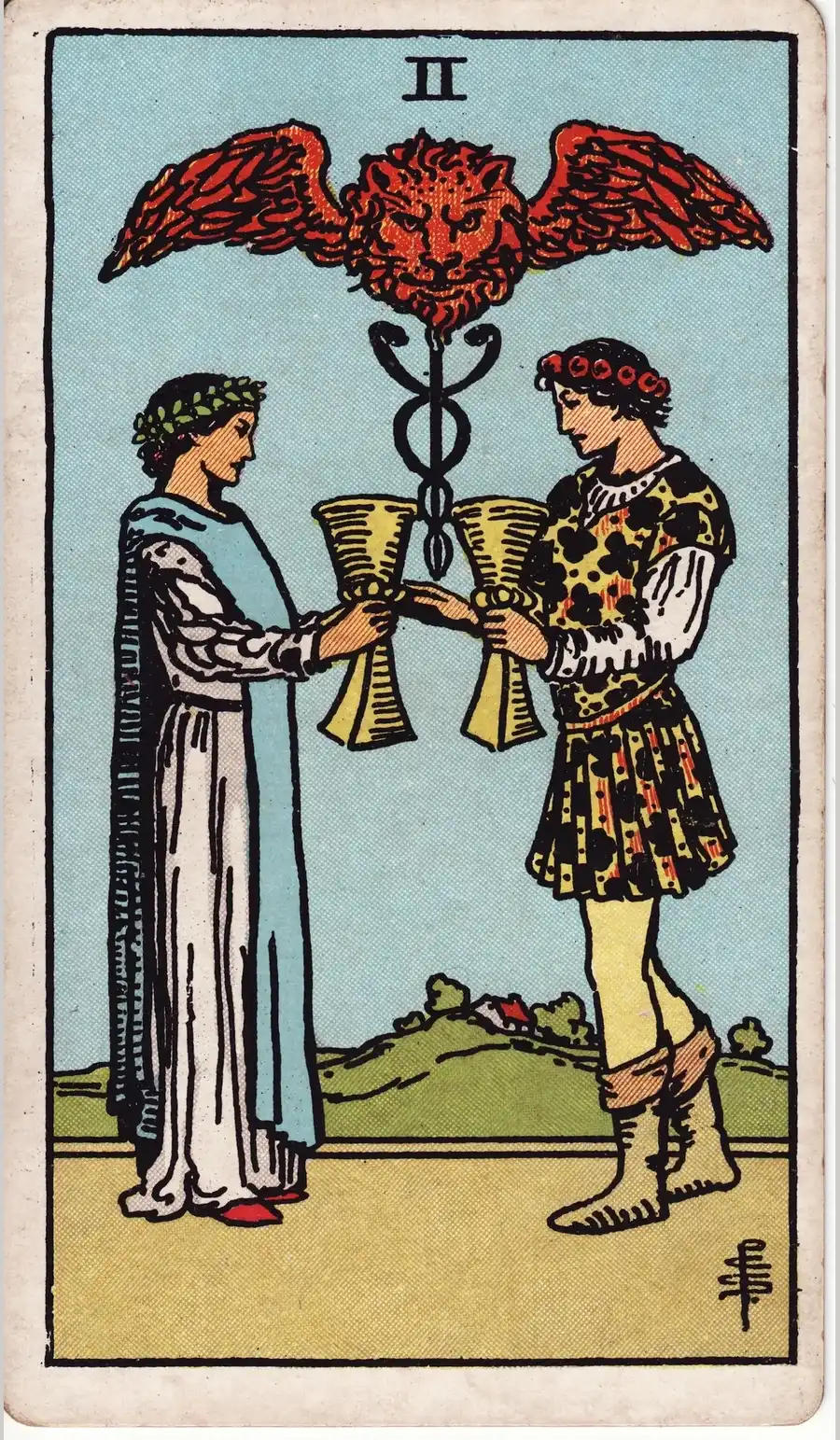
The Two of Cups shows two young people facing each other and exchanging cups, as if making a promise. Above them floats a winged lion’s head on a staff with two snakes.
It is a card of partnership, mutual attraction and a bond that works both ways. Here is what the Two of Cups means upright and reversed, what Pamela Colman Smith drew in 1909 and how to read it in love, work and friendship.
Here is the Two of Cups at a glance.
| At a glance | This card |
|---|---|
| Upright keywords | unity, partnership, mutual attraction |
| Reversed keywords | imbalance, disharmony, separation |
| Number | 2 in the suit of Cups |
| Golden Dawn title | Lord of Love Later tradition |
| Astrology | Venus in Cancer, first decan (0° to 10° Cancer) Later tradition |
| Tree of Life | Chokmah (2), Wisdom Later tradition |
| Suit and element | Cups, Water Later tradition |
| Yes or no | Yes Modern |
Book T calls the Two of Cups the Lord of Love and gives it Venus in Cancer, the first decan of the sign, on Chokmah. Venus in the most nurturing of the water signs is about as clear a picture of affection as astrology offers. The winged lion over the caduceus in Smith’s card has been read since Waite’s time as a sign of union blessed by something higher.
Later tradition The Golden Dawn also gave each decan two of the 72 Goetic spirits, one for the day and one for the night. For the first decan of Cancer, and so for the Two of Cups, they are Buer (spirit 10, day) and Bifrons (spirit 46, night). Their pages read the old entries as history; see the spirit directory for all 72.
The card: what Pamela Colman Smith drew
Waite wrote: “A youth and maiden are pledging one another, and above their cups rises the Caduceus of Hermes, between the great wings of which there appears a lion’s head.”
He added that this is “a variant of a sign which is found in a few old examples of this card”, which is true: some older decks put a decorative emblem between the two cups.
The pledge. They hold their cups out toward each other at the same height. Neither gives more than the other. That is the heart of the card: reciprocity.
The caduceus. The staff with two snakes is the caduceus of Hermes, the messenger god. Two forces twine around one center, a good picture of two people who stay themselves and still meet.
The winged lion. The lion’s head with wings sits above the snakes. Many readers see passion (the lion) lifted by spirit (the wings). The attraction is real, and so is the care.
Upright meaning
Upright, the Two of Cups is a meeting of equals. Two young people face each other and exchange cups as if making a vow. Above them floats a winged lion’s head over a staff entwined with two snakes, an image of union and healing. The card speaks of mutual attraction, partnership, friendship and the beginning of a bond in which both people give and receive.
It is often a love card, but it is not only romantic. Any partnership in which there is respect and real feeling, a business partnership, a deep friendship, reconciliation after a quarrel, can appear here. The important thing is the balance. They meet on the same level and look each other in the eye.
The Two of Cups asks you to notice the connections that are mutual. Invest in those.
Reversed meaning
Reversed, the Two of Cups shows imbalance: one person giving more, a misunderstanding, or a bond strained by distance or mismatched expectations. It can also show a breakup or the end of a friendship, though often it points to a quarrel that can be repaired.
Ask what each of you needs, and say it plainly. If the bond is worth keeping, repair begins with a small, sincere gesture rather than a big speech.
Look at who holds the larger share of the exchange. If you always reach first, apologize first or plan first, the reversed Two may be asking you to wait and see whether the other person reaches back. Mutual bonds survive a pause. One-sided ones show themselves in it.
In love, work and spirituality
In love. Upright: Mutual attraction, a new relationship, or a commitment between equals. Reversed: Imbalance, a quarrel, or a relationship drifting apart.
At work. Upright: A good partnership, collaboration based on respect, or a contract signed in good faith. Reversed: Disagreement with a partner, or a deal that is unequal.
With money. Upright: A financial partnership that benefits both sides. Reversed: Money tension in a partnership.
In spiritual practice. Upright: Working with a partner, or honoring the divine as a beloved. Reversed: Feeling disconnected from your spiritual partner or community.
As feelings. Mutual attraction and real affection. They feel connected to you.
As a person. A loving partner or close friend who meets you as an equal.
As advice. Meet the other person halfway, and keep the exchange balanced.
Reading the Two of Cups: positions and yes or no
In the past position: A meaningful connection shaped who you are now. In the present position: A balanced bond is here. Nurture it.
In the future position: A new partnership or a renewed closeness is coming. As advice: Meet the other person halfway.
In modern yes or no readings, the Two of Cups leans yes. Mutual feeling points to yes.
What the Two means, and the history behind the card
In the water suit, the Two is the first meeting of two hearts. The Golden Dawn’s title, Lord of Love, is the simplest name in the whole set of small cards, and the picture lives up to it.
Here is how the Two looks across the four suits:
- Two of Wands: planning, decisions, expansion
- Two of Cups (this card): unity, partnership, mutual attraction
- Two of Swords: indecision, stalemate, difficult choices
- Two of Pentacles: balance, adaptability, time management
When A. E. Waite published The Pictorial Key to the Tarot in 1910, he listed these divinatory meanings for the Two of Cups: “Love, passion, friendship, affinity, union, concord, sympathy, the inter-relation of the sexes, and, as a suggestion apart from all offices of divination, that desire which is not in Nature, but by which Nature is sanctified.”
Reversed, he gave: “.”
Common questions
Is the Two of Cups a yes or no card? Yes. It is one of the strongest love and partnership cards.
What does the Two of Cups mean in love? Mutual attraction, partnership and real connection. Reversed, an imbalance or a rift.
Can the Two of Cups mean friendship? Yes. It can describe any bond built on mutual respect, including friendship and business partnerships.
Try this
Try this small spread for the Two of Cups. Use it to look at any partnership.
| Card | Question | What it shows |
|---|---|---|
| 1 | What do I bring? | My part in the bond. |
| 2 | What do they bring? | Their part in the bond. |
| 3 | What does our connection need? | One way to keep it balanced. |
Affirmation: I build connections on mutual regard and clear care.
Reversed affirmation: I name imbalance and choose honesty over quiet resentment.
If you keep a tarot journal, take one of these questions to it: Which of my relationships feels truly mutual? What do I bring to my closest bonds? Where am I giving more than I receive, or the other way around?
What next
Cards that sit close to this one are The Lovers (the Major Arcana card of union and choice), Ten of Cups (the shared happiness that a bond like this can grow into) and Two of Pentacles (another Two, about juggling rather than joining).
The Two of Cups is part of the lesson Cups in my free Tarot for Beginners course. To see the whole suit on one page, go to the suit of Cups. To keep walking the suit, read the card before it, Ace of Cups or the card after it, Three of Cups, or go back to all the card meanings.
For the suits and numbers in one place, see The Minor Arcana: suits and numbers made simple. For every card with keywords, affirmations and examples, see my book The Novice’s Guide to Tarot. If you would like a printable cheat sheet for all 78 cards, my 45-page Tarot Workbook is on Etsy.
Sources
- A. E. Waite, The Pictorial Key to the Tarot (London: Rider, 1910), Part III, sections 1 and 2.
- Pamela Colman Smith and A. E. Waite, the Rider-Waite-Smith tarot (London: Rider, 1909).
- Nicolas Conver, Tarot de Marseille (Marseille, 1760).
- Lauri Mukkala, The Novice’s Guide to Tarot, entry for the Two of Cups.
- Aleister Crowley, 777 (London: Walter Scott, 1909), columns of the decans, the Minor Arcana and the court cards.
- Israel Regardie, ed., The Golden Dawn (Chicago: Aries Press, 1937 to 1940), “Book T”, titles and attributions of the small cards and the court.
All 78 cards
Major Arcana
- The Fool
- The Magician
- The High Priestess
- The Empress
- The Emperor
- The Hierophant
- The Lovers
- The Chariot
- Strength
- The Hermit
- Wheel of Fortune
- Justice
- The Hanged Man
- Death
- Temperance
- The Devil
- The Tower
- The Star
- The Moon
- The Sun
- Judgement
- The World
Wands
- Ace of Wands
- Two of Wands
- Three of Wands
- Four of Wands
- Five of Wands
- Six of Wands
- Seven of Wands
- Eight of Wands
- Nine of Wands
- Ten of Wands
- Page of Wands
- Knight of Wands
- Queen of Wands
- King of Wands
Cups
- Ace of Cups
- Two of Cups
- Three of Cups
- Four of Cups
- Five of Cups
- Six of Cups
- Seven of Cups
- Eight of Cups
- Nine of Cups
- Ten of Cups
- Page of Cups
- Knight of Cups
- Queen of Cups
- King of Cups
Swords
- Ace of Swords
- Two of Swords
- Three of Swords
- Four of Swords
- Five of Swords
- Six of Swords
- Seven of Swords
- Eight of Swords
- Nine of Swords
- Ten of Swords
- Page of Swords
- Knight of Swords
- Queen of Swords
- King of Swords
Pentacles
Get the free Mini-Grimoire
A short printable starter guide to tarot and everyday witchcraft, plus my newsletter. Unsubscribe any time.
Opens Substack in a new tab to confirm. More about the newsletter · Privacy