


How to read the labels Historical what the old sources say. Later tradition what later writers added. Modern modern practice and my own notes.
| Number | 10 of 72 |
|---|---|
| Rank | President |
| Legions | 50 |
| Office (1904) | Teaches philosophy, both moral and natural. |
| Other spellings | none common |
Buer is number 10 in the catalog of 72 spirits that opens the Lesser Key of Solomon. The 1904 edition by S. L. MacGregor Mathers and Aleister Crowley calls him a president ruling 50 legions, and the first office it gives him is this: Buer teaches philosophy, both moral and natural.
Here I go through his entry layer by layer: the old text first, then what later centuries added, then modern practice, each part labeled so you can see how old it is.
If you came here wondering whether Buer suits a beginner, the short answer is in the Practical notes below: he meets the three beginner criteria I use, though his entry, like most, is mixed.
At a glance
Historical These are the facts of the entry itself, from the 1904 text and its Observations.
- Number: 10 of 72, in the 1904 order.
- Name and spellings: Buer in 1904; other spellings: none common.
- Rank and legions: President, 50 legions.
- Metal of his rank (Observations): mercury.
- Hours for presidents (Observations): “At any time, excepting Twilight, at Night, unless the King whom they are under be Invocated.”
- In Weyer’s catalog (1577): yes, as the source comparison below shows.
The Observations also say to work only when the Moon is 2, 4, 6, 8, 10, 12 or 14 days old. These rules show how the Goetia imagined its spirits, as officials with office hours. You do not need them to read the entry, and the facts table above gives the short version.
The seal (1904)
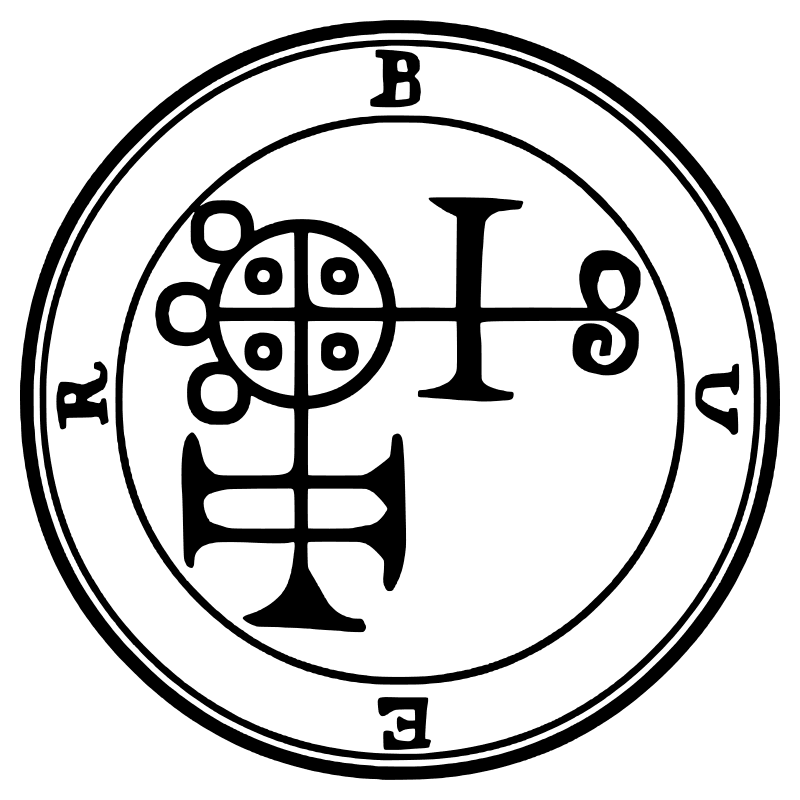
Historical The seal shown above is Buer’s seal as printed in the 1904 edition, in a faithful vector drawing of that public-domain printing. The Observations ask for each seal to be made in the metal of the spirit’s rank, which for Buer means mercury. In the text’s world the seal identifies the spirit and protects the magician; several entries say it is worn on the breast as a lamen.
Seals are not identical from one source to the next. The 1904 versions follow the manuscripts Mathers used, and later books and websites sometimes redraw, simplify or mix them. If two seals for the same spirit disagree, ask which edition each one follows.
Modern Looking at a seal does nothing on its own; it is a drawing in an old book. Modern practitioners almost always draw seals on paper rather than casting them in metal. Mercury, the metal of presidents, is a toxic liquid metal: never handle it or try to make anything from it. Copying Buer’s seal slowly by hand is also a good study exercise, because you notice lines and circles that the eye skips.
Appearance
Historical Buer “appeareth in Sagittary, and that is his shape when the Sun is there.” The text seems to mean the shape of the sign, the centaur archer, though it does not say so.
Offices in the Ars Goetia
Historical These are all the offices the 1904 text gives him, in the order it gives them.
- Teaches philosophy, both moral and natural.
- Teaches the art of logic.
- Teaches the virtues of all herbs and plants.
- Heals all distempers in man.
- Gives good familiars.
He governs 50 legions.
Offices of harm or compulsion are part of the historical record, and reporting them is not endorsing them. For how offices work across the 72, see ranks and offices.
Source comparison: Weyer and Scot
Historical Scot’s Weyer says Buer “is seene in this signe,” referring back to Sagittarius in the previous entry for Barbatos. He “absolutelie teacheth philosophie morall and naturall, and also logicke, and the vertue of herbes,” gives “the best familiars,” and “can heale all diseases, speciallie of men.” The Goetia is a close copy.
Weyer’s catalog appeared in 1577 and Reginald Scot translated it into English in 1584. Comparing the two with the 1904 text shows how much the Goetia owes to them, and where it changed or added things. More in Weyer and Scot.
Later tradition
Later tradition Collin de Plancy’s Dictionnaire Infernal shows Buer as a lion’s head surrounded by five goat legs, arranged like a wheel. This striking image is the illustrator’s invention, not the Goetia’s description.
Modern practice and pop culture
Modern Modern practitioners often approach Buer for help with herbal study and health. Remember that his “healing” office is a claim in a seventeenth-century text. It is not medicine.
Some things said about Buer online are not in any grimoire at all: personalities, favorite foods, signs that a spirit has “picked” someone, or birth demons. They come from modern writing and social media. Treat them as one person’s experience, not as facts about the old text.
Beginner’s quick reference
Each line below is labeled by layer, so you can see how old each piece is.
- Rank metal and hours (Goetia): President: mercury (toxic; never handle it); any time except twilight or night, unless his king is invoked (the wording is unclear).
- Planet (later tradition: Golden Dawn and Crowley’s 777): Mercury.
- Decan and day or night spirit (later tradition: 777): Cancer, first decan (0 to 10 degrees); day spirit. 777 decan incense: camphor (irritating smoke; not for beginners).
- Commonly reported color, incense, and plant (modern UPG; sources copy each other): Color orange; incense storax; plant aloe (toxic to cats).
- Associated symbols: Goetia image: none; the Goetia gives Buer no figure and says only that he “appeareth in Sagittary”; herbs belong to his office. 777 Magical Image: “Probably a centaur or archer,” Crowley’s guess from the sign. Le Breton engraving (1863): a lion’s head ringed by five goat legs, like a wheel. Modern Demonolatry/UPG: the seal, used as an altar image.
- Associated offerings: Modern practice, not in the Goetia manuscripts: most often listed, storax, then acacia, angelica, and vervain.
Incense means smoke. If you burn any, use a stick or cone with a window open, no charcoal indoors, and none at all in a home with pet birds or anyone with asthma. A plant listed here is a correspondence, not something to eat or burn, and a plant without a warning is not automatically safe. Modern offering lists copy one another, so “most often listed” means widely copied, not confirmed. Water, light, time or a note of thanks is always enough.
Practical notes
Buer fits the beginner criteria well. He is a president, not a king, and his offices center on philosophy, logic, and the study of plants. A question about how to approach the study of ethics, logic, or botany would suit a first contact. Do not use contact work in place of medical care, and never take an herb internally on the basis of an “answer” from practice. Check any plant with reliable sources and, where health is concerned, a doctor or pharmacist.
The beginner criteria I use have three parts: the spirit is not a king, at least one office is teaching, and the entry does not center on harm, deception or compulsion. In the directory, Buer is counted among the 31 spirits that fit.
To compare Buer with other spirits of his rank, read Marbas and Botis. Presidents are a group of 14 in the 1904 Classified List, several of whom hold a second rank. Their metal in the Observations is mercury, and their hour rule is the most confusing sentence in that section. Many presidents have teaching offices: arts and sciences, herbs, logic or astronomy.
How to study this entry
Studying Buer needs only the texts, a notebook and some patience. This is the method I suggest for every entry.
- Read the offices above in order and write each one in your own words.
- Compare the 1904 wording with Scot’s English in The Discoverie of Witchcraft (Book 15, chapter 2), which is free to read online.
- Copy the seal by hand, slowly, and note anything you missed at first glance.
- Keep a two-column log: what the text says on the left, and what you have read online or feel about it on the right.
Then go back to all 72 spirits and read a neighbor or two. The entries make more sense side by side than alone.
Get the free Mini-Grimoire
A short printable starter guide to tarot and everyday witchcraft, plus my newsletter. Unsubscribe any time.
Opens Substack in a new tab to confirm. More about the newsletter · Privacy