


How to read the labels Historical what the old sources say. Later tradition what later writers added. Modern modern practice and my own notes.
| Number | 34 of 72 |
|---|---|
| Rank | Earl |
| Legions | 26 |
| Office (1904) | Never speaks truth "unless he be compelled, or brought up within a triangle." |
| Other spellings | Furtur |
Furfur is number 34 in the catalog of 72 spirits that opens the Lesser Key of Solomon. The 1904 edition by S. L. MacGregor Mathers and Aleister Crowley calls him an earl ruling 26 legions, and the first office it gives him is this: Furfur never speaks truth “unless he be compelled, or brought up within a triangle.”
His image, a stag with a fiery tail, is one of the most memorable in the Goetia. Each part below carries a label for its layer, explained in how to read a spirit page.
At a glance
| Fact | In the entry |
|---|---|
| Number | 34 of 72, in the 1904 order. |
| Name and spellings | Furfur in 1904; other spellings: Furtur. |
| Rank and legions | Earl, 26 legions. |
| Metal of his rank (Observations) | Copper and silver. |
| Hours for earls (Observations) | “Any hour of the Day, so it be in Woods, or in any other places whither men resort not, or where no noise is.” |
| In Weyer’s catalog (1577) | Yes, as the source comparison below shows. |
The 1904 entry
Historical The full entry from the 1904 edition, with footnote numbers and the dash after the heading left out and the heading set in ordinary type:
Furfur. The Thirty-fourth Spirit is Furfur. He is a Great and Mighty Earl, appearing in the Form of an Hart with a Fiery Tail. He never speaketh truth unless he be compelled, or brought up within a triangle. Being therein, he will take upon himself the Form of an Angel. Being bidden, he speaketh with a hoarse voice. Also he will wittingly urge Love between Man and Woman. He can raise Lightnings and Thunders, Blasts, and Great Tempestuous Storms. And he giveth True Answers both of Things Secret and Divine, if commanded. He ruleth over 26 Legions of Spirits. And his Seal is this, etc.
Furfur is “a Great and Mighty Earl” who appears as “an Hart with a Fiery Tail”. He “never speaketh truth unless he be compelled, or brought up within a triangle”, where he takes the form of an angel and speaks hoarsely. He urges love “between Man and Woman”, raises lightning, thunder and storms, and gives true answers “of Things Secret and Divine, if commanded”. “Hart” is an old word for a male deer.
Appearance
Historical Furfur appears “in the Form of an Hart with a Fiery Tail.” Brought into the triangle, he “will take upon himself the Form of an Angel.” Bidden, he speaks “with a hoarse voice.”
Offices in the Ars Goetia
Historical The offices of Furfur, in the order the 1904 text gives them:
- Never speaks truth “unless he be compelled, or brought up within a triangle.”
- Willingly urges love between man and woman. Reported as history; not taught here.
- Can raise lightnings, thunders, blasts, and great tempestuous storms. Reported as history; not taught here.
- Gives true answers of things secret and divine, if commanded.
Source comparison: Weyer and Scot
Historical Scot’s translation of Weyer gives “Furfur” as “a great earle, appearing as an hart, with a firie taile,” who “lieth in everie thing, except he be brought up within a triangle.” Weyer has him make “love betweene man and wife,” a narrower phrase than the Goetia’s “Man and Woman.” The storms and answers match. Both give 26 legions.
Historical Weyer’s Latin is “cervus cauda flammea” and “in omnibus mentitur”, he lies in everything, unless brought into the triangle. Where the Latin says love “inter virum et mulierem”, between man and woman, Scot narrowed it to “man and wife”. The Latin adds that he raises storms “in ijs partibus ubi iussum fuerit”, in the places where he is ordered. (About Weyer and Scot.)
Name and etymology
Historical Latin furfur means bran or husks. Whether the name was meant to carry that meaning is unknown.
Seal and images
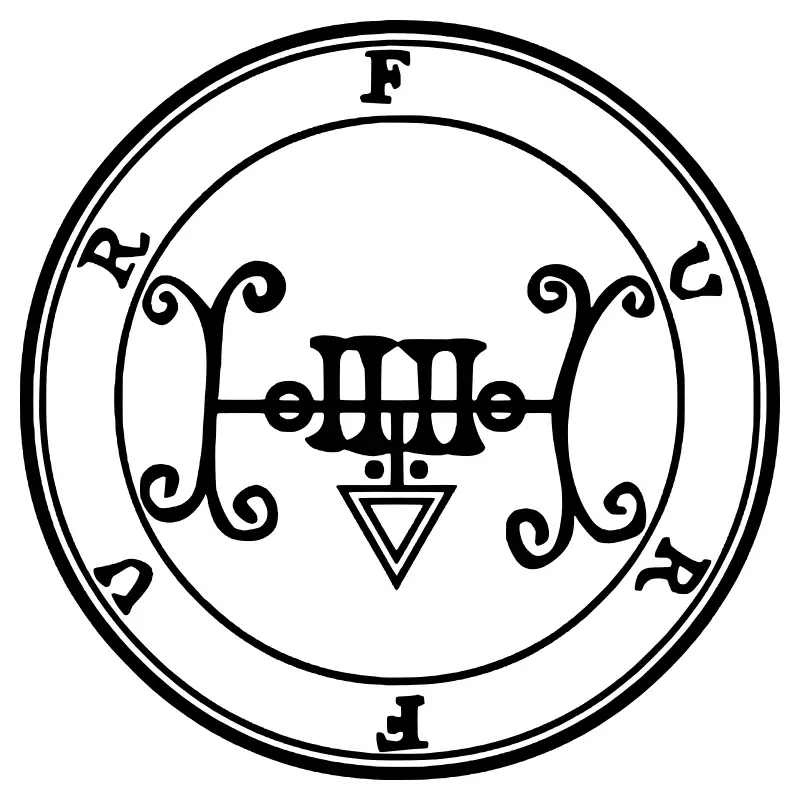
Historical The seal above is Furfur’s as printed in 1904, and by the rules of the Observations it would be made in copper and silver, the metal of his rank. Why seals were worn, why editions draw them differently and how to study one are explained in seals, circle and triangle.
Later tradition and modern practice
Later tradition The fiery-tailed stag is one of the more memorable images in the Goetia. Collin de Plancy’s Dictionnaire Infernal (1863 edition) illustrates Furfur as a winged stag with clawed forelegs; the fiery tail is not shown.
Modern Modern writers sometimes approach Furfur for weather magic or for relationships. Both are modern applications of offices the text frames as dangerous.
Lore about Furfur’s personality, likes or chosen people is modern, not grimoire material; modern approaches explains where such claims come from.
Beginner’s quick reference
| Item | What the sources say |
|---|---|
| Rank metal and hours (Goetia) | Earl: copper and silver; any hour of the day, in woods or other quiet places. |
| Planet (later tradition: Golden Dawn and Crowley’s 777) | Mars. For earls, 777 gives Mars, following the 1904 editor’s note, rather than the Venus and Moon of their copper and silver. |
| Decan and day or night spirit (later tradition: 777) | Pisces, first decan (0 to 10 degrees); day spirit. 777 decan incense: thyme. Tarot card of the decan: Eight of Cups. |
| Commonly reported color, incense, and plant (modern UPG; sources copy each other) | Color red; incense dragon’s blood; plant cypress. |
| Associated symbols | Goetia image: a hart with a fiery tail; later an angel; a hoarse voice. 777 Magical Image: the same image. Le Breton engraving (1863): a winged stag. Modern Demonolatry/UPG: the seal, used as an altar image. |
| Associated offerings | Modern practice, not in the Goetia manuscripts: most often listed, cypress and dragon’s blood resin. |
Before you burn or handle anything listed for Furfur, read incense, plants and offerings.
Practical notes
Furfur is said to lie unless constrained in the triangle, and his offices include storms and love work. The beginner criteria would not suggest this spirit for a first contact. The approach I describe uses no triangle and no constraint, which is one reason I do not recommend spirits that the text says will deceive without them.
In the directory, Furfur is not among the 30 spirits that fit the beginner criteria.
Try this: one question to study
Mark the conditions in Furfur’s entry (“unless”, “if commanded”) and note how many of his offices depend on them.
What next
To compare Furfur with other spirits of his rank, read Halphas and Raum.
Later tradition In the Golden Dawn scheme of the decans, Furfur is the day spirit of the first decan of Pisces, which belongs to the Eight of Cups; the night spirit of the same decan is Seere (spirit 70).
Common questions
Is Furfur a good spirit for beginners?
Not as a first choice. He does not meet all three beginner criteria I use: not a king, at least one teaching office, and no central harm, deception or compulsion. His entry is still worth reading as history.
What does Furfur do in the Ars Goetia?
The 1904 text calls him an earl ruling 26 legions. Its first office for him is this: Furfur never speaks truth "unless he be compelled, or brought up within a triangle." The entry lists 4 offices in all.
Does looking at Furfur's seal call him?
No. Reading a name or looking at a seal does not call a spirit. The seal is a drawing from a 1904 book, and even the grimoire itself required long rituals for its own purposes.
Get the free Mini-Grimoire
A short printable starter guide to tarot and everyday witchcraft, plus my newsletter. Unsubscribe any time.
Opens Substack in a new tab to confirm. More about the newsletter · Privacy