


| Arcana | Minor Arcana: Cups |
|---|---|
| Image | RWS 1909 (PD) |
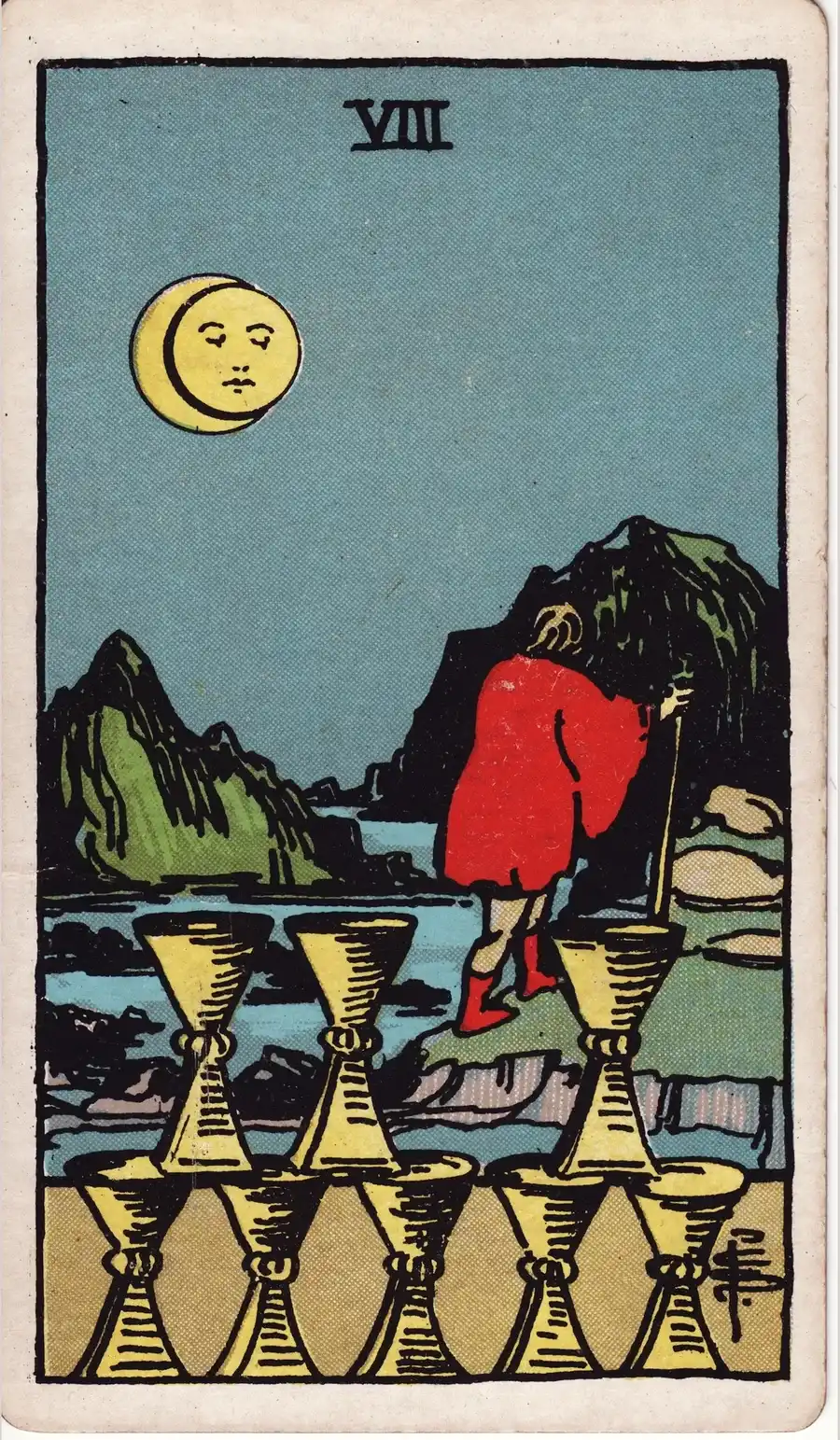
The Eight of Cups shows a figure in a red cloak walking away from eight neatly stacked cups, leaning on a staff and heading into rocky hills at night. Above, the moon watches with a face.
It is a card of walking away, letting go and looking for deeper meaning. Here is what the Eight of Cups means upright and reversed, the symbols in the 1909 card and a spread for knowing when to leave.
Here is the Eight of Cups at a glance.
| At a glance | This card |
|---|---|
| Upright keywords | walking away, letting go, seeking meaning |
| Reversed keywords | avoidance, fear of change, stagnation |
| Number | 8 in the suit of Cups |
| Golden Dawn title | Lord of Abandoned Success Later tradition |
| Astrology | Saturn in Pisces, first decan (0° to 10° Pisces) Later tradition |
| Tree of Life | Hod (8), Splendour Later tradition |
| Suit and element | Cups, Water Later tradition |
| Yes or no | No Modern |
Book T calls the Eight of Cups the Lord of Abandoned Success and gives it Saturn in Pisces, the first decan of the sign, on Hod. Saturn’s sober weight in the dreamy last sign of the zodiac suits a card about leaving behind something that no longer satisfies. The success is real, but it has been abandoned on purpose.
Later tradition The Golden Dawn also gave each decan two of the 72 Goetic spirits, one for the day and one for the night. For the first decan of Pisces, and so for the Eight of Cups, they are Furfur (spirit 34, day) and Seere (spirit 70, night). Their pages read the old entries as history; see the spirit directory for all 72.
The card: what Pamela Colman Smith drew
Waite wrote: “A man of dejected aspect is deserting the cups of his felicity, enterprise, undertaking or previous concern.” Felicity means happiness. Smith set the scene at night, with a moon that seems to be both full and waning at once.
The stacked cups. The eight cups are stacked carefully, but there is a gap in the top row. Something is missing, even though the arrangement looks complete from outside.
The walker with a staff. He leaves on foot with a walking staff, like a pilgrim. This is a chosen departure, not a rescue. He will have to walk the whole way himself.
The moon. The moon shows a face and seems to be in two phases at once. Many readers see a time of change and intuition, when you trust a feeling you cannot fully explain.
Upright meaning
Upright, the Eight of Cups is walking away. A figure in a red cloak leaves eight neatly stacked cups behind and climbs into rocky hills under a watching moon. Nothing is broken. The cups are still there. But something is missing, and he has decided to look for it elsewhere.
The card appears when a job, relationship or way of life looks fine from the outside but no longer feels true. It speaks of the courage to leave what is comfortable for what is meaningful, even when you do not yet know what you will find. It also speaks of solitude and introspection.
Leaving is not failure. The gap in the stack of cups shows what is missing, and that gap is worth taking seriously.
Reversed meaning
Reversed, the Eight of Cups can show someone staying out of fear or habit, or wandering away from everything without ever committing to anything. It can also show a return: deciding that what you left was worth going back to.
Ask whether you are leaving to find something or to avoid something. If you are staying, make sure it is a real choice, not a default.
Some readers treat the reversed Eight as a sign to try one more honest repair before leaving: a conversation, a change of role, a clear request. If that repair fails, the walk into the hills becomes easier, because you know you looked properly at what you were leaving.
In love, work and spirituality
In love. Upright: Walking away from a relationship that no longer feels right, or needing time alone. Reversed: Staying out of fear, or returning to a former partner.
At work. Upright: Leaving a stable job for something more meaningful. Reversed: Fear of change keeping you stuck, or drifting without direction.
With money. Upright: Leaving security for a more meaningful path. Reversed: Clinging to security that no longer satisfies you.
In spiritual practice. Upright: A spiritual quest or pilgrimage, or leaving a tradition that no longer fits. Reversed: Running from one path to another without depth.
As feelings. Restless and withdrawn. They may be emotionally pulling away.
As a person. A seeker who cannot settle for less than meaning.
As advice. Leave what no longer fulfills you, and walk toward meaning.
Reading the Eight of Cups: positions and yes or no
In the past position: You walked away from something, and that choice still shapes you. In the present position: Something no longer feeds you. Admit it.
In the future position: A departure or a search for meaning is ahead. As advice: Leave kindly and on purpose.
In modern yes or no readings, the Eight of Cups leans no. It is a card of leaving, so it leans no for staying the course.
What the Eight means, and the history behind the card
Eight is movement after testing, and in Cups the movement is leaving. Abandoned Success, the Golden Dawn’s title, is a fine description of a choice most people find hard.
Here is how the Eight looks across the four suits:
- Eight of Wands: swift action, movement, progress
- Eight of Cups (this card): walking away, letting go, seeking meaning
- Eight of Swords: restriction, imprisonment, fear
- Eight of Pentacles: diligence, craftsmanship, skill development
When A. E. Waite published The Pictorial Key to the Tarot in 1910, he listed these divinatory meanings for the Eight of Cups: “The card speaks for itself on the surface, but other readings are entirely antithetical, giving joy, mildness, timidity, honor, modesty.”
Reversed, he gave: “Great joy, happiness, feasting.”
Common questions
Is the Eight of Cups a yes or no card? It leans no. It is about leaving rather than continuing.
What does the Eight of Cups mean in love? Walking away from a relationship that has lost its meaning, or one partner withdrawing. Reversed, fear of leaving.
Does the Eight of Cups always mean leaving? Not always physically. It can also mean letting go of an attitude, a hope or a role.
Try this
Try this small spread for the Eight of Cups. Use it when you are wondering whether to walk away.
| Card | Question | What it shows |
|---|---|---|
| 1 | What am I leaving? | The situation that no longer feeds me. |
| 2 | Why now? | The real reason this is ending. |
| 3 | What am I seeking? | The meaning I am walking toward. |
Affirmation: I leave what no longer sustains me and walk toward meaning.
Reversed affirmation: I face the choice to stay differently or go, without endless delay.
If you keep a tarot journal, take one of these questions to it: What looks complete but feels empty to me? What am I walking toward, even if I cannot see it yet? What would a kind goodbye look like here?
What next
Cards that sit close to this one are The Hermit (the Major Arcana card of the solitary search for meaning), Four of Cups (the boredom that often comes before leaving) and Six of Swords (another departure, toward calmer water).
The Eight of Cups is part of the lesson Cups in my free Tarot for Beginners course. To see the whole suit on one page, go to the suit of Cups. To keep walking the suit, read the card before it, Seven of Cups or the card after it, Nine of Cups, or go back to all the card meanings.
For the suits and numbers in one place, see The Minor Arcana: suits and numbers made simple. For every card with keywords, affirmations and examples, see my book The Novice’s Guide to Tarot. If you would like a printable cheat sheet for all 78 cards, my 45-page Tarot Workbook is on Etsy.
Sources
- A. E. Waite, The Pictorial Key to the Tarot (London: Rider, 1910), Part III, sections 1 and 2.
- Pamela Colman Smith and A. E. Waite, the Rider-Waite-Smith tarot (London: Rider, 1909).
- Nicolas Conver, Tarot de Marseille (Marseille, 1760).
- Lauri Mukkala, The Novice’s Guide to Tarot, entry for the Eight of Cups.
- Aleister Crowley, 777 (London: Walter Scott, 1909), columns of the decans, the Minor Arcana and the court cards.
- Israel Regardie, ed., The Golden Dawn (Chicago: Aries Press, 1937 to 1940), “Book T”, titles and attributions of the small cards and the court.
All 78 cards
Major Arcana
- The Fool
- The Magician
- The High Priestess
- The Empress
- The Emperor
- The Hierophant
- The Lovers
- The Chariot
- Strength
- The Hermit
- Wheel of Fortune
- Justice
- The Hanged Man
- Death
- Temperance
- The Devil
- The Tower
- The Star
- The Moon
- The Sun
- Judgement
- The World
Wands
- Ace of Wands
- Two of Wands
- Three of Wands
- Four of Wands
- Five of Wands
- Six of Wands
- Seven of Wands
- Eight of Wands
- Nine of Wands
- Ten of Wands
- Page of Wands
- Knight of Wands
- Queen of Wands
- King of Wands
Cups
- Ace of Cups
- Two of Cups
- Three of Cups
- Four of Cups
- Five of Cups
- Six of Cups
- Seven of Cups
- Eight of Cups
- Nine of Cups
- Ten of Cups
- Page of Cups
- Knight of Cups
- Queen of Cups
- King of Cups
Swords
- Ace of Swords
- Two of Swords
- Three of Swords
- Four of Swords
- Five of Swords
- Six of Swords
- Seven of Swords
- Eight of Swords
- Nine of Swords
- Ten of Swords
- Page of Swords
- Knight of Swords
- Queen of Swords
- King of Swords
Pentacles
Get the free Mini-Grimoire
A short printable starter guide to tarot and everyday witchcraft, plus my newsletter. Unsubscribe any time.
Opens Substack in a new tab to confirm. More about the newsletter · Privacy