


How to read the labels Historical what the old sources say. Later tradition what later writers added. Modern modern practice and my own notes.
| Number | 11 of 72 |
|---|---|
| Rank | Duke |
| Legions | 40 |
| Office (1904) | Tells all things past, present, and to come. |
| Other spellings | Gusoin (Weyer, Scot), Gusoyn, Gusayn |
Spirit 11 of the Ars Goetia is Gusion. The 1904 edition by S. L. MacGregor Mathers and Aleister Crowley calls him a duke ruling 40 legions, and the first office it gives him is this: Gusion tells all things past, present, and to come.
His entry is short and almost entirely about answering questions, but his appearance is one of the Goetia’s unsolved puzzles. Each part below carries a label for its layer, explained in how to read a spirit page.
At a glance
| Fact | In the entry |
|---|---|
| Number | 11 of 72, in the 1904 order. |
| Name and spellings | Gusion in 1904; other spellings: Gusoin (Weyer, Scot), Gusoyn, Gusayn. |
| Rank and legions | Duke, 40 legions. |
| Metal of his rank (Observations) | Copper. |
| Hours for dukes (Observations) | “From Sunrise till Noonday in Clear Weather.” |
| In Weyer’s catalog (1577) | Yes, as the source comparison below shows. |
The 1904 entry
Historical The full entry from the 1904 edition, with footnote numbers and the dash after the heading left out and the heading set in ordinary type:
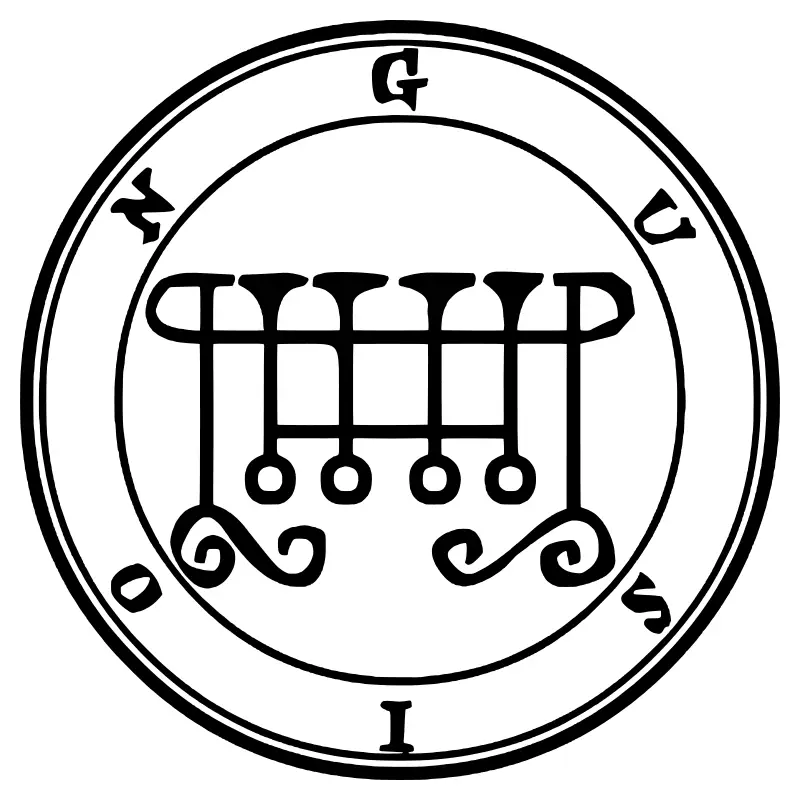
Gusion. The Eleventh Spirit in order is a great and strong Duke, called Gusion. He appeareth like a Xenopilus. He telleth all things, Past, Present, and to Come, and showeth the meaning and resolution of all questions thou mayest ask. He conciliateth and reconcileth friendships, and giveth Honour and Dignity unto any. He ruleth over 40 Legions of Spirits. His Seal is this, the which wear thou as aforesaid.
Gusion is a “great and strong Duke” who “appeareth like a Xenopilus”, with no further explanation. His offices are knowledge of past, present and future, showing “the meaning and resolution of all questions”, reconciling friendships and giving honour and dignity. The entry is a good example of how the Goetia treats divination, reconciliation and social favour as related powers.
Appearance
Historical Gusion “appeareth like a Xenopilus.” No one knows what a Xenopilus is; Sloane 3825 spells it “Xenophilus.”
Offices in the Ars Goetia
Historical The offices of Gusion, in the order the 1904 text gives them:
- Tells all things past, present, and to come.
- Shows the meaning and resolution of all questions asked.
- Conciliates and reconciles friendships.
- Gives honor and dignity to anyone.
Source comparison: Weyer and Scot
Historical Scot’s Weyer has “Gusoin,” “a great duke, and a strong, appearing in the forme of a Xenophilus.” The offices match. Weyer’s Latin gives Gusoyn 45 legions, Scot 40.
The spelling Xenophilus, Greek for “lover of strangers” or “friend of guests,” suggests a lost meaning, possibly an animal or a personification, but no source explains it. The Goetia’s Xenopilus may be a further copying slip.
Historical Weyer’s Latin has “in forma zenophali”, which Scot rendered as “Xenophilus”. One modern editor has suggested that the Latin might stand for cynocephalus, “dog-headed”, which would make sense as an image, but that is a conjecture. Weyer also gives him 45 legions (“quadragintaquinque”), five more than Scot and the Goetia. (About Weyer and Scot.)
Name and etymology
Historical Weyer and Scot spell him Gusoyn and Gusoin. The name has no known meaning.
Seal and images
Historical The seal above is Gusion’s as printed in 1904, and by the rules of the Observations it would be made in copper, the metal of his rank. Why seals were worn, why editions draw them differently and how to study one are explained in seals, circle and triangle.
Later tradition and modern practice
Later tradition Sloane 3825 has “Xenophilus.” No one knows what creature is meant.
Modern Some modern illustrators show Gusion as a baboon-headed figure, a choice inspired by the Egyptian god Thoth’s baboon, with no textual basis.
The mystery of the Xenopilus has produced many modern guesses: a baboon, a cynocephalus, a stranger, a creature with a fox’s head. None is supported by the texts. Modern practitioners sometimes approach Gusion for clarity on questions and for repairing friendships.
Lore about Gusion’s personality, likes or chosen people is modern, not grimoire material; modern approaches explains where such claims come from.
Beginner’s quick reference
| Item | What the sources say |
|---|---|
| Rank metal and hours (Goetia) | Duke: copper; sunrise to noon, in clear weather. |
| Planet (later tradition: Golden Dawn and Crowley’s 777) | Venus. |
| Decan and day or night spirit (later tradition: 777) | Cancer, second decan (10 to 20 degrees); day spirit. 777 decan incense: “Succum” (unidentified). Tarot card of the decan: Three of Cups. |
| Commonly reported color, incense, and plant (modern UPG; sources copy each other) | Color green; incense sandalwood; plant aloe (toxic to cats). |
| Associated symbols | Goetia image: “like a Xenopilus,” a word no one has explained. 777 Magical Image: repeats the same unexplained word. Modern Demonolatry/UPG: the seal, used as an altar image. |
| Associated offerings | Modern practice, not in the Goetia manuscripts: most often listed, sandalwood, clary sage, eyebright, and blue vervain. |
Before you burn or handle anything listed for Gusion, read incense, plants and offerings.
Practical notes
Gusion is a duke, and his offices of explaining questions and reconciling friendships involve no harm. He fits the beginner criteria reasonably well, especially for a question about understanding a subject you are studying. Do not use contact work to influence a particular friend’s feelings. Reconciliation is best pursued directly with the person.
In the directory, Gusion is one of the 30 spirits that fit the beginner criteria.
Try this: one question to study
Write the three forms Zenophali, Xenophilus and Xenopilus in a row and think about how each copy could have produced the next.
What next
To compare Gusion with other spirits of his rank, read Barbatos and Eligos.
Later tradition In the Golden Dawn scheme of the decans, Gusion is the day spirit of the second decan of Cancer, which belongs to the Three of Cups; the night spirit of the same decan is Vual (spirit 47).
Common questions
Is Gusion a good spirit for beginners?
He is counted among the 30 of the 72 that fit the three beginner criteria I use: not a king, at least one teaching office, and no central harm, deception or compulsion. Even so, read his whole entry first, because nearly every entry is mixed.
What does Gusion do in the Ars Goetia?
The 1904 text calls him a duke ruling 40 legions. Its first office for him is this: Gusion tells all things past, present, and to come. The entry lists 4 offices in all.
Does looking at Gusion's seal call him?
No. Reading a name or looking at a seal does not call a spirit. The seal is a drawing from a 1904 book, and even the grimoire itself required long rituals for its own purposes.
Get the free Mini-Grimoire
A short printable starter guide to tarot and everyday witchcraft, plus my newsletter. Unsubscribe any time.
Opens Substack in a new tab to confirm. More about the newsletter · Privacy