


How to read the labels Historical what the old sources say. Later tradition what later writers added. Modern modern practice and my own notes.
| Number | 8 of 72 |
|---|---|
| Rank | Duke |
| Legions | 30 |
| Office (1904) | Gives understanding of the singing of birds and the voices of other creatures, "such as the barking of Dogs." |
| Other spellings | none common |
Spirit 8 of the Ars Goetia is Barbatos. The 1904 edition by S. L. MacGregor Mathers and Aleister Crowley calls him a duke ruling 30 legions, and the first office it gives him is this: Barbatos gives understanding of the singing of birds and the voices of other creatures, “such as the barking of Dogs.”
His entry is full of sound, from birdsong to barking dogs, and it carries one of the Goetia’s few hints that a fallen spirit keeps something of its angelic past. Each part below carries a label for its layer, explained in how to read a spirit page.
At a glance
| Fact | In the entry |
|---|---|
| Number | 8 of 72, in the 1904 order. |
| Name and spellings | Barbatos in 1904; other spellings: none common. |
| Rank and legions | Duke, 30 legions. |
| Metal of his rank (Observations) | Copper. |
| Hours for dukes (Observations) | “From Sunrise till Noonday in Clear Weather.” |
| In Weyer’s catalog (1577) | Yes, as the source comparison below shows. |
The 1904 entry
Historical The full entry from the 1904 edition, with footnote numbers and the dash after the heading left out and the heading set in ordinary type:
Barbatos. The Eighth Spirit is Barbatos. He is a Great Duke, and appeareth when the Sun is in Sagittary, with four noble Kings and their companies of great troops. He giveth understanding of the singing of Birds, and of the Voices of other creatures, such as the barking of Dogs. He breaketh the Hidden Treasures open that have been laid by the Enchantments of Magicians. He is of the Order of Virtues, of which some part he retaineth still; and he knoweth all things Past, and to come, and conciliateth Friends and those that be in Power. He ruleth over 30 Legions of Spirits. His Seal of Obedience is this, the which wear before thee as aforesaid.
Barbatos “appeareth when the Sun is in Sagittary”, one of the few entries tied to a season, and arrives with four kings and their troops. His first office is understanding “the singing of Birds, and of the Voices of other creatures”. He also opens treasures hidden by enchantment, knows past and future and reconciles friends and those in power. “Of the Order of Virtues, of which some part he retaineth still” is the phrase that has drawn most modern attention.
Appearance
Historical Barbatos “appeareth when the Sun is in Sagittary, with four noble Kings and their companies of great troops.” The text gives no description of his own form.
Offices in the Ars Goetia
Historical The offices of Barbatos, in the order the 1904 text gives them:
- Gives understanding of the singing of birds and the voices of other creatures, “such as the barking of Dogs.”
- Breaks open hidden treasures laid by magicians’ enchantments.
- Knows all things past and to come.
- Reconciles friends and those in power.
He is “of the Order of Virtues, of which some part he retaineth still,” and rules 30 legions.
Source comparison: Weyer and Scot
Historical Scot’s Weyer calls Barbatos “a great countie or earle, and also a duke,” who appears “in Signo sagittarii sylvestris,” in the sign of the woodland archer, with four kings. Weyer adds “the lowings of bullocks” to the animal voices. The remark that he keeps part of his angelic nature is in both.
Historical Weyer’s Latin is “in signo Sagittarii silvestris”, in the sign of the woodland archer, and the kings bear trumpets (“tubas ferentibus”). Scot turned the trumpets into “companies and great troopes”, and the Goetia kept the troops. Weyer also lists “mugitus boum”, the lowing of oxen. Most interesting is the order: the Latin says he is of the Virtues “partim Dominationum”, partly of the Dominations. Scot rendered this as “which in part beare rule”, and the Goetia’s “of which some part he retaineth still” grows out of that reading, not out of the Latin. (About Weyer and Scot.)
Name and etymology
Historical Barbatos looks like Latin barbatus, “bearded”. That link is plausible but unproven, so treat it as speculation.
Seal and images
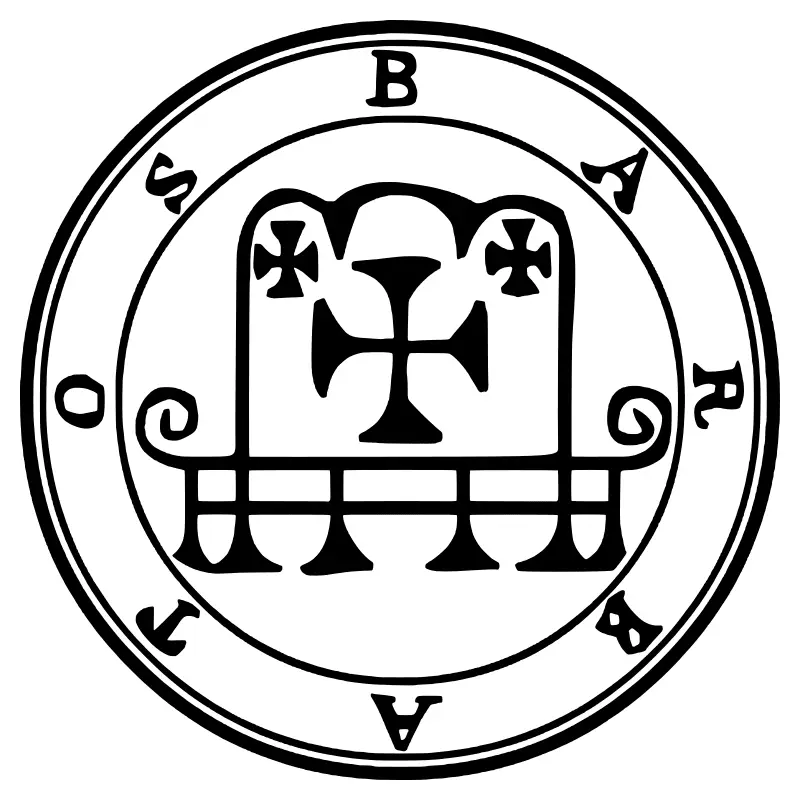
Historical The seal above is Barbatos’s as printed in 1904, and by the rules of the Observations it would be made in copper, the metal of his rank. Why seals were worn, why editions draw them differently and how to study one are explained in seals, circle and triangle.
Later tradition Le Breton’s 1863 plate turns the woodland archer into a nineteenth-century huntsman with a gun, surrounded by hunting horns, a clever reading of the trumpets in Weyer.
Later tradition and modern practice
Later tradition His treasure office belongs to the early modern world of buried hoards, a real concern then.
Modern The line that Barbatos still retains “some part” of the order of Virtues has made him popular in modern writing as a spirit “between” angel and demon. That is a modern reading. His office of understanding animal voices is linked by some modern practitioners with nature study and work with animals.
Lore about Barbatos’s personality, likes or chosen people is modern, not grimoire material; modern approaches explains where such claims come from.
Beginner’s quick reference
| Item | What the sources say |
|---|---|
| Rank metal and hours (Goetia) | Duke: copper; sunrise to noon, in clear weather. |
| Planet (later tradition: Golden Dawn and Crowley’s 777) | Venus. |
| Decan and day or night spirit (later tradition: 777) | Gemini, second decan (10 to 20 degrees); day spirit. 777 decan incense: cinnamon. Tarot card of the decan: Nine of Swords. |
| Commonly reported color, incense, and plant (modern UPG; sources copy each other) | Color green; incense sandalwood; plant ground ivy. |
| Associated symbols | Goetia image: he comes when the Sun is in Sagittarius, with four noble kings and their troops; birdsong and animal voices belong to his office. 777 Magical Image: the four kings and their troops. Le Breton engraving (1863): a hunter with a long gun, hunting horns sounding around him. Modern Demonolatry/UPG: the seal, used as an altar image. |
| Associated offerings | Modern practice, not in the Goetia manuscripts: most often listed, sandalwood and ground ivy; one source adds catnip. |
Before you burn or handle anything listed for Barbatos, read incense, plants and offerings.
Practical notes
Barbatos is a duke, and his offices include understanding the voices of animals and reconciling friends, neither of them harmful. He fits the beginner criteria reasonably well.
A question about learning to observe birds or nature would suit him. I do not teach treasure-finding, and his office of gaining favor with “those that be in Power” should not be used to influence particular people.
In the directory, Barbatos is one of the 30 spirits that fit the beginner criteria.
Try this: one question to study
Find the word “tubas” in Weyer’s Latin and trace how it became “troops” in Scot and the Goetia.
What next
To compare Barbatos with other spirits of his rank, read Valefor and Gusion.
Later tradition In the Golden Dawn scheme of the decans, Barbatos is the day spirit of the second decan of Gemini, which belongs to the Nine of Swords; the night spirit of the same decan is Shax (spirit 44).
Common questions
Is Barbatos a good spirit for beginners?
He is counted among the 30 of the 72 that fit the three beginner criteria I use: not a king, at least one teaching office, and no central harm, deception or compulsion. Even so, read his whole entry first, because nearly every entry is mixed.
What does Barbatos do in the Ars Goetia?
The 1904 text calls him a duke ruling 30 legions. Its first office for him is this: Barbatos gives understanding of the singing of birds and the voices of other creatures, "such as the barking of Dogs." The entry lists 4 offices in all.
Does looking at Barbatos's seal call him?
No. Reading a name or looking at a seal does not call a spirit. The seal is a drawing from a 1904 book, and even the grimoire itself required long rituals for its own purposes.
Get the free Mini-Grimoire
A short printable starter guide to tarot and everyday witchcraft, plus my newsletter. Unsubscribe any time.
Opens Substack in a new tab to confirm. More about the newsletter · Privacy