


| Arcana | Minor Arcana: Cups |
|---|---|
| Image | RWS 1909 (PD) |
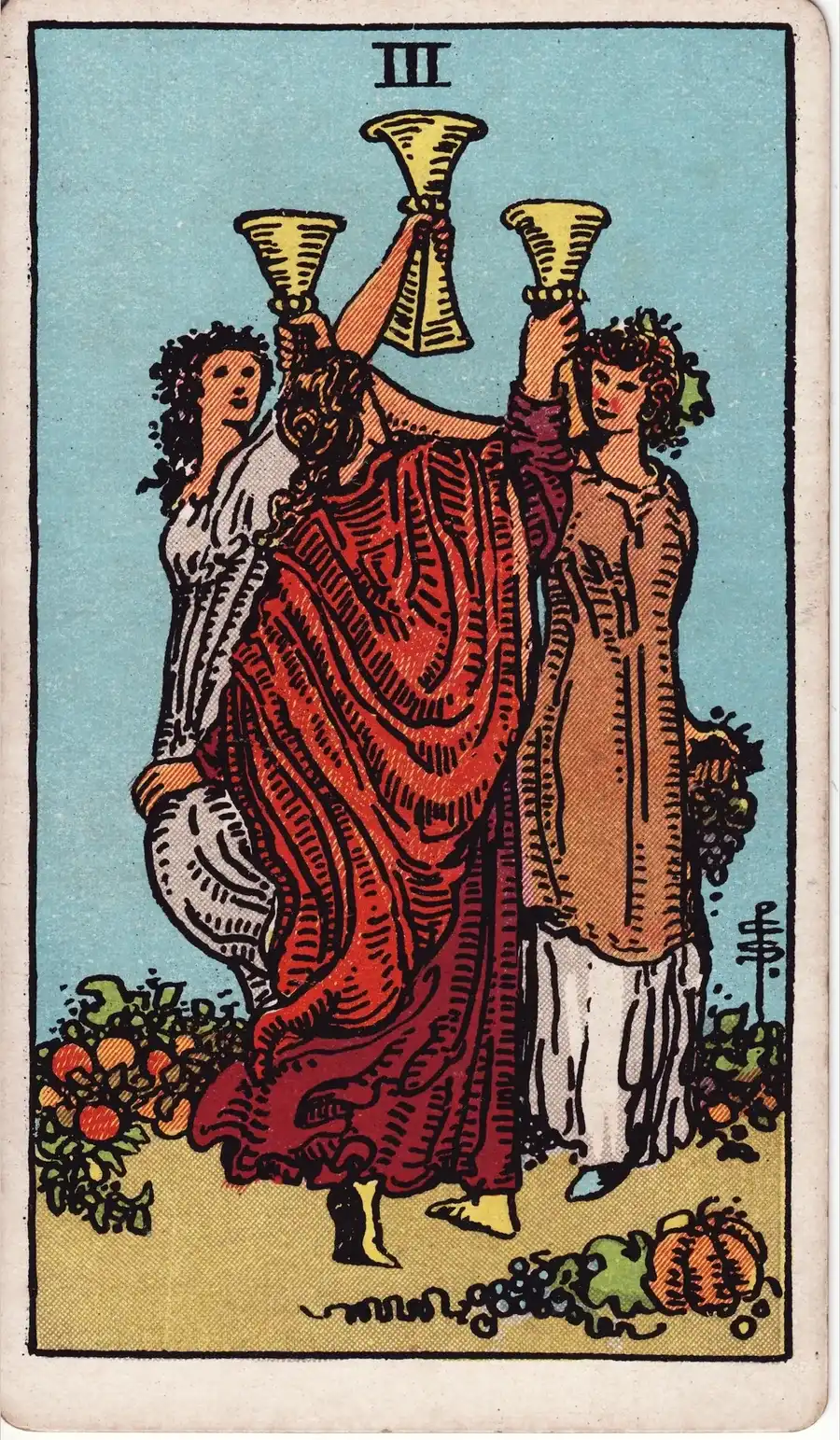
The Three of Cups shows three women dancing in a garden and raising their cups in a toast. There is fruit on the ground and a harvest feeling in the air.
It is a card of friendship, celebration and the relief of being among people who like you as you are. This page covers what the Three of Cups means upright and reversed, the symbols in the 1909 card and how to read it in a spread.
Here is the Three of Cups at a glance.
| At a glance | This card |
|---|---|
| Upright keywords | celebration, friendship, creativity |
| Reversed keywords | overindulgence, gossip, isolation |
| Number | 3 in the suit of Cups |
| Golden Dawn title | Lord of Abundance Later tradition |
| Astrology | Mercury in Cancer, second decan (10° to 20° Cancer) Later tradition |
| Tree of Life | Binah (3), Understanding Later tradition |
| Suit and element | Cups, Water Later tradition |
| Yes or no | Yes Modern |
The Golden Dawn named this card the Lord of Abundance and gave it Mercury in Cancer, the middle decan of the sign, on Binah. Mercury brings talk and exchange into the home-loving sign, which fits a card of friends gathering. Smith’s three dancing women may echo the classical Three Graces, though Waite did not say so.
Later tradition The Golden Dawn also gave each decan two of the 72 Goetic spirits, one for the day and one for the night. For the second decan of Cancer, and so for the Three of Cups, they are Gusion (spirit 11, day) and Vual (spirit 47, night). Their pages read the old entries as history; see the spirit directory for all 72.
The card: what Pamela Colman Smith drew
Waite’s description is one line: “Maidens in a garden-ground with cups uplifted, as if pledging one another.” Smith filled the ground with fruit and pumpkins and gave the three women garlands and flowing dresses. Some readers see the Three Graces of classical art behind the image.
Three raised cups. Three cups meet in the air in a shared toast. No one is on stage and no one is the audience. Joy is passed around the circle.
The harvest. Fruit and gourds lie at their feet. Something has ripened, and they celebrate the result together.
The dance. They seem to be moving in a circle. A circle has no head, which fits a card about friendship rather than hierarchy.
Upright meaning
Upright, the Three of Cups is friendship and shared joy. Three women raise their cups in a garden full of fruit, dancing in a circle with no leader. It is the card of reunions, parties, weddings, girls’ nights, choirs and all the gatherings that remind you that you belong somewhere.
It also speaks of community support. When you have good news, these are the people who are glad for you. When you have bad news, they bring food. The harvest at their feet suggests that something has ripened and is ready to be enjoyed together.
The Three of Cups often encourages you to celebrate, create with others, or simply call your friends. Joy shared is joy that lasts.
Reversed meaning
Reversed, the Three of Cups can mean too much of a good thing, such as overindulgence, gossip, or a party that went too long. It can also show exclusion: a friendship group that has turned into a clique, a third person causing tension, or feeling left out of the circle.
Ask whether your social life is feeding you. If you feel isolated, reach out to one person directly. If you are surrounded by people but still lonely, look for a smaller, more honest circle.
When the reversed Three appears with the Seven of Swords or the Five of Swords, take gossip seriously and keep confidences close. With the Four of Cups it more often describes your own withdrawal from friends who still want you there.
In love, work and spirituality
In love. Upright: Love that grows from friendship, or celebrating a relationship with friends. Reversed: A third person, gossip, or friends interfering in a relationship.
At work. Upright: Team celebrations, creative collaboration, a supportive group of colleagues. Reversed: Office cliques, or socializing taking the place of work.
With money. Upright: Money spent on shared experiences and celebrations. Reversed: Overspending on parties or keeping up with friends.
In spiritual practice. Upright: Celebrating a sabbat with your circle, or creating ritual together. Reversed: A spiritual group that excludes newcomers.
As feelings. Friendly joy and fun. They enjoy your company and see you as part of their world.
As a person. A social, fun-loving friend who brings people together.
As advice. Celebrate with your people, and let them celebrate you.
Reading the Three of Cups: positions and yes or no
In the past position: Friends and shared celebrations supported you. In the present position: Joy is easier with others now. Gather your people.
In the future position: A celebration, reunion or happy news is ahead. As advice: Reach out and plan something fun together.
In modern yes or no readings, the Three of Cups leans yes. Celebration points to yes.
What the Three means, and the history behind the card
In Cups, three is the moment a feeling spreads beyond two people into a circle. The Golden Dawn called it the Lord of Abundance, and here abundance is measured in friendship rather than money.
Here is how the Three looks across the four suits:
- Three of Wands: progress, foresight, exploration
- Three of Cups (this card): celebration, friendship, creativity
- Three of Swords: heartbreak, sorrow, betrayal
- Three of Pentacles: collaboration, skill, teamwork
When A. E. Waite published The Pictorial Key to the Tarot in 1910, he listed these divinatory meanings for the Three of Cups: “The conclusion of any matter in plenty, perfection and merriment; happy issue, victory, fulfilment, solace, healing.”
Reversed, he gave: “Expedition, dispatch, achievement, end. It signifies also the side of excess in physical enjoyment, and the pleasures of the senses.”
Common questions
Is the Three of Cups a yes or no card? Yes. It is a happy card of friendship and celebration.
What does the Three of Cups mean in love? Fun, lightness and joy, often in a social setting. Reversed, a third party or gossip.
Does the Three of Cups mean a party? It often does: a wedding, a birthday, a reunion or any happy gathering.
Try this
Try this small spread for the Three of Cups. Use it when you want to strengthen your friendships.
| Card | Question | What it shows |
|---|---|---|
| 1 | Who are my people? | The circle that supports me. |
| 2 | What can I celebrate with them? | A joy worth sharing. |
| 3 | How can I give back? | One way to support my friends. |
Affirmation: I make time for the people who make room for me.
Reversed affirmation: I choose company and rest with equal honesty.
If you keep a tarot journal, take one of these questions to it: Who are the people who are glad when good things happen to me? When did I last celebrate something with others? What circle do I want to create or join?
What next
Cards that sit close to this one are Four of Wands (another card of celebration and homecoming), Ten of Cups (lasting shared happiness) and The Empress (the Major Arcana card of abundance and pleasure).
The Three of Cups is part of the lesson Cups in my free Tarot for Beginners course. To see the whole suit on one page, go to the suit of Cups. To keep walking the suit, read the card before it, Two of Cups or the card after it, Four of Cups, or go back to all the card meanings.
For the suits and numbers in one place, see The Minor Arcana: suits and numbers made simple. For every card with keywords, affirmations and examples, see my book The Novice’s Guide to Tarot. If you would like a printable cheat sheet for all 78 cards, my 45-page Tarot Workbook is on Etsy.
Sources
- A. E. Waite, The Pictorial Key to the Tarot (London: Rider, 1910), Part III, sections 1 and 2.
- Pamela Colman Smith and A. E. Waite, the Rider-Waite-Smith tarot (London: Rider, 1909).
- Nicolas Conver, Tarot de Marseille (Marseille, 1760).
- Lauri Mukkala, The Novice’s Guide to Tarot, entry for the Three of Cups.
- Aleister Crowley, 777 (London: Walter Scott, 1909), columns of the decans, the Minor Arcana and the court cards.
- Israel Regardie, ed., The Golden Dawn (Chicago: Aries Press, 1937 to 1940), “Book T”, titles and attributions of the small cards and the court.
All 78 cards
Major Arcana
- The Fool
- The Magician
- The High Priestess
- The Empress
- The Emperor
- The Hierophant
- The Lovers
- The Chariot
- Strength
- The Hermit
- Wheel of Fortune
- Justice
- The Hanged Man
- Death
- Temperance
- The Devil
- The Tower
- The Star
- The Moon
- The Sun
- Judgement
- The World
Wands
- Ace of Wands
- Two of Wands
- Three of Wands
- Four of Wands
- Five of Wands
- Six of Wands
- Seven of Wands
- Eight of Wands
- Nine of Wands
- Ten of Wands
- Page of Wands
- Knight of Wands
- Queen of Wands
- King of Wands
Cups
- Ace of Cups
- Two of Cups
- Three of Cups
- Four of Cups
- Five of Cups
- Six of Cups
- Seven of Cups
- Eight of Cups
- Nine of Cups
- Ten of Cups
- Page of Cups
- Knight of Cups
- Queen of Cups
- King of Cups
Swords
- Ace of Swords
- Two of Swords
- Three of Swords
- Four of Swords
- Five of Swords
- Six of Swords
- Seven of Swords
- Eight of Swords
- Nine of Swords
- Ten of Swords
- Page of Swords
- Knight of Swords
- Queen of Swords
- King of Swords
Pentacles
Get the free Mini-Grimoire
A short printable starter guide to tarot and everyday witchcraft, plus my newsletter. Unsubscribe any time.
Opens Substack in a new tab to confirm. More about the newsletter · Privacy