


How to read the labels Historical what the old sources say. Later tradition what later writers added. Modern modern practice and my own notes.
| Number | 37 of 72 |
|---|---|
| Rank | Marquis |
| Legions | 20 |
| Office (1904) | Speaks "marvellously of all wonderful Sciences if required." |
| Other spellings | Pheynix (1904), Phoenix (Weyer, Scot), Pheniex |
Phenex is number 37 in the catalog of 72 spirits that opens the Lesser Key of Solomon. The 1904 edition by S. L. MacGregor Mathers and Aleister Crowley calls him a marquis ruling 20 legions, and the first office it gives him is this: Phenex speaks “marvellously of all wonderful Sciences if required.”
His entry is the most musical in the catalog, and it opens with a warning not to listen. Each part below carries a label for its layer, explained in how to read a spirit page.
At a glance
| Fact | In the entry |
|---|---|
| Number | 37 of 72, in the 1904 order. |
| Name and spellings | Phenex in 1904; other spellings: Pheynix (1904), Phoenix (Weyer, Scot), Pheniex. |
| Rank and legions | Marquis, 20 legions. |
| Metal of his rank (Observations) | Silver. |
| Hours for marquises (Observations) | “From 3 in the afternoon till 9 at Night, and from 9 at Night till Sunrise.” |
| In Weyer’s catalog (1577) | Yes, as the source comparison below shows. |
The 1904 entry
Historical The full entry from the 1904 edition, with footnote numbers and the dash after the heading left out and the heading set in ordinary type:
Phenex. The Thirty-seventh Spirit is Phenex (or Pheynix). He is a Great Marquis, and appeareth like the Bird Phœnix, having the Voice of a Child. He singeth many sweet notes before the Exorcist, which he must not regard, but by-and-by he must bid him put on Human Shape. Then will he speak marvellously of all wonderful Sciences if required. He is a Poet, good and excellent. And he will be willing to perform thy requests. He hath hopes also to return to the Seventh Throne after 1,200 years more, as he said unto Solomon. He governeth 20 Legions of Spirits. And his Seal is this, which wear thou, etc.
Phenex arrives as the phoenix with “the Voice of a Child”, and the first instruction is a refusal: he “singeth many sweet notes before the Exorcist, which he must not regard”. Only after he takes human shape do the offices begin, the sciences and poetry. “By-and-by” here means at once, its older sense. The entry also gives one of the few personal details in the book: “He hath hopes also to return to the Seventh Throne after 1,200 years more, as he said unto Solomon.” A fallen spirit who hopes to rise again fits the bird that is reborn from its ashes.
Appearance
Historical Phenex “appeareth like the Bird Phoenix, having the Voice of a Child.” He “singeth many sweet notes before the Exorcist, which he must not regard,” and the magician must “by-and-by” bid him put on human shape.
Offices in the Ars Goetia
Historical The offices of Phenex, in the order the 1904 text gives them:
- Speaks “marvellously of all wonderful Sciences if required.”
- Is “a Poet, good and excellent.”
- Will be willing to perform the magician’s requests.
He governs 20 legions and “hath hopes also to return to the Seventh Throne after 1,200 years more, as he said unto Solomon.”
Source comparison: Weyer and Scot
Historical Scot’s Weyer gives “Phoenix” as “a great marquesse, appearing like the bird Phoenix, having a childs voice.” Before he stands still, “he singeth manie sweet notes,” and “the exorcist with his companions must beware he give no eare to the melodie.”
In human shape “he speake marvellouslie of all woonderfull sciences” and “is an excellent poet.” The match is close. Both give 20 legions.
Historical Weyer’s Latin is more emphatic about the danger of the song. The singing is “cantus dulcissimos”, the sweetest songs, and the exorcist and his companions must take care “ne suavitati cantus aures accommodent”, not to lend their ears to its sweetness. Weyer calls him “Poeta est optimus & obediens”, an excellent and obedient poet; the Goetia keeps the poet and turns “obedient” into “willing to perform thy requests”. The hope of the seventh throne after “mille ducentos annos”, 1,200 years, is already in Weyer. (About Weyer and Scot.)
Name and etymology
Historical The name is the phoenix itself: Weyer writes “Phœnix” and Scot “Phoenix”. The 1904 spellings Phenex and Pheynix are English copyists’ forms of the same word.
Seal and images
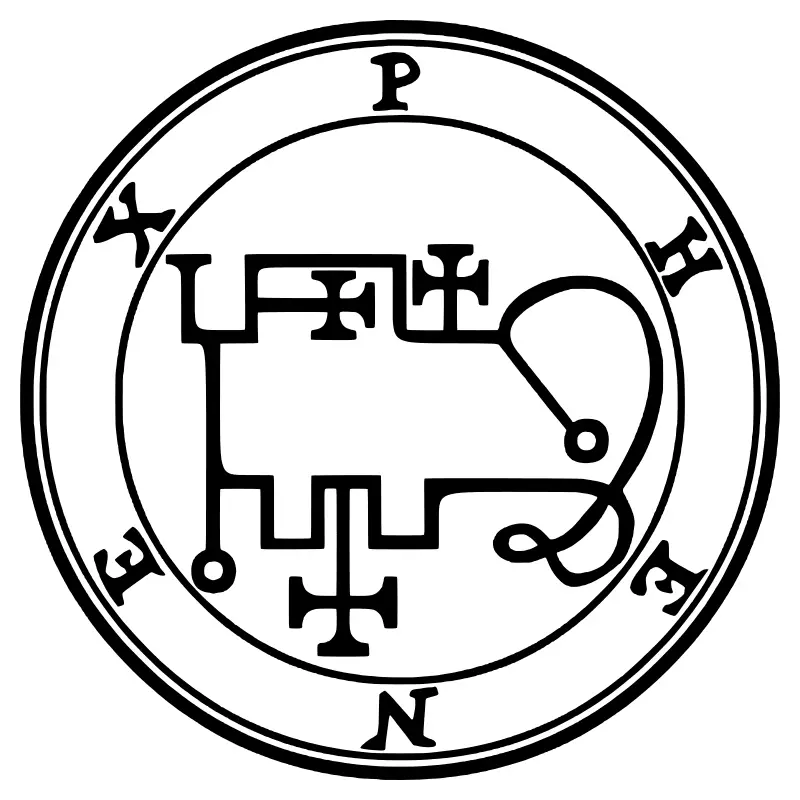
Historical The seal above is Phenex’s as printed in 1904, and by the rules of the Observations it would be made in silver, the metal of his rank. Why seals were worn, why editions draw them differently and how to study one are explained in seals, circle and triangle.
Later tradition and modern practice
Modern The warning not to listen to the song has drawn modern comparison with the Sirens of the Odyssey. The comparison is a modern one. Phenex is popular with modern poets, writers, and musicians, following his poetic office, and with those drawn to themes of renewal, through the legend of the phoenix bird.
Lore about Phenex’s personality, likes or chosen people is modern, not grimoire material; modern approaches explains where such claims come from.
Beginner’s quick reference
| Item | What the sources say |
|---|---|
| Rank metal and hours (Goetia) | Marquis: silver; 3 p.m. to 9 p.m., and 9 p.m. to sunrise. |
| Planet (later tradition: Golden Dawn and Crowley’s 777) | Moon. |
| Decan and day or night spirit (later tradition: 777) | Aries, first decan (0 to 10 degrees); night spirit. 777 decan incense: myrtle. Tarot card of the decan: Two of Wands. |
| Commonly reported color, incense, and plant (modern UPG; sources copy each other) | Color purple; incense jasmine; plant rose. |
| Associated symbols | Goetia image: a phoenix singing sweet notes in a child’s voice. 777 Magical Image: the same image. Modern Demonolatry/UPG: the seal, used as an altar image. |
| Associated offerings | Modern practice, not in the Goetia manuscripts: most often listed, rose, then jasmine, meadowsweet, passion flower, and vervain. |
Before you burn or handle anything listed for Phenex, read incense, plants and offerings.
Practical notes
Phenex fits the beginner criteria well. He is a marquis whose offices are the sciences and poetry, with no office of harm. A question about your own writing would suit a first contact.
The text’s warning against regarding his song is worth noticing. The old magicians were wary even of beauty in a spirit’s approach. If a practice feels seductive or hard to end, close it.
In the directory, Phenex is one of the 30 spirits that fit the beginner criteria.
Try this: one question to study
Compare the warning about the song in Weyer’s Latin and in the 1904 text, and note who must not listen in each: the exorcist alone, or his companions too.
What next
To compare Phenex with other spirits of his rank, read Marchosias and Sabnock.
Later tradition In the Golden Dawn scheme of the decans, Phenex is the night spirit of the first decan of Aries, which belongs to the Two of Wands; the day spirit of the same decan is Bael (spirit 1).
Common questions
Is Phenex a good spirit for beginners?
He is counted among the 30 of the 72 that fit the three beginner criteria I use: not a king, at least one teaching office, and no central harm, deception or compulsion. Even so, read his whole entry first, because nearly every entry is mixed.
What does Phenex do in the Ars Goetia?
The 1904 text calls him a marquis ruling 20 legions. Its first office for him is this: Phenex speaks "marvellously of all wonderful Sciences if required." The entry lists 3 offices in all.
Does looking at Phenex's seal call him?
No. Reading a name or looking at a seal does not call a spirit. The seal is a drawing from a 1904 book, and even the grimoire itself required long rituals for its own purposes.
Get the free Mini-Grimoire
A short printable starter guide to tarot and everyday witchcraft, plus my newsletter. Unsubscribe any time.
Opens Substack in a new tab to confirm. More about the newsletter · Privacy