


| Arcana | Minor Arcana: Wands |
|---|---|
| Image | RWS 1909 (PD) |
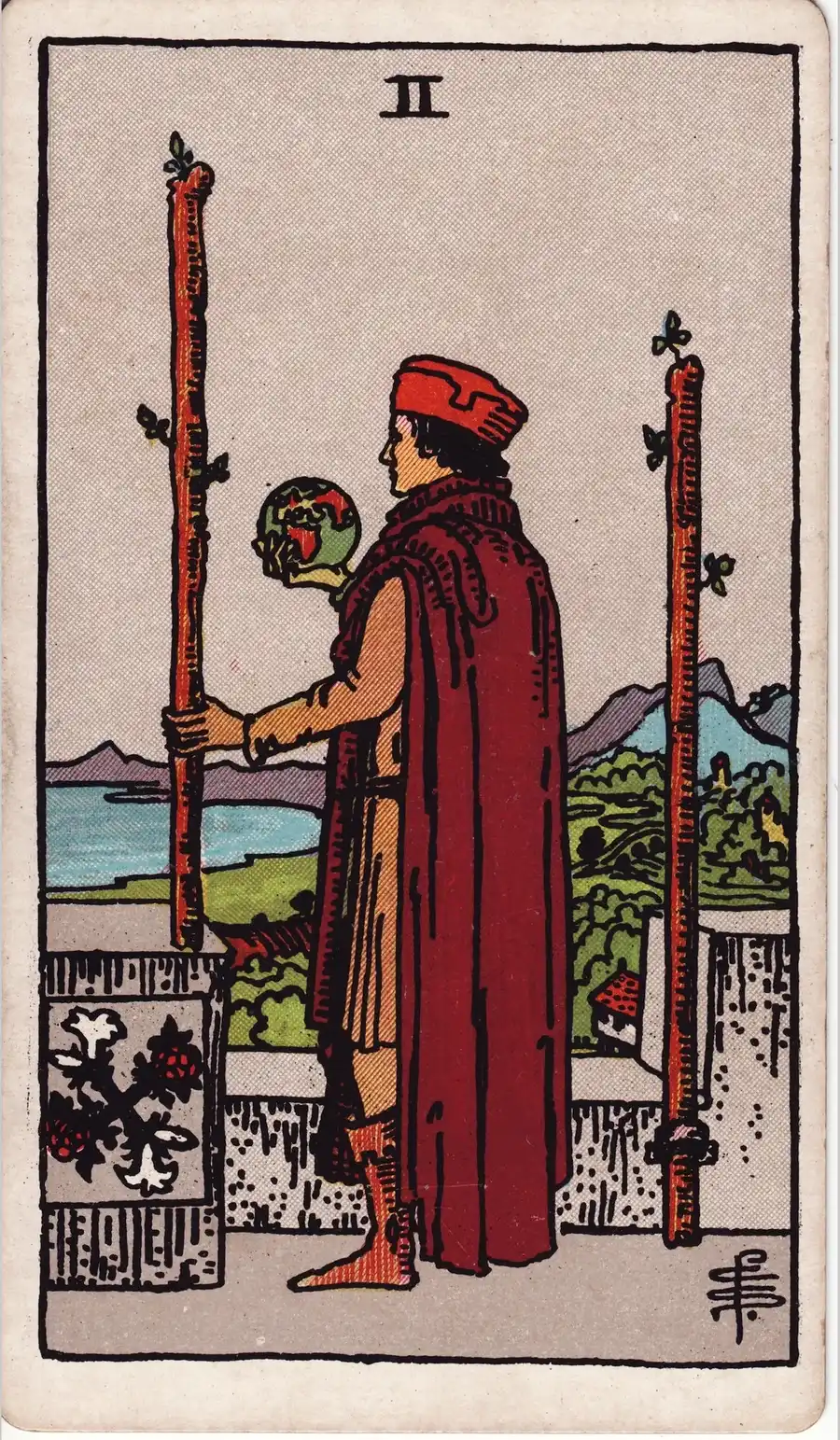
The Two of Wands shows a man standing on the walls of his castle with a small globe in his hand, looking out at the world beyond. He already has something secure, and he is wondering what else is possible.
The card is about planning, choosing and the pull to grow. Here is what the Two of Wands means upright and reversed, the symbols Pamela Colman Smith drew and a spread for big decisions.
Here is the Two of Wands at a glance.
| At a glance | This card |
|---|---|
| Upright keywords | planning, decisions, expansion |
| Reversed keywords | fear of change, indecision, playing it safe |
| Number | 2 in the suit of Wands |
| Golden Dawn title | Lord of Dominion Later tradition |
| Astrology | Mars in Aries, first decan (0° to 10° Aries) Later tradition |
| Tree of Life | Chokmah (2), Wisdom Later tradition |
| Suit and element | Wands, Fire Later tradition |
| Yes or no | Yes Modern |
Book T calls the Two of Wands the Lord of Dominion and gives it Mars in Aries, the first decan of the zodiac, on Chokmah, the second sephira. Mars is at home in Aries, so the decan is pure drive. Smith’s figure holding the whole world in one hand fits the title well: he has territory, and he wants more.
Later tradition The Golden Dawn also gave each decan two of the 72 Goetic spirits, one for the day and one for the night. For the first decan of Aries, and so for the Two of Wands, they are Bael (spirit 1, day) and Phenex (spirit 37, night). Their pages read the old entries as history; see the spirit directory for all 72.
The card: what Pamela Colman Smith drew
Waite wrote: “A tall man looks from a battlemented roof over sea and shore; he holds a globe in his right hand, while a staff in his left rests on the battlement; another is fixed in a ring.” The man is safe on high ground. The question in the picture is whether he will stay there.
The globe in his hand. He holds the world small enough to fit in his palm. It is a picture of planning: looking at options from a distance before you commit. The globe can also mean the wider world, travel and ventures abroad.
Two wands, one fixed. One wand is fixed to the wall with a ring, and he holds the other. Read them as two sides of the choice: what you already have and what you are reaching for. You cannot hold both forever.
The rose, the cross and the lily. On the wall to the left, Waite pointed out a small design of crossed roses and lilies, “the Rose and Cross and Lily”. Roses are desire, lilies are pure intention. Together they suggest a plan made with heart and with clear purpose.
Upright meaning
Upright, the Two of Wands is the moment after the first success, when you look out from the walls you have built and ask what comes next. The man in the card already holds something secure, a castle and a staff fixed to the wall, yet he is looking at a globe. This is planning with ambition: the decision to grow beyond what is comfortable.
The card often appears when you are weighing two directions, staying with what you know or reaching for something larger. It favors the bigger choice, but it asks for a plan, not just a wish. Map the route. Count what you have. Decide what you are willing to leave behind.
The Two of Wands also speaks of personal authority. You are the one who decides the direction now, and nobody else can make the choice for you.
Reversed meaning
Reversed, the Two of Wands shows a person who keeps looking at the globe and never puts it down. Fear of change, or a love of safety, turns planning into an endless loop. You may also be making plans that are too small for what you actually want, just to avoid the risk of failing at the larger version.
Another reversed reading is a partnership or plan that has two leaders and no agreement. Ask what you would choose if you knew the outcome would be acceptable either way, then take one step in that direction.
In love, work and spirituality
In love. Upright: Deciding whether to take a relationship further, move in together or move abroad for love. Reversed: Staying in a comfortable situation while dreaming of something else, or unequal ambitions between partners.
At work. Upright: Long-range planning, expanding a business, considering a job in another city or country. Reversed: Analysis paralysis, or a promotion turned down out of fear rather than wisdom.
With money. Upright: Planning investments with a clear horizon. Ambition backed by numbers. Reversed: Holding money so tightly that nothing grows, or a plan without a budget.
In spiritual practice. Upright: Choosing a direction for your practice and making a year-long plan for it. Reversed: Reading about many paths without ever walking one.
As feelings. Interest with hesitation. They are thinking about what a future with you might look like.
As a person. An ambitious planner, often someone who has already achieved one thing and wants the next.
As advice. Make the plan, then commit to the larger option.
Reading the Two of Wands: positions and yes or no
In the past position: A decision you made, or a plan you drew up, shaped the road you are on. In the present position: You are standing between what you have and what you want. Look at both honestly.
In the future position: A choice about growth or travel is coming. Prepare your map now. As advice: Write a one-page plan with a date for the first step.
In modern yes or no readings, the Two of Wands leans yes. It favors moving forward, but only once you have actually decided.
What the Two means, and the history behind the card
In the fire suit, the Two is the first real decision about where to aim. The Golden Dawn’s title, Lord of Dominion, puts it more bluntly: once you have power, the question is how far you want it to reach.
Here is how the Two looks across the four suits:
- Two of Wands (this card): planning, decisions, expansion
- Two of Cups: unity, partnership, mutual attraction
- Two of Swords: indecision, stalemate, difficult choices
- Two of Pentacles: balance, adaptability, time management
When A. E. Waite published The Pictorial Key to the Tarot in 1910, he listed these divinatory meanings for the Two of Wands: “Between the alternative readings there is no marriage possible; on the one hand, riches, fortune, magnificence; on the other, physical suffering, disease, chagrin, sadness, mortification. The design gives one suggestion; here is a lord overlooking his dominion and alternately contemplating a globe.”
Reversed, he gave: “Surprise, wonder, enchantment, emotion, trouble, fear.”
Common questions
Is the Two of Wands a yes or no card? It leans yes, as long as you are willing to choose and act. It does not favor waiting forever.
What does the Two of Wands mean in love? Upright, planning a future together or deciding whether to go deeper. Reversed, avoiding the conversation about where things are going.
What is the difference between the Two and the Three of Wands? In the Two you are still planning on the castle wall. In the Three the ships have sailed and you are watching your plans unfold.
Try this
Try this small spread for the Two of Wands. Use it when you are weighing two directions.
| Card | Question | What it shows |
|---|---|---|
| 1 | What do I already hold? | The security or skill I have now. |
| 2 | What is on the horizon? | The growth that is calling me. |
| 3 | What helps me choose? | The thing to look at before I decide. |
Affirmation: I plan expansion with clear eyes and a real next move.
Reversed affirmation: I stop hiding in research and either act or admit I am staying.
If you keep a tarot journal, take one of these questions to it: What am I holding on to, and what am I reaching for? If I knew it would work, which horizon would I choose? Where has “not yet” become a habit with no end date?
What next
Cards that sit close to this one are Three of Wands (the next step: the plan is launched and you watch it travel), The World (the Major Arcana card that also holds the whole world, now as completion) and Two of Swords (another Two about choosing, but frozen instead of looking outward).
The Two of Wands is part of the lesson Wands in my free Tarot for Beginners course. To see the whole suit on one page, go to the suit of Wands. To keep walking the suit, read the card before it, Ace of Wands or the card after it, Three of Wands, or go back to all the card meanings.
For the suits and numbers in one place, see The Minor Arcana: suits and numbers made simple. For every card with keywords, affirmations and examples, see my book The Novice’s Guide to Tarot. If you would like a printable cheat sheet for all 78 cards, my 45-page Tarot Workbook is on Etsy.
Sources
- A. E. Waite, The Pictorial Key to the Tarot (London: Rider, 1910), Part III, sections 1 and 2.
- Pamela Colman Smith and A. E. Waite, the Rider-Waite-Smith tarot (London: Rider, 1909).
- Nicolas Conver, Tarot de Marseille (Marseille, 1760).
- Lauri Mukkala, The Novice’s Guide to Tarot, entry for the Two of Wands.
- Aleister Crowley, 777 (London: Walter Scott, 1909), columns of the decans, the Minor Arcana and the court cards.
- Israel Regardie, ed., The Golden Dawn (Chicago: Aries Press, 1937 to 1940), “Book T”, titles and attributions of the small cards and the court.
All 78 cards
Major Arcana
- The Fool
- The Magician
- The High Priestess
- The Empress
- The Emperor
- The Hierophant
- The Lovers
- The Chariot
- Strength
- The Hermit
- Wheel of Fortune
- Justice
- The Hanged Man
- Death
- Temperance
- The Devil
- The Tower
- The Star
- The Moon
- The Sun
- Judgement
- The World
Wands
- Ace of Wands
- Two of Wands
- Three of Wands
- Four of Wands
- Five of Wands
- Six of Wands
- Seven of Wands
- Eight of Wands
- Nine of Wands
- Ten of Wands
- Page of Wands
- Knight of Wands
- Queen of Wands
- King of Wands
Cups
- Ace of Cups
- Two of Cups
- Three of Cups
- Four of Cups
- Five of Cups
- Six of Cups
- Seven of Cups
- Eight of Cups
- Nine of Cups
- Ten of Cups
- Page of Cups
- Knight of Cups
- Queen of Cups
- King of Cups
Swords
- Ace of Swords
- Two of Swords
- Three of Swords
- Four of Swords
- Five of Swords
- Six of Swords
- Seven of Swords
- Eight of Swords
- Nine of Swords
- Ten of Swords
- Page of Swords
- Knight of Swords
- Queen of Swords
- King of Swords
Pentacles
Get the free Mini-Grimoire
A short printable starter guide to tarot and everyday witchcraft, plus my newsletter. Unsubscribe any time.
Opens Substack in a new tab to confirm. More about the newsletter · Privacy