


How to read the labels Historical what the old sources say. Later tradition what later writers added. Modern modern practice and my own notes.
| Number | 1 of 72 |
|---|---|
| Rank | King |
| Legions | 66 |
| Office (1904) | Makes the magician go invisible. |
| Other spellings | Baal, Baell, Baël (Weyer, Scot) |
Bael is number 1 in the catalog of 72 spirits that opens the Lesser Key of Solomon. The 1904 edition by S. L. MacGregor Mathers and Aleister Crowley calls him a king ruling 66 legions, and the first office it gives him is this: Bael makes the magician go invisible.
His entry is one of the shortest among the kings, yet it opens the whole catalog, which is why so many readers meet the Goetia through him. Each part below carries a label for its layer, explained in how to read a spirit page.
At a glance
| Fact | In the entry |
|---|---|
| Number | 1 of 72, in the 1904 order. |
| Name and spellings | Bael in 1904; other spellings: Baal, Baell, Baël (Weyer, Scot). |
| Rank and legions | King, 66 legions. |
| Direction | The text places him in the East. |
| Metal of his rank (Observations) | Gold. |
| Hours for kings (Observations) | “From 9 till 12 o’clock at Noon, and from 3 till Sunset.” |
| In Weyer’s catalog (1577) | Yes, as the source comparison below shows. |
The 1904 entry
Historical The full entry from the 1904 edition, with footnote numbers and the dash after the heading left out and the heading set in ordinary type:
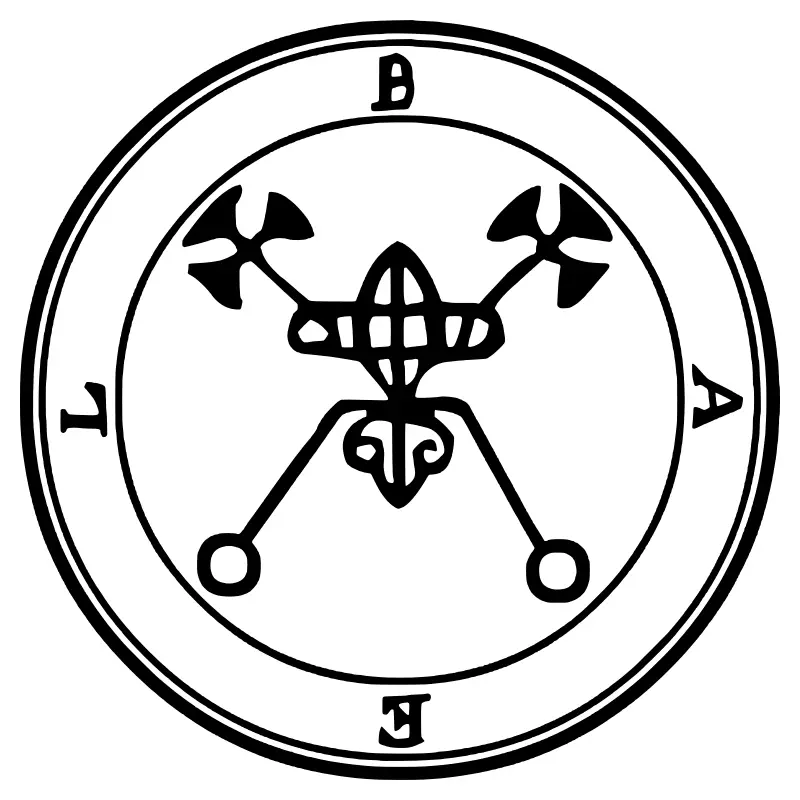
Bael. The First Principal Spirit is a King ruling in the East, called Bael. He maketh thee to go Invisible. He ruleth over 66 Legions of Infernal Spirits. He appeareth in divers shapes, sometimes like a Cat, sometimes like a Toad, and sometimes like a Man, and sometimes all these forms at once. He speaketh hoarsely. This is his character which is used to be worn as a Lamen before him who calleth him forth, or else he will not do thee homage.
The entry packs four things into six sentences: a rank and a quarter (a king “ruling in the East”), one office, a number of legions and a shape-shifting appearance. “Maketh thee to go Invisible” is the only office, and it is addressed to the reader directly, as “thee”. The closing line explains what the seal is for: a “Lamen”, a plate or pendant worn on the breast, without which “he will not do thee homage”. In other words, the seal works as a badge of the magician’s authority, not as a picture of the spirit.
Appearance
Historical Bael is “the First Principal Spirit,” a king “ruling in the East.” He appears “in divers shapes, sometimes like a Cat, sometimes like a Toad, and sometimes like a Man, and sometimes all these forms at once.” He “speaketh hoarsely.”
Offices in the Ars Goetia
Historical The offices of Bael, in the order the 1904 text gives them:
- Makes the magician go invisible.
- Rules 66 legions of “Infernal Spirits.”
The text adds that his seal “is used to be worn as a Lamen before him who calleth him forth, or else he will not do thee homage.”
Source comparison: Weyer and Scot
Historical Weyer, in Scot’s English, also places Baell first, as “first and principall king (which is of the power of the east).”
Where the Goetia gives three separate shapes, Weyer gives one figure with three heads: “the first, like a tode; the second, like a man; the third, like a cat.” The hoarse voice, the gift of invisibility, and the 66 legions are the same.
Historical Weyer’s Latin is fuller than either English text. It calls Bael “formator morum et insignis certator”, roughly “a shaper of manners and a notable contender”, and says he makes a person invisible “et sapientem”, “and wise”. Scot’s 1584 English drops both phrases, and the Goetia, which follows Scot’s wording, inherits only the invisibility. (About Weyer and Scot.)
Name and etymology
Historical The spellings move from Weyer’s Baël, where the two dots mark two syllables (Ba-el), to Scot’s Baëll and the Goetia’s Bael. The likely origin of the name in the Semitic title Baal is discussed under later tradition below.
Seal and images
Historical The seal above is Bael’s as printed in 1904, and by the rules of the Observations it would be made in gold, the metal of his rank. Why seals were worn, why editions draw them differently and how to study one are explained in seals, circle and triangle.
Later tradition and modern practice
Later tradition The name is almost certainly a form of Baal, a Semitic title meaning “lord” or “master,” used for several gods of the ancient Levant, most famously the Canaanite storm god.
The Hebrew Bible condemns the worship of Baal many times. Christian demonology turned the old title into a demon’s name. This does not mean the Goetic Bael preserves anything of the Canaanite god’s worship. It means a hostile name traveled into a catalog.
Collin de Plancy’s Dictionnaire Infernal (1863 edition) shows Bael with the heads of a cat, a man, and a toad set on spider legs, an image often reproduced online. The spider body is the illustrator’s invention.
Modern As the first spirit in the list, Bael appears in many modern books and games. Modern devotional writers describe him in various ways; none of these descriptions are in the Goetia.
Lore about Bael’s personality, likes or chosen people is modern, not grimoire material; modern approaches explains where such claims come from.
Beginner’s quick reference
| Item | What the sources say |
|---|---|
| Rank metal and hours (Goetia) | King: gold; 9 a.m. to noon and 3 p.m. to sunset. |
| Planet (later tradition: Golden Dawn and Crowley’s 777) | Sun. |
| Decan and day or night spirit (later tradition: 777) | Aries, first decan (0 to 10 degrees); day spirit. 777 decan incense: myrtle. Tarot card of the decan: Two of Wands. |
| Commonly reported color, incense, and plant (modern UPG; sources copy each other) | Color yellow (sometimes with black); incense frankincense; plant fern. |
| Associated symbols | Goetia image: a cat, a toad, a man, or all three at once; a hoarse voice. 777 Magical Image: the same image. Le Breton engraving (1863): a crowned man’s head joined to a cat’s and a toad’s head, on spider legs. Modern Demonolatry/UPG: the seal, used as an altar image. |
| Associated offerings | Modern practice, not in the Goetia manuscripts: most often listed, frankincense and fern, then oak, cinnamon, and bayberry. |
Before you burn or handle anything listed for Bael, read incense, plants and offerings.
Practical notes
Bael is a king, and the only office the text gives him is invisibility, a claim no practice can or should test. Not a first-contact choice under the beginner criteria. If you are drawn to him because he comes first, read his entry as history and choose a teaching spirit for practice.
In the directory, Bael is not among the 30 spirits that fit the beginner criteria.
Try this: one question to study
Read Weyer’s phrase “formator morum et insignis certator” beside the 1904 entry and write down what kind of spirit each version describes.
What next
To compare Bael with other spirits of his rank, read Paimon and Beleth.
Later tradition In the Golden Dawn scheme of the decans, Bael is the day spirit of the first decan of Aries, which belongs to the Two of Wands; the night spirit of the same decan is Phenex (spirit 37).
Common questions
Is Bael a good spirit for beginners?
Not as a first choice. He does not meet all three beginner criteria I use: not a king, at least one teaching office, and no central harm, deception or compulsion. His entry is still worth reading as history.
What does Bael do in the Ars Goetia?
The 1904 text calls him a king ruling 66 legions. Its first office for him is this: Bael makes the magician go invisible. The entry lists 2 offices in all.
Does looking at Bael's seal call him?
No. Reading a name or looking at a seal does not call a spirit. The seal is a drawing from a 1904 book, and even the grimoire itself required long rituals for its own purposes.
Get the free Mini-Grimoire
A short printable starter guide to tarot and everyday witchcraft, plus my newsletter. Unsubscribe any time.
Opens Substack in a new tab to confirm. More about the newsletter · Privacy