


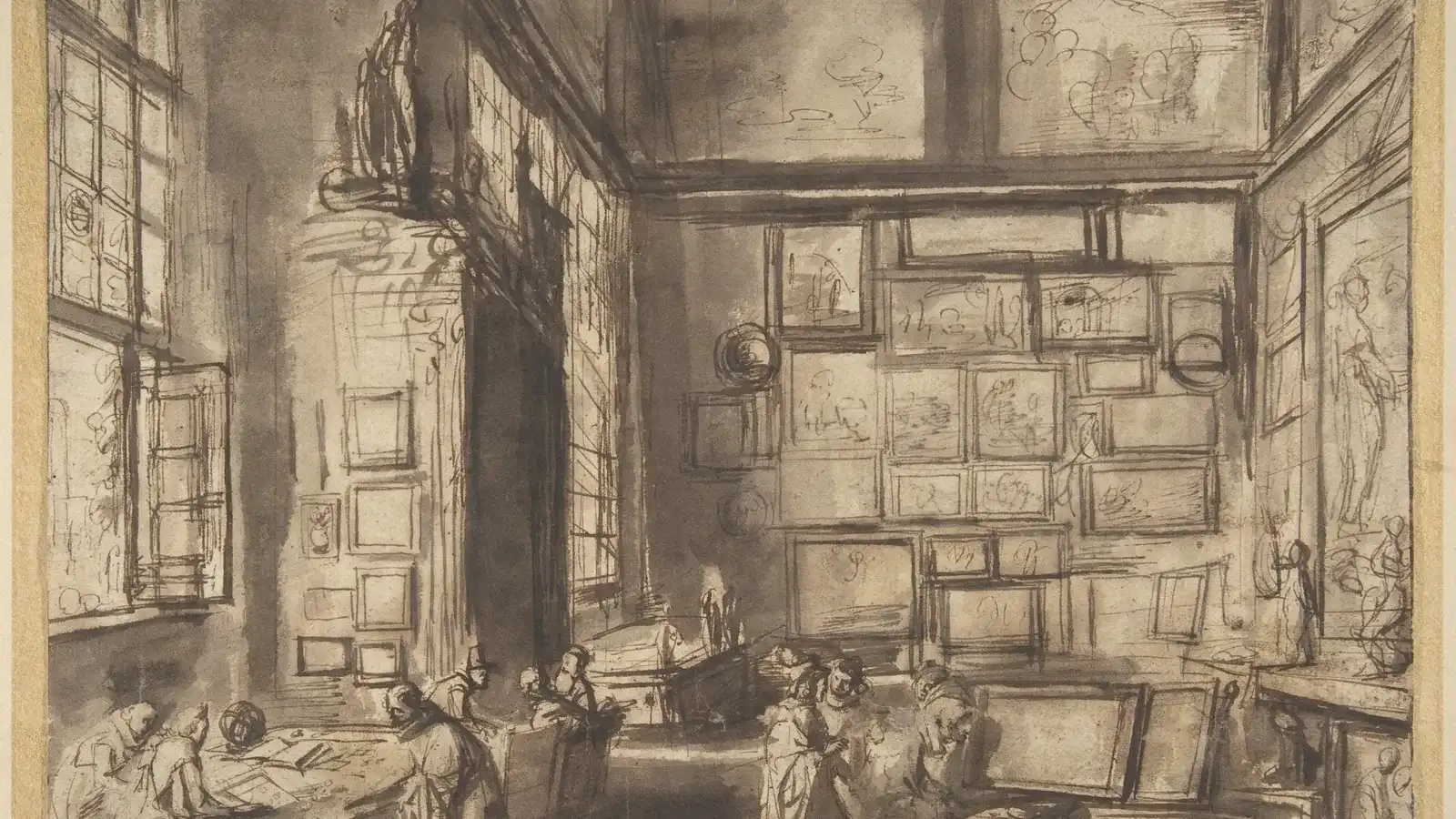
In this lesson: why we look so briefly, a ten-minute slow-looking method, and the four steps of describe, analyze, interpret, judge.
Tarot cards, witches on old woodcuts (prints made from carved wooden blocks), alchemical emblems and Symbolist dreams are all pictures, and pictures reward people who know how to look at them. Art history gives you that skill. It helps you see more in a single tarot card, notice when an “ancient symbol” is really a modern invention, and enjoy a museum visit instead of drifting past the walls. This first lesson explains what art history is and teaches one simple method that makes any picture open up. You will use it in every lesson that follows.
What art history is
Historical Art history is the study of things people have made to be looked at, used or believed in: paintings, statues, buildings, books, cloth, cards and much more. It asks what a work is, who made it, for whom, why, and what it meant to the people who first saw it. It is not a list of famous names to memorize. It is a way of looking, with evidence.
The story told in this course is mostly the story of European art, because that is where tarot, the witch in art and the occult revival grew. But art history is global. The great traditions of China, Japan, India, Africa, the Islamic world and the Americas are just as deep, and I hope you will explore them too.
We look too fast
Historical In a study published in 2001, Jeffrey K. Smith and Lisa F. Smith watched visitors at the Metropolitan Museum of Art in New York in front of famous paintings. On average people looked for about 27 seconds, and half of them looked for 17 seconds or less. That is enough time to recognize an image. It is not enough time to see it. The good news is that looking is a skill, and skills can be practiced.
The innocence of the eye
Historical Slow looking is a new name for an old idea. The Victorian critic John Ruskin wrote in The Elements of Drawing (1857) that “the whole technical power of painting depends on our recovery of what may be called the innocence of the eye”. He meant seeing colors and shapes as they really are, before the mind labels them.
In the third volume of Modern Painters (1856) he put it even more simply: “The greatest thing a human soul ever does in this world is to see something, and tell what it saw in a plain way.” That is a good motto for this whole course.
The ten-minute method
Modern Museum educators call this “slow looking”. You do not need to draw or know any art words to do it, though a quick sketch with stick figures can help you notice more. There is nothing mystical about it, and you can use it in a museum or at home with a large image on a screen.
- Minutes one and two: look without reading. Do not read the label yet. Notice where your eye goes first, and where it goes next.
- Minutes three and four: make an inventory. Name what you see: figures, objects, colors, shapes, light, the edges.
- Minutes five and six: move. Step close, then step back. On a screen, zoom in, then out. Some details appear only up close.
- Minutes seven and eight: ask questions. Write three things you wonder about.
- Minutes nine and ten: now read. Read the label or the museum’s page. Which of your questions does it answer?
The label is not the enemy. But if you read it first, you tend to look only for what it tells you.
Four steps for writing about art
Later tradition The American art educator Edmund Burke Feldman described four stages of art criticism in his book Art as Image and Idea (1967), and teachers still use them because they keep us honest. First you describe what is there: “her eyes look down” is description, while “she looks sad” is already interpretation.
Then you analyze how the parts are arranged: where the brightest spot is, which shapes repeat. Only then do you interpret what it might mean, based on what you described. Last, you judge whether it works, and you name the standard you are judging by. Beginners tend to jump straight to “I love it” or “I don’t get it”. The first two steps give your later ideas something to stand on.
Three questions for any picture
Modern In the late 1980s and early 1990s, the psychologist Abigail Housen and the museum educator Philip Yenawine developed Visual Thinking Strategies. It rests on three questions: “What’s going on in this picture?”, “What do you see that makes you say that?” and “What more can we find?” The second one is the heart of it. Every idea must point to something you can see.
If you read tarot, this will feel familiar. Asking “what is happening in this card?” is the same kind of looking. That comparison is mine, not the developers’, but it shows how naturally the skill crosses over.
Slow looking with a tarot card
Try the ten-minute method on a card you may already know, the Star from the 1909 Rider-Waite-Smith deck, which is in the public domain in many countries. In the first two minutes, notice where your eye lands: for many people it is the large yellow star. In minutes three and four, make an inventory: one large star and seven smaller ones, a kneeling figure, two jugs, a pool, land, a tree with a bird, hills.
In minutes five and six, zoom in: the water from one jug falls into the pool, and from the other onto the land, where it splits into small streams. In minutes seven and eight, ask questions: why two jugs, why water on land, what is the bird? Only then read a guide. Most people find they now notice the five streams on the ground, which they had never seen before.
Variations for different days
On a busy day, do a two-minute version: one minute of looking, one minute writing five things you saw. On a slow day, do the full ten minutes and then sketch the picture from memory, and compare. With a friend, look at the same picture for five minutes in silence and then each describe it; you will be surprised by what the other person noticed. In a museum, choose only three works in one visit and give each ten minutes, rather than walking past hundreds.
Ruskin’s sunlit grass
Historical Ruskin explained what he meant by the innocence of the eye with a homely example. He asked readers to imagine seeing for the first time, with sunlight falling across grass: “it would appear to us that part of the grass was green, and part a dusty yellow (very nearly of the color of primroses)”. Only by experience, he said, do we learn that the yellow comes from the light and not from the grass itself, and after that we stop seeing it.
You can test this at home in one minute. Look at a white wall near a window in the late afternoon. Then name the colors you actually see, not the color you know the wall to be. Most people find warm yellows near the window, cool greys or blues in the corners and perhaps a faint tint reflected from a rug or a plant.
The wall is “white” to the mind and many colors to the eye. Slow looking at a painting works in the same way: you set aside what you know for a few minutes and attend to what is there.
A looking journal
A small notebook kept only for looking is a lovely habit. Give each picture one page: the title, the artist and date, five things you saw in the first minutes and one question you still have. Leave a few lines blank at the bottom. When you learn something new about the work weeks later, add it there. After a season you will have a record of how your eye has grown, and many people find that the early pages, with their simple lists, are the most useful to reread.
Questions beginners ask
Do I need to know art history words? No. Plain words are better than wrong technical ones. Lesson 2 gives you a few useful terms.
Is it all right to dislike famous art? Yes. Feldman’s last step, judging, is yours. Just say why, and name your standard.
Can I do this from a phone? Yes, though a larger screen helps. Museums’ open-access websites let you zoom into details you could never see in a gallery.
Myths to drop: You do not need talent to look well; it is a skill anyone can practice. Art history is not only memorizing names and dates. And a “correct” reading does not exist for most works; there are better and worse arguments.
A worked example
Imagine standing in front of Bruegel’s The Harvesters (1565) on a screen. In the first two minutes your eye goes to the bright yellow wheat, then to the group eating under the pear tree. Making an inventory, you notice a man asleep with his legs splayed, women carrying sheaves, a church tower and, far off, a pond. Zooming in, you find tiny people swimming and a game being played in the distance.
Your questions: why is the scene so ordinary? Is the sleeping man lazy or just tired? Then you read the Met’s page and learn the picture was one of a series showing the times of the year. Suddenly the ordinary scene makes sense: it is a portrait of a season, not of a story. Ten minutes, and the picture has changed from “a nice field” into a whole world.
Try this
Find Pieter Bruegel the Elder’s The Harvesters (1565) in the Met’s online collection and follow the ten-minute method. Write down every separate activity you can find in the picture. Then read about the period on the Northern Renaissance page.
A second step: after a week, return to the same picture without looking at your notes, list what you remember, and then compare. What stuck?
Recap
Art history studies things people made to be looked at, used or believed in, and asks who made them, for whom and why. Most of us look for less than half a minute, but slow looking can be practiced: ten minutes moving from looking to listing, moving, questioning and finally reading. Feldman’s four steps (describe, analyze, interpret, judge) and the Visual Thinking Strategies question “what do you see that makes you say that?” keep your ideas tied to what is really there.
What next
Press “Mark as done” and continue with The language of images. For more practice, read how to look at art and browse the art movements, each with its own page.
Further reading: John Ruskin, The Elements of Drawing (1857), free in many online libraries. Shari Tishman, Slow Looking: The Art and Practice of Learning Through Observation (Routledge, 2018).
Sources
- Jeffrey K. Smith and Lisa F. Smith, Spending Time on Art, Empirical Studies of the Arts 19 (2001).
- Edmund Burke Feldman, Art as Image and Idea (Englewood Cliffs: Prentice-Hall, 1967).
- Philip Yenawine, Visual Thinking Strategies: Using Art to Deepen Learning Across School Disciplines (Cambridge, MA: Harvard Education Press, 2013).
- The Metropolitan Museum of Art, The Harvesters, Pieter Bruegel the Elder, 1565, accession 19.164.
Quick check
Go deeper: the art movements timeline and art history pages on this site
Get the free Mini-Grimoire
A short printable starter guide to tarot and everyday witchcraft, plus my newsletter. Unsubscribe any time.
Opens Substack in a new tab to confirm. More about the newsletter · Privacy
Comments
Questions and notes from readers. Anyone with a free account can comment, and I reply when I can. Please read the community guidelines.
Comments load from Google Firebase (EU) when you ask for them. Nothing is stored on your device. Privacy