


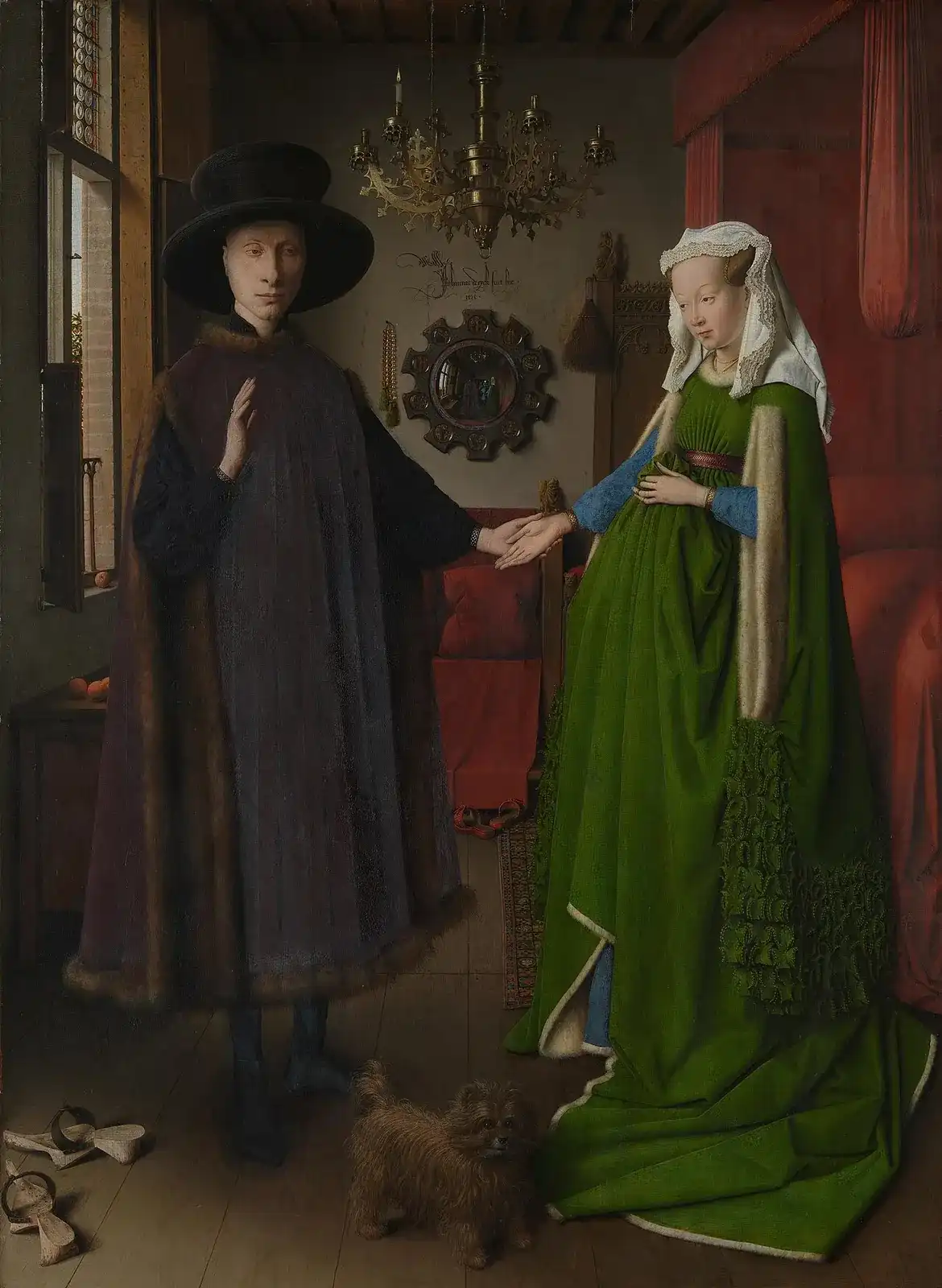
How to read the labels Historical what the old sources say. Later tradition what later writers added. Modern modern practice and my own notes.
The Northern Renaissance is the art of Flanders, the Netherlands, Germany and France from about 1420 to 1580, famous for oil painting of astonishing detail, hidden symbols, printmaking and portraits. Its key artists include Jan van Eyck in Bruges, Rogier van der Weyden, Hieronymus Bosch, Albrecht Dürer in Nuremberg, Hans Holbein the Younger and Pieter Bruegel the Elder.
While Florence studied perspective and ancient statues, the North built a different Renaissance. Its pictures are full of fur, brass, glass, fields and faces, and also full of devils, witches and dreams.
Key dates
| When | What happened |
|---|---|
| 1432 | The Van Eyck brothers complete the Ghent Altarpiece. |
| 1434 | Jan van Eyck paints the Arnolfini Portrait. |
| About 1490 to 1510 | Bosch paints his dream worlds. |
| 1514 | Dürer engraves Melencolia I. |
| 1565 | Bruegel paints The Harvesters. |
What is the Northern Renaissance?
The Northern Renaissance is the renewal of art north of the Alps, where painters combined deep religious feeling with close observation of the visible world in oil paint and print.
Throughout this page I mark three layers. Historical What the works and records show. Later tradition What later admirers and occultists made of them. Modern How the images live today.
Historical Light in thin layers. Jan van Eyck worked in Bruges for the Duke of Burgundy. With his brother Hubert he made the Ghent Altarpiece, completed in 1432. He did not invent oil paint, but he refined it, laying down thin translucent glazes that let light pass through and bounce back.
The result is a detail never seen before: every jewel, every hair of a fur collar. The Met has a small van Eyck diptych of the Crucifixion and the Last Judgment from about 1436 to 1438. Rogier van der Weyden added deep emotion, with weeping figures that seem to feel every inch of their grief.
Prayer books for the home. 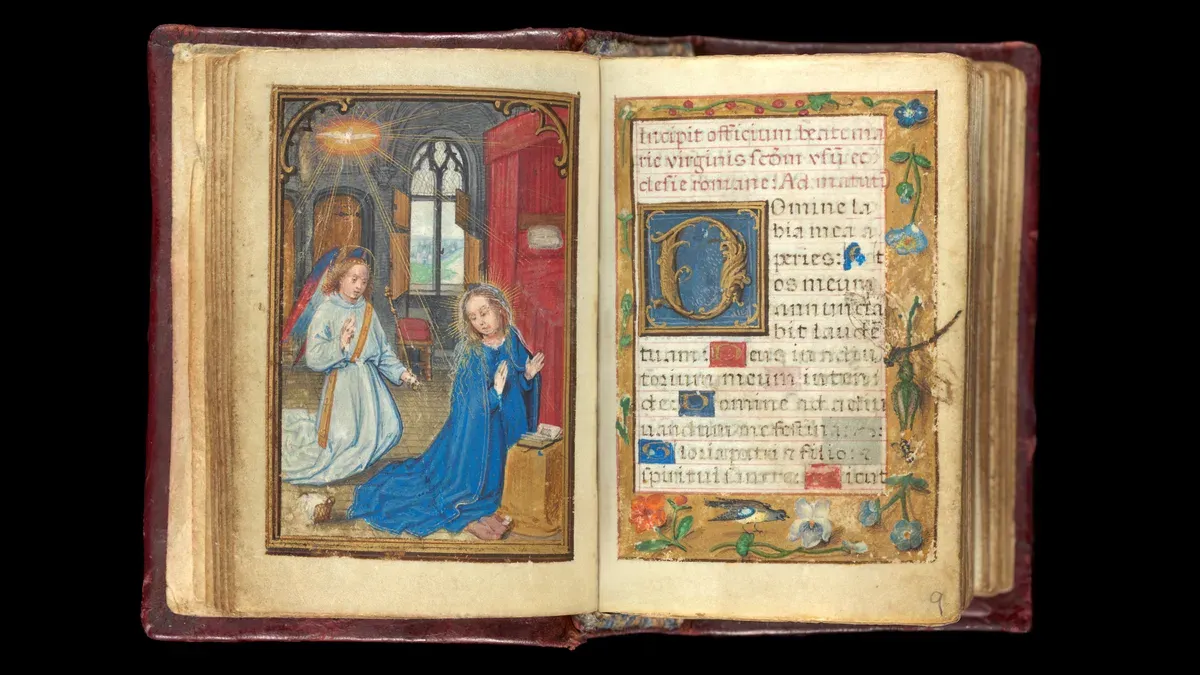
Simon Bening, Book of Hours, about 1530 to 1535. The Metropolitan Museum of Art (2015.706). Image: Open Access, public domain (CC0).
Historical Books of hours were prayer books for lay people. Simon Bening of Bruges, the last great Flemish illuminator, worked in the decades around 1530.
In this small book at the Met, the angel Gabriel greets Mary on the page that opens the Hours of the Virgin, the heart of the book, and the text is framed by flowers, a bird and insects so real they seem to rest on the page.
For a wealthy household, such a book was a private chapel that fit in the hand.
Historical Bosch’s dream world. Hieronymus Bosch (about 1450 to 1516) of ’s-Hertogenbosch painted hybrid demons, burning cities and strange pleasures.
His Garden of Earthly Delights in the Prado, which I describe in words since it is full of nudes, warns against sin. He belonged to a respected religious confraternity, so the old idea that he was a secret heretic has little support.
Historical Dürer and the print. Albrecht Dürer of Nuremberg (1471 to 1528) travelled to Italy and brought back its theory, but his greatest fame came from prints. Woodcuts and engravings could be printed in hundreds, so his images travelled across Europe. In 1514 he engraved Melencolia I, with its magic square, compass and brooding winged figure.
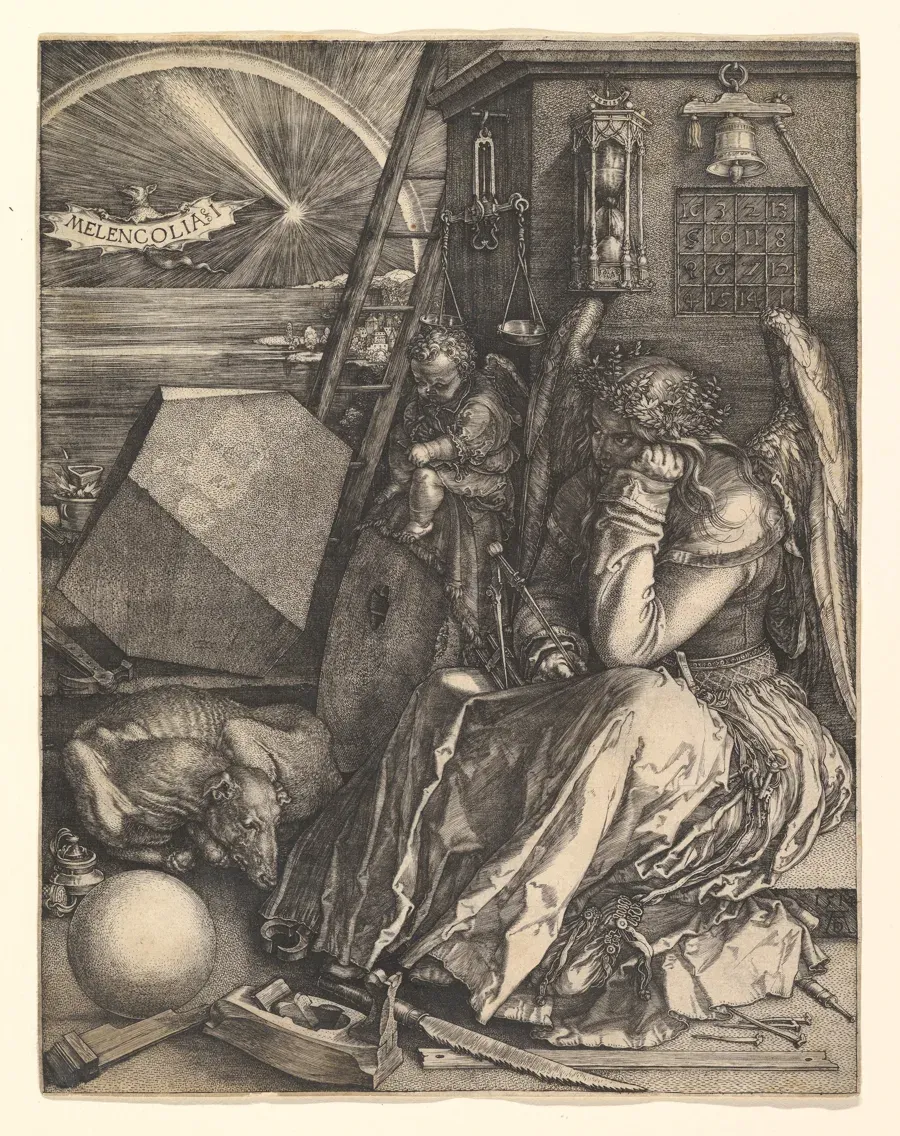
Albrecht Dürer, Melencolia I, 1514. The Metropolitan Museum of Art (43.106.1). Image: public domain.
Bruegel’s world. 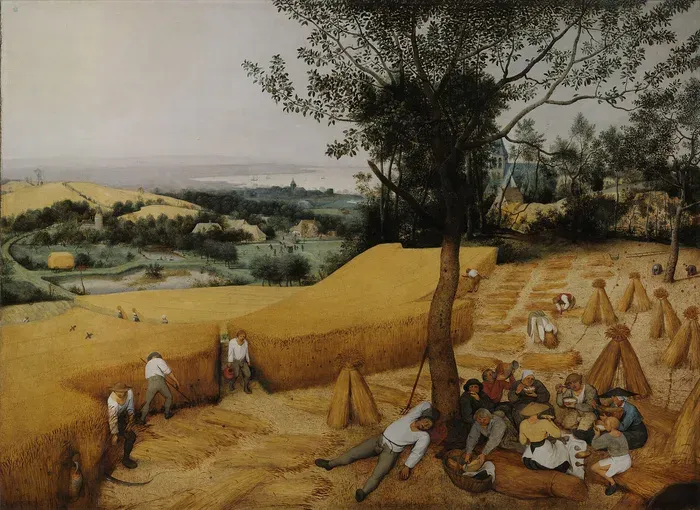
Pieter Bruegel the Elder, The Harvesters, 1565. The Metropolitan Museum of Art (19.164). Image: public domain.
Historical Pieter Bruegel the Elder painted the seasons of the year for an Antwerp merchant in 1565. The Harvesters, now at the Met, shows a hot afternoon: some people cut wheat, others eat and sleep under a pear tree.
Bruegel also painted proverbs, children’s games and the Tower of Babel, and his sharp eye for ordinary people changed what art could show.
Key artists
| Artist | Lived | Why they matter |
|---|---|---|
| Jan van Eyck | about 1390 to 1441 | The master of oil glazes and microscopic detail. |
| Rogier van der Weyden | about 1399 to 1464 | The painter of grief and tenderness. |
| Hieronymus Bosch | about 1450 to 1516 | Creator of monsters, hybrids and moral warnings. |
| Albrecht Dürer | 1471 to 1528 | The printmaker who made Melencolia I and spread images across Europe. |
| Pieter Bruegel the Elder | about 1525 to 1569 | The painter of peasants, seasons and proverbs. |
How do you recognise the Northern Renaissance?
Look for jewel-like detail: every hair, reflection and thread painted in thin oil glazes. Ordinary objects hide symbols. Interiors and landscapes are seen close up and far away at once. Prints carry images into every town, and humor, fear and morality sit side by side.
Common misconceptions. One is that van Eyck invented oil painting. Oil was used before him; he and his contemporaries refined it in thin glazes to reach a new brilliance.
Another is that every object in these paintings is a coded symbol. Some clearly are, but historians now warn against reading a secret meaning into every dog or shoe. Keep the documented symbols separate from modern guesses. A third is that women did not paint. Catharina van Hemessen painted a self-portrait at her easel in 1548, one of the earliest of its kind, and Levina Teerlinc, from Bruges, became a court miniaturist to Henry VIII and Elizabeth I.
Esoteric themes
Historical Northern artists gave Europe its picture of the witch. Dürer and his pupil Hans Baldung Grien made prints of witches in the early 1500s, often nude and riding goats, which I describe rather than show.
These images appeared in the same decades as the witch-hunting manuals, and they helped fix the stereotype. I tell that story in Witches in art.
Later tradition Melencolia I became an emblem of the melancholy genius, linked to Agrippa’s ideas about Saturn. Scholars still debate how much Dürer knew of Agrippa.
Modern Bosch’s monsters appear on album covers, tattoos and tarot decks. They began as warnings, not decorations.
Works to see
| Work | Artist | Date | Where to see it |
|---|---|---|---|
| The Arnolfini Portrait | Jan van Eyck | 1434 | The National Gallery, London |
| Melencolia I | Albrecht Dürer | 1514 | The Metropolitan Museum of Art, New York, and many other print rooms |
| The Harvesters | Pieter Bruegel the Elder | 1565 | The Metropolitan Museum of Art, New York |
| Saint John on Patmos | Hieronymus Bosch | about 1489 to 1499 | Gemäldegalerie, Berlin |
Every work in this list is free of nudity, so you can look them up with confidence. Works still in copyright are named but not shown here.
How to look at a Northern Renaissance painting
Get close, then closer. Look at reflections in metal and glass, at the threads of fur and carpet, at tiny landscapes through windows. Then step back and ask what the details add up to: wealth, faith, mortality.
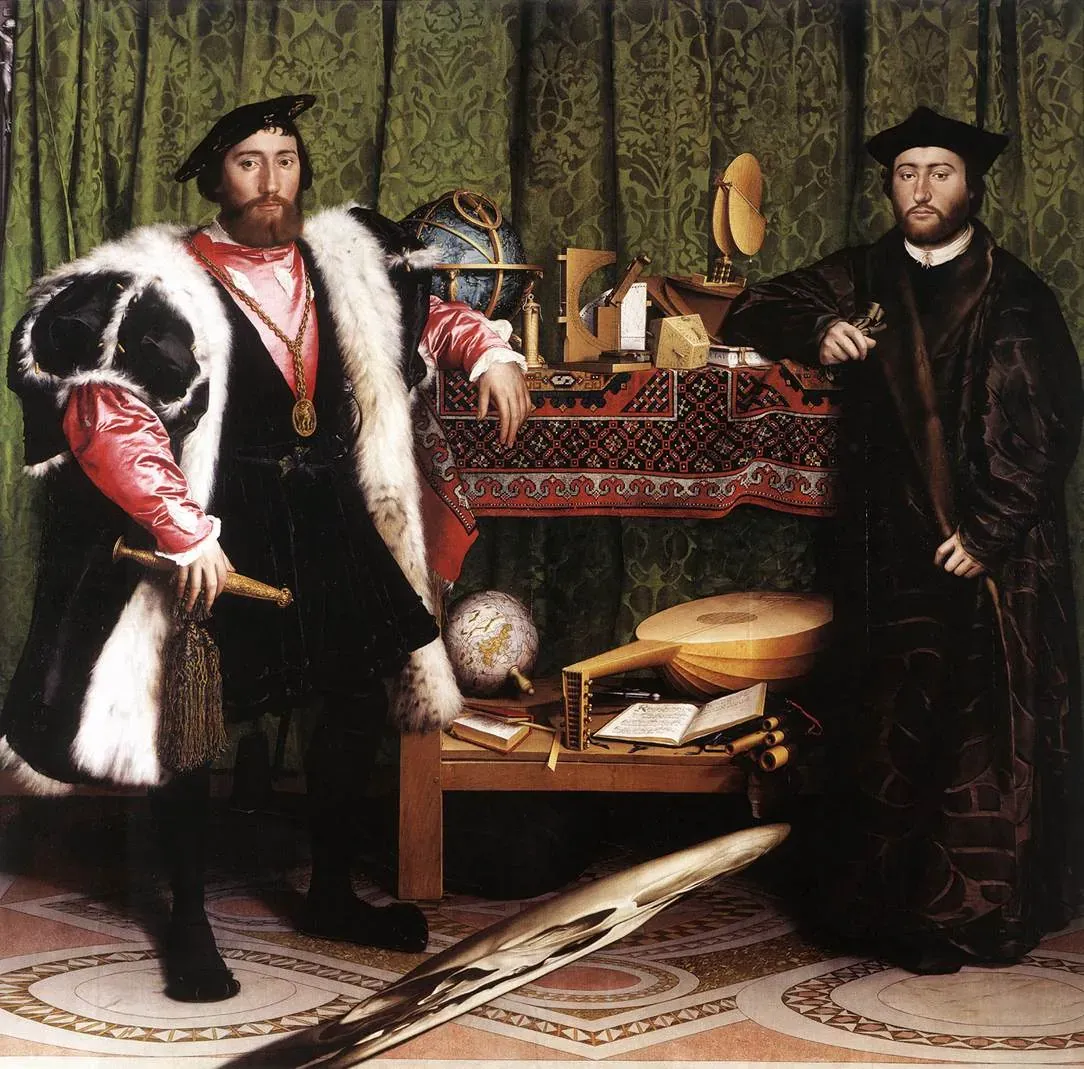
Hans Holbein the Younger, The Ambassadors, 1533. National Gallery, London. Image: Wikimedia Commons, public domain.
Hans Holbein the Younger, The Ambassadors, 1533. At the National Gallery in London. Jean de Dinteville and Georges de Selve stand among symbols of learning. Now look at the blur across the floor and move to the right of the picture: it becomes a skull, a reminder of death. There is also a tiny crucifix half hidden behind the curtain at top left.
The Northern Renaissance grew from International Gothic and illuminated manuscripts, exchanged ideas with the Early Renaissance and High Renaissance in Italy, and led to the Dutch Golden Age. Bosch’s dream worlds were later claimed as ancestors by the Surrealists.
Try this
Look closely at the Harvesters on the Met website and zoom in. Count the activities you can find: cutting, carrying, eating, sleeping, playing. Which one is closest to how your week feels right now?
What next
Before this: High Renaissance.
After this: Mannerism.
Also worth reading alongside it: Early Renaissance, Dutch Golden Age.
See every movement in order on the art movements timeline, or learn to look step by step in the free Art History for Beginners course.
If you want to carry this into tarot and practice, these pages connect to it: The Hermit, the scholar and the lamp of Dürer’s melancholy genius; Ten of Pentacles, home, household and wealth painted in loving detail; A close reading of Melencolia I; and Melancholy, Saturn and genius.
Sources
- Erwin Panofsky, Early Netherlandish Painting: Its Origins and Character (1953).
- Erwin Panofsky, The Life and Art of Albrecht Dürer (1943).
- The Metropolitan Museum of Art, Book of Hours, 2015.706. Open the record
- The Metropolitan Museum of Art, The Harvesters, 19.164. Open the record
- E. H. Gombrich, The Story of Art (1950).
- Wikimedia Commons, The Arnolfini Portrait (hero image record). Open the record
- Craig Harbison, The Mirror of the Artist: Northern Renaissance Art in its Historical Context (1995).

Questions
Did Jan van Eyck invent oil painting?
No. Oil paint was known before him. He refined it, building up thin translucent glazes that give his pictures their jewel-like depth, and that is why the legend grew.
What is a book of hours?
A prayer book for lay people, with prayers for set hours of the day, a calendar of saints and often beautiful painted pictures. They were the best-selling books of the late Middle Ages.
Where can I see works of Northern Renaissance art in person?
Good places to start are Ghent, Bruges, Madrid (the Prado), Vienna, Nuremberg, and the Met. Museums change their displays, so check the collection page before you travel.
What is the difference between the Italian and Northern Renaissance?
Italian painters stressed ideal bodies, perspective and antiquity. Northern painters stressed detail, texture, light on surfaces and religious devotion, often in oil on wooden panels.
Where can I see Northern Renaissance art?
The National Gallery in London, the Prado in Madrid, the Groeningemuseum in Bruges, St Bavo's Cathedral in Ghent for the Ghent Altarpiece, the Kunsthistorisches Museum in Vienna for Bruegel and the Alte Pinakothek in Munich for Dürer.
What is the Ghent Altarpiece?
A large folding altarpiece in St Bavo's Cathedral in Ghent, completed by Jan van Eyck in 1432. An inscription says his brother Hubert began it. Its central panel shows the Adoration of the Mystic Lamb.
Get the free Mini-Grimoire
A short printable starter guide to tarot and everyday witchcraft, plus my newsletter. Unsubscribe any time.
Opens Substack in a new tab to confirm. More about the newsletter · Privacy