


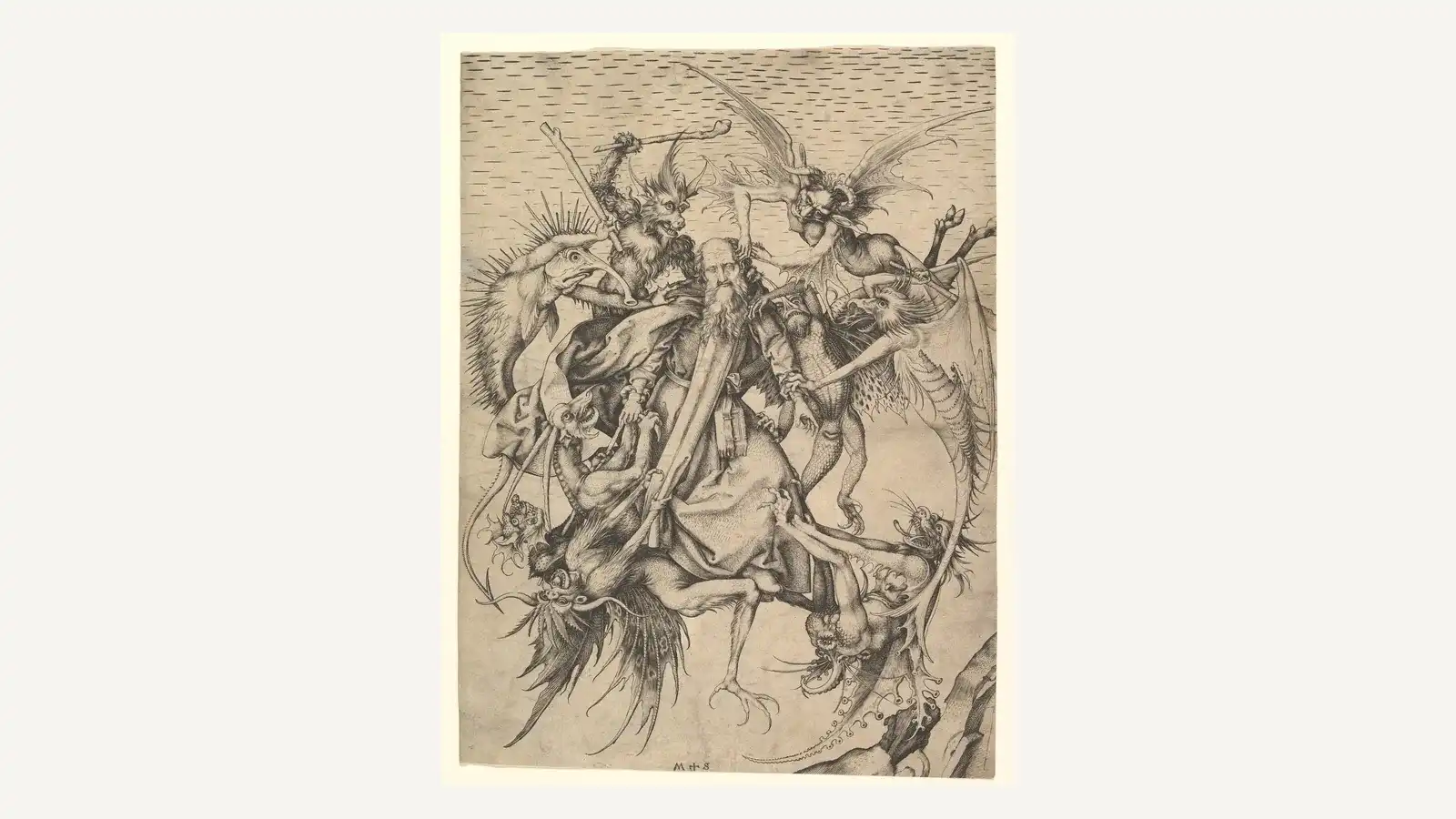
In this lesson: the Greek daimon, how the word darkened, what goetia meant and the map of a course that runs from Plato to the 1904 Goetia.
Before you open the Goetia, or any book about demons, it helps to know that the word “demon” has not always meant what horror films have taught us. It began as a neutral Greek word for a spirit or divine power, and only slowly darkened into the Christian fallen angel.
Knowing that history protects you from two common mistakes: treating every spirit in old texts as pure evil, and treating modern ideas as ancient. This first lesson traces the word, introduces the term “goetia” itself and maps out the course. Everything here is history and reading; nothing in this course asks you to summon anything.
The Greek daimon
Historical Our word demon comes from the Greek daimōn. In early Greek it was not an evil word. It meant a divine power, a spirit or even a person’s fate. In Hesiod’s Works and Days (lines 121 to 126), the people of the golden age become kindly daimones after death, guardians of mortals.
In Plato’s Symposium (202e), the priestess Diotima calls Love a great daimōn, a being between gods and humans who carries prayers up and gifts down. Socrates spoke of his daimonion, an inner sign that warned him when he was about to make a mistake. So for a Greek reader, a daimon could be good, bad or neither. It was a go-between.
Socrates and his inner sign
Historical The most famous personal daimon in Greek literature belongs to Socrates. In Plato’s Apology (31c to d), Socrates tells the jury at his trial in 399 BCE that since childhood a kind of voice has come to him, and that it always turns him away from something he is about to do, never toward anything. He calls it his daimonion, “the divine something”. His accusers charged him with bringing in new divine beings, and this inner sign may have been part of what they meant.
Later philosophers argued about what it was. Plutarch wrote a whole dialogue, On the Sign of Socrates, and the second century writer Apuleius wrote On the God of Socrates. Apuleius gave a tidy scheme: gods live far above in the heavens, humans live on earth and daimones live in the air between, carrying prayers and answers. That middle position matters for the rest of this course, because Christian writers took over the idea of airy beings between heaven and earth and turned it dark.
Augustine’s turn
Historical Augustine of Hippo read Apuleius closely. In The City of God, written between about 413 and 426 CE, he spends books 8 and 9 arguing with the Platonists about daimones. He accepts that they live in the air and have bodies of air, but he concludes that they are not go-betweens at all. For Augustine they are the fallen angels, proud and deceiving, and the pagan gods were these demons in disguise. His books were read for over a thousand years, and they did much to fix the dark meaning of the word in Western Christianity.
How the word darkened
Historical Jewish writers who translated the Bible into Greek used daimonion for foreign gods and harmful spirits. The New Testament uses it for the unclean spirits that Jesus casts out. In Christian Latin, daemon came to mean an evil spirit, one of the angels who fell with Satan. By the Middle Ages, a demon was a fallen angel, and every pagan daimon had become a devil.
Goetia: from lament to sorcery
Historical The title of the book this course is about, the Ars Goetia, is Greek too. A goēs was a kind of sorcerer. The word is linked to goos, the wailing lament sung over the dead, and the scholar Sarah Iles Johnston has argued that the goēs was first a specialist in lament and in dealing with the restless dead.
By Plato’s time the word meant a cheat. Late antique philosophers set goeteia, low sorcery, against theurgia, “god-work”. The seventeenth-century title Ars Goetia, “the goetic art”, uses the word in that later sense: a manual for working with evil spirits.
A short excerpt from the Greek Bible
Historical You can see the darkening in a single verse. Psalm 96:5 in the Hebrew Bible says that all the gods of the nations are elilim, a word meaning “worthless things” or idols, and the King James Version (1611) translates it “For all the gods of the nations are idols.”
The Greek translation known as the Septuagint, made in the last centuries BCE, numbers it Psalm 95:5 and renders the word as daimonia. So in Greek the verse says that the gods of the nations are demons. Deuteronomy 32:17 does something similar, and the King James Version reads: “They sacrificed unto devils, not to God.” Once foreign gods were called daimonia, the old neutral word carried a new charge.
Questions beginners ask
Is “demon” the same as “devil”? Not quite. “Devil” comes from the Greek diabolos, “slanderer” or “accuser”. In Christian usage the Devil is Satan himself, and devils or demons are the spirits under him, but older English texts often use the words loosely.
Were daimones worshipped in ancient Greece? Mostly they were honoured as part of wider religion rather than as a separate cult. The “good daimon”, Agathos Daimon, did receive small offerings of unmixed wine at meals.
Does every culture have demons? Many cultures have harmful or dangerous spirits, but translating all of them as “demons” can flatten very different ideas. In this course we try to use each culture’s own words.
Myths to drop: Demons were not always evil. The word goetia did not always mean summoning. And the 72 spirits of the Goetia do not come from ancient Greece; their book is early modern, as you will see in lesson 4.
A worked example
Imagine three readers meeting the same Greek sentence about a daimon. A farmer in Hesiod’s time hears of a guardian spirit watching over the living. A Christian monk in the ninth century, reading the same word, sees a devil to be resisted. A modern reader who has only seen exorcism films pictures a monster in a basement. The word on the page has not changed; the readers have. That is the habit this course will build: whenever you meet a spirit in a text, ask who wrote it, when, and what the word meant to them.
The map of this course
Over the next nine lessons we will travel from ancient Mesopotamia, Greece, Jewish texts and the New Testament, through Solomon and the medieval grimoires (handbooks of magic), to the two sceptics Weyer and Scot and the famous 1904 edition of the Goetia. Then you will learn how to read a spirit entry, how to keep safe and ethical and how modern practitioners approach these spirits, ending with a plan for a year of study. The last three lessons are hands-on reading practice: comparing sources, looking critically at seals and pictures, and reading ritual language.
Are the spirits real? People answer that in very different ways: as beings, as parts of the mind, or as characters in old books. This course does not ask you to decide. It treats the 72 spirits as figures in texts with a history you can study, whatever you believe.
If you are struggling right now, call your local emergency number (112 in Europe, 911 in the US and Canada) or see Getting help.
Try this
Write down where you first met the idea of demons, such as a film, a church, a game or a book. Then write one feeling the word brings up. Do not judge it. Keep the page; you will look at it again in lesson 7.
A second step: look up one modern use of the word “demon”, such as a song, a game or a phrase like “speed demon” or “inner demons”. Write which of the historical meanings it is closest to.
A word study you can do at home
A good first habit in this course is to keep a small “word page” in your notebook. Each time you meet a word for a spirit, write it down with its language, its rough meaning and where you found it. Here are a few to start. The Greek daimon meant a divine power or guiding spirit, not necessarily evil.
The Hebrew shedim appears in Deuteronomy 32:17, which the King James Version of 1611 renders as “They sacrificed unto devils, not to God”. The Arabic jinn are a separate category in Islamic tradition, beings made of smokeless fire who can be good or bad, and they should not simply be called demons.
After a few lessons your word page will show you something important: English has squeezed many different ideas from many cultures into the single word “demon”. Keeping them apart is the start of reading the sources well.
A beginner’s worry, answered. “Is it disrespectful to my religion to study this?” Studying how people have understood spirits is history, and many religious scholars do exactly this. If you are unsure, talk it over with someone you trust in your own tradition.
Recap
The Greek daimōn was a neutral go-between, sometimes a guardian, sometimes harmful. Greek Bible translations, the New Testament and Christian Latin narrowed it to an evil spirit and finally to a fallen angel. The word goēs began with lament for the dead, came to mean a cheat, and by late antiquity meant low sorcery, which is the sense behind the seventeenth-century Ars Goetia. Reading about spirits is safe, and asking who wrote a text and when is your best tool.
What next
Press “Mark as done” and continue with Demons in the ancient world. For an overview of the whole subject, see the Goetia hub and a short history of the Goetia.
Further reading: Augustine, The City of God, books 8 and 9, in any public domain translation such as Marcus Dods (1871). Apuleius, On the God of Socrates, available in older English translations.
Sources
- Plato, Symposium 202e to 203a.
- Hesiod, Works and Days 121 to 126.
- Sarah Iles Johnston, Restless Dead: Encounters between the Living and the Dead in Ancient Greece (Berkeley: University of California Press, 1999).
- Owen Davies, Grimoires: A History of Magic Books (Oxford University Press, 2009).
Quick check
Go deeper: the Goetia pages on this site
Get the free Mini-Grimoire
A short printable starter guide to tarot and everyday witchcraft, plus my newsletter. Unsubscribe any time.
Opens Substack in a new tab to confirm. More about the newsletter · Privacy
Comments
Questions and notes from readers. Anyone with a free account can comment, and I reply when I can. Please read the community guidelines.
Comments load from Google Firebase (EU) when you ask for them. Nothing is stored on your device. Privacy