


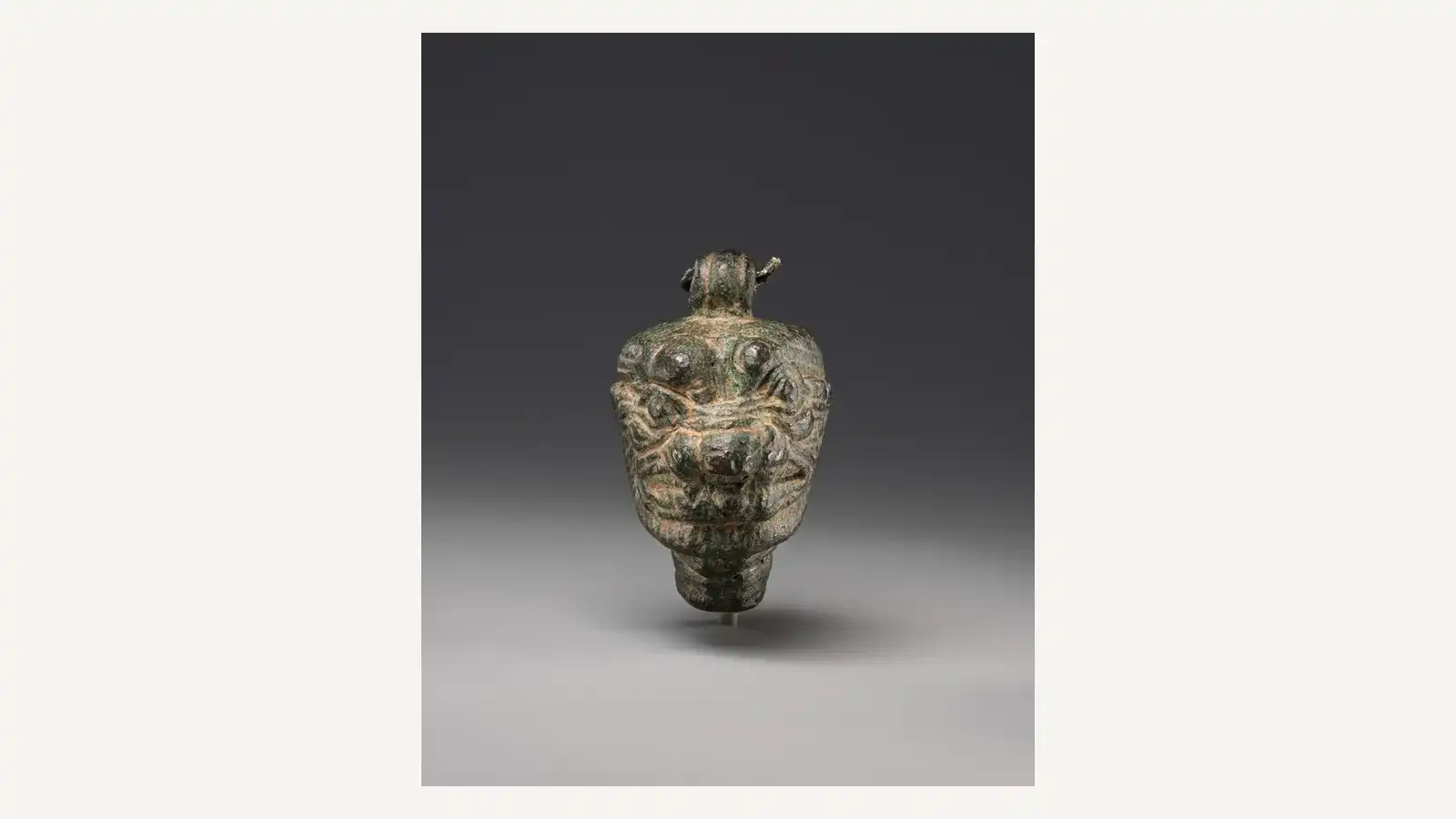
The spirits of the Goetia did not appear out of nowhere in seventeenth-century England. Their names, their ranks and the idea that they can be commanded by holy names all have roots in the ancient world. In this lesson you will meet the demons of Mesopotamia, of Jewish texts such as Tobit and 1 Enoch, and of the New Testament, and see which of their ideas carried forward. You will also notice something that surprises many beginners: for most of history, people’s main relationship with demons was protection, not worship.
Mesopotamia: protection, not worship
Historical Mesopotamian texts from the second and first millennia BCE describe many demons, often as causes of illness and bad luck. The fearsome Lamashtu threatened pregnant women and babies. Pazuzu, a winged demon king of the winds with a dog-like face, was himself dangerous, but his image was used to drive Lamashtu away.
Small Pazuzu heads in bronze or clay, worn as amulets, are in many museums. Healers called āšipu recited incantations and performed rites to send harmful spirits off. The main relationship was protection: you kept demons away, and you could name, depict and drive them off by ritual.
Lamashtu and Pazuzu
Historical Two Mesopotamian figures show how protective magic worked. Lamashtu was feared as a being who attacked pregnant women, mothers and newborn babies. She was described with a lion’s head, donkey’s teeth and bird’s talons, and she was not a minor demon but the daughter of the sky god Anu. Pazuzu, with a dog-like face, wings and talons, was himself a fearsome wind demon, but his image was used to drive Lamashtu away.
Small bronze and stone Pazuzu heads, often with a loop for hanging, were worn or hung in the house, especially around childbirth. Museums such as the British Museum and the Louvre hold many of these amulets from the early first millennium BCE.
Historical Mesopotamian specialists, called āšipu in Akkadian, used long series of incantations against harmful spirits. One series, known in Akkadian as Utukkū Lemnūtu, “evil spirits”, lists many kinds of demons and the rites to expel them. The point of all this was protection and healing, not friendship with the spirits.
Jewish texts: fallen angels and named demons
Historical The Book of Tobit, a Jewish story from about the third or second century BCE, has a named demon, Asmodeus, who kills the seven husbands of Sarah until the angel Raphael teaches Tobias to drive him off with the smoke of a fish’s heart and liver. Asmodeus later reappears as Asmoday, spirit 32 of the Goetia.
The Book of the Watchers, the first part of 1 Enoch (third century BCE), tells of angels called Watchers who came down to earth, took human wives and taught forbidden arts, including spells, root-cutting and astrology. Their giant children died, and their spirits became evil spirits on earth. The Dead Sea Scrolls also speak of Belial, a leader of the forces of darkness. Belial is spirit 68 of the Goetia. From these texts come the ideas of fallen angels, forbidden knowledge and individually named demons.
The New Testament
Historical The Gospels show Jesus casting out unclean spirits. In Mark 5, a man in the tombs is possessed by many spirits who give their name as “Legion, for we are many”, and they are sent into a herd of pigs. These stories made exorcism by a holy name central to Christian ideas about demons. The Goetia’s later conjurations use holy names in the same way, as authority over spirits, and the Goetia gives each of its spirits a number of “legions”, an echo of Mark 5.
Tobit and Asmodeus in more detail
Historical The Book of Tobit, probably written in the third or second century BCE, tells a story that later demon books never forgot. A young woman named Sarah has been married seven times, and each husband has died on the wedding night, killed by the demon Asmodeus (Tobit 3:8). Young Tobias travels with a companion who is the archangel Raphael in disguise.
Raphael tells him to burn the heart and liver of a fish, and the smoke drives the demon away. Tobit 8:3 says the demon fled “into the utmost parts of Egypt” and the angel bound him there. Asmodeus, or Asmoday, appears again centuries later as spirit number 32 in the 1904 Goetia, which shows how long these names travel.
The Watchers
Historical Chapters 6 to 16 of 1 Enoch, part of which may date from the third century BCE, tell how angels called the Watchers came down, took human wives and taught forbidden knowledge such as metalwork, cosmetics and spells. Their giant children brought violence to the earth, and when the giants died their spirits became evil spirits. This story offered one answer to the question “where do demons come from?” It was popular among Jewish groups, copies were found among the Dead Sea Scrolls, and it remains part of the scriptures of the Ethiopian Orthodox Church.
Illness, fear and protection
Historical It helps to remember what life was like for the people who wrote these texts. In the ancient Near East, many children died young, childbirth was dangerous, and fevers came without warning. Demons gave a name and a face to these terrors. An incantation or an amulet was a way of doing something when medicine could do little. Seen this way, much ancient “demonology” is really a record of human fear and care: parents trying to protect their babies, healers trying to explain disease.
This is why so many surviving objects are protective. Pazuzu heads were worn or hung up to drive away Lamashtu. Clay plaques and inscribed amulets asked gods to keep the household safe. When you see a demon image from the ancient world in a museum, ask first: who was this meant to protect, and from what?
Jinn are a different category
Historical Popular books often lump Middle Eastern spirits together as “demons”. In Islamic tradition, the jinn are a distinct kind of being, created from smokeless fire according to the Qur’an, with free will like humans. Some jinn are believers and some are not. The figure of Iblis, who refused to bow to Adam, is described in the Qur’an as being of the jinn. Calling all jinn demons is a little like calling all humans villains. If you study them, read sources written from within Islamic scholarship as well as Western ones.
A timeline exercise
Make a simple timeline on one page of your notebook. Mark Mesopotamian incantations against Lamashtu (second and first millennia BCE), the Book of the Watchers in 1 Enoch (around the third century BCE), the Book of Tobit (around the third or second century BCE), the Gospel of Mark (around 70 CE), and Augustine’s City of God (early fifth century CE). Seeing these dates spaced out on a line makes it clear that ideas about demons developed slowly, over more than two thousand years, and changed a great deal along the way.
Questions beginners ask
Did ancient people worship demons? In Mesopotamia and Jewish tradition, the main aim was protection from them. Pazuzu is an interesting case: his image was used for protection, but he was not a god of the temples.
Is Asmodeus in the Bible? He is in Tobit, which is part of the Bible for Catholic and Orthodox Christians and in the Apocrypha for many Protestants.
Is the “Legion” story about many demons? In Mark 5:9 the spirit answers Jesus: “My name is Legion: for we are many.” Some scholars read a comment on Roman occupation in the word legion, though this is debated.
Myths to drop: Pazuzu is not a Satan figure, despite his role in a famous horror film. Mesopotamian demons were not fallen angels; that idea comes later. And not every ancient spirit was evil: many protective beings, such as the Mesopotamian lamassu guardians, were welcome.
A worked example
Imagine a pregnant woman in Assyria around 700 BCE. She is afraid for her baby, because everyone knows Lamashtu attacks newborns. Her family buys a small bronze Pazuzu head and hangs it near her bed. An āšipu comes to recite an incantation.
Nobody in the house worships Pazuzu; they are using one dangerous power to drive off another, the way you might keep a fierce dog to guard the door. Now jump forward two thousand years to the Goetia, where a magician uses God’s names to command spirits. The tools have changed, but the shape is similar: name the spirit, hold authority over it and keep yourself safe.
If you are struggling right now, call your local emergency number (112 in Europe, 911 in the US and Canada) or see Getting help.
Try this
Make a three-row table with Mesopotamia, Jewish texts and New Testament. In each row, write one sentence on what demons did and how people protected themselves.
A beginner’s worry, answered. “Pazuzu looks frightening. Is it unlucky to look at him?” Not at all. In his own world Pazuzu was a protector, and museums around the world display his image. Looking at ancient art is a way of meeting the people who made it.
Recap
Mesopotamian demons such as Lamashtu caused illness, and protective images like Pazuzu and the incantations of the āšipu kept them away. Jewish texts added named demons such as Asmodeus and Belial, both later in the Goetia, and the Watchers of 1 Enoch who taught forbidden arts. The New Testament made command by a holy name central and gave us “Legion”. Naming, holy authority and legions all carried forward into the Goetia.
What next
Press “Mark as done” and continue with Solomon and the grimoires. For more background, read a short history of the Goetia and, for another figure from Mesopotamian and Jewish demon lore, the history of Lilith.
Further reading: Jeremy Black and Anthony Green, Gods, Demons and Symbols of Ancient Mesopotamia (British Museum Press, 1992). The Book of Tobit in the Revised Standard Version or the King James Apocrypha.
Sources
- The Book of Enoch, translated by R. H. Charles (Oxford, 1912), chapters 6 to 16.
- Mark 5:1 to 20, King James Version (1611).
- Book of Tobit, chapters 3 and 8.
- British Museum and Musée du Louvre, collection records for Pazuzu head amulets.
Quick check
Go deeper: the Goetia pages on this site
Get the free Mini-Grimoire
A short printable starter guide to tarot and everyday witchcraft, plus my newsletter. Unsubscribe any time.
Opens Substack in a new tab to confirm. More about the newsletter · Privacy
Comments
Questions and notes from readers. Anyone with a free account can comment, and I reply when I can. Please read the community guidelines.
Comments load from Google Firebase (EU) when you ask for them. Nothing is stored on your device. Privacy