


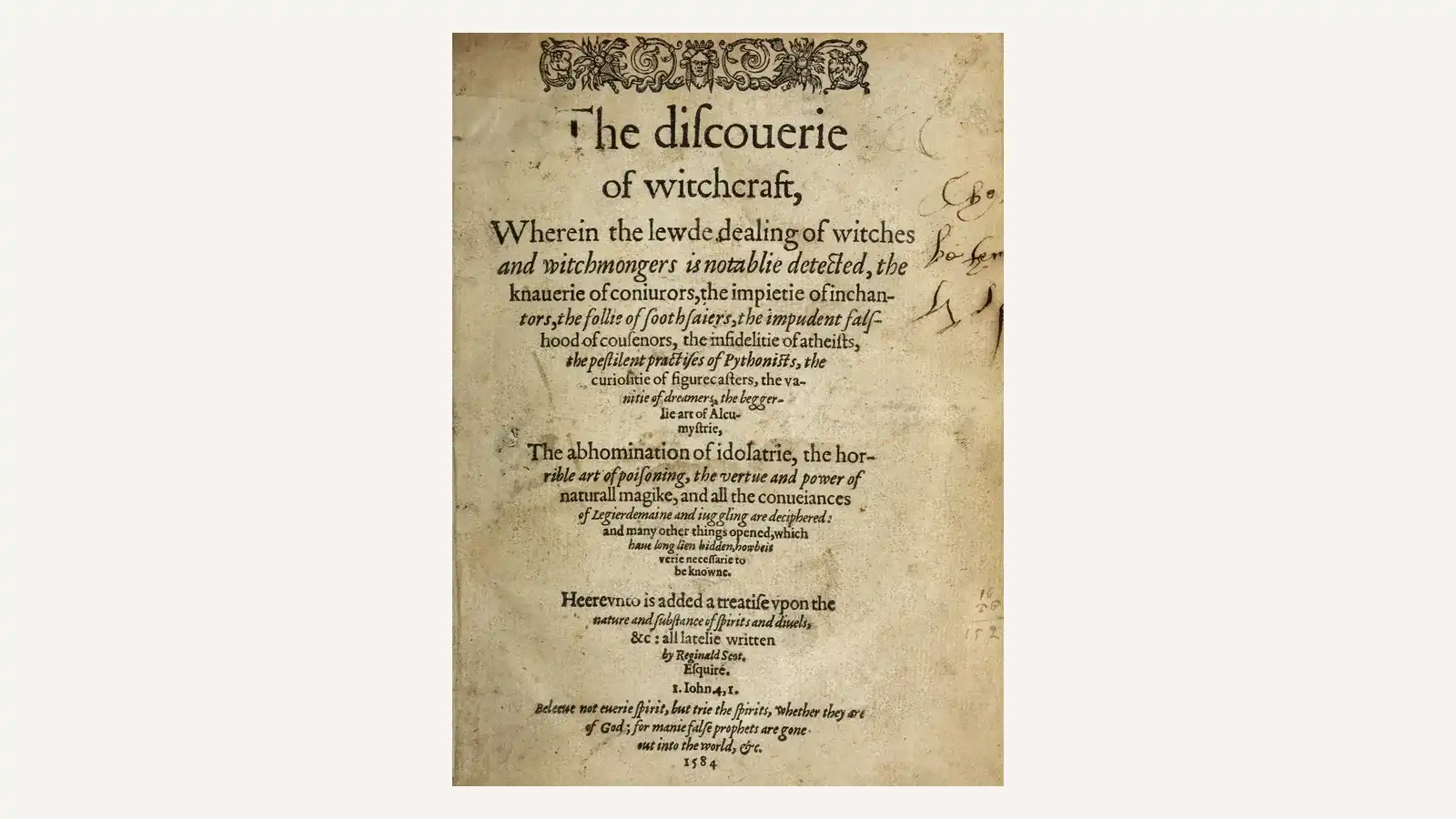
Most people who own a copy of the Goetia have the 1904 edition, or something copied from it, and assume it is an ancient book handed down unchanged. The real story is stranger and more interesting. The list of 72 spirits survives partly thanks to two sixteenth-century sceptics who were fighting the witch trials, and the famous 1904 book mixes a seventeenth-century manuscript with new material by Aleister Crowley. In this lesson you will learn which parts are old and which are new, so you can read any edition with clear eyes.
Two sceptics
Historical The Dutch physician Johann Weyer argued in De praestigiis daemonum (1563) that many women accused of witchcraft were ill or deluded and should be treated by doctors, not burned. To the 1577 edition he added the Pseudomonarchia daemonum, “the false monarchy of demons”, a catalog of 69 demons copied from a magician’s book, to show what conjurers claimed.
The English gentleman Reginald Scot went further. His Discoverie of Witchcraft (1584) argued that most witchcraft claims were fraud, delusion or the product of cruel interrogation. In Book 15 he translated Weyer’s catalog into English. Of Agares, Scot says “he commeth up mildlie in the likenes of a faire old man, riding upon a crocodile”. The Goetia’s wording often follows Scot’s English closely. Of its 72 spirits, 68 appear in Weyer, though in a different order and spelling. Two sceptics preserved the list that magicians later copied.
Who Weyer was
Historical Johann Weyer (1515 to 1588) was a Dutch physician who had studied as a young man in the household of Heinrich Cornelius Agrippa, the author of Three Books of Occult Philosophy. Later he served as physician to Duke William of Jülich-Cleves-Berg. In 1563 he published De praestigiis daemonum, “On the tricks of demons”. Weyer believed in the Devil, but he argued that many women accused of witchcraft were confused, melancholic or ill, and needed doctors rather than executioners. That was a brave argument at the height of the witch trials.
Historical In the 1577 edition he added an appendix, the Pseudomonarchia daemonum, “the false monarchy of demons”. It listed 69 spirits with their ranks, appearances and offices. Weyer said he had copied it from a manuscript called the Book of the Offices of Spirits, and he printed it so readers could see how foolish and wicked such books were. Ironically, by printing it he made sure it survived.
Who Scot was
Historical Reginald Scot (about 1538 to 1599) was an English country gentleman from Kent. His Discoverie of Witchcraft (1584) went further than Weyer: he argued that most witchcraft accusations were the product of fraud, illness, malice and bad theology, and he exposed conjuring tricks. In book 15 he translated Weyer’s spirit list into English, which is how the list entered the English language.
Historical Both men had a famous critic. King James VI of Scotland, later James I of England, published Daemonologie in 1597, and in its preface he names “Wierus” and “Scot” as writers who wrongly deny the power of witches.
The Lemegeton
Historical The Ars Goetia is the first of five books in a collection called the Lemegeton or Lesser Key of Solomon, which survives in seventeenth-century English manuscripts now in the British Library. Most scholars date its compilation to the middle or later part of that century.
The other books deal with spirits of the compass, angels of the hours, a wax tablet called the almadel and prayers for memory. The Goetia itself contains the catalog of 72 spirits with their seals, followed by instructions for the circle, the triangle and the conjurations. It is a Christian book: the magician commands spirits by the names of God.
Mathers and Crowley, 1904
Later tradition S. L. MacGregor Mathers, a leader of the Hermetic Order of the Golden Dawn, prepared an English text from the Sloane manuscripts in the 1890s. Aleister Crowley, after falling out with him, published it in 1904 from his house, Boleskine, on Loch Ness, as The Book of the Goetia of Solomon the King.
Crowley added a prefatory note, a Greek invocation mocking “the terrible Mathers”, his essay “The Initiated Interpretation of Ceremonial Magic” arguing that the spirits are “portions of the human brain”, and a “Preliminary Invocation” taken from a Greek magical papyrus. The seals were redrawn for print. The 1904 edition is the one most readers know, and the spirit pages on this site follow its numbering.
Modern Later editions, such as Joseph H. Peterson’s The Lesser Key of Solomon (2001), go back to the manuscripts and show their differences. Online, the 1904 text, Crowley’s notes and modern lore are often mixed without labels. Now you can separate them.
The 1904 edition, line by line
Historical The 1904 title page is worth reading closely. It calls the book The Book of the Goetia of Solomon the King, “Translated into the English Tongue by a Dead Hand and Adorned with Divers Other Matters Germane Delightful to the Wise”.
The “dead hand” was Mathers, with whom Crowley had fallen out; Crowley published the book from Boleskine House on Loch Ness. Crowley added a preliminary invocation, a short essay called “The Initiated Interpretation of Ceremonial Magic” and other material. In that essay he suggested that the spirits are “portions of the human brain”, one of the first psychological readings of the Goetia.
Why sceptics printed the demon list
It seems strange that two men who doubted witchcraft printed a list of demons. Their reasons were practical. Weyer included the Pseudomonarchia daemonum to show readers what kind of material the magicians of his day were copying, and to expose it as vain and foolish. Scot translated it into English in the same spirit, setting it out so that readers could judge for themselves how absurd it seemed to him. Neither man meant to create a handbook.
History had other plans. By printing the list, they preserved and spread it. Readers who did not share their scepticism found in their books a ready catalogue of spirits, and some of that material flowed into the later Goetia. It is one of the great ironies of the subject: the sceptics helped save the very texts they wanted to expose.
A reading exercise: three voices on one page
Choose one spirit, such as Agares, and find three short descriptions: Weyer’s Latin (or an English summary of it), Scot’s English of 1584 and the 1904 edition. Copy each into your notebook, one under another. Then write one sentence about each writer’s attitude. Weyer is cataloguing and disapproving. Scot is translating with clear scorn in his surrounding chapters. The 1904 edition presents the material as a working manual with Crowley’s psychological gloss. The same spirit looks different depending on who holds the pen.
Reading early modern English
Scot’s English can look strange at first. Spelling was not fixed in 1584, so you will see “u” and “v” swapped, extra final “e”s and words like “doth” and “hath”. Read sentences aloud slowly; your ear often understands what your eye resists. Keep a short glossary in your notebook. After a few pages most readers find the language becomes surprisingly easy, and even enjoyable.
Questions beginners ask
Why does the Goetia have 72 spirits but Weyer only 69? The Goetia adds four spirits not found in Weyer, namely Vassago, Seere, Dantalion and Andromalius, and leaves out Weyer’s Pruflas. Lesson 8 looks at this in practice.
Which is the “real” Goetia? There is no single original. There are seventeenth-century manuscripts, Weyer’s printed list, Scot’s translation and later editions, each slightly different.
Did Weyer and Scot end the witch trials? Not alone. They were influential voices, but trials continued for over a century in many places, and their end had many causes.
Myths to drop: Weyer was not a demonologist who wanted to summon spirits; he printed the list to criticise it. The 1904 edition was not translated from Hebrew. And Crowley did not write the Goetia; he edited and published it.
A worked example
Imagine you find a website that says: “Agares, the second spirit, is an ancient Sumerian god who teaches languages and appears as an old man on a crocodile.” Take it apart layer by layer. The old man riding a crocodile is in Scot’s English of 1584, translated from Weyer’s 1577 Latin, so that part is genuinely sixteenth-century.
His number, 2, follows the seventeenth-century Goetia as printed in 1904. Teaching languages is in the Goetia’s entry too. But “ancient Sumerian god” has no source at all; it is a modern claim. One sentence, three layers, and only one of them is invented.
If you are struggling right now, call your local emergency number (112 in Europe, 911 in the US and Canada) or see Getting help.
Try this
Make a timeline with five dates: 1563, 1577, 1584, the mid-1600s and 1904. Next to each, write who or what it stands for in one line.
A beginner’s worry, answered. “Should I buy the 1904 edition?” You do not need to. The text is in the public domain and widely available online. For serious study, a modern scholarly edition based on the manuscripts is more useful.
Recap
Weyer’s 1563 book argued against the witch trials, and his 1577 edition added a catalog of 69 demons to expose conjurers’ claims. Scot translated it into English in 1584, and the Goetia’s wording often follows him; 68 of the Goetia’s 72 spirits appear in Weyer. The Goetia is the first book of the seventeenth-century Lemegeton, a Christian manual. Mathers edited it in the 1890s and Crowley published it in 1904 with his own additions. Modern editions such as Peterson’s return to the manuscripts.
What next
Press “Mark as done” and continue with How to read a spirit entry. For the full story, read about Weyer and Scot, the Lemegeton and Mathers and Crowley’s 1904 edition. To see how sceptics fought the witch trials more widely, revisit the history of witchcraft.
Further reading: Reginald Scot, The Discoverie of Witchcraft (1584), book 15, in the 1886 Brinsley Nicholson reprint or online. James VI, Daemonologie (1597), especially the preface.
Sources
- Johann Weyer, De praestigiis daemonum, with the Pseudomonarchia daemonum (Basel, 1577).
- Reginald Scot, The Discoverie of Witchcraft (London, 1584), book 15.
- S. L. MacGregor Mathers and Aleister Crowley, The Book of the Goetia of Solomon the King (Boleskine, 1904).
- Joseph H. Peterson (ed.), The Lesser Key of Solomon (York Beach: Weiser, 2001).
Quick check
Go deeper: the Goetia pages on this site
Get the free Mini-Grimoire
A short printable starter guide to tarot and everyday witchcraft, plus my newsletter. Unsubscribe any time.
Opens Substack in a new tab to confirm. More about the newsletter · Privacy
Comments
Questions and notes from readers. Anyone with a free account can comment, and I reply when I can. Please read the community guidelines.
Comments load from Google Firebase (EU) when you ask for them. Nothing is stored on your device. Privacy