


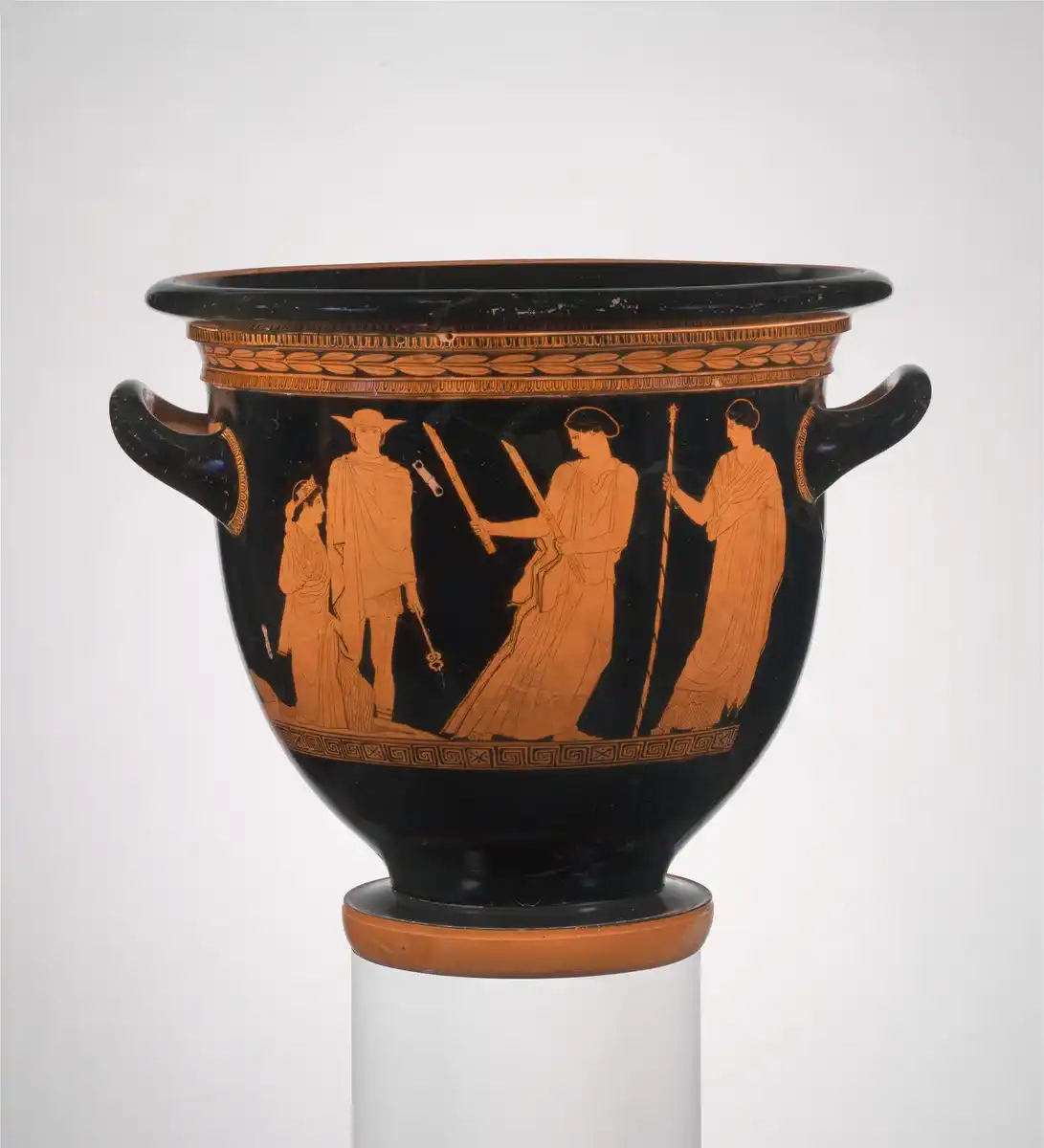
In this lesson: Hesiod, the Homeric Hymn to Demeter, triple statues, doorway shrines and household suppers in ancient Greece.
If you only know Hekate from modern books, the oldest texts about her may surprise you. They show not a dark goddess of night and witches but a generous, helpful power and a kind companion. This lesson reads the two oldest texts, Hesiod’s Theogony and the Homeric Hymn to Demeter, and then looks at how ordinary Greeks honored her at doorways and crossroads. These are the foundations every later picture of Hekate is built on.
Hesiod’s generous goddess
Historical Hesiod’s Theogony, a poem about the origins of the gods, was probably composed around 700 BCE. Its passage on Hekate, lines 411 to 452, is long and warm. Her mother is Asteria, a starry goddess, and her father is Perses, which makes her a cousin of Apollo and Artemis. In Evelyn-White’s 1914 translation, Zeus “gave her splendid gifts, to have a share of the earth and the unfruitful sea. She received honour also in starry heaven.”
Hesiod’s Hekate is not a dark figure. She helps kings in judgment, soldiers in battle, athletes, horsemen, fishermen and herders, and she nurses the young. Some scholars wonder whether Hesiod had a personal devotion to her, others whether the passage was expanded later. Neither idea can be proven.
Reading Hesiod closely
Historical Hesiod lived in Ascra, a village in Boeotia in central Greece. His other surviving poem, Works and Days, is addressed to his brother, whose name was Perses. That is also the name of Hekate’s father in the Theogony. The scholar M. L. West took this as a hint that Hekate mattered to Hesiod’s family. It is an attractive idea and impossible to prove.
The passage is worth reading slowly, because it is the longest early description of her. Three things stand out. First, she has a share in earth, sea and sky, so she is not limited to one realm. Second, Zeus honors her above all and lets her keep her old privileges, which is unusual.
Third, she gives help when she wishes and withholds it when she wishes. She is generous, but not a vending machine. Hesiod also says that whenever someone makes a fine sacrifice and prays, they call on Hekate. That suggests she was invoked widely, not only in special rites.
The torch in the Hymn to Demeter
Historical The Homeric Hymn to Demeter, probably from the seventh or sixth century BCE, tells how Hades carried off Persephone. Her mother Demeter searches for nine days with torches. On the tenth dawn, “Hecate, with a torch in her hands, met her” and told her she had heard Persephone cry out but had not seen who took her.
Together they go to Helios, the sun, who saw everything. When Persephone returns at the end of the hymn, Hekate embraces her and becomes her companion. This small scene gave Hekate two of her lasting roles: the torch-bearer who lights the way, and the one who hears.
How the hymn reached us
Historical The Homeric Hymn to Demeter survives in a single medieval manuscript. It was found in 1777 in Moscow and is now in Leiden. Without that lucky find, we would know the hymn only from a few quotations. It is called “Homeric” because it uses the same style and metre as Homer, not because Homer wrote it.
The hymn is closely tied to the Eleusinian Mysteries, the famous initiation rites of Demeter and Persephone at Eleusis near Athens. Near the end, Hekate becomes Persephone’s attendant and companion. That small detail places her beside the goddesses of one of the most important religious rites in Greece.
Triple statues, doorways and suppers
Historical A hekataion is any shrine or image of Hekate, and especially the type with three female figures standing back to back around a column. Many survive, mostly Hellenistic and Roman, often small enough for a household or a roadside. Pausanias, writing in the second century CE, believed the sculptor Alkamenes, active in the later fifth century BCE, was the first to make her as three figures. His statue stood on the Athenian Acropolis.
Greek writers mention small shrines of Hekate at house doors, where she guarded the threshold. She was honored at crossroads, the places where three roads meet; one of her titles, Trioditis, means “of the three ways”. Athenian sources, such as Aristophanes’ comedy Wealth (388 BCE), also mention “Hekate’s suppers”: food set out for her at the crossroads at the end of the lunar month. The evidence is scattered, and much of the detail comes from later commentators. We will return to it, and to a modern version, in lesson 7.
Aegina, Athens and the three faces
Historical Pausanias gives us two useful facts in one passage of his Description of Greece (2.30.2). On Aegina, he says, Hekate was the goddess honored most, with a yearly mystery rite, and her wooden statue there, by the sculptor Myron, had one face and one body. In Athens, Alkamenes was in his view the first to make her as three figures joined together. Alkamenes’ statue was known as Hekate Epipyrgidia, “on the tower”, because it stood on the bastion beside the temple of Athena Nike.
So even the triple form had a beginning. Earlier images showed her as one woman, often holding torches. The three-bodied type spread later and became the most famous. When you see a triple Hekate, you are looking at a fifth-century idea that became a standard image.
Questions beginners ask
Was Hekate one of the twelve Olympians? No. She stood outside that group, close to doors, roads and households.
Did every Greek city honor her the same way? No. Greek religion was local. Aegina, Athens and Lagina each had their own customs, and we know only fragments of most of them.
Which translation of Hesiod should I read? Evelyn-White’s 1914 translation is free online. M. L. West’s translation for Oxford World’s Classics (1988) is modern and clear.
Myths to drop:
- “The Greeks feared Hekate above all gods.” The early sources show a helpful goddess, honored in daily life.
- “She always had three faces.” The triple statue type seems to begin with Alkamenes in the later fifth century BCE.
- “Hesiod made her up.” He is our oldest long text, not her inventor. He clearly speaks of a goddess people already prayed to.
A worked example
Imagine an Athenian household around 400 BCE. By the front door stands a small stone image of Hekate, perhaps a triple figure no taller than a forearm. As the family leaves for a journey, someone touches it or murmurs a word, the way many people today touch a doorframe for luck.
At the end of the month, a little food is carried to the nearby crossroads. Nothing here is secret or sinister. It is ordinary household religion: a goddess of thresholds watching the place where home meets the wider world. Holding that picture next to the modern dark image helps you see how much she has changed.
Reading the Theogony in its own words
Historical Here are a few lines from Hugh G. Evelyn-White’s 1914 translation, free on Project Gutenberg. Zeus did not take away her honors among the old Titan gods; “she holds, as the division was at the first from the beginning, privilege both in earth, and in heaven, and in sea.” Then comes a list of the people she helps: she “sits by worshipful kings in judgement”, stands by men in the assembly and in battle, helps athletes at the games, horsemen, fishermen and herders, and Zeus “made her a nurse of the young.”
A good way to read this passage is to make a simple table in your notebook with two columns, “who” and “what she gives”. You will find kings, speakers, soldiers, athletes, riders, sailors, herders and children. Then read the phrase that repeats through the passage: “whom she will”. Her help is generous, but it is hers to give. That small phrase is a useful key to the whole Greek picture of Hekate.
Why is Hesiod so enthusiastic? Some scholars have suggested a local or family reason for his devotion; others see the passage as a poet’s hymn inside a larger poem. We do not know, and it is fine to say so.
The Hymn’s Hekate, in a few lines
Historical In Evelyn-White’s version of the Homeric Hymn to Demeter, no one hears Persephone’s cry “only tender-hearted Hecate, bright-coiffed, the daughter of Persaeus”, who hears it “from her cave”. At the end, when mother and daughter are reunited, “from that time the lady Hecate was minister and companion to Persephone.” Tender-hearted, a witness, a companion: this is the Hekate many beginners never meet. Read the hymn’s opening and closing scenes once, slowly, and notice how gentle she is.
A study variation
If you like to read with others, try this. Each person reads one source, Hesiod, the Hymn or Pausanias, and describes Hekate in three words. Compare the lists. You will usually find “generous”, “kind” and “watchful” more often than “dark” or “fearsome”, and that is a fine lesson in itself.
Try this
Read the Hekate passage of the Hymn to Demeter, lines 51 to 63 in Evelyn-White’s translation, which is free to read online. Write one sentence on what Hekate does in the scene, and one on what she does not do. Notice how small her part is, and how much later people made of it.
Journal prompts: Which of Hesiod’s groups, kings, soldiers, athletes, horsemen, fishermen, herders or the young, would you most like to ask Hekate’s help for, and why? What does it feel like to meet her first as a helper rather than a dark power?
Recap
The two oldest texts about Hekate show a kind, generous goddess. In Hesiod’s Theogony, around 700 BCE, Zeus gives her a share of earth, sea and sky, and she helps people of every kind. In the Homeric Hymn to Demeter she carries a torch, hears Persephone’s cry and becomes her companion. Ordinary Greeks honored her with triple statues called hekataia, shrines at doorways, worship at crossroads and suppers at the end of the lunar month.
What next
Press “Mark as done” and continue with Magic and philosophy: the papyri and the Oracles. For her torches, keys and crossroads, read Hekate’s symbols, and return to the Hekate page whenever you need the overview.
Further reading: Hesiod, Theogony and Works and Days, translated by M. L. West (Oxford World’s Classics, 1988). Helene P. Foley (ed.), The Homeric Hymn to Demeter (Princeton University Press, 1994), with translation and essays. Jenny Strauss Clay, Hesiod’s Cosmos (Cambridge University Press, 2003), discusses the Hekate passage.
Sources
- Hesiod, Theogony, lines 411 to 452, translated by H. G. Evelyn-White (1914).
- Homeric Hymn to Demeter, lines 51 to 63 and 438 to 440, translated by H. G. Evelyn-White (1914).
- Pausanias, Description of Greece 2.30.2.
- Aristophanes, Wealth (388 BCE).
Quick check
Go deeper: the Hekate pages on this site
Get the free Mini-Grimoire
A short printable starter guide to tarot and everyday witchcraft, plus my newsletter. Unsubscribe any time.
Opens Substack in a new tab to confirm. More about the newsletter · Privacy
Comments
Questions and notes from readers. Anyone with a free account can comment, and I reply when I can. Please read the community guidelines.
Comments load from Google Firebase (EU) when you ask for them. Nothing is stored on your device. Privacy