


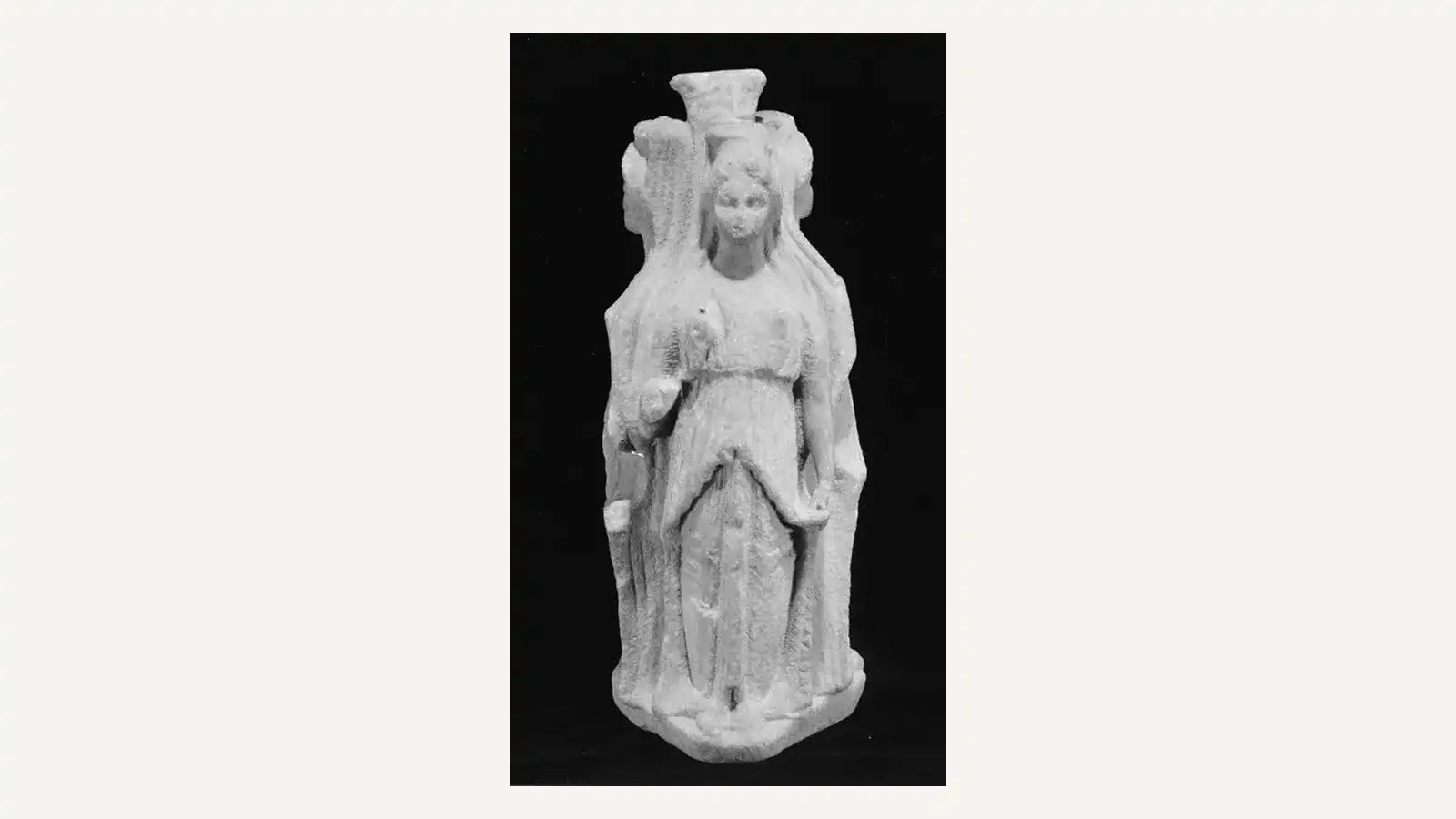
In this lesson: who Hekate is, the kinds of evidence we have, the debate about her origins and the three layers used in this course.
Hekate is a Greek goddess whose story runs for well over two thousand years and is still being written. In the oldest long poem about her she is a generous power with a share of earth, sea and sky. In a famous hymn she carries a torch for a grieving mother. In Roman Egypt she is called on in magical papyri.
In Shakespeare she is queen of the witches. Online today she is often a moonlit crone with keys and black dogs. All of these are Hekate, and none of them is the whole of her. This first lesson gives you the tools to tell those layers apart, so that everything you learn later sits in the right place.
If you are struggling right now, call your local emergency number (112 in Europe, 911 in the US and Canada) or a crisis line in your country.
Where did she come from?
Historical You will see it debated whether Hekate was Greek at first. Her great sanctuary at Lagina in Caria, in what is now southwestern Turkey, led some scholars to suggest she began as an Anatolian goddess. Others point out that the earliest texts are mainland Greek and that the Lagina temple we know is Hellenistic, which is late. The fair summary is that an Anatolian origin is possible, debated and unproven. By the time we can see her clearly, she was honored across the Greek world.
Her name and her titles
Historical The name is Greek, Hekate, and the Romans spelled it Hecate. In English you will hear both HEK-a-tee and heh-KAH-tee. Nobody knows for certain what the name meant. A popular idea links it to hekatos, “far-off” or “working from afar”, a title also used for Apollo. It is a guess, and some scholars doubt it.
Her titles, called epithets, tell us more than her name. An epithet is a descriptive title added to a god’s name, a little like a job description. These are some you will meet again and again:
- Phosphoros, “light-bringer”, for her torches.
- Propylaia, “before the gate”, for her place at doors and gateways.
- Enodia, “of the road”, and Trioditis, “of the three ways”, for roads and crossroads.
- Kourotrophos, “nurse of the young”, from Hesiod.
- Kleidouchos, “key-holder”, which grows important later.
- Soteira, “saviour”, which belongs mainly to the philosophers of lesson 3.
I find epithets the quickest way into any Greek deity. Each one points to a real place or task where people met her.
Where she was honored
Historical Hekate had no single home. At Lagina in Caria, near the ancient city of Stratonikeia, she had a large sanctuary with yearly festivals, and parts of its carved temple frieze survive in the Istanbul Archaeology Museums. On the island of Aegina, Pausanias says, she was the goddess honored most, with a yearly mystery rite. In Athens she appears in smaller ways: at house doors, at crossroads and on the Acropolis by the temple of Athena Nike.
So two pictures sit side by side. In some places she was a great civic goddess with a temple. In many others she was a small, close, household power. Both are real, and modern practice usually draws on the second.
What kind of evidence do we have?
Our evidence comes in four kinds, and each speaks with its own voice. There are poems and plays, such as Hesiod’s Theogony, the Homeric Hymn to Demeter, Greek tragedy and the Roman poets; a poet telling a story is not writing a temple manual. There are inscriptions and objects: dedications, temple records and the triple statues called hekataia, many now in museums.
There are the magical papyri, working spells from Roman Egypt with hymns to a moon-linked Hekate. And there is philosophy, in the Chaldean Oracles and the Neoplatonists, who made her a cosmic power. When a modern book says “the ancients believed”, ask: which ancients, in which kind of source?
Three layers
In every lesson I mark what I say with one of three labels.
- Historical means ancient evidence: texts, objects and inscriptions from the ancient world.
- Later tradition means what medieval writers, Shakespeare, Victorian occultists and others added.
- Modern means practice and interpretation of our own time.
Modern is not a polite word for fake. Every living religion changes, and the Hekate of Hesiod was already different from the Hekate of the Chaldean Oracles, eight centuries later. The labels simply help you know what you are holding.
Hekate also belongs to Hellenic polytheism, the revived religion of the ancient Greek gods, practiced today in Greece and around the world. You do not need to join it to study her, but it is good manners to know it exists and to treat its people as you would any faith.
Questions beginners ask
Is Hekate dark or evil? Not in the oldest texts. Hesiod’s Hekate is generous and helpful. The darker image grows later, through tragedy, Roman poetry and Shakespeare. Darkness in the sense of night and thresholds is part of her. Evil is not.
Is she a Titan? In Hesiod her parents, Perses and Asteria, belong to the generation of the Titans, and Zeus lets her keep the honors she held before he ruled. Later writers sometimes call her a Titan. She is not one of the twelve Olympians.
Is she the same as Artemis or Selene? Not at first. Over time ancient writers linked her with both, and some spoke of “Artemis Hekate”. It is fair to say they overlapped. It is not fair to say they were always one goddess.
Was she a goddess of witches in ancient times? Partly. In Euripides’ Medea (431 BCE), the sorceress Medea swears by Hekate, the goddess she honors most. So the link with magic is early. The idea of Hekate as queen of all witches comes much later.
Do I need to be chosen to study her? No. Anyone can read about her, and you need no sign or calling. If you later choose to honor her, lesson 6 shows a calm way to begin.
Myths to drop:
- “Maiden, mother and crone is ancient.” The triple statue is ancient. The maiden, mother and crone reading is modern.
- “Hekate is only for women.” No ancient evidence limits her to women. Hesiod’s Hekate helps kings, soldiers, horsemen and fishermen.
- “Her origins are known.” An Anatolian origin is possible, debated and unproven.
How I check a claim about Hekate
When I meet a new claim, I ask four questions. Which source says this? How old is it? What kind of source is it, a poem, an object, a spell or philosophy? And who wrote it, for whom? If a claim cannot answer the first question, I file it under “modern, source unknown”. It may still be beautiful. I just do not call it ancient.
A worked example
Imagine you read this sentence on a social media post: “Hekate, the ancient crone goddess of witches, holds the keys to the underworld and walks with black dogs.” Sort it with the three labels. Hekate holding keys has ancient roots: she was sometimes called Kleidouchos, “key-holder”. Dogs are linked with her in ancient sources too.
“Goddess of witches” is mainly later tradition, from Roman poets and Shakespeare, as you will see in lesson 4. “Crone” is modern, from the maiden, mother and crone idea of the twentieth century. One sentence, all three layers. Nothing in it is a lie, but now you know which parts are old.
Her oldest portrait, in a few words
Historical If you read only one ancient line about Hekate, let it be this one from Hesiod’s Theogony, in Hugh G. Evelyn-White’s 1914 translation: Asteria “bare Hecate whom Zeus the son of Cronos honoured above all.” Notice what is missing. There is no crone, no underworld throne, no black dogs. The earliest Hekate we can read is a generous, many-sided goddess honored by Zeus himself. You will read the whole passage in lesson 2.
A second worked example: “Hekate is a moon goddess”
Try the same method on a shorter claim. Where is it from? Moon links grow strong in Hellenistic and Roman times, when Hekate was often merged with Selene the moon and with Artemis, and Roman poets spoke of a triple goddess of heaven, earth and the underworld. What do the earliest sources say? Hesiod and the Homeric Hymn to Demeter do not call her a moon goddess. What can I honestly say? “In later antiquity Hekate became closely linked with the moon, and many modern devotees honor her that way.” That sentence is true, short and fair to both history and practice.
Try this
Write down three things you already believe about Hekate. Next to each, guess whether it is ancient, later tradition or modern. Keep the list. You will check your guesses in lesson 4, and most people are surprised at least once.
Journal prompts: Which of Hekate’s epithets draws you most, and why? Where in your own life do you stand at a threshold or a crossroads right now? What would change if you held the oldest, generous Hekate next to the modern image?
Recap
Hekate is a goddess with a long, layered history: a generous power in Hesiod, a torch-bearer in the Hymn to Demeter, a moon goddess in the magical papyri, a witch queen in Shakespeare and a crone in modern spirituality. Her origin may lie in Anatolia, but that is debated. Our evidence comes from poems, objects, magical papyri and philosophy, and each must be read for what it is. The Historical, Later tradition and Modern labels help you know which layer you are reading, and modern does not mean fake.
What next
Press “Mark as done” and continue with Hekate in ancient Greece. For a fuller portrait, read the Hekate page, and see the deities hub for the other goddesses and figures on this site.
Further reading: Sarah Iles Johnston, Hekate Soteira (Scholars Press, 1990) is the classic academic study. Robert Von Rudloff, Hekate in Ancient Greek Religion (Horned Owl, 1999) gathers the Greek evidence. Stephen Ronan (ed.), The Goddess Hekate (Chthonios Books, 1992) collects essays and texts. The free Theoi Project website (theoi.com) lists ancient passages about her in English translation.
Sources
- Hesiod, Theogony, lines 411 to 452, translated by H. G. Evelyn-White (1914).
- Sarah Iles Johnston, Hekate Soteira (Atlanta: Scholars Press, 1990).
- Pausanias, Description of Greece 2.30.2.
Quick check
Go deeper: the Hekate pages on this site
Get the free Mini-Grimoire
A short printable starter guide to tarot and everyday witchcraft, plus my newsletter. Unsubscribe any time.
Opens Substack in a new tab to confirm. More about the newsletter · Privacy
Comments
Questions and notes from readers. Anyone with a free account can comment, and I reply when I can. Please read the community guidelines.
Comments load from Google Firebase (EU) when you ask for them. Nothing is stored on your device. Privacy