


In this lesson: Roman poets, Shakespeare, Thomas Taylor, the Golden Dawn, Robert Graves and modern witchcraft, and how they reshaped Hekate.
How did a goddess who nursed children in Hesiod become Shakespeare’s queen of the witches, and then the crone of modern goddess spirituality? This lesson follows Hekate from the Roman poets to Wicca, one step at a time. Each step added something real to her image. By the end, you will be able to check the list you made in lesson 1 and see exactly where each of your beliefs about her came from.
Medea’s goddess
Historical The witch link did not begin in Rome. In Euripides’ Medea (431 BCE), Medea swears by Hekate, the mistress she honors most, who dwells in the inmost part of her house. In Apollonius of Rhodes’ Argonautica (third century BCE), Medea is a priestess of Hekate. Jason, following her instructions, bathes in a river at midnight, digs a pit and makes an offering to Hekate. The goddess rises, ringed with snakes and torches, and hellhounds bark around her.
The historian Diodorus of Sicily, writing in the first century BCE, goes further. He turns Hekate into a mortal princess, the daughter of Perses, skilled in poisons and the mother of Circe and Medea. That is a rationalized story, not a myth people prayed with. It shows how firmly Hekate, Medea and dangerous plants had become tied together.
The learned witch goddess
Later tradition When public pagan worship ended in late antiquity, Hekate lived on in the books educated Europeans read. In Ovid’s Metamorphoses (book 7), the sorceress Medea calls on her before a night rite. In Lucan’s Pharsalia (book 6), the Thessalian witch Erictho threatens the underworld powers, Hekate among them. Seneca’s Medea has a dark incantation scene too. From these poems a picture formed: Hekate as goddess of the night, the moon, the underworld and of sorceresses like Medea and Circe. Medieval mythographers and Renaissance scholars such as Boccaccio passed it on.
Shakespeare’s Hecate
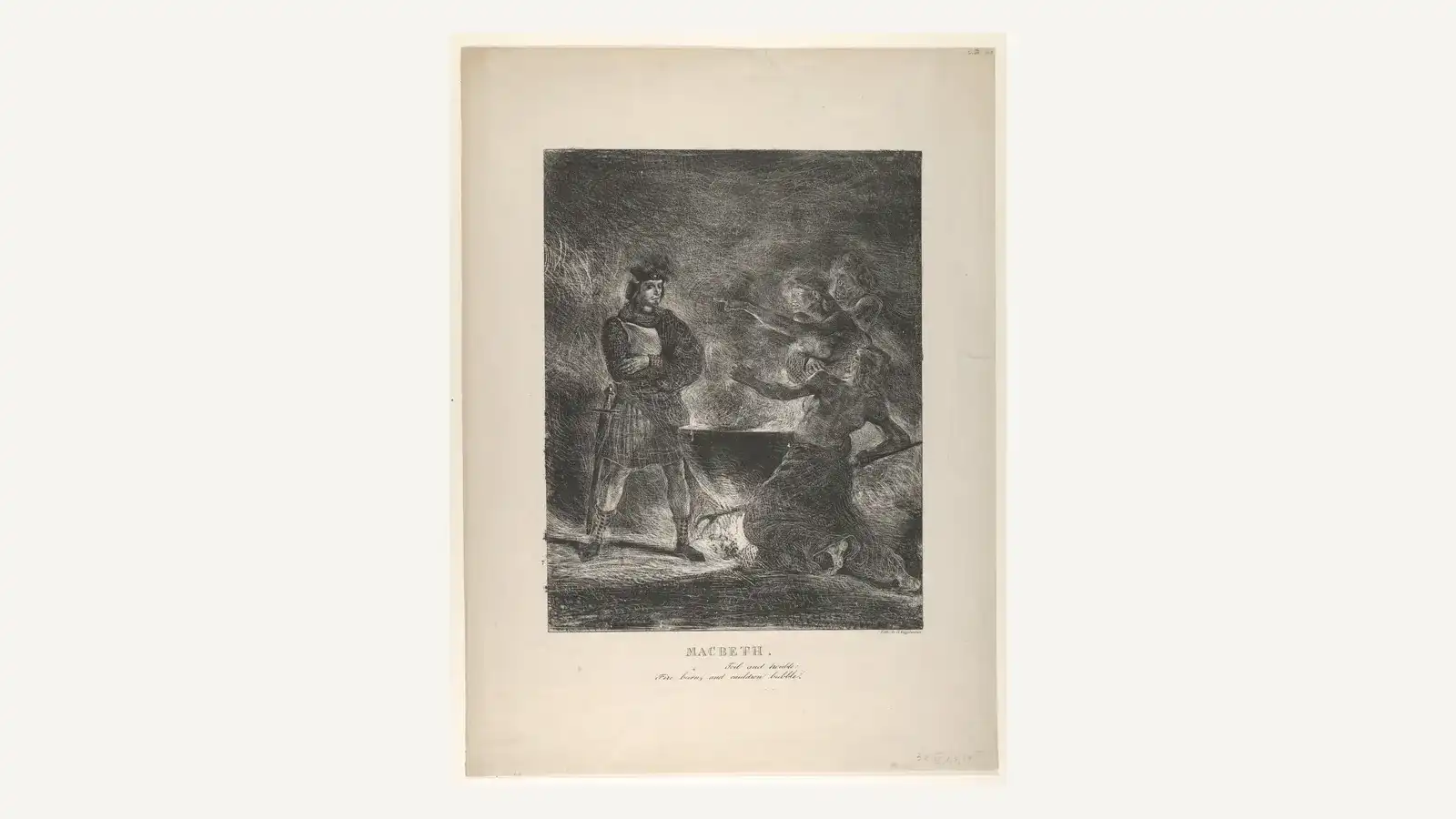
Later tradition In Macbeth (printed in the First Folio of 1623), Hecate appears in two scenes. In Act 3, Scene 5, she scolds the three witches for meddling with Macbeth without her and calls herself “the mistress of your charms”. Many scholars think these scenes were added by Thomas Middleton, whose play The Witch contains the songs they cue. That is a scholarly judgment, not a certainty. Because Macbeth is performed everywhere, its witch queen spread further than any ancient hymn.
Hecate across the English stage
Later tradition Shakespeare names her in other plays too. In A Midsummer Night’s Dream the fairy Puck speaks of “triple Hecate’s team”, and in King Lear the king swears by “the mysteries of Hecate”. Ben Jonson’s The Masque of Queens (1609) brought a coven of witches onto the court stage and filled its notes with classical references to Hecate. Thomas Middleton’s The Witch gave her a leading role. For English audiences, she was a figure of the theater long before she was a goddess people honored.
Translators and occultists
Later tradition The English Platonist Thomas Taylor translated the Orphic Hymns in 1787 and 1792, including the hymn to Hekate, and later published Chaldean material. Members of the Hermetic Order of the Golden Dawn, founded in 1888, studied these texts, and William Wynn Westcott published an edition of the Chaldean Oracles in 1895. These versions are old-fashioned and sometimes wrong, but they gave English readers a Hekate who was more than Shakespeare’s.
Graves, Wicca and Hekate today
Modern The idea of a goddess in three ages of life first took shape in Jane Harrison’s Prolegomena to the Study of Greek Religion (1903). In 1948 Robert Graves published The White Goddess, a passionate book about poetry and a great goddess he believed lay behind all myth.
He tied her three faces to the moon’s phases and to stages of a woman’s life. Later popular writers and Wicca fixed this as maiden, mother and crone, and Hekate was often cast as the crone. The triple statue is ancient. The maiden, mother and crone reading of it is modern.
Modern Wicca, made public by Gerald Gardner in the 1950s, honors a Goddess and a God, and Hekate became one of the goddess names most often invoked in witchcraft circles. Since the late twentieth century, books, groups and online networks centered on Hekate alone have grown, some careful with history and some not. None of this is a betrayal of an “original” Hekate. The ancient Greeks themselves had no single image of her. Every age has added something, and our age is part of her story.
Questions beginners ask
Is the modern Hekate fake? No. She is modern. Modern devotion is a real part of her long history, as long as we do not dress it up as ancient.
Should I avoid Shakespeare’s Hecate? Not at all. Reading Macbeth helps you understand why so many people picture her as a witch queen.
Was Hekate part of Wicca from the start? Wicca honored a Goddess with many names, and Hekate became one of the most popular over time. The intense, Hekate-centered devotion of today is mostly a development of the late twentieth and early twenty-first centuries.
Myths to drop:
- “Hekate was always a crone.” The crone image comes from twentieth-century goddess spirituality.
- “Shakespeare wrote every line about Hecate in Macbeth.” Many scholars think Middleton added those scenes, though it is not certain.
- “The Victorians recovered pure ancient Hekate.” Taylor and Westcott helped, but their versions are old-fashioned and sometimes wrong.
A timeline to keep: about 700 BCE, Hesiod’s Theogony. 431 BCE, Euripides’ Medea. Third century BCE, Apollonius’ Argonautica. Early first century CE, Ovid’s Metamorphoses. Second century CE, the Chaldean Oracles. 1623, Macbeth in print. 1787, Taylor’s Orphic Hymns. 1895, Westcott’s Chaldean Oracles. 1948, Graves’s The White Goddess. 1950s, Wicca goes public.
A worked example
Imagine a theater-goer in London around 1611 who has never read Hesiod. She watches Macbeth and sees Hecate appear in the storm, scolding the witches. That is her whole idea of the goddess: a queen of witchcraft and night. Three centuries later, her descendant reads Graves and sees Hekate as the crone of a triple moon goddess. Today, her great-granddaughter scrolls past a picture of an old woman with keys and dogs at a crossroads. Each of them met a real Hekate, shaped by her own time. None of them met Hesiod’s nurse of the young, unless she went looking.
Apollonius’ night rite, in his own words
Historical R. C. Seaton’s 1912 translation of the Argonautica is free on Project Gutenberg, and its scenes with Hekate are vivid. Medea is described as a maiden “whom the goddess Hecate taught to handle magic herbs with exceeding skill.” Later Jason digs his pit and pours libations, “calling on Hecate Brimo to aid him in the contests.” Then the goddess comes: “round her horrible serpents twined themselves among the oak boughs; and there was a gleam of countless torches; and sharply howled around her the hounds of hell.”
Compare this with Hesiod’s generous nurse of the young, and you can see how much changed in about four centuries. Apollonius wrote for readers in Hellenistic Alexandria who enjoyed thrilling scenes. His Hekate is still a goddess of torches and the night, but she is now surrounded by snakes, howling dogs and the herbs of a sorceress. Brimo, “the terrible one”, is an old title that appears in a few sources.
Shakespeare’s verse, read closely
Later tradition In Macbeth, Act 3, Scene 5, Hecate scolds the witches for dealing with Macbeth without her: “And I, the mistress of your charms, / The close contriver of all harms, / Was never call’d to bear my part, / Or show the glory of our art?” A few lines later she announces, “I am for th’ air; this night I’ll spend / Unto a dismal and a fatal end.”
Notice the short, rhyming lines. They sound different from the rest of the play, which is one reason many scholars think this scene was added later, perhaps by Thomas Middleton, as you saw above. Notice too the phrase “the mistress of your charms”. Here Hecate is queen of the witches, the boss of a working coven. That picture, more than any ancient source, shaped the English-speaking image of Hecate for three centuries.
A reading variation: one goddess, three portraits
Read three short passages in one sitting: Hesiod’s Theogony on Hekate, Jason’s rite in the Argonautica, and Hecate’s speech in Macbeth. For each, write one line on how she looks, one on what she gives or demands, and one on who is reading the poem. You will have traced, in under an hour, the journey this lesson describes: from a generous Greek goddess, to a Hellenistic night goddess of sorceresses, to a Renaissance witch queen.
Try this
Take the list you made in lesson 1. Mark each belief again as ancient, later tradition or modern, using what you have read. How many guesses did you change? Write one line on the change that surprised you most.
Journal prompts: Which layer of Hekate did you meet first in your own life, and where? Which later image do you want to keep, knowing it is later? Which would you like to let go of?
A quick self-check. Put these in order: Euripides’ Medea, Apollonius’ Argonautica, Ovid’s Metamorphoses, the First Folio of Macbeth. (431 BCE, third century BCE, about 8 CE, 1623.) Then say in one sentence how Hekate changes across the four.
Recap
After late antiquity, Hekate lived on in literature: Ovid, Lucan and Seneca made her a goddess of night and sorceresses, and Shakespeare’s Macbeth, perhaps with scenes by Middleton, made her mistress of the witches. Thomas Taylor and the Golden Dawn brought Orphic and Chaldean Hekate back to English readers. Robert Graves’s The White Goddess (1948) led to the maiden, mother and crone idea, and Wicca and modern devotion have made her one of the most invoked goddesses today.
What next
Press “Mark as done” and continue with Symbols, animals and places. For the history of witchcraft that shaped her witch-queen image, read the history of witchcraft, and revisit the Hekate page.
Further reading: Apollonius of Rhodes, Jason and the Argonauts, translated by Aaron Poochigian (Penguin Classics, 2014). Ronald Hutton, The Triumph of the Moon (Oxford University Press, 1999; 2nd ed. 2019) for the rise of Wicca. Ronald Hutton, The Witch: A History of Fear (Yale University Press, 2017) for the witch figure in Europe.
Sources
- Ovid, Metamorphoses, book 7.
- Lucan, Pharsalia, book 6.
- William Shakespeare, Macbeth, Act 3 Scene 5 and Act 4 Scene 1 (First Folio, 1623).
- Thomas Taylor (trans.), The Mystical Hymns of Orpheus (1792).
- Robert Graves, The White Goddess (1948).
Quick check
Go deeper: the Hekate pages on this site
Get the free Mini-Grimoire
A short printable starter guide to tarot and everyday witchcraft, plus my newsletter. Unsubscribe any time.
Opens Substack in a new tab to confirm. More about the newsletter · Privacy
Comments
Questions and notes from readers. Anyone with a free account can comment, and I reply when I can. Please read the community guidelines.
Comments load from Google Firebase (EU) when you ask for them. Nothing is stored on your device. Privacy