


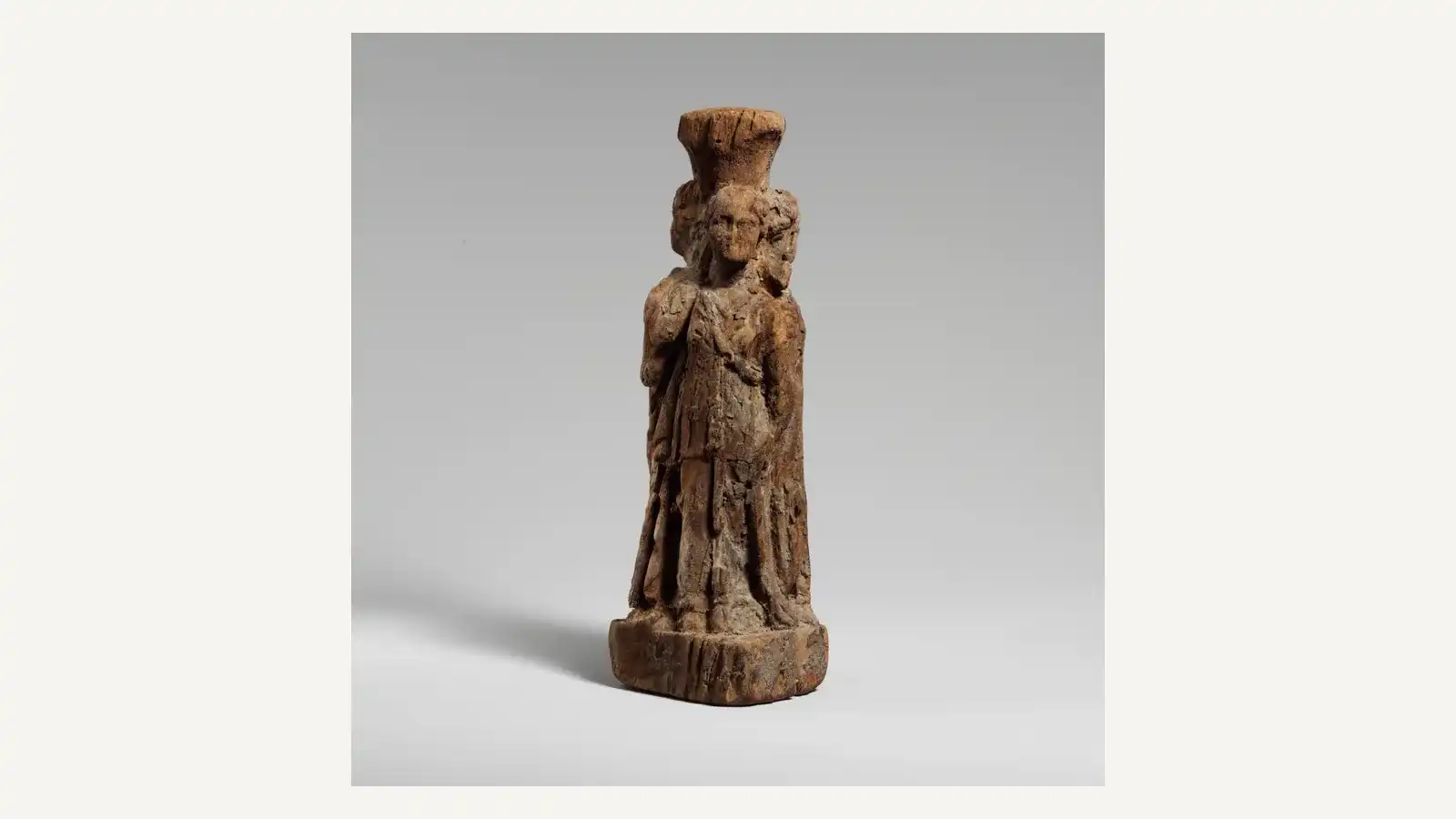
Hekate’s places are in-between places: crossroads, doorways, gates and the edge of night. In this lesson you work with them in practice. There is an optional crossroads walk with a full safety checklist, a doorway habit you can keep for life, a page exercise for hard decisions and a gentle way to remember someone you have lost.
The crossroads as place and idea
Historical In ancient Greece the crossroads was a real place with real customs. Images of Hekate stood there, food for her was left there and household sweepings were carried there. Folk belief also linked crossroads with restless spirits, as Sarah Iles Johnston shows. And it was an idea: the point of choice. In Sophocles, Oedipus meets his father where three roads meet.
Modern Today some devotees walk to a real intersection, and many more use the crossroads as a symbol in prayer and journaling. You do not need a physical crossroads to honor Hekate Trioditis, “of the three ways”. Every choice is a crossroads and every doorway a threshold. If going out at night is unsafe or unappealing, the indoor practices here are complete.
A safe crossroads walk
Modern A crossroads walk is a modern, reflective walk to an intersection, often at dusk. Read this checklist before every walk.
- Choose a public, well-lit place you know in daylight. Avoid isolated spots and busy junctions where you would stand in the road.
- Stay on public land: no private property, closed parks, cemeteries after hours or building sites.
- Tell someone where you are going and when you will be back, carry a charged phone, and consider going with a friend.
- Wear something reflective and sturdy shoes, and stand on the pavement or verge, never in the road.
- No open flame outdoors. Use a torch or LED lantern.
- Leave nothing behind: no food, candles, coins or ribbons. Offer silence, or pick up litter and carry it home.
- Trust your instincts. If a place or person feels wrong, leave. That is good judgment, not failure.
- If you are under 18, go only with a parent, guardian or other safe adult.
Choose your crossroads in daylight and write your purpose: to honor Hekate, to think about a decision or to mark a change such as a move or a birthday. Walk there in silence if you can. Many people find the walk is the heart of it.
Stand safely at the edge, take three slow breaths and notice where each road goes. Greet her quietly: “Hekate Trioditis, goddess of the three ways, I come to your crossroads.” If you brought a decision, picture each option as a road and notice how each feels. Offer a minute of silence, then turn and go home.
Historical Some modern devotees walk away without looking back, and ancient literature has examples. In the Argonautica, Jason leaves his midnight sacrifice to Hekate without turning around. In the Odyssey (10.528), Circe tells Odysseus to turn away while making offerings to the dead. These are literary and magical settings, not a rule for you. At home, write what you noticed, and label any sense of contact as personal experience.
Hekate of the three ways in the sources
Historical Hekate’s link to crossroads is old and well attested. Greek writers called her Trioditis, “of the three ways”, and the Romans called her Trivia, from tri- “three” and via “road”. A three-way junction, where one road splits into two, was the classic place for her images. From the fifth century BCE onward, sculptors made the hekataion, a pillar with three figures of the goddess back to back, one facing each road. Pausanias says the sculptor Alkamenes made such a triple statue for the Athenian Acropolis (2.30.2).
Historical Why the crossroads? Ancient writers do not give one answer, so be careful with anyone who does. Crossroads were places of travel and choice, places outside the safe household, and also places where the leftovers of purification and the suppers for Hekate were carried. The Roman poet Virgil describes Hekate “howled to at night at the crossroads of the cities” (Aeneid 4.609, translated by H. R. Fairclough, 1916). That line shows how, by Roman times, the crossroads had become part of her night-time image in literature.
The doorway as a smaller crossroads
Historical The threshold of a house is also a boundary between the inside and the outside, the family and the world. Hekate’s shrine by the front door, mentioned in lesson 8, guarded that boundary. Some scholars, including Sarah Iles Johnston, connect her role at doorways with her role at crossroads: both are liminal places, from the Latin limen, “threshold”. Liminal means “in between”. This is a useful word for beginners because it explains why Hekate appears at births, deaths, journeys and changes of life.
Modern In practice, many people find that working with their front door is easier and safer than walking to a road at night. Sweeping the doorstep, greeting the goddess as you leave the house, or pausing before you open a difficult email are all threshold practices. They take seconds and fit any life.
A worked decision at the threshold
Here is a practice for a real choice. Stand at your front door or any doorway with a notebook. Name the choice aloud or silently: for example, “stay in my job or apply for the new one”. Write each option at the top of a page.
Under each, list what you would carry with you and what you would leave behind. Then step through the doorway and back, slowly, noticing how each option feels in your body. Write one honest sentence. You are not asking for an omen. You are using the symbol of the threshold to slow down and see the choice clearly.
Doors, guests and decisions
Modern Ancient Hekate guarded house doors, so your front door is your easiest threshold. Each time you leave, pause and touch the frame: “Hekate Propylaia, guard this door.” When you come home: “Thank you for keeping the way.” It takes seconds, and it reminds you to check for your keys.
Once a month, perhaps at the Deipnon, clean the threshold, touch a little water to the frame and ask that what is good come in and what is harmful stay out. A silent version is fully valid if you share your home. You can extend it to guests, too. Greek religion valued xenia, the bond of host and guest, so see people to the door and wish them safe on the road.
For a hard choice, try the three roads on paper, below. It does not tell you what to do. It shows you your options, including one you had not considered. For big decisions, also talk to people you trust. The same attention works at modern thresholds: a breath as you badge into work, a pause before opening a difficult email or logging off for the night.
Remembrance, not summoning
Later tradition Hekate’s link with the dead is old: Persephone’s companion and a goddess of the restless dead. This course does not teach necromancy or ways to contact a specific person. Remembering is safe and meaningful. Trying to compel contact is not.
On an anniversary, place a photo or a written name at your shrine, light your candle or LED and say: “Hekate, torch-bearer, companion of Persephone, light the way for them. I remember them with love.” Speak or write to them if you wish, sit quietly, thank Hekate and put out the light. Afterward, do something comforting: tea, a call, a short walk.
Questions beginners ask
Do I need a real three-way crossroads? No. A doorway, a fork in a path in a park, or even a drawing of three lines on paper all carry the symbol.
Is it safe to go out at night? Only if your area is safe and you tell someone where you are. Daylight or dusk walks are just as valid. Your safety matters more than any symbolism.
Can I leave offerings at a crossroads? Leaving food outdoors harms animals and annoys neighbors. Leave water poured on the earth, or nothing, and carry any rubbish home.
Does walking away without looking back really matter? Ancient accounts of offerings to the dead and to underworld powers sometimes say people turned away without looking, for example in Homer’s Odyssey 10.528. Many modern devotees keep this as a gesture of respect. It is a custom, not a safety rule.
Myths to drop: Hekate is not a “goddess of crossroads deals”. The idea of making a bargain with a spirit at a crossroads comes from much later folklore, including African American blues stories, not from Greek religion. Do not mix those traditions carelessly.
A worked example
Imagine someone choosing between staying in her city and taking a job abroad. She draws the three roads. Under “stay” she writes friends, rent, a sense of being stuck. Under “go” she writes salary, language worries, excitement. On the third road, after five quiet minutes by her LED, she writes “ask for a six-month remote trial”. She sleeps on it and rereads the page the next morning. The practice gave her no answer from outside. It gave her a third option and a calmer conversation with her manager.
Try this
Try the three roads on paper. Draw three lines meeting at a point, label two with your options and the third “a path I have not considered”, and write what you know, fear and hope under each. Do not decide today.
Journal prompts: Which threshold in my life am I standing at right now? What do I want to carry across, and what can I leave behind? How does my front door feel when I greet it each day?
Recap
The Greek crossroads was both a place with customs and an idea of choice. A modern crossroads walk is optional and needs a safety checklist, no flame and nothing left behind. Doorway greetings, a monthly threshold blessing and care for guests bring Hekate Propylaia into daily life. The three roads helps with decisions without deciding for you. With the dead, remember and do not summon, and lean on real support in grief.
What next
Press “Mark as done” and continue with Torchlight meditation and dreams. For more on keys and torches, see Hekate’s symbols, and for doorway care, my home protection spell.
Further reading: Sarah Iles Johnston, Restless Dead (University of California Press, 1999), discusses crossroads and the dead. Victor Turner, The Ritual Process (Aldine, 1969), is the classic study of liminality in ritual.
Sources
- Apollonius of Rhodes, Argonautica, book 3, translated by R. C. Seaton (1912).
- Homer, Odyssey 10.528, translated by A. T. Murray (1919).
- Hesiod, Theogony, lines 411 to 452, translated by H. G. Evelyn-White (1914).
- Sarah Iles Johnston, Restless Dead (Berkeley: University of California Press, 1999).
- Arnold van Gennep, The Rites of Passage (1909; English translation 1960).
Quick check
Go deeper: the Hekate pages on this site, and The Novice's Guide to Witchcraft
Get the free Mini-Grimoire
A short printable starter guide to tarot and everyday witchcraft, plus my newsletter. Unsubscribe any time.
Opens Substack in a new tab to confirm. More about the newsletter · Privacy
Comments
Questions and notes from readers. Anyone with a free account can comment, and I reply when I can. Please read the community guidelines.
Comments load from Google Firebase (EU) when you ask for them. Nothing is stored on your device. Privacy