


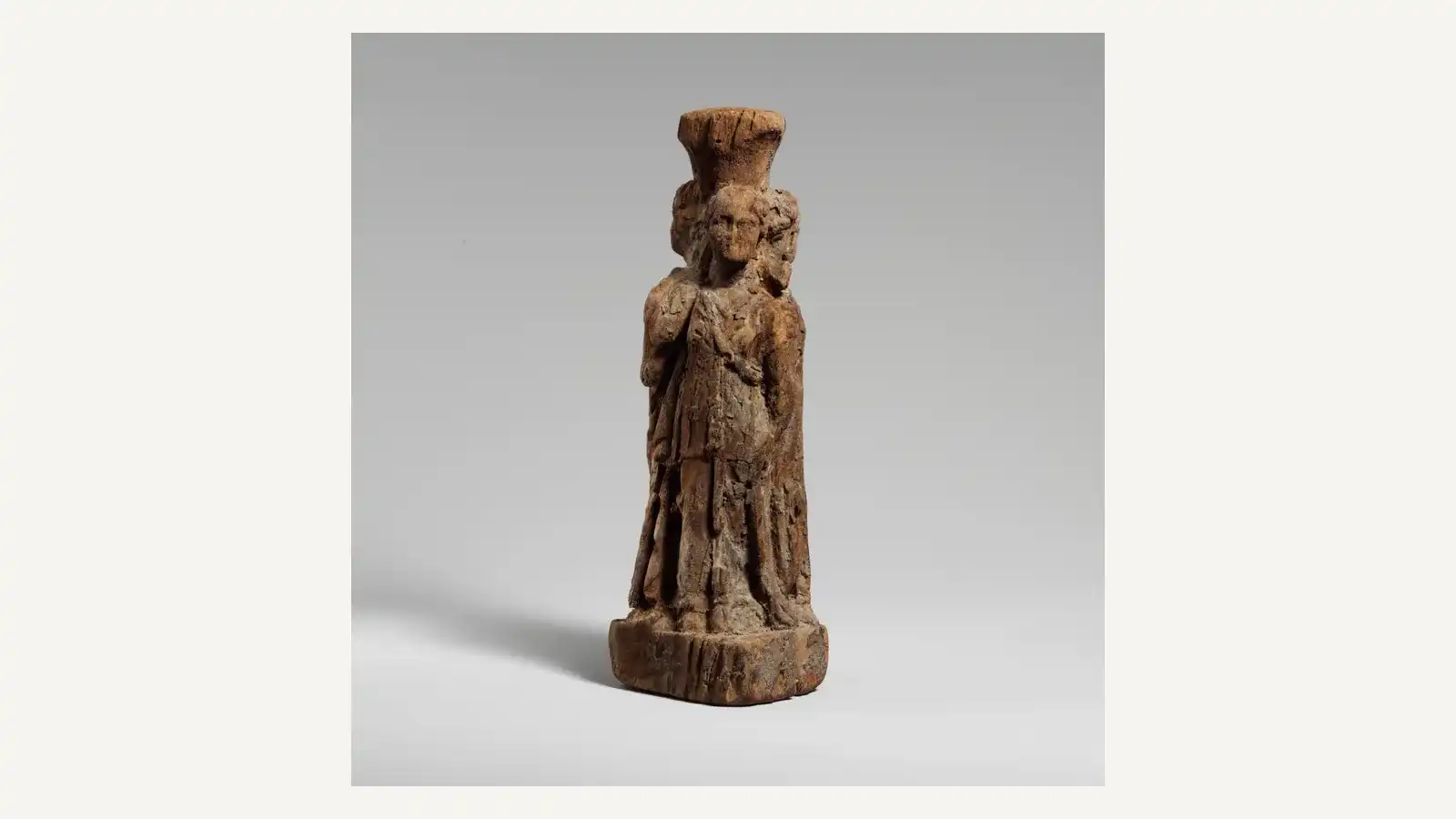
In this lesson: Hekate with Persephone, Hermes and Hestia, the modern dark pantheon question, a yearly review and a first-year reading path.
Hekate was never worshiped alone. Ancient Greeks honored many gods, and her stories tie her to several of them. In this last lesson you sort her ancient companions from modern pairings, map your own connections, and then step back to look at practice over a whole year: its seasons, a yearly review and what to read next.
Her ancient companions
Historical The best-attested link is with Persephone and Demeter. In the Homeric Hymn to Demeter, Hekate hears Persephone’s cry, meets the searching Demeter with a torch and becomes Persephone’s companion after the reunion. Hekate and Demeter even go together to Helios, the all-seeing sun, to learn the truth. Hesiod makes Hekate a cousin of Artemis, and both carry torches and share the title Phosphoros. Hermes stands near her often: Hesiod has Hekate increase the herds “with Hermes” (Theogony 444), herms and hekataia both stood at Athenian doors, and the two appear together on curse tablets.
That last use is history, and this course does not adapt it. At home, Hestia held the hearth while Hekate kept the door, and the Homeric Hymn to Hestia says she received wine “both first and last” at every feast. Her link with Selene, the moon, is ancient but mostly Hellenistic and Roman.
Later tradition In late antiquity Hekate was linked with Isis in Roman Egypt, with Ereshkigal in the magical papyri and with the World Soul in the Chaldean Oracles.
Gods she stands beside in the texts
Historical Ancient sources place Hekate with particular gods, and knowing them gives your practice a firm footing. In the Homeric Hymn to Demeter she joins Demeter in the search for Persephone and afterward becomes Persephone’s attendant, “her minister and companion” (line 440). In Athens and elsewhere she shared shrines and cult with Hermes, another god of roads and boundaries, and with Artemis, with whom she was sometimes identified, as at Artemis-Hekate dedications. In the Chaldean Oracles of the second century CE, she becomes a cosmic soul between the highest Father and the world, which you met in lesson 3.
Historical Hesiod presents her as honored by Zeus, who keeps her ancient privileges. This is worth remembering: in the oldest account, Hekate is not an outsider or rebel against the Olympians. She is respected by them.
A worked example: a shared shelf
A beginner who honors both Hekate and Hermes might keep one shelf with two small sections. On the Deipnon she clears both sides. She gives Hermes a coin she later donates and Hekate a cup of water. On the first day of her new job she greets Hermes for travel and Hekate at the doorway. Nothing about this mixes traditions badly, because both gods were honored together in antiquity. Contrast this with combining Hekate with a deity from a living closed tradition, which lesson 6 discussed: there the respectful step is to learn from that tradition’s own people first.
How long-term practitioners keep a year
Modern When I look at long-term practitioners, the ones whose practice lasts tend to have three things: a fixed monthly rhythm, a yearly review, and a reading list that grows slowly. Here is a simple shape. In the first quarter, read one primary source in translation, such as the Theogony and the Homeric Hymn to Demeter, which are short.
In the second quarter, read one scholarly book. In the third, visit a museum collection in person or online and look for torches, keys and triple figures. In the fourth, review your journal and decide what to keep for the next year.
A yearly review can be one evening. Read your journal from the start. Note how many Deipna you kept, what changed in your life, which practices felt alive and which felt like duty. Then write a short letter to yourself for next year. Many people choose the last dark moon of the year for this.
The modern “dark pantheon”
Modern Online, Hekate is often grouped with Lilith and Lucifer. There is no ancient connection with Lilith, who comes from Mesopotamian demon lore and Jewish tradition. With Lucifer there is a real word overlap: Lucifer is Latin for “light-bringer”, and its Greek equivalent Phosphoros is one of Hekate’s epithets.
That does not mean any Greek linked her with the later Christian devil. Working with all three is a modern choice, not more advanced or more authentic than honoring Hekate alone. The same care applies to Kali or Santa Muerte, who belong to living traditions with their own devotees. If one calls to you, start with study from those communities, not ritual.
If you honor several deities, give each a space or a clear order. Many Hellenic polytheists begin with Hestia. Keep the Deipnon food for Hekate alone, and write in your journal why you honor each one and where the link comes from.
Seasons of a practice
Modern Practice moves through seasons. Spring is the bright beginning, when every coincidence feels like a sign, so write things down and wait. Summer is when habits settle into a greeting and a monthly supper. Autumn brings either deepening or questions such as “Is this real?”, and both are healthy.
Winter is rest: illness, grief, a new baby or plain loss of interest. A fallow time is not failure. The shrine can be packed away and brought back, and nothing in the evidence suggests Hekate punishes a gap. If nothing seems to happen at all, remember that steady attention, not sensation, was the heart of Greek devotion.
Your yearly review and reading path
Once a year, perhaps on the anniversary of your first practice, set aside an hour with your journal. Read the year from the start, then answer: What did I keep and drop, and why? What did I learn about Hekate’s history? Which personal experiences stood out, and do they still make sense? How has practice touched my everyday life? Which season am I in? Then write a letter to yourself, sealed and dated, to open in a year: what you do now, what you hope stays, what you hope changes and one thing you are unsure of.
For your first year of reading, go to the sources in order. Read Hesiod, Theogony 411 to 452, then the Homeric Hymn to Demeter, then the Orphic Hymn to Hekate. Read book 3 of Apollonius’ Argonautica and Theocritus, Idyll 2, for Hekate in poetry and magic. Then read Robert Von Rudloff’s Hekate in Ancient Greek Religion and Sarah Iles Johnston’s Hekate Soteira for the scholarship.
If the maiden, mother and crone idea interests you, read three short passages side by side: Horace, Odes 3.22, where the “three-formed goddess” is Diana; the Roman commentator Servius on Aeneid 4.511, who splits one goddess into birth, growth and death; and Porphyry, quoted by Eusebius, who links Hekate’s three forms with the moon’s phases.
None of them speaks of ages of life. That idea came much later, through Jane Harrison in 1903, then Robert Graves, and then Wicca. If you want company, choose groups that welcome questions, label personal experience as personal and never pressure you over money or secrecy.
Questions beginners ask
Is it disrespectful to honor more than one deity? Not in Greek religion, which was polytheistic. Households routinely honored many gods.
Do I need a patron deity? No. The idea of one patron who “claims” you is mostly modern. Greeks honored the gods relevant to each part of life.
What if my practice fades after a year? That is normal and not a failure. Some devotions are for a season. Thank the goddess, take down the shrine respectfully and keep the journal.
Where can I learn more safely? Start with translations of ancient texts and scholarly books, then compare modern authors against them.
Myths to drop: Hekate is not part of an ancient “dark triad” with Lilith and Lucifer. That grouping is modern and mixes three different cultures. And she is not a “Queen of Witches” in any source earlier than the Roman poets, who were writing literature, not describing cult.
A worked example
Imagine someone a year into her practice. Her connection map shows Hekate linked to Persephone by the Hymn, to Hestia by the shape of her kitchen shrine, and to Lilith only by her own feeling, which she labels clearly. In her yearly review she sees that she kept the doorway greeting and the Deipnon, dropped the crossroads walks in winter darkness, and is in an autumn season of questions. She writes her letter, seals it and puts the Theocritus poem on next year’s reading list. Her practice is smaller than she imagined a year ago, and steadier.
Try this
Make a connection map: write Hekate in the middle of a page, add any other deities you honor or feel drawn to, and on each line write where the link comes from: an ancient text, later tradition, modern practice or your own experience.
Journal prompts: Which god or tradition sits naturally beside Hekate in my life, and why? What has a year of practice changed? What do I want to read next?
A beginner’s worry, answered. “Am I doing enough?” A year of short, regular visits to a shelf, twelve or thirteen Deipna and a few good books is a real devotional life. Ancient households kept their religion in small acts woven into ordinary days, and you can too. Depth comes from steadiness, not size.
Recap
Hekate’s best-attested ancient companions are Persephone and Demeter, with Artemis, Hermes, Hestia and later Selene close behind. The modern grouping with Lilith and Lucifer is a choice, not ancient tradition, and living traditions deserve study first. Practice has seasons, rest is allowed and a yearly review keeps it honest. Your reading path starts with Hesiod and the Hymn.
What next
You have finished Hekate for Beginners. Press “Mark as done” and claim your certificate of completion. If the modern pairings interest you, learn each figure on its own terms in Lilith for Beginners and Lucifer for Beginners, and return to my Hekate page whenever you need the sources again.
Further reading: Helene P. Foley, The Homeric Hymn to Demeter (Princeton University Press, 1994). Robert Parker, Polytheism and Society at Athens (Oxford University Press, 2005).
Sources
- Hesiod, Theogony, lines 411 to 452, translated by H. G. Evelyn-White (1914).
- Homeric Hymn to Demeter and Homeric Hymn 29, to Hestia, translated by H. G. Evelyn-White (1914).
- Theocritus, Idyll 2.
- Robert Von Rudloff, Hekate in Ancient Greek Religion (Victoria, BC: Horned Owl Publishing, 1999).
- Sarah Iles Johnston, Hekate Soteira (Atlanta: Scholars Press, 1990).
Quick check
Go deeper: the Hekate pages on this site, and The Novice's Guide to Witchcraft
Your certificate with an account
You have finished every lesson of Hekate for Beginners. Well done. Your free certificate of completion is waiting.
Your certificate is ready.
Get the free Mini-Grimoire
A short printable starter guide to tarot and everyday witchcraft, plus my newsletter. Unsubscribe any time.
Opens Substack in a new tab to confirm. More about the newsletter · Privacy
Comments
Questions and notes from readers. Anyone with a free account can comment, and I reply when I can. Please read the community guidelines.
Comments load from Google Firebase (EU) when you ask for them. Nothing is stored on your device. Privacy