


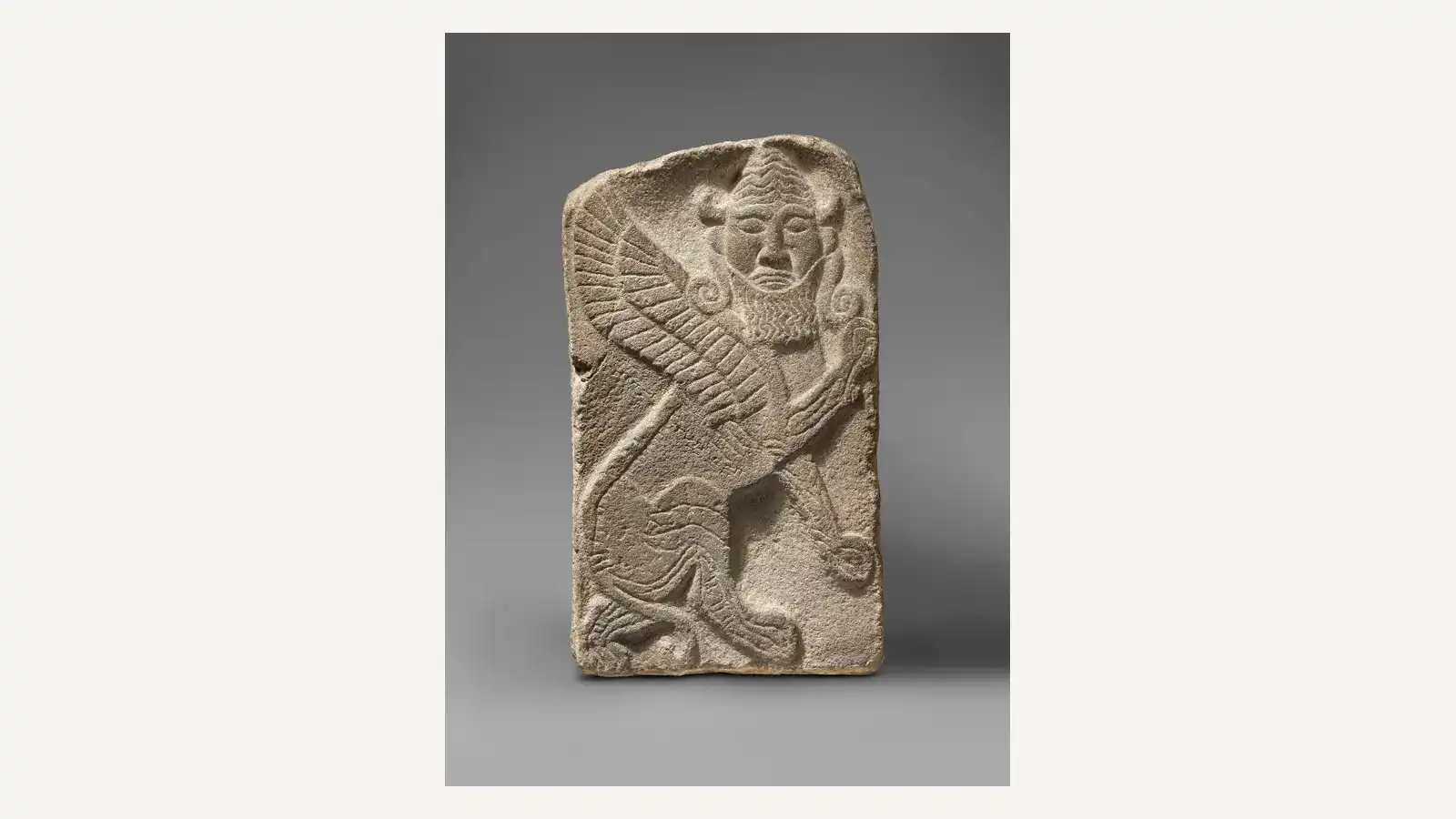
In this lesson: the lilû spirits, the phantom maid in the huluppu tree, Lamashtu and why the identity of the Burney Relief is still debated.
Many books and websites say Lilith began as an ancient Sumerian goddess and print a beautiful winged figure from the British Museum as her portrait. The real Mesopotamian evidence is both more modest and more interesting: a group of restless night spirits, a phantom in a goddess’s tree and a terrifying demon of childbirth who was not Lilith at all. This lesson reads that evidence carefully and shows you how to spot claims that go beyond it.
The lilû spirits
Historical Mesopotamian incantations and medical-magical texts, from the third and second millennia BCE, name a group of spirits: the male lilû, the female lilītu and the ardat-lilî, “maiden of the lilû”. Their Sumerian names use the element líl, which can mean “wind”, “air” or “breath”, and by extension something ghostly.
The texts are fragmentary, but patterns recur. These spirits were linked with young people who died before they could marry or have children. Their ghosts were thought to roam restlessly and to trouble the living of their own age, often in sexual ways, a little like the incubi and succubi of later European folklore.
They were also blamed for illnesses that baffled healers. Is the Hebrew lilit the same word? Scholars debate it. It may come from these spirits, from the Semitic word for night (Hebrew laylah), or from both through confusion. Many think the Mesopotamian spirits at least shaped the later figure.
How Mesopotamian healers worked
Historical To understand the lilû, it helps to know who fought them. Mesopotamian healing had two kinds of expert. The asû worked mainly with plants and remedies. The āšipu, often translated “exorcist” or “incantation priest”, diagnosed which god, ghost or demon lay behind an illness and recited spells to drive it away. The two often worked together.
Their texts were collected into long series of incantations, copied by scribes for centuries. Spirits like the lilû appear in lists of troublemakers, alongside ghosts, fevers and other demons. They were not honored with temples. They were named so they could be sent away.
The phantom maid in Inanna’s tree
Historical The Sumerian poem Gilgamesh, Enkidu and the Netherworld, known from Old Babylonian copies of the early second millennium BCE, is often called the first Lilith story. In paraphrase: the goddess Inanna rescues a huluppu tree from the Euphrates and plants it in her garden in Uruk, hoping to make a chair and a bed from its wood. When it grows, a snake lives at its roots, the Anzud bird nests in its crown and a female being lives in its trunk. The hero Gilgamesh drives them out, and she flees to the wild.
That female being is called ki-sikil-lil-la. The Oxford Electronic Text Corpus of Sumerian Literature translates her as “the phantom maid”. Translators in the 1930s rendered the name “Lilith”, and that choice spread. Whether she is Lilith is debated: some scholars see an early witness, while many treat her as the Sumerian counterpart of the ardat-lilî, a related spirit, and warn against a direct equation.
Lamashtu and the Burney Relief
Historical Lamashtu was a fearsome female demon, called a daughter of the sky god Anu. Incantations say she attacked pregnant women, caused miscarriage and harmed newborns. Families protected themselves with amulets showing her being driven away, often with the wind demon Pazuzu as protector. Lamashtu is a separate figure, but her role, a threat to mothers and babies, is exactly the role later given to Lilith, and scholars see a link in function.
Historical The image most often printed as “ancient Lilith” is the Burney Relief, also called the Queen of the Night, a fired clay plaque in the British Museum, dated to about 1800 to 1750 BCE. It shows a winged female figure with bird talons, a horned headdress, a rod and ring in each hand, standing on two lions between two owls. Who she is remains debated. Emil Kraeling proposed Lilith in 1937, and Henri Frankfort agreed.
Edith Porada argued for Ereshkigal, queen of the underworld, and others suggest Inanna or Ishtar, or a goddess whose name is lost. Her horned crown, which in Mesopotamian art usually marks a deity, is one reason many doubt the Lilith reading, and even the plaque’s authenticity was once questioned. The British Museum calls her simply the Queen of the Night. I describe it in words only here. You can see it on the British Museum website.
The Arslan Tash plaques
Historical You may meet one more piece of evidence in books: two small limestone plaques said to come from Arslan Tash in northern Syria, usually dated to the seventh century BCE. They carry an incantation in a Phoenician or Aramaic script against night “flyers” and a strangling spirit, with carved demons. Some writers read a lilith-like figure into them. The reading is debated, and so is the authenticity of the plaques themselves, since they came through the antiquities market. I treat them as a question mark, not as proof.
A little about the Queen of the Night today
The British Museum bought the Burney Relief in 2003 and gave it the neutral name Queen of the Night. Dominique Collon, a curator there, wrote a short book about it in 2005. The museum’s choice of name is itself a lesson: when we do not know who a figure is, it is better to describe her than to guess.
Questions beginners ask
Was Lilith worshipped in Sumer? There is no evidence for it. The lilû spirits were driven away, not worshipped.
Is Lamashtu the same as Lilith? No. They are separate figures. Lamashtu’s role as a danger to mothers and babies is similar to the role Lilith takes later.
Why do so many websites use the Queen of the Night picture? It is beautiful, it is old and a 1937 article linked it to Lilith. The identification has stuck online even though it remains debated.
Can I read the Sumerian texts myself? Yes, in translation. The Electronic Text Corpus of Sumerian Literature is free online.
Myths to drop:
- “Lilith was a Sumerian goddess.” She was not. The lilû were spirits, and the link to Lilith is debated.
- “The Epic of Gilgamesh tells Lilith’s story.” The phantom maid appears in a separate Sumerian poem, and whether she is Lilith is debated.
- “Pazuzu was evil.” He was a fearsome demon, but on amulets he protects mothers against Lamashtu.
A worked example
Imagine a book that says: “Lilith was worshipped as a Sumerian goddess, as her famous portrait in the British Museum shows, and she appears in the Epic of Gilgamesh.” Apply the three-step habit. What do we know? Mesopotamian texts name lilû and lilītu spirits, and a poem about Gilgamesh mentions a phantom maid in Inanna’s tree. What is debated?
Whether the Hebrew lilit comes from those spirits. What is a later guess? That the Burney Relief shows Lilith, an idea from 1937 that most specialists now reject, and that the phantom maid is Lilith herself, a choice made by 1930s translators. Spirits were not worshipped as goddesses. The book has stacked three guesses on one fact.
A second worked example: reading an object like a historian
Here is a calm way to approach the Burney Relief, or any ancient object you see in a book. Describe it. A fired clay plaque, about half a metre tall, showing a winged female figure with bird’s feet, standing on two lions and flanked by owls, with a horned crown. Date it. About 1800 to 1750 BCE, in the Old Babylonian period. Compare it. Horned crowns usually mark deities in Mesopotamian art; winged figures and owls appear in other images too. Conclude carefully. “Who she is remains debated. Proposals include Inanna or Ishtar, Ereshkigal, and a figure linked with the lilītu spirits, which many specialists doubt.”
Notice that the conclusion is a list of possibilities with a note on how strong each is. That is not a failure to decide. It is what the evidence allows, and it is far more interesting than a confident caption.
Three spirits, side by side
It helps to keep three Mesopotamian names apart. The lilû and lilītu were restless spirits linked with the young dead and with illness. Lamashtu was a single fearsome demon, said to attack mothers and babies, and fought with amulets of Pazuzu. The ki-sikil-lil-la of the Sumerian poem is a being in a tree, whose link with later Lilith is debated. Later Jewish sources gave Lilith a role close to Lamashtu’s, as a danger to newborns, and that is one reason the names are often blurred together. When you read any book, ask which of the three it means.
Try this
Write one sentence for each of these. What do we know about the lilû spirits? What is debated? What is a later guess? Keep the three sentences side by side. You will use the same three-step habit in every lesson.
Journal prompts: How does it feel to meet Lilith first as a group of restless spirits rather than one woman? Why do I think the Queen of the Night picture became so popular? What do I gain by leaving a figure unnamed when the evidence is unclear?
Recap
Mesopotamian texts of the third and second millennia BCE name lilû, lilītu and ardat-lilî spirits, linked with the restless young dead and with illness; whether the Hebrew lilit comes from them is debated. Whether the “phantom maid” in Inanna’s tree is Lilith is debated, and the name Lilith came from 1930s translators. Lamashtu, the demon who threatened mothers and babies, is a separate figure whose role later passed to Lilith. The Burney Relief’s figure is debated: Lilith, Ereshkigal, Inanna or Ishtar, or a lost goddess. The British Museum calls her the Queen of the Night.
What next
Press “Mark as done” and continue with Isaiah and the Dead Sea Scrolls. For more on these early sources, read Lilith’s history, and for Mesopotamian art, see ancient Near Eastern art.
Further reading: Jeremy Black and Anthony Green, Gods, Demons and Symbols of Ancient Mesopotamia (British Museum Press, 1992). Dominique Collon, The Queen of the Night (British Museum Press, 2005). The Electronic Text Corpus of Sumerian Literature (etcsl.orinst.ox.ac.uk) has a free translation of Gilgamesh, Enkidu and the Netherworld.
Sources
- Gilgamesh, Enkidu and the Netherworld, in the Electronic Text Corpus of Sumerian Literature (University of Oxford), https://etcsl.orinst.ox.ac.uk/
- British Museum, the Burney Relief (Queen of the Night), collection record.
- Raphael Patai, The Hebrew Goddess, 3rd enlarged edition (Detroit: Wayne State University Press, 1990).
Quick check
Go deeper: the Lilith pages on this site
Get the free Mini-Grimoire
A short printable starter guide to tarot and everyday witchcraft, plus my newsletter. Unsubscribe any time.
Opens Substack in a new tab to confirm. More about the newsletter · Privacy
Comments
Questions and notes from readers. Anyone with a free account can comment, and I reply when I can. Please read the community guidelines.
Comments load from Google Firebase (EU) when you ask for them. Nothing is stored on your device. Privacy