


How to read the labels Historical what the old sources say. Later tradition what later writers added. Modern modern practice and my own notes.
Ancient Near Eastern art is the art of Mesopotamia and its neighbours, roughly present-day Iraq, Syria, Iran and Turkey, from the first cities of Sumer around 3500 BCE to the fall of the Persian Empire in 330 BCE. It includes Sumerian worshipper statues, Babylonian law steles, Assyrian palace reliefs and the glazed brick Ishtar Gate. Much of it was made to show kings as chosen by the gods.
Mesopotamia means “between the rivers”, the Tigris and the Euphrates. It was never one civilization but a sequence of cities and empires that shared much of their culture, from Sumer to Babylon, followed by the Persian Empire to the east.
Key dates
| When | What happened |
|---|---|
| About 3400 to 3100 BCE | Writing begins in Uruk, in southern Mesopotamia. |
| About 2600 BCE | The Royal Cemetery at Ur is filled with gold, lapis lazuli and the Standard of Ur. |
| About 1754 BCE | Hammurabi of Babylon sets up his law code on a carved stele. |
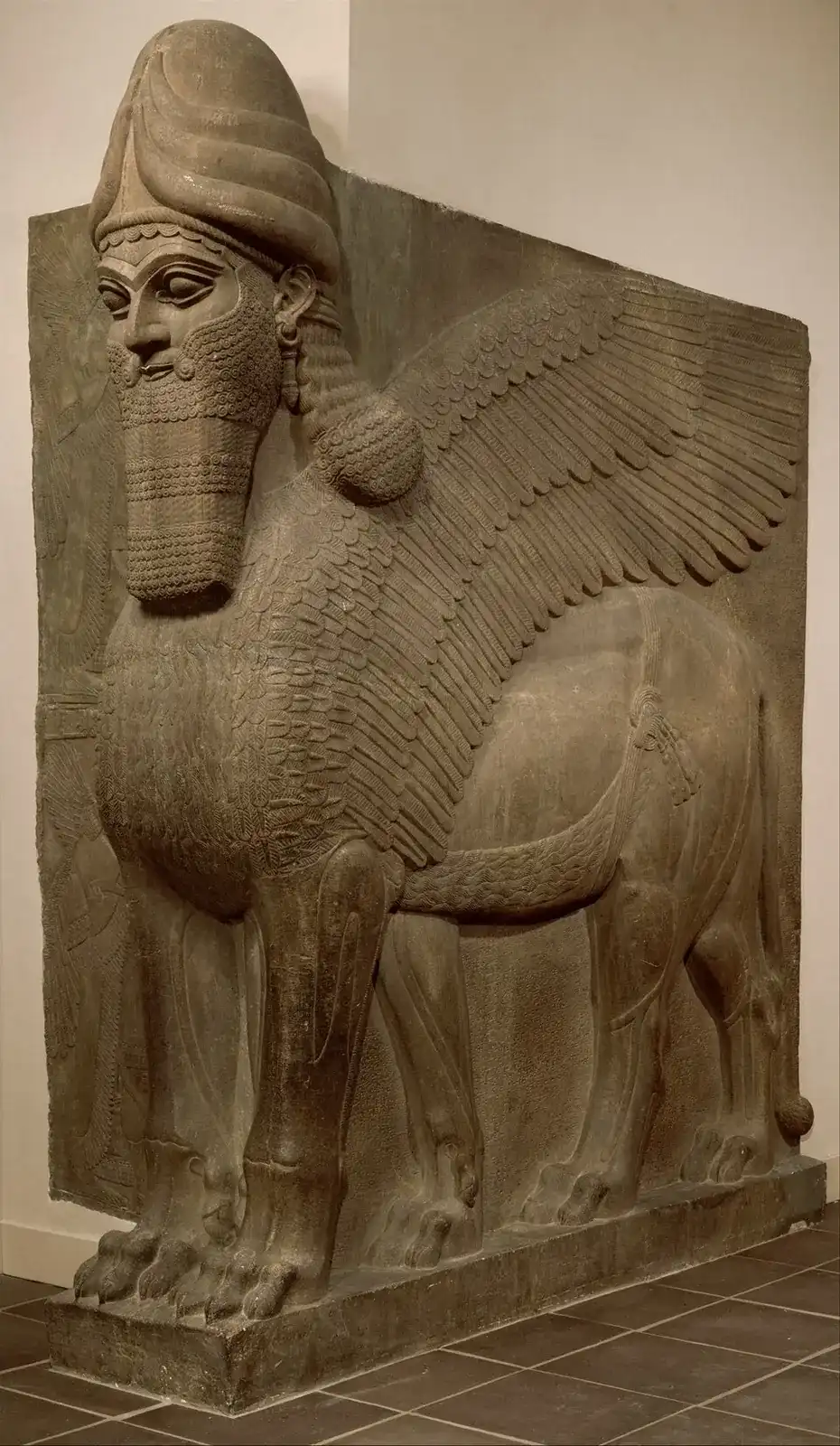
| 883 to 859 BCE | Ashurnasirpal II builds his palace at Nimrud, guarded by winged lamassu. |
| About 575 BCE | Nebuchadnezzar II builds the Ishtar Gate of Babylon in blue glazed brick. |
| 330 BCE | Alexander the Great burns Persepolis. |
What is Ancient Near Eastern art?
Ancient Near Eastern art is the art of the Sumerian, Akkadian, Babylonian, Assyrian and Persian worlds, made over about three thousand years for temples, palaces and royal display.
Throughout this page I mark three layers. Historical What the objects and inscriptions show. Later tradition What later religions and writers made of these gods and kings. Modern How people use the images in practice today.
Historical Uruk and Sumer. Uruk, in southern Iraq, was one of the first true cities, and some of the earliest writing appears there around 3200 BCE.
The Uruk Vase, an alabaster vessel about a meter high from roughly 3200 to 3000 BCE, is carved in bands: water, plants, animals, men carrying offerings, and at the top a procession bringing gifts to a female figure, probably the goddess Inanna or her priestess.
Read from bottom to top, it is a picture of the whole ordered world rising toward the divine.
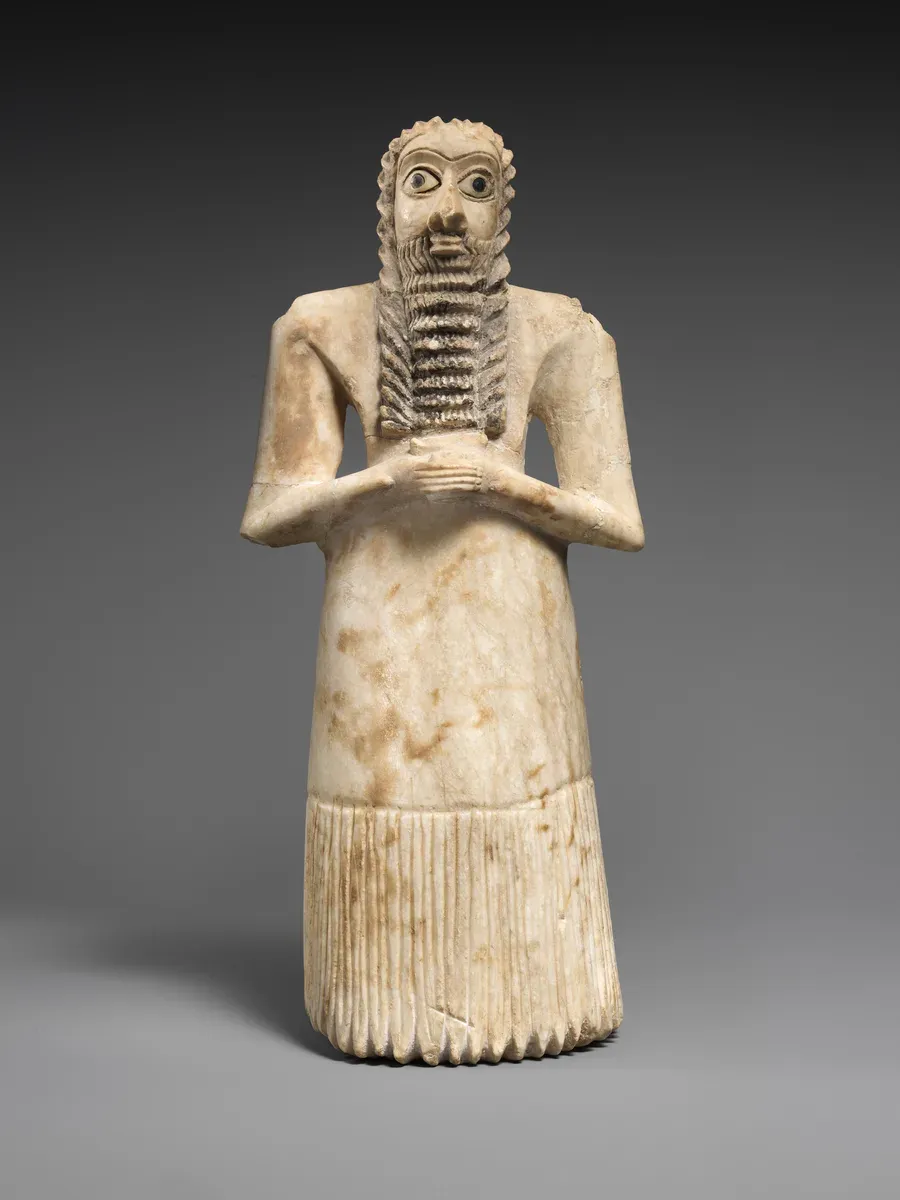
Standing male worshiper, about 2900 to 2600 BCE. The Metropolitan Museum of Art (40.156). Image: Open Access, public domain (CC0).
The Sumerian city-states made votive figures like this one at the Met: men and women with clasped hands and wide eyes of shell and stone. They were placed in temples to stand in endless prayer for the people who gave them.
The Royal Cemetery at Ur, dug in the 1920s and 1930s, produced gold, lapis lazuli and the inlaid box called the Standard of Ur, now in the British Museum, with war on one side and a banquet on the other.
Historical Akkad and Babylon. Around 2300 BCE Sargon of Akkad united the region in what is often called the first empire.
The Victory Stele of his grandson Naram-Sin, in the Louvre, breaks the old bands: the king, much larger than anyone else and wearing a horned crown that signals divinity, climbs a mountain over his enemies. That size rule, hierarchical scale, is one you will meet again and again.
The Code of Hammurabi, about 1750 BCE, is a basalt stele topped by a relief of the king before Shamash, the sun god of justice, with nearly three hundred laws below. Image and text work together: the laws carry divine authority.
Historical Assyria: palaces and guardians. From the ninth to the seventh century BCE, Assyrian kings lined their palaces with carved reliefs of hunts, battles, sieges and tribute. At the gateways stood lamassu, colossal guardians with the bodies of bulls or lions, wings and crowned human heads.
The Met’s pair comes from the palace of Ashurnasirpal II at Nimrud, about 883 to 859 BCE. Look at the legs from the side: many lamassu have five, so they look complete from the front and from the side.
These reliefs lined the routes foreign ambassadors walked. They were meant to impress and to frighten.
Historical Babylon’s blue gate and Persepolis. Under Nebuchadnezzar II, Babylon’s Ishtar Gate, about 575 BCE, was faced with glazed blue bricks showing dragons and bulls in relief. Its reconstruction is in the Pergamon Museum in Berlin, which is closed for a long renovation.
The Achaemenid Persian Empire, founded by Cyrus the Great in the sixth century BCE, stretched from Egypt to the Indus. Darius I began the ceremonial capital of Persepolis around 518 BCE. Its staircases are carved with delegations from across the empire, each in its own dress, bringing gifts to the king.
It is tempting to read them as a documentary record. They are better read as an ideal picture: an empire of many peoples, peaceful and orderly, all moving toward one ruler. Persepolis burned in 330 BCE during Alexander’s conquest.
Key artists
| Artist | Lived | Why they matter |
|---|---|---|
| Enheduanna | about 2300 BCE | High priestess of the moon god at Ur and the first author known by name; she appears on a carved disk. |
| Sculptors of Ashurnasirpal II | 9th century BCE | The workshops that carved the lamassu and the palace reliefs at Nimrud. |
| Builders of Nebuchadnezzar II | 6th century BCE | The makers of the glazed brick lions, bulls and dragons of the Ishtar Gate. |
| Craftsmen of Persepolis | 6th to 5th century BCE | The stone carvers who lined the stairways with tribute bearers from across the Persian Empire. |
How do you recognise Ancient Near Eastern art?
Look for figures in strict profile, rows of registers like a comic strip, and kings far larger than everyone around them. Beards are curled in neat rows. Guardian beasts mix bull, lion, eagle and human. Inscriptions in cuneiform often run right across the carving, and the materials speak of trade: lapis from Afghanistan, gold, carnelian and glazed brick.
Common misconceptions. One is that this is “Babylonian art” all the way through. Babylon is only one city and one period; Sumer, Akkad, Assyria, Elam and Persia each had their own styles.
Another is that it was a world without women’s voices. Enheduanna, daughter of King Sargon of Akkad and high priestess of the moon god at Ur around 2300 BCE, is the earliest named author in history, and she appears on a carved limestone disk now at the Penn Museum in Philadelphia.
Esoteric themes
Historical Mesopotamian religion was full of protective magic: incantation texts, amulets and figures buried under thresholds. The lamassu were part of that world. They guarded a doorway in both a physical and a spiritual sense.
Later tradition Many later figures of Western magic have roots here, often through long and winding paths.
The Lilith of Jewish folklore is linked by many scholars to the Mesopotamian lilû and lilītu spirits, and Babylonian astrology shaped the zodiac. My Lilith course follows that thread carefully, including the famous clay relief often called the Queen of the Night.
Modern Some modern practitioners honor Inanna or Ishtar. If you do, I suggest reading translations of the actual hymns, such as those to Inanna, so your practice grows from the sources rather than from internet summaries.
Works to see
| Work | Artist | Date | Where to see it |
|---|---|---|---|
| Human-headed winged lion (lamassu) | Assyrian | 883 to 859 BCE | The Metropolitan Museum of Art, New York |
| Standard of Ur | Sumerian | about 2600 BCE | The British Museum, London |
| Law Code of Hammurabi | Babylonian | about 1754 BCE | Musée du Louvre, Paris |
| Ishtar Gate | Babylonian | about 575 BCE | Pergamonmuseum, Berlin |
Every work in this list is free of nudity, so you can look them up with confidence. Works still in copyright are named but not shown here.
How to look at a Mesopotamian relief or object
I look for three things. First, the bands, or registers: many scenes are stacked in rows to be read from bottom to top or left to right. Second, scale: kings and gods are larger. Third, the materials, because lapis lazuli, gold and glazed brick were statements of wealth and long-distance trade.
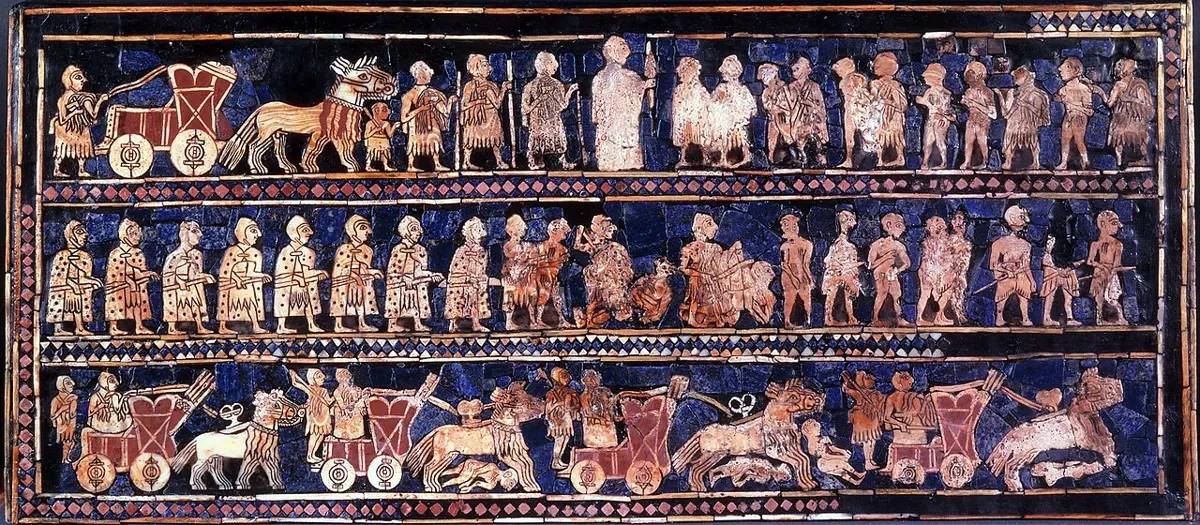
Unknown Sumerian artist, Standard of Ur, about 2600 BCE. British Museum, London. Image: Wikimedia Commons, public domain.
The Standard of Ur, about 2600 BCE. Found by Leonard Woolley in the Royal Cemetery of Ur in the late 1920s and now in the British Museum. Its purpose is unknown. Start at the bottom band of the war side, where chariots trample enemies, and read upward to the king in the top row, who is taller than everyone else.
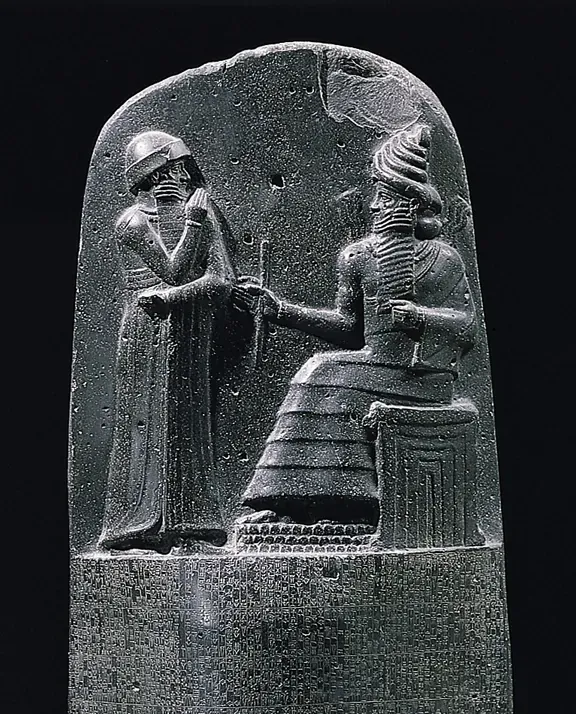
Unknown Babylonian artist, Top of the law code stele of Hammurabi (photograph published 1929), about 1754 BCE. Musée du Louvre, Paris. Image: Wikimedia Commons, public domain.
The top of the law code stele of Hammurabi, about 1754 BCE. In the Louvre. The king stands before the seated sun god Shamash, the god of justice, who seems to hand him a rod and ring, signs of authority. Below are around 280 laws in cuneiform. The stele was carried off to Susa as war booty in the 12th century BCE and found there in 1901.
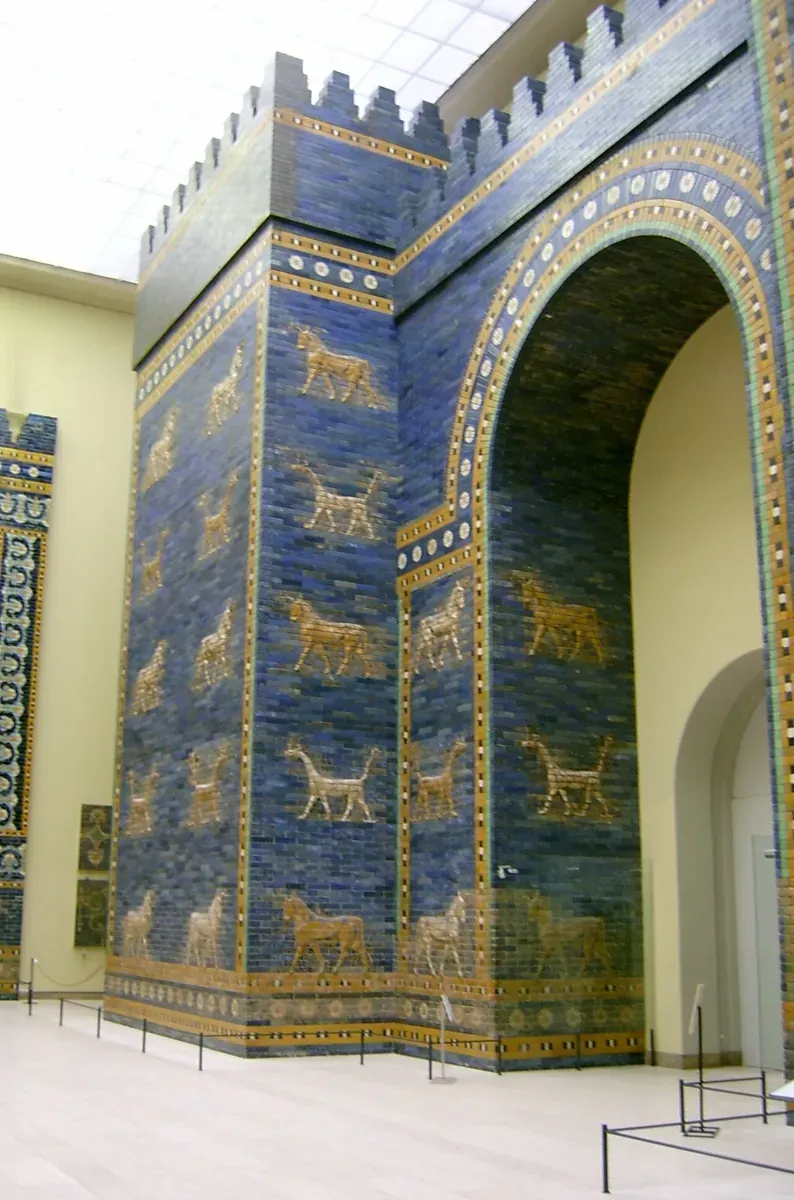
Unknown Babylonian artists, Ishtar Gate (reconstruction with original glazed bricks), about 575 BCE. Pergamon Museum, Berlin. Image: Wikimedia Commons, public domain.
The Ishtar Gate, about 575 BCE. Built for King Nebuchadnezzar II at Babylon and rebuilt from excavated bricks in the Pergamon Museum in Berlin. Look at the animals: aurochs for the weather god Adad and the scaly mušḫuššu dragon of the god Marduk. The gate section of the museum is closed for long-term renovation, so check before you travel.
The powerful seated and standing figures of this world have relatives in ancient Egypt, and Near Eastern animal friezes and monsters passed into early Greek art. If you are drawn to the demons and protective spirits of Mesopotamia, the demons course follows that thread.
Try this
Open the Met’s lamassu page and look at the figure first from the front and then from the side. Count the legs. Then write who would have walked past it when it was new, from what distance and in what light. How does seeing it on a screen change its meaning?
What next
Before this: Prehistoric art.
After this: Ancient Egyptian art.
See every movement in order on the art movements timeline, or learn to look step by step in the free Art History for Beginners course.
If you want to carry this into tarot and practice, these pages connect to it: The Star, the eight-pointed star of Ishtar and Inanna, one of the oldest star symbols we can trace; Justice, Hammurabi receiving his laws from the sun god of justice; The lamassu and the Lilith-like figures of Mesopotamia; and What the ancient sources really say about Lilith.
Sources
- Seton Lloyd, The Art of the Ancient Near East (1961).
- Hugh Honour and John Fleming, A World History of Art (1982).
- The Metropolitan Museum of Art, Human-headed winged lion (lamassu), 32.143.2. Open the record
- The Metropolitan Museum of Art, Standing male worshiper, 40.156. Open the record
- The Metropolitan Museum of Art, Heilbrunn Timeline of Art History. Visit the website
- E. H. Gombrich, The Story of Art (1950).
- Wikimedia Commons, Human-headed winged lion (lamassu) (hero image record). Open the record
- Zainab Bahrani, Art of Mesopotamia (2017).

Questions
What is a lamassu?
A colossal guardian figure that stood at Assyrian palace gateways, with the body of a bull or lion, wings and a crowned human head. The Met's pair comes from the palace of Ashurnasirpal II at Nimrud, about 883 to 859 BCE.
Why do the Sumerian statues have such big eyes?
They were votive figures placed in temples to stand in prayer for the people who gave them. Their wide inlaid eyes show attention and devotion. They were not portraits.
Where can I see works of Ancient Near Eastern art in person?
Good places to start are the Met, the British Museum, the Louvre, and the Pergamon Museum in Berlin. Museums change their displays, so check the collection page before you travel.
Who was Enheduanna?
Enheduanna was a princess and high priestess at Ur around 2300 BCE, the daughter of Sargon of Akkad. Hymns attributed to her make her the earliest author known by name.
Get the free Mini-Grimoire
A short printable starter guide to tarot and everyday witchcraft, plus my newsletter. Unsubscribe any time.
Opens Substack in a new tab to confirm. More about the newsletter · Privacy