


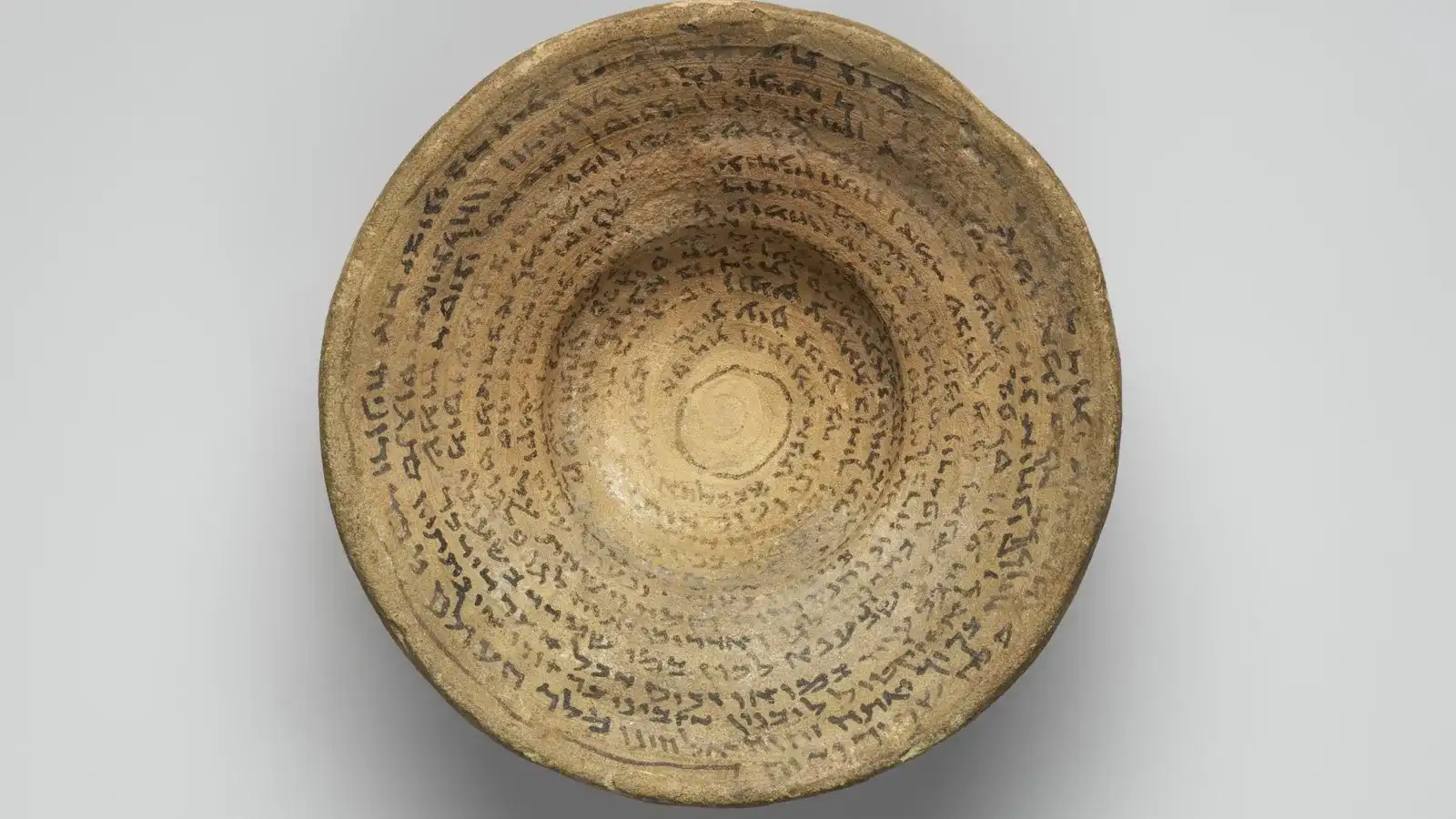
In this lesson: Aramaic incantation bowls, divorce writs for liliths, the Talmud, the Alphabet of Ben Sira and the three angels on birth amulets.
The story everyone knows about Lilith, that she was Adam’s first wife and left him rather than submit, is not ancient. It comes from a medieval book, written long after the Bible and probably with a satirical smile. Before that book, Lilith lived in the everyday fears of ordinary families, who buried spell bowls under their floors to keep her away from their babies. This lesson looks at both: the bowls and the Talmud, then the Alphabet of Ben Sira and the protective amulets it explains.
Spells in a soup bowl
Historical Incantation bowls are ordinary earthenware bowls with a spell written in ink on the inside, usually spiraling from the center to the rim. Most come from Mesopotamia in the Sasanian period, many from about the fifth to seventh centuries CE, and they are written in Jewish Babylonian Aramaic, Syriac, Mandaic and other scripts. Bowls were often buried upside down under the floors of houses. James Montgomery published many from the excavations at Nippur in 1913.
A client went to a specialist who could write. The spell named the client, usually by their mother’s name, and everything to be protected: spouse, children, house and goods. In the bowls, liliths come in both genders, “male liliths and female liliths”. They threaten the household, above all pregnant women and newborns, and some appear at night, in dreams or in the form of a spouse.
Some bowls even frame the spell as a get, a Jewish bill of divorce, issued to Lilith. In Jewish law a get ends a marriage and sends the wife away. Applied to a demon, it expresses a vivid idea: the lilith is a false spouse in the house, and she is being lawfully dismissed.
Where the bowls come from
Historical Scholars know of around two thousand incantation bowls. The first well-documented group came from American excavations at Nippur, in southern Iraq, in the late nineteenth century. Many more have reached collections through the antiquities market, often without a known find-spot. That raises a real ethical problem, because some were looted, and scholars disagree about how to publish such objects. When you see a bowl for sale online, it is fair to ask where it came from.
The bowls were not only Jewish. Clients and scribes included Jews, Christians, Mandaeans, Zoroastrians and others, sometimes using each other’s formulas. Lilith belongs to a shared world of household protection in late antique Mesopotamia.
The Talmud
Historical The Babylonian Talmud, compiled in the same region and roughly the same centuries, mentions lilit only a few times. A man should not sleep alone in a house, or lilit will seize him (Shabbat 151b). A lilit has long hair (Eruvin 100b). These are passing remarks, not a mythology.
The Alphabet of Ben Sira
Later tradition The Alphabet of Ben Sira is an anonymous Hebrew and Aramaic work, usually dated between the eighth and tenth centuries CE. It borrows the name of a real sage of the second century BCE but has nothing to do with him. Many scholars read it as satirical.
In paraphrase, its story runs like this. God made Lilith from the earth, as Adam had been made. They quarreled at once: Adam insisted she lie beneath him, and Lilith said they were equal, since both came from the earth. She spoke the divine name and flew away. God sent three angels, Senoy, Sansenoy and Semangelof, to bring her back. She refused, but swore that wherever she saw their names on an amulet, she would not harm a newborn. Read in context, this is an origin story for a protective custom already in use, not ancient sacred myth.
Later tradition Amulets with the three angels’ names became widespread in Jewish communities in the medieval and early modern periods, hung in the room of a woman giving birth. A printed design in Sefer Raziel ha-Malakh, first printed in Amsterdam in 1701, helped standardize them. These belong to a living tradition, and they are not tools for a modern Lilith practice.
How old is the Ben Sira story?
Later tradition The date of the Alphabet of Ben Sira is debated. Most scholars place it somewhere between the eighth and tenth centuries CE, and some argue for other dates within the medieval period. Its tone is debated too. Many read it as satire, full of rude jokes about famous figures. Others take parts of it more seriously. Either way, it is medieval, and the Lilith episode is only one short story in the book.
Questions beginners ask
Did Jews worship Lilith? No. The bowls, the Talmud and the amulets all treat her as a danger to be kept away.
Why does this course leave out the angels’ names? They belong to a living protective tradition. Using them in a modern Lilith practice would turn someone else’s sacred safeguard into a prop.
Is the Ben Sira story feminist? In its own setting it is probably not. It still ends with Lilith as a threat to babies. Modern feminists reread it, as lesson 6 shows.
Can I buy an incantation bowl? Be careful. Many on the market may be looted, and buying them can feed that trade.
Myths to drop:
- “The first-wife story is in the Talmud.” The Talmud mentions lilit only in passing. The story is in Ben Sira.
- “Ben Sira is an ancient book.” It borrows an ancient sage’s name but is medieval, with its exact date debated.
- “The bowls were a Jewish secret.” They were made for clients of several faiths.
A worked example
Imagine a family in a Mesopotamian town around 600 CE. The mother is pregnant, and two babies in the street have died that year. The father visits a scribe, who writes a spiral of Aramaic inside a clay bowl: the mother’s name, the unborn child, the house, and a command that every lilith, male and female, leave as a divorced wife leaves.
That evening the bowl is buried upside down under the floor. Several centuries later, a writer in a very different world tells a clever story about why amulets with three angels’ names protect newborns, and the demon those parents feared becomes Adam’s rebellious first wife. Same name, very different stories.
How scholars date a text like Ben Sira
The date of the Alphabet of Ben Sira is debated, and it is worth knowing how such debates work, because the same method applies to many occult claims. Scholars look at several kinds of clue. The language: words and grammar change over time, so the Hebrew and Aramaic of a text point to a period. Quotations: if another dated author quotes or mentions the work, it must be older than that author. Manuscripts: the oldest surviving copy gives a latest possible date. Content: references to customs, places or other books can point earlier or later.
None of these clues is perfect alone. Together they usually narrow the date to a range of a few centuries, which is why you see “between the eighth and tenth centuries CE” rather than a single year.
A worked example: reading a bowl translation
Suppose you open a scholarly edition of incantation bowls, such as James A. Montgomery’s Aramaic Incantation Texts from Nippur (1913), which is old enough to be freely available online. As you read a bowl, look for four things. The client: the people protected, often named with their mother’s name. The threat: the demons named, liliths among them. The method: the words used, such as the legal language of divorce that sends a lilith out of the house. The scribe’s world: names of angels, biblical phrases or formulas shared with other faiths. Write one line for each. You will quickly see how practical and personal these bowls were, and why scholars call them a window into the fears of ordinary households.
Remember that Montgomery wrote more than a century ago. Later scholars have improved many readings, so treat his translations as a starting point, and compare a modern edition when you can.
Three sources, three tones
It helps to hear how differently our three sources sound. The bowls are urgent and protective: a family wants a demon out of the house. The Talmud is brief and practical: a few remarks in legal and folk discussions, such as not sleeping alone in a house. The Alphabet of Ben Sira is a story, clever and perhaps playful, that explains a custom. When a modern book blends all three into one voice, you can now pull them apart.
More questions beginners ask
Were the bowls only against Lilith? No. They name many demons, curses and illnesses. Liliths are common, but they are one threat among many.
Did the Ben Sira story replace the older beliefs? No. Families went on using protective amulets, and the story offered one explanation for them. Old fears and new stories lived side by side.
Try this
Retell the Ben Sira story in five sentences, in your own words. Then add one sentence that says when and why it was written. Notice how that last sentence changes the way the story feels.
Journal prompts: What do the bowls tell me about the fears of ordinary families? How do I feel about a famous story that may have begun as satire? Why does it matter to leave protective amulets to the tradition they belong to?
Recap
Incantation bowls from Sasanian Mesopotamia, about the fifth to seventh centuries CE, protected households against male and female liliths who threatened mothers and newborns; some used the form of a divorce writ to dismiss them lawfully. The Talmud mentions lilit only in passing. The first-wife story comes from the Alphabet of Ben Sira, written around the eighth to tenth centuries CE and perhaps satirical, which explains the three angels’ amulets. Those amulets belong to a living Jewish tradition and are not for copying.
What next
Press “Mark as done” and continue with Kabbalah and the Zohar. For more on these sources, read Lilith’s history.
Further reading: David Stern and Mark Jay Mirsky (eds.), Rabbinic Fantasies (Jewish Publication Society, 1990) includes an English translation of the Alphabet of Ben Sira. Dan Levene, A Corpus of Magic Bowls (Kegan Paul, 2003). Shaul Shaked, James Nathan Ford and Siam Bhayro, Aramaic Bowl Spells (Brill, 2013).
Sources
- James A. Montgomery, Aramaic Incantation Texts from Nippur (Philadelphia, 1913).
- Babylonian Talmud, Shabbat 151b, Eruvin 100b, Niddah 24b, Bava Batra 73a.
- David Stern and Mark Jay Mirsky (eds.), Rabbinic Fantasies (1990), with Norman Bronznick’s translation of the Alphabet of Ben Sira.
Quick check
Go deeper: the Lilith pages on this site
Get the free Mini-Grimoire
A short printable starter guide to tarot and everyday witchcraft, plus my newsletter. Unsubscribe any time.
Opens Substack in a new tab to confirm. More about the newsletter · Privacy
Comments
Questions and notes from readers. Anyone with a free account can comment, and I reply when I can. Please read the community guidelines.
Comments load from Google Firebase (EU) when you ask for them. Nothing is stored on your device. Privacy