


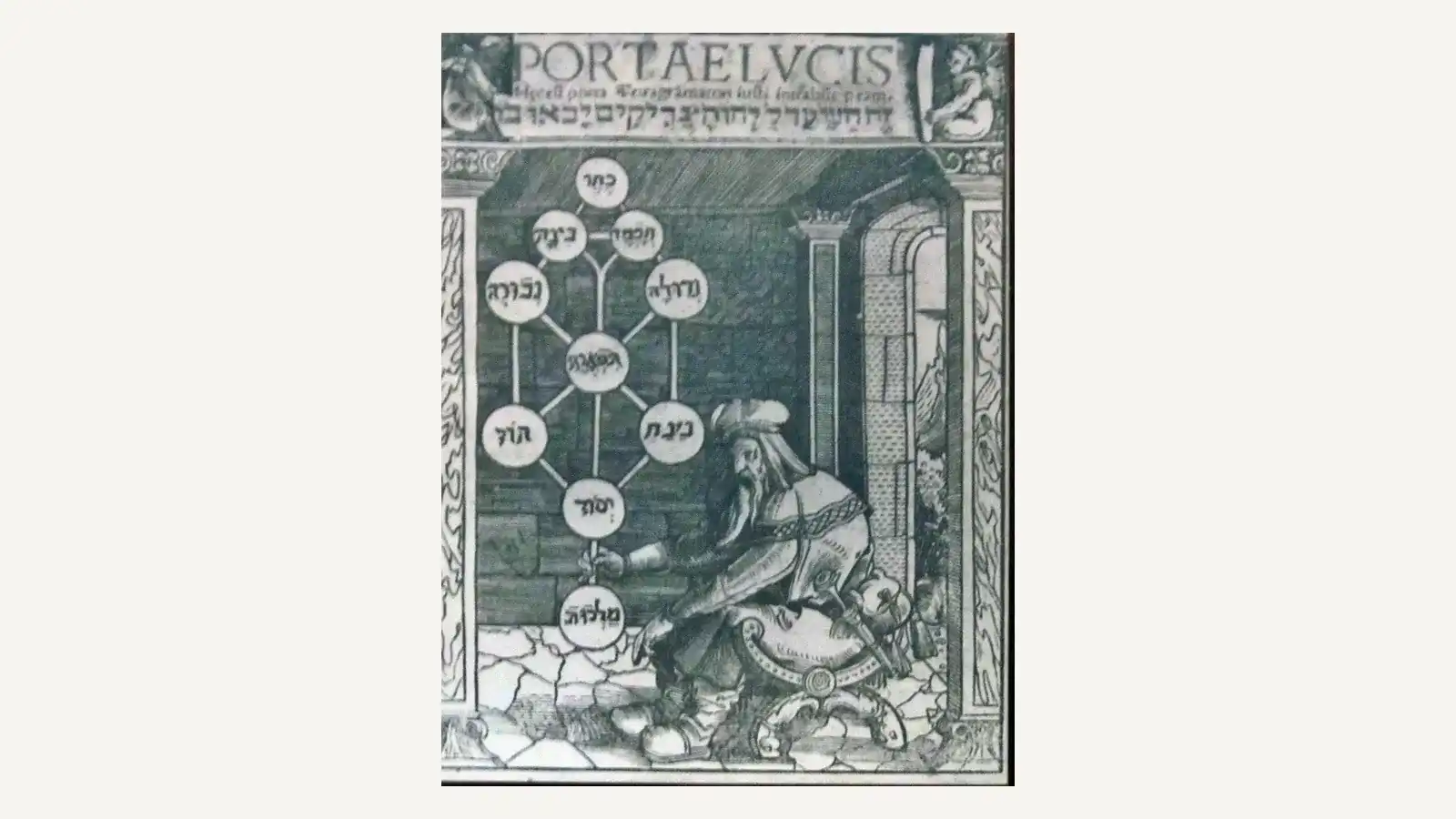
In this lesson: Lilith and Samael in thirteenth-century Kabbalah, the Zohar, the husks of Lurianic thought and how modern occultism borrowed them.
In the thirteenth century, Jewish mystics in Spain gave Lilith a new and much grander role: no longer just a night spirit or a runaway wife, but the queen of a whole demonic “other side”, paired with the angel Samael. Centuries later, Western occultists borrowed this picture and remade it again. If you read modern books about Lilith and the qliphoth, you need to know which parts come from Jewish Kabbalah and which are modern. This lesson walks you through both.
What Kabbalah is
Later tradition Kabbalah, Hebrew for “receiving” or “tradition”, is a family of Jewish mystical teachings that took shape in Provence and Spain in the twelfth and thirteenth centuries. Kabbalists described God’s inner life through ten sefirot, divine attributes, and asked how evil and impurity could arise in a world made by a good God. Lilith became one of their answers.
Key words
A few terms will help you read any book on this subject.
- Sefirot are the ten divine attributes or powers through which, in Kabbalah, the hidden God is revealed and the world is sustained.
- Sitra Achra, Aramaic for “the other side”, is the realm of impurity and evil in Kabbalistic thought.
- Kelipot, “husks” or “shells”, are the forces of impurity that surround and trap holiness. Western occultists later spelled the word “qliphoth”.
- Samael is a name for a fallen angel or the angel of death in Jewish tradition. In some Kabbalistic texts he is Lilith’s partner.
These words come from a Jewish religious system. Using them accurately is a way of showing respect.
The left emanation and the Zohar
Later tradition Around the 1260s or 1270s, the Castilian Kabbalist Isaac ben Jacob ha-Kohen wrote a short work usually called the Treatise on the Left Emanation. It describes a demonic “left side” mirroring the holy emanations. Here Samael and Lilith are born together, joined as one being, like a dark reflection of Adam and Eve. The treatise even distinguishes an elder Lilith, partner of Samael, from a younger Lilith, partner of Asmodeus.
Later tradition The Zohar, “Radiance”, is the central work of medieval Kabbalah, written mostly in Aramaic as a commentary on the Torah. It presents itself as the teaching of the second-century sage Rabbi Shimon bar Yochai. Most scholars, following Gershom Scholem, attribute its core to Moses de León and his circle in Castile, around the 1280s.
Many traditional Jews regard it as ancient and holy, and that difference of view deserves respect. In the Zohar, Samael and Lilith become the king and queen of the other side, a dark mirror of the holy union of the divine masculine and feminine. Lilith seduces men in their sleep and threatens children, the old roles in a grand new frame.
The husks
Later tradition In sixteenth-century Safed, Isaac Luria taught that creation involved a “breaking of the vessels”, which scattered sparks of divine light into the kelipot, the “husks” or “shells” of impurity. Human beings, through the commandments and prayer, help lift the sparks back. In this system Lilith remains a central figure of the other side.
Modern borrowings
Modern Western occultists borrowed these ideas, spelling the husks “qliphoth”. Kenneth Grant’s Nightside of Eden (1977) is a key text for modern qliphothic occultism, where Lilith often becomes a goddess of the dark side to be explored. That is a modern esoteric reworking, not Jewish Kabbalah, and honest practitioners say so.
Christian Kabbalah and the occult revival
Later tradition From the late fifteenth century, Christian scholars such as Giovanni Pico della Mirandola and Johann Reuchlin read Kabbalah through Christian eyes. This “Christian Cabala” passed into Renaissance magic and, centuries later, into the Hermetic Order of the Golden Dawn and its heirs. Along the way, Kabbalistic ideas were rearranged to fit very different beliefs. If you have taken my Occult History course, you will recognize the path.
Questions beginners ask
Is Kabbalah open to non-Jews? Anyone can read the scholarly literature. Traditional Jewish teachers often see Kabbalah as a practice within Jewish life and law. It is courteous to know that before borrowing.
Did Kabbalists worship Lilith? No. In Kabbalah she belongs to the other side, a force to be resisted and overcome.
Is the Zohar ancient? Tradition attributes it to a second-century sage. Most scholars date its core to thirteenth-century Castile. Both views exist, and many traditional Jews hold the first.
Is qliphothic magic dangerous? It is a modern occult practice built on a reworking of Jewish ideas. It is not part of this course. If you explore it later, keep the safety advice of lesson 7 in mind.
Myths to drop:
- “In Kabbalah, Lilith is a goddess of liberation.” In Kabbalah she is a demonic queen of the other side.
- “The qliphoth of modern occultism are pure Jewish teaching.” They are a modern Western reworking.
- “Kabbalah is a single book.” It is a family of teachings and texts over many centuries.
A worked example
Imagine two books on your desk. One is a scholarly history of the Zohar; the other is a modern occult guide promising “Lilith’s path through the qliphoth”. Both use the same words, the other side, the husks, Samael and Lilith.
In the first, the husks are impurity that Jews help overcome through prayer and the commandments, and Lilith is a danger to be guarded against. In the second, the shells are a path to explore and Lilith is a guide. The vocabulary is shared, the meaning is reversed. Asking “which tradition is this author speaking from?” keeps you from mistaking one for the other.
Who wrote the Zohar? A short history of a debate
Later tradition Traditionally the Zohar is the teaching of Rabbi Shimon bar Yochai, a sage of the second century CE. In the twentieth century the great historian of Kabbalah Gershom Scholem argued, in Major Trends in Jewish Mysticism (1941), that most of it was written by the Castilian Kabbalist Moses de León in the late thirteenth century.
Later scholars, including Yehuda Liebes, have suggested that a circle of Kabbalists wrote it together, with Moses de León as a central figure. Today the academic consensus places its core in thirteenth-century Castile, while many traditional Jews hold to the older attribution. Both views exist, and a respectful student can describe both.
If you want to read the Zohar itself in English, the standard scholarly translation is The Zohar: Pritzker Edition, translated mainly by Daniel C. Matt and published by Stanford University Press in twelve volumes from 2004 to 2017. It has careful notes that explain each passage.
Lilith and the Shekhinah
Later tradition To understand Lilith in Kabbalah, it helps to know the Shekhinah, the divine presence, which Kabbalists imagined as feminine and linked with the last of the ten sefirot. In some Kabbalistic texts Lilith is pictured as a dark counterpart to the Shekhinah, a false queen who tries to take her place.
This is one reason Lilith became so important in Kabbalah: she is defined by what she mirrors. If you read a modern claim that Kabbalah honors Lilith as a dark goddess, remember this picture. In the sources she is a counterfeit of holiness, not a goddess to be worshipped.
A worked example, step by step: reading a Kabbalah claim
Imagine a website says: “In the ancient Kabbalah, Lilith rules the qliphoth and grants dark wisdom to initiates.” Work through it slowly. “Ancient”: Kabbalah as a movement took shape in the twelfth and thirteenth centuries, so “medieval” is closer. “Rules the qliphoth”: in some Kabbalistic texts Lilith is a queen of the other side, so this part has a real source, though the spelling “qliphoth” belongs to Western occultism. “Grants dark wisdom to initiates”: this comes from modern occult reworkings, not from Jewish sources, where she is a danger to be resisted.
Your honest rewrite: “In medieval Kabbalah, Lilith is a demonic queen of the other side; some modern occultists reinterpret her as a guide.” It is less dramatic and much more useful.
A study variation: one term, three meanings
Choose one word, such as “kelipot”. Write what it means in Lurianic Kabbalah, what it means in Western occultism and what it means to you as a reader. Seeing a single term change across traditions is one of the best ways to understand why accurate language is a form of respect.
More questions beginners ask
Do I need to understand the sefirot to study Lilith? Only a little. Knowing that there are ten divine attributes, and that Kabbalists imagined a dark mirror of them, is enough for this course.
Why did Western occultists borrow so much from Kabbalah? Since the Renaissance, Christian scholars saw Kabbalah as an ancient key to hidden wisdom. That view passed into the occult revival of the nineteenth century, as you saw above.
Try this
Make a short timeline with four dates: the Ben Sira tale (8th to 10th centuries), the Treatise on the Left Emanation (1260s to 1270s), the Zohar (1280s) and Kenneth Grant (1977). Write one word next to each that sums up how Lilith appears there.
Journal prompts: Why might medieval mystics have needed a figure like Lilith to explain evil? What do I feel when a sacred system is borrowed and changed by outsiders? Where is the line between learning from a tradition and taking from it?
Recap
Kabbalah is a family of Jewish mystical teachings from twelfth- and thirteenth-century Provence and Spain. The Treatise on the Left Emanation of the 1260s or 1270s pairs Lilith with Samael on a demonic left side, and the Zohar, attributed by most scholars to Moses de León’s circle around the 1280s, makes them king and queen of the other side. Lurianic Kabbalah keeps her among the husks of impurity. Modern qliphothic occultism, from Kenneth Grant’s 1977 book on, is a Western reworking, not Jewish Kabbalah.
What next
Press “Mark as done” and continue with Lilith transformed: art, poetry, feminism and the stars. For the wider history of Kabbalah and its Christian and occult borrowers, take Occult History for Beginners, and see Lilith’s history.
Further reading: Joseph Dan, Kabbalah: A Very Short Introduction (Oxford University Press, 2006). Gershom Scholem, Kabbalah (Keter, 1974), with an entry on Lilith. Arthur Green, A Guide to the Zohar (Stanford University Press, 2004).
Sources
- Gershom Scholem, Major Trends in Jewish Mysticism (1941).
- Raphael Patai, The Hebrew Goddess, 3rd enlarged edition (Detroit: Wayne State University Press, 1990).
- Kenneth Grant, Nightside of Eden (London: Frederick Muller, 1977).
Quick check
Go deeper: the Lilith pages on this site
Get the free Mini-Grimoire
A short printable starter guide to tarot and everyday witchcraft, plus my newsletter. Unsubscribe any time.
Opens Substack in a new tab to confirm. More about the newsletter · Privacy
Comments
Questions and notes from readers. Anyone with a free account can comment, and I reply when I can. Please read the community guidelines.
Comments load from Google Firebase (EU) when you ask for them. Nothing is stored on your device. Privacy