


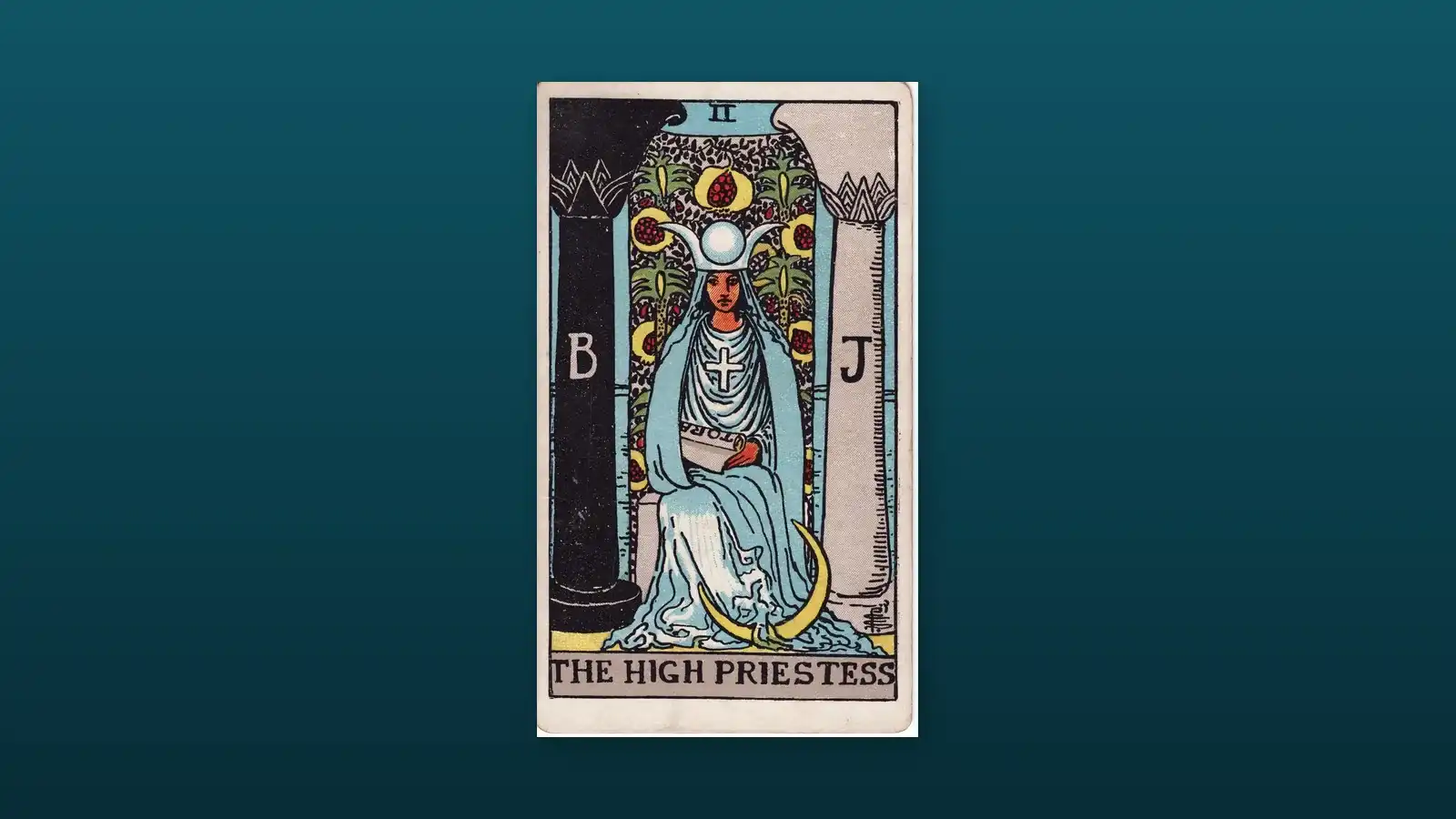
In this lesson: what tarot really is, the Major and Minor Arcana, what a reading can and cannot do and how to think about the future.
Before you learn what any single card means, it helps to know what kind of thing a tarot deck is, and what you can fairly ask of it. Beginners who expect tarot to be a crystal ball are often disappointed or frightened. Beginners who understand it as a set of pictures for thinking and reflecting tend to stay, and to grow into good readers. This lesson sets your expectations in the right place.
A deck of 78 pictures
Tarot is a deck of 78 picture cards. People use it for reflection, journaling, storytelling, creative prompts and divination. You do not need to believe in one fixed future to use it well. You need attention to the pictures and enough honesty to notice what they are pointing at in your life.
The deck has two parts. The Major Arcana are 22 cards numbered 0 to 21, from the Fool to the World. They name big themes such as identity, love, crisis, renewal, calling and meaning, and when a Major card appears in a reading it deserves extra weight.
The Minor Arcana are 56 cards in four suits: Cups, Swords, Pentacles and Wands. Each suit runs from Ace to Ten, followed by four court cards, the Page, Knight, Queen and King. The Minors describe the texture of everyday life: moods, work, money, conversations and conflict. They are not less important. They are simply closer to ordinary days.
What a reading can do
A reading is a little like holding up a mirror at an unusual angle. You ask a question, lay out a few cards and look at how their pictures meet your situation. Often the cards put words to something you already half knew. Sometimes they point at something you were avoiding. Sometimes they simply help you slow down and think.
So tarot is best at showing patterns, choices and influences. A reading reflects the moment you ask in. When your choices and circumstances change, the picture can change too. That is why I treat “the future” in a reading as a direction, not a locked ending.
What a reading cannot do
Tarot cannot predict anything with certainty, and it cannot read another person’s mind. It cannot replace a doctor, a therapist, a lawyer or a financial adviser. If a question is about health, the law, money or safety, the cards can help you think about how you feel, but the real answers belong with qualified people. A good reader says so plainly, to herself and to others.
A mirror, not a crystal ball
Modern Many readers describe tarot as a mirror. A card’s picture gives your mind something to respond to, and your response often shows what you already feel but have not said. Psychologists have long used ambiguous pictures in this way; the Thematic Apperception Test, developed by Christiana Morgan and Henry Murray in the 1930s, asks people to tell stories about drawings of unclear scenes. Tarot is not a psychological test, and it should never be used as one, but the comparison explains why a card can unlock a thought.
Modern It also explains a risk. Vague cards and our wish for meaning can make a reading feel uncannily accurate, a well-known effect called the Barnum or Forer effect. Our Divination for Beginners course explains it. Knowing this does not spoil tarot; it keeps you honest.
Do you need to be psychic?
No. You need practice, attention and honesty. Intuition grows with use, the same way your eye for a good photograph grows when you look at many photographs. A beginner who studies the meanings and notices what each picture is doing already has enough to start.
Reading in layers: an example
When you look at a card, you can read it in three layers. The first is the keywords you have learned. The second is the picture: who is there, what they are doing, what the sky and the colors are like. The third is your question: how does this card sit with what you asked?
Here is how that works. Say you ask, “How can I handle this busy week?” and draw the Four of Swords. Even without any keywords, the picture speaks. A figure lies still on a tomb in a quiet church, hands together, with three swords hanging on the wall and one beneath. Everything about it says stillness.
Now add the keyword layer, rest and recovery, and the question layer, a busy week. The reading becomes practical: build real rest into the week before you run out of energy. Notice that the picture did most of the work. Most of this course trains those three layers, but today you only need the second one. Just look.
Three ways people use tarot
Most readers use tarot in one or more of three ways. Reflection: drawing a card to think about the day, a feeling or a choice. Creative prompting: using cards to plan a story, a painting or a ritual, which many writers and artists do. Divination: asking about events and possible directions. This course teaches all three, with the most weight on reflection, because it is safe, useful and honest. You may find, as many people do, that the line between them blurs over time.
A worked example in prose
Imagine someone draws the Eight of Pentacles on a morning when she is dreading a training course. In the picture, a young craftsman carefully carves pentacles at a workbench. As reflection, she notices that the image makes repeated, patient work look calm and dignified, and her dread softens.
As a creative prompt, she imagines the craftsman’s story and writes three lines in her notebook. As divination, she might read it as a sign the course will go well. The first two uses help her whatever happens. The third is a hope, and she notes it in her journal to check later.
The Forer experiment
Modern In 1948 the American psychologist Bertram Forer gave his students a personality test, then handed each of them what he said was a personal description based on their results. In fact every student received the same text, built from general statements taken largely from a newsstand astrology book, such as a wish to be liked and a tendency to be critical of oneself.
Asked to rate how well it described them on a scale from 0 to 5, the students gave an average of about 4.3. He published the study in 1949. Later the psychologist Paul Meehl popularized the name “Barnum effect”, after the showman said to have something for everyone.
This does not mean tarot is worthless. It means that the feeling “this is so accurate” is not evidence by itself. It is a feeling everyone has when a statement is general and flattering enough.
Guarding against the Barnum effect
You can use a few simple habits to keep your readings honest.
Write before you interpret. Note your question and what you expect before you draw. Afterwards you can see whether the cards surprised you or simply echoed you.
Be specific. “Change is coming” fits everyone. “I need to finish one task before starting another this week” can be checked.
Review later. Each week, reread a few readings with fresh eyes and mark which ones turned out useful. Usefulness, not uncanny accuracy, is the real test.
Notice when you stretch. If you find yourself bending a card’s meaning to fit what you wanted, write that down too. It is not failure; it is self-knowledge.
When tarot is the wrong tool
Some moments call for a different kind of help. If you are in danger, in crisis or making a medical, legal or financial decision, a reading is not the place to start. Speak to a professional, or to someone you trust, first. Tarot can still help afterwards, as a way to think about how you feel, but it should never replace real help when you need it.
Practice variations
The no-keyword week. For seven days, draw one card each morning and describe only the picture, without looking up any meaning. You will build the picture layer quickly, and you will notice details that keyword lists skip.
The same card, three questions. Pick one card and ask what it might say about work, about rest and about a friendship. Seeing one picture answer three questions shows how much of a reading comes from the question itself.
The honest score. At the end of each month, look back at your daily draws and count how many prompted a useful thought or action. Do not count how many seemed to “come true”. This keeps your practice focused on what tarot does best.
Questions beginners ask
Can tarot predict the future? No reliable evidence shows that it can. Many readers find it very useful for thinking about the future.
Is tarot religious? Not in itself. People of many faiths and none use it.
Can I use tarot to make decisions? Use it to think through decisions, then decide with your own judgment, especially on big matters.
Myths to drop: Tarot is not fortune-telling only. You do not need special powers. And a reading is not a verdict.
Try this
Draw one card and describe the picture out loud for one full minute before you look up any meaning. Then write one sentence about how the picture might connect to your day. A minute feels long the first time. That is the point: it trains you to see before you interpret.
Recap
Tarot is a deck of 78 cards, with 22 Major Arcana for life’s big themes and 56 Minor Arcana for everyday life. A reading is a mirror for patterns, choices and influences, and its “future” is a direction, not a fixed fate. It cannot read minds or replace professional help. You do not need to be psychic, only attentive, and the picture is often the strongest layer of meaning you have.
What next
Press “Mark as done” and continue with A short history of tarot. To browse the deck, open the card meanings, and for the common misunderstandings, see tarot misconceptions.
Further reading: Lauri Mukkala, The Novice’s Guide to Tarot.
Sources
- Lauri Mukkala, The Novice’s Guide to Tarot, “Introduction to Tarot”.
- A. E. Waite, The Pictorial Key to the Tarot (London: Rider, 1910).
Quick check
Go deeper: The Novice's Guide to Tarot: Introduction to Tarot
Get the free Mini-Grimoire
A short printable starter guide to tarot and everyday witchcraft, plus my newsletter. Unsubscribe any time.
Opens Substack in a new tab to confirm. More about the newsletter · Privacy
Comments
Questions and notes from readers. Anyone with a free account can comment, and I reply when I can. Please read the community guidelines.
Comments load from Google Firebase (EU) when you ask for them. Nothing is stored on your device. Privacy